주요 콘텐츠로 건너뛰기

Open Letter to the UN SG on the issue of Comfort Women

지역

Open Letter to the UN SG on the issue of Comfort Women

익명 (미확인) | 월, 2016/01/11- 10:24

11 January 2016


United Nations Secretary General Ban Ki-moon
UN Headquarters
405 East 42nd Street
New York, NY 10017
USA    


Cc : Zainab Hawa Bangura, UN Special Representative on Sexual Violence in Conflict
Zeid Ra’ad Al Hussein, UN High Commissioner for Human Rights
Rashida Manjoo, UN Special Rapporteur on Violence against Women
Pablo de Greiff, UN Special Rapporteur on the Promotion of Truth, Justice, Reparation, and Guarantees of Non-recurrence
H.E. Choi Kyong-lim, President of the UN Human Rights Council
Members of the UN Committee against Torture
Members of the UN Human Rights Committee 
    

Re: Clarification on the UN Secretary-General’s Position on the Recent Republic of Korea-Japan Agreement on Wartime “Comfort Women”


People's Solidarity for Participatory Democracy (PSPD) is a non-governmental organization based in Seoul, the Republic of Korea (ROK) with United Nations(UN) ECOSOC consultative status. We are writing to you today to seek clarification of the Secretary-General's position on the recent ROK-Japan agreement on wartime “comfort women”. We express our concern on your recent congratulatory remarks on the agreement, because we view that the agreement was not made in a way to implement the values and principles put forth by the UN, which has emphasized a victim-centered approach.


In the official statement regarding the recent agreement between the ROK and Japan on issues related to “comfort women” from the ROK which was released on 28 December 2015, you welcomed “that the Governments of Japan and the Republic of Korea have reached an agreement,” and hoped “that the agreement will contribute to improving the bilateral relationship between the two countries.” Following your statement, the ROK President’s Office (Blue House) released a briefing on 1 January 2016, saying that you congratulated President Park Geun-hye, via telephone, on reaching the agreement with Japan, and stated that “history will laud President Park’s courageous decision based on her vision.”   


Yet, the latest agreement between the ROK and Japan hardly reflects the wishes of the victims themselves, nor did the process involve any participation by the victims. Lee Yong-soo, one of the few surviving victims of Japan’s wartime sexual slavery policy, harshly criticized the agreement, saying “The agreement does not reflect the views of former ’comfort women’. I will ignore it completely.”  Ms. Lee condemned the deal as amounting to “a second death of the victims.” The latest agreement indeed does not incorporate any of the demands which include official apologies, legal reparations, and guarantees of non-recurrence. The victims have consistently put forward these demands since making their past agony public for the first time in 1991. According to the recent agreement, the Japanese government did promise to provide JPY 1 billion (around 8.3 million USD) for a new special fund to be set up for a foundation for the surviving “comfort women”. However, Mr. Fumio Kishida, Japanese Minister of Foreign Affairs, made it clear that the money was not legal reparation , and still refuses to recognize Japan’s legal responsibility for wartime sexual slavery. However, the governments of both countries have concluded that the latest agreement will be the “final and irreversible” resolution to the “comfort women” issues, thus inviting mounting criticism from inside and outside the ROK.


We would like to remind you that the latest agreement on “comfort women” does not even satisfy the UN recommendations regarding Japan’s wartime sexual slavery and related issues which were made in the past. Different human rights mechanisms of the UN have condemned the acts of wartime sexual slavery committed by Japan as “crimes against humanity,” and recommended that the Japanese government acknowledge its legal responsibility, make formal reparations to the victims, and prosecute the parties responsible for such crimes. During its review on Japan in July 2014, the UN Human Rights Committee noted that most “comfort women” were recruited by, transported to, and managed at Japanese military bases or agencies working on behalf of the Japanese military through force and coercion, and expressed concerns at the Japanese government’s continued denial that these women were “ever mobilized or migrated by force” (CCPR/C/JPY/CO/6, para 11). In August 2014, the UN Committee on the Elimination of Racial Discrimination expressed its concerns that the Japanese government had not recognized nor apologized to “comfort women”, and urged the Japanese government to immediately conclude investigations and bring to justice those responsible for human rights violations (CERD/C/JPN/CO/7-9, para 18).


We would also like to point out that the UN and the international community at large uphold a consistent set of victim-centered principles and standards with respect to the rights of victims of human rights violations.


In February 2005, the UN Commission on Human Rights (now the UN Human Rights Council) adopted “Principles for the protection and promotion of human rights through action to combat impunity” (E/CN.4/2005/102/Add.1), followed by “Basic Principles and Guidelines on the Right to a Remedy and Reparation for Victims of Gross Violations of International Human Rights Law and Serious Violations of International Humanitarian Law” (A/60/509/Add.1) adopted by the UN General Assembly in December 2005. These two documents endorse the “victim-centered perspective” in international human rights law, and emphasize the victims’ right to justice, right to reparation, and right to know. These documents also stress as essential principles the need to give victims restitution, compensation, rehabilitation, reparation, and redress.


Since its establishment in 2002, the International Criminal Court has also stressed the need for victim participation in all phases of investigation and judicial procedures. “The Chicago Principles on Post-Conflict Justice 2001-2008”, which provide basic guidelines on the handling of atrocities perpetrated under authoritarian rule and amid armed conflicts, also emphasize: “Policies that seek justice for past violations should be victim-centered and should address victims’ rights to remedies and reparations.”


We note with serious concern that your remarks on "welcoming" the recent agreement between the ROK and Japan, and lauding it as a “courageous decision” by the South Korean President are not in line with the human rights principles and positions the UN and the international community have accumulated so far. 


We would therefore like to request your response to the following questions to further clarify your position. 


1. Do you think that the recent agreement between South Korea and Japan satisfy the UN-emphasized principles of the rights of the victims of human rights violations and properly address war crime legacies and past recommendations made by the UN human rights mechanisms to Japan?


2. According to the briefing issued by the Presidential Blue House of the ROK, you phoned the President of the ROK to discuss the recent agreement. Have you done the same with the Prime Minister of Japan? If so, what exactly was discussed or remarked in the latter conversation? If no such conversation took place with the Prime Minister of Japan, why have you had such a conversation with the President of the ROK and not with the Prime Minister of Japan?


3. The UN Secretary-General is obligated to make efforts to promote human rights in all Member States. Therefore, some argue that the UN Secretary-General should help invalidate the recent agreement between the ROK and Japan that seems to condone war crimes. What do you think of this argument?


4. Is the Secretary-General inclined to urge both the government of the Republic of Korea and Japanese governments to resolve the “comfort women” issues through official apologies, legal reparations, and guarantees of non-recurrence from the Japanese state through processes that are actually based upon victim participation?


We thank you for your reply in advance and look forward to hearing back from you at the earliest possible time. If you have any questions or would like clarification, please do not hesitate to contact us at [email protected] or +82 (0)2 723 4250. 

Yours sincerely,


Ms. Hyunback Jung
Co-Representative
People's Solidarity for Participatory Democracy 
 

시민들의 의견

댓글 달기

Plain text

  • 웹 페이지 주소 및 이메일 주소는 자동으로 링크로 전환됩니다.
  • 줄과 단락은 자동으로 분리됩니다.
  • 사용할 수 있는 HTML 태그: <a href hreflang> <em> <strong> <cite> <blockquote cite> <code> <ul type> <ol start type> <li> <dl> <dt> <dd>
이미지
무제한 수의 파일을 이 필드에 업로드할 수 있습니다.
50 MB 한계입니다.
허용된 유형: png gif jpg jpeg.
Enter the YouTube URL. Valid URL formats include: http://www.youtube.com/watch?v=1SqBdS0XkV4 and http://youtu.be/1SqBdS0XkV4.
CAPTCHA
스펨 사용자 차단 질문

인간다운 생활을 할 권리 보장할 구체적인 개헌안 마련해야


20171113_토론회_사회권강화를위한개헌

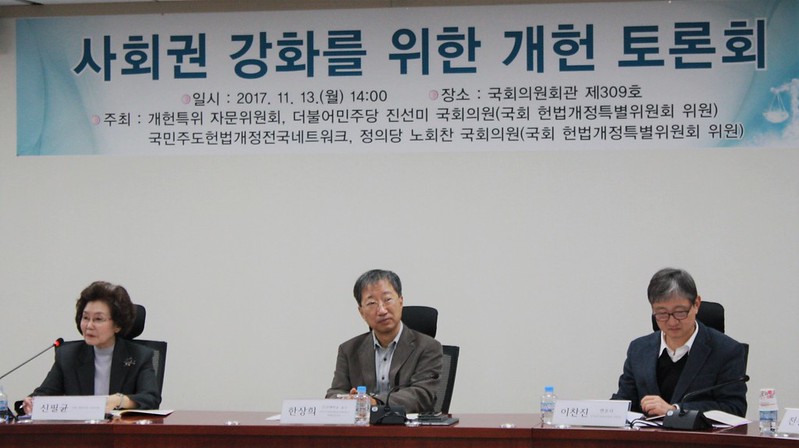
<2017.11.13. "사회권 강화를 위한 개헌" 토론회에 참석한 신필균 자문위원, 한상희 교수, 이찬진 변호사 (좌측 순서)>


최근 국회에서 논의하고 있는 개헌 방안에 시민들의 사회적 권리를 강화할 수 있는 구체적인 내용을 마련하기 위해, 국민주도헌법개정네트워크, 국회 헌법개정특별위원회 자문위원회, 더불어민주당 진선미 의원, 정의당 노회찬 의원은 2017년11월13일 오후2시 국회의원회관 제309호에서 <사회권 강화를 위한 개헌> 토론회를 개최했다.


토론회의 첫 발제 순서를 맡은 신필균 국회 헌법개정특별위원회 자문위원은 현행 헌법체계의 사회보장권의 한계를 지적하며, “30년만에 이루어질 헌법 개정안에 시민들이 인간다운 생활을 할 권리와 사회보장을 받을 권리를 구체적으로 명시해야 한다”고 말했다. 또한 신필균 자문위원은 “사회권은 단지 정치적 구호나 입법 방침이 되어선 안 된다”는 점을 강조하며, 개헌의 목표가 “모든 구성원이 인간적 존엄과 가치를 지키면서 건강하고 문화적인 삶을 누릴 수 있는 사회를 만드는 것”이 되어야 한다고 말했다.


두 번째 발제를 맡은 이찬진 참여연대 사회복지위원회 실행위원은 “심각한 수준에 다다른 우리 사회의 양극화와 불평등을 완화하기 위한 실천적 과제가 반드시 개헌안에 담겨야 한다”며, “인간다운 생활을 할 권리를 보장하기 위해 사회보장 예산의 우선 편성권을 정립하고, 주거권, 보건권, 문화향유권 등을 개헌안에 구체적으로 명시해야 한다”고 말했다. 특히 이찬진 실행위원은 청년층에게 가장 심각한 문제로 대두된 주거권을 보장하기 위해 “최저주거기준의 설정 등의 국가의 보장 의무를 명시하고, 다주택 보유 규제 등을 통해 불로소득을 환수하도록 하는 주택공개념을 도입할 필요가 있다”고 강조했다. 또한 이찬진 실행위원은 “사회보장권을 실질적으로 강화하기 위해서는 차별금지와 평등권을 강화해야 한다”며, “인간의 존엄을 보장하고 지속가능한 공동체를 만들기 위한 방향으로 사회권은 다시 정립되어야 한다”고 말했다.


토론자로 나선 이정우 경북대학교 교수는 “개헌 과정의 주요 쟁점인 권력구조 개편뿐만 아니라 사회보장권 강화가 반드시 필요하다”며, “사회보장 예산의 우선권을 확립하고 주택,토지에 대한 공개념을 도입해야 한다”라고 말했다. 한편, 전광석 연세대학교 교수는 “헌법재판소가 사회적 약자의 사회권을 적극적으로 보장할 수 있도록 헌법 조문을 개정해야 한다”며, 그 중에서도 “가장 시급한 빈곤 문제를 해결하기 위한 최저 생활을 보장하기 위한 조항을 강화해야 한다”고 말했다. 또한 김지혜 강릉원주대학교 교수는 “영토 내에서 공동의 생활을 영위하는 모든 ‘사람’에게 사회보장권, 주거권, 건강권, 문화향유권을 보장해야 한다”고 강조했고, “식량에 대한 권리도 건강권 또는 안전권의 일부로 정의해 모든 사람의 기본권으로 보장할 필요가 있다”고 말했다. 마지막으로 장지연 한국노동연구원 연구위원은 “헌법이 사회 구성원들의 정체성과 눈높이에 맞는 권리로 작용할 수 있게 해야 한다”며, “사회보장기본법 등이 정의한 구체적 권리를 누락하지 않아야 하며 개인의 권리를 보장하기 위한 국가의 의무를 명시해야 한다”고 말했다. 좌장을 맡은 한상희 건국대학교 교수는 토론회를 맺으며, “자유권을 보장하기 위한 구체적인 헌법 조항처럼, 사회권을 보장하기 위한 조항 역시 개헌안에 구체적으로 담을 필요가 있다.”라고 말했다.


올해 10월 UN 사회권위원회가 발표한 한국 정부 심의의 최종 권고에 따르면, 한국의 개헌 과정에서 헌법 조문에 사회권 규약에 보장된 사회권을 반영하라는 내용이 포함되어 있다. 국회 헌법개정특별위원회에서도 기본권 실현을 위한 개헌안을 준비하고 있지만, 사회권 보장과 관련한 내용은 미흡하다. 이번 토론회를 계기로, 국회 헌법개정특별위원회는 시민들의 사회권을 강화하기 위한 구체적인 개헌안을 마련해야 한다. 끝.


▶ <사회권 강화를 위한 개헌> 토론회 자료집 [원문보기/다운로드]

▶ 보도자료 [원문보기/다운로드]


SW20171113_웹자보_사회권실현토론회2.png


▶ 토론회 개요

  • 제목: 사회권 강화를 위한 개헌
  • 일시 장소 : 2017. 11. 13. (월) 14:00 / 국회의원회관 제309호
  • 주최 : 국민주도헌법개정네트워크, 국회 헌법개정특별위원회 자문위원회, 더불어민주당 진선미 국회의원(개헌특위), 정의당 노회찬 국회의원(개헌특위)
  • 참가자
    • 사회 : 한상희_건국대학교 교수, 국민주도헌법개정전국네트워크 정책자문단장
    • 발제1: 개헌특위에서 사회권 보장을 위한 제안_ 신필균 국회 개헌특위 자문위원
    • 발제2: UN 사회권 규약을 반영한 사회권 강화 개헌방안_이찬진 변호사, 참여연대 사회복지위원회 실행위원
    • 토론1: 이정우_경북대학교 교수
    • 토론2: 전광석_연세대학교 교수
    • 토론3: 김지혜_강릉원주대학교 교수
    • 토론4: 장지연_한국노동연구원 연구위원
월, 2017/11/13- 15:15
215
0

16 October 2015


Urgent Appeal to
- The UN Special Rapporteur in the Field of Cultural Rights


Re: Republic of Korea - Government-issued History Textbook 


Dear Ms. Farida Shaheed,


We are writing to you today to express our grave concerns over the announcement made by the Government of the Republic of Korea on 12 October 2015 that the Government will issue middle school history textbook and high school Korean history textbook from 2017. Currently, there are eight different types of history textbooks and they are examined by the National Institute of Korean History before being published. We note with serious concern that the Government-issued history textbook will result the history being written in a way to idealize the history of military dictatorships and indoctrinate people with a standardized history.  


The current Minister of Education, Hwang Woo-yea, said that “it was an inevitable choice in order to eventually realise national cohesion by ending social disputes based on ideological bias and to correct the history”. However, we are all well aware that it is a misconception that there is only one objective truth concerning history. In 1992, the Constitutional Court of the Republic of Korea also ruled that “in the case of Korean history, it is difficult to confirm that one theory is an absolute truth, and when different interpretations exist with valid background, it is essential to present different views.” Article 31(4) of the Constitution stipulates “Independence, professionalism and political impartiality of education and the autonomy of institutions of higher learning shall be guaranteed under the conditions as prescribed by law.”


The Government-issued history textbook create more confusion and ideological conflicts in a society. Most historians announced that they oppose the Government-issued history book and refuse to be authors of the textbook. As a result, only Government friendly historians will be authors. In response to the Government’s decision, history and social science professors, teachers of elementary school, middle school and high school, politicians, 14 Superintendents of Education out of 17, and civil society organisations officially and heavily criticised the Government’s plan to issue official history textbook. In addition, on 12 October 2015, around 15 university students were arrested by the police while protesting against Government-issued history textbook. 


We would like to draw the special attention of the Special Rapporteur on this issue. As you pointed out in the report presented to the 68th Session of the UN General Assembly in 2013, the accreditation of one single history textbook is problematic and State-sponsored textbook carry the risk of being highly politicized. We would appreciate it if you could strongly remind the Government of the Republic of Korea of the importance of diverse history textbook and urge them to withdraw their decision on the Government-issued history textbook.


If you have any questions or need clarifications, please do not hesitate to contact Ms. Gayoon Baek ([email protected], +82 (0)2 723 4250) at any time. We hope this will help in your work.


Yours Sincerely,


CHUNG Hyun-back
Co-Representative 
People’s Solidarity for Participatory Democracy 


People’s Solidarity for Participatory Democracy (PSPD)
PSPD is a non-governmental organization based in Seoul, South Korea. We were founded in 1994 and has been working on promoting people’s participation in government’s decision making process and socio-economic reforms. PSPD has ECOSOC consultative status since 2004.


금, 2015/10/16- 12:25
215
0

유엔 의사·표현의 자유 특별보고관의

통신자료 제공 제도 반대의견서를 환영한다

표현의 자유 특보 데이비드 케이, 통신자료 제공 헌법소원에 대해 의견서 제출

“국가기관의 무영장 이용자 정보 취득은 익명 표현 및 통신의 자유 침해”


6월 8일 유엔(UN) 의사 ·표현의 자유 특별보고관 데이비드 케이(David Kaye)는 현재 진행중인 통신자료 제공 제도에 대한 헌법소원과 관련해, 이 제도가 국가기관이 영장 없이 이용자의 정보를 취득하게 함으로써 익명 표현 및 통신의 자유 침해한다는 내용의 제3자 의견서를 헌법재판소에 제출했다.

<데이비드 케이, 유엔 표현의 자유 특별보고관>

통신자료 제공 제도란 수사기관 등이 전기통신사업자에게 이용자의 성명, 주민등록번호, 주소, 전화번호 등 통신자료의 제공을 요청할 수 있다고 규정한 전기통신사업법 제83조 제3항 및 제4항을 말한다. 이 제도는 수사기관이 압수수색 영장을 받지 않고도 이용자의 개인정보를 무단으로 취득할 수 있게 하고 있어 헌법상 영장주의 원칙의 우회 수단으로 남용되어 왔다. 2016 5월 18일 시민 500명은 해당 전기통신사업법 조항들에 대해 헌법소원을 청구했으며, 이에 대해 지난 4월 19일 국제적 인권단체인 아티클19(ARTICLE19)과 프라이버시인터내셔널(PRIVACY INTERNATIONAL)이 먼저 제3자 의견서를 제출했고, 이번에 유엔 특별보고관이 세 번째로 의견서를 제출한 것이다.

사단법인 오픈넷은 2016년 3월에 샌프란시스코에서 열린 라이츠콘(RightsCon)에서 케이 특별보고관을 초청하여 무영장 통신자료 제공의 문제점에 대한 패널토론 세션을 개최한 바 있다. 또한 오픈넷은 2017 3월에 이루어진 아티클19의 세계 표현의 자유와 프라이버시 원칙의 발표에 자문단체로 참여하였다. 이 원칙은 표현의 자유와 프라이버시가 상호 지지적인 관계임을 천명하고 있다. 오픈넷은 2015년초부터 프라이버시인터내셔널과 통신자료제공제도의 문제점에 관한 UN기관 제출 문서에 공동작업을 한 바 있다.

헌법소원에 제출된 세 의견서 모두 한국에서 통신 감시가 광범위하게 이루어지고 있음에 우려를 표하면서, 통신자료 제공 제도가 명백한 국제인권법 위반이라는 점에 목소리를 같이 하고 있다. 구체적으로 아티클19의 의견서는 ‘통신자료 제공 관련 조항은 요청 이유에 대한 명확성이 결여되어 있고 영장이나 정보 주체에 대한 통지 등 아무런 절차적 제약이 없기 때문에 필요성과 비례성이 충족되지 않아 인권침해’라는 점을 강조하고 있고, 프라이버시인터내셔널의 의견서는 ‘익명성도 개인신상정보에 대한 일종의 프라이버시권이기 때문에 단 한 명에 대한 익명성 침해라도 다른 프라이버시권 침해과 마찬가지로 법원 등 독립적인 기관의 명령이 필요하다’는 점을 강조하고 있다.

데이비드 케이 특별보고관은 ‘시민적·정치적 권리에 관한 국제규약(이하 “자유권 규약”)’ 제19조 제2항이 익명 표현 및 통신의 자유를 보장하고 있음을 지적하고, 제19조 제2항 및 제3항에 따라 자유권 규약의 당사국인 대한민국은 국가기관이 이용자 정보를 취득할 때 익명 표현 및 통신의 자유를 과도하게 침해하지 않도록 보장해야 함을 분명히 했다. 결론적으로는 ‘국가기관이 영장 제시 없이 이용자 정보를 취득할 수 있게 하는 통신자료 제공 제도는 자유권 규약으로 인한 대한민국의 의무와 국제적인 합의에 위반하여 익명 표현과 통신의 자유를 침해하고 있을 뿐만 아니라 국민 1인당 정보 요청 건수가 다른 나라에 비해 이례적으로 높은 현실은 표현의 자유에 대한 위험을 악화시킨다’고 하면서, 헌법재판소가 이러한 우려를 신중하게 고려해 판단할 것을 촉구했다.

오픈넷은 2015년 1월부터 참여연대와 함께 이통사 통신자료 제공 알권리 찾기 캠페인을 진행했으며, 2016년 6월에는 시민 22명을 대리하여 국정원 등 수사기관을 상대로 위법한 통신자료 취득에 대해 국가배상 청구 소송을 제기했다. 이러한 시민사회의 노력의 결과로 통신자료 제공 건수는 감소하는 추세다. 6월 5일 미래부가 발표한 2016년 하반기 통신자료 등 현황자료를 보면 통신자료 제공은 전화번호수 기준으로 알 권리 찾기 캠페인이 시작된 2015년 상반기를 기점으로 소폭이지만 지속적으로 감소하고 있다.


2015년

2016년

상반기

하반기

상반기

하반기

전화번호수

5,901,664

4,675,415

4,480,266

3,792,238

문서수

560,027

564,847

574,769

534,845

문서1건당 전화번호수

10.5

8.3

7.8

7.1

현재 국회에는 통신자료 제공 제도 개선을 위한 다수의 통신비밀보호법과 전기통신사업법 개정안이 발의되어 있다. 오픈넷은 2014년 12월 민주당 정청래 전 의원과 함께 통신자료 제공 폐지를 포함한 사이버사찰방지법을 발의하기도 했다. 그러나 언제쯤 관련 논의가 시작되고 입법이 이루어질지는 기약이 없는 상황이다.

하지만 아직도 연간 800여만 명에 달하는 시민들의 개인정보가 제공되고 있다는 것은 심각한 문제이다. 2016년 한 해 국민 6명당 1건의 통신자료 제공이 있었던 것인데, 의견서에서도 지적된 바와 같이 유사한 제도가 있는 다른 나라들과 비교했을 때 압도적으로 높은 비율이다.

위헌임이 명백한 제도에 대한 가장 궁극적인 해법은 제도 자체의 폐기이다. 헌법재판소는 국제인권법과 헌법에 위배되는 통신자료 제공 제도에 대해 과감하게 위헌결정을 내리기 바란다.


2017년 6월 13일

사단법인 오픈넷


첨부. 미래부 보도자료-16년 하반기 통신자료 및 통신사실확인자료 제공 등 현황

문의: 오픈넷 사무국 02-581-1643, [email protected]


[관련 글]

화, 2017/06/13- 15:53
210
0

‘comfort women’ victims by the japanese army

This is an English version of “Sorrowful Homecoming” a documentary produced by “Team Witness” and uploaded twice on the website of the Korea Center for Investigative Journalism (Newstapa) on Mar. 2016.

This documentary include testimony as North Korean ‘comfort women’ victim who was raped by japanese military during the japanese colonial Rule.

Mr.Dakashi Ito who is japanese journalist shooted twice in 1999, 2015 when he visited North Korea.

Part 2

Korean Version

수, 2016/03/30- 17:23
210
0

solidarity message


Solidarity Message to <Anti-War Coalition In Solidarity to Protect Article 9>

People's Solidarity for Participatory Democracy(PSPD) has opposed the amendment of peace constitution and rearmament of Japan by Abe administration. We are very concerned about national security bills in a bid to be passed at the National Diet of Japan.


Japan must be prevented from exercising the right of collective self-defense. This will nullify the Japanese peace constitution, particularly article 9, which has served as an anchor of peace in East Asia.


This year is the 70th anniversary of the end of WWII. The memories of the atrocious Japanese colonial rule and aggression in the past in many of its neighboring countries cannot be simply erased.


Japan must stop military buildup and preserve its peace constitution.

We will continue to stand in solidarity with those who are concerned about and marching for peace across Asia-pacific.


Peace & Solidarity


Peace and Disarmament Center, PSPD


call for support


금, 2015/06/12- 21:08
200
0