주요 콘텐츠로 건너뛰기

Open Letter to the UN SG on the issue of Comfort Women

지역

Open Letter to the UN SG on the issue of Comfort Women

익명 (미확인) | 월, 2016/01/11- 10:24

11 January 2016


United Nations Secretary General Ban Ki-moon
UN Headquarters
405 East 42nd Street
New York, NY 10017
USA    


Cc : Zainab Hawa Bangura, UN Special Representative on Sexual Violence in Conflict
Zeid Ra’ad Al Hussein, UN High Commissioner for Human Rights
Rashida Manjoo, UN Special Rapporteur on Violence against Women
Pablo de Greiff, UN Special Rapporteur on the Promotion of Truth, Justice, Reparation, and Guarantees of Non-recurrence
H.E. Choi Kyong-lim, President of the UN Human Rights Council
Members of the UN Committee against Torture
Members of the UN Human Rights Committee 
    

Re: Clarification on the UN Secretary-General’s Position on the Recent Republic of Korea-Japan Agreement on Wartime “Comfort Women”


People's Solidarity for Participatory Democracy (PSPD) is a non-governmental organization based in Seoul, the Republic of Korea (ROK) with United Nations(UN) ECOSOC consultative status. We are writing to you today to seek clarification of the Secretary-General's position on the recent ROK-Japan agreement on wartime “comfort women”. We express our concern on your recent congratulatory remarks on the agreement, because we view that the agreement was not made in a way to implement the values and principles put forth by the UN, which has emphasized a victim-centered approach.


In the official statement regarding the recent agreement between the ROK and Japan on issues related to “comfort women” from the ROK which was released on 28 December 2015, you welcomed “that the Governments of Japan and the Republic of Korea have reached an agreement,” and hoped “that the agreement will contribute to improving the bilateral relationship between the two countries.” Following your statement, the ROK President’s Office (Blue House) released a briefing on 1 January 2016, saying that you congratulated President Park Geun-hye, via telephone, on reaching the agreement with Japan, and stated that “history will laud President Park’s courageous decision based on her vision.”   


Yet, the latest agreement between the ROK and Japan hardly reflects the wishes of the victims themselves, nor did the process involve any participation by the victims. Lee Yong-soo, one of the few surviving victims of Japan’s wartime sexual slavery policy, harshly criticized the agreement, saying “The agreement does not reflect the views of former ’comfort women’. I will ignore it completely.”  Ms. Lee condemned the deal as amounting to “a second death of the victims.” The latest agreement indeed does not incorporate any of the demands which include official apologies, legal reparations, and guarantees of non-recurrence. The victims have consistently put forward these demands since making their past agony public for the first time in 1991. According to the recent agreement, the Japanese government did promise to provide JPY 1 billion (around 8.3 million USD) for a new special fund to be set up for a foundation for the surviving “comfort women”. However, Mr. Fumio Kishida, Japanese Minister of Foreign Affairs, made it clear that the money was not legal reparation , and still refuses to recognize Japan’s legal responsibility for wartime sexual slavery. However, the governments of both countries have concluded that the latest agreement will be the “final and irreversible” resolution to the “comfort women” issues, thus inviting mounting criticism from inside and outside the ROK.


We would like to remind you that the latest agreement on “comfort women” does not even satisfy the UN recommendations regarding Japan’s wartime sexual slavery and related issues which were made in the past. Different human rights mechanisms of the UN have condemned the acts of wartime sexual slavery committed by Japan as “crimes against humanity,” and recommended that the Japanese government acknowledge its legal responsibility, make formal reparations to the victims, and prosecute the parties responsible for such crimes. During its review on Japan in July 2014, the UN Human Rights Committee noted that most “comfort women” were recruited by, transported to, and managed at Japanese military bases or agencies working on behalf of the Japanese military through force and coercion, and expressed concerns at the Japanese government’s continued denial that these women were “ever mobilized or migrated by force” (CCPR/C/JPY/CO/6, para 11). In August 2014, the UN Committee on the Elimination of Racial Discrimination expressed its concerns that the Japanese government had not recognized nor apologized to “comfort women”, and urged the Japanese government to immediately conclude investigations and bring to justice those responsible for human rights violations (CERD/C/JPN/CO/7-9, para 18).


We would also like to point out that the UN and the international community at large uphold a consistent set of victim-centered principles and standards with respect to the rights of victims of human rights violations.


In February 2005, the UN Commission on Human Rights (now the UN Human Rights Council) adopted “Principles for the protection and promotion of human rights through action to combat impunity” (E/CN.4/2005/102/Add.1), followed by “Basic Principles and Guidelines on the Right to a Remedy and Reparation for Victims of Gross Violations of International Human Rights Law and Serious Violations of International Humanitarian Law” (A/60/509/Add.1) adopted by the UN General Assembly in December 2005. These two documents endorse the “victim-centered perspective” in international human rights law, and emphasize the victims’ right to justice, right to reparation, and right to know. These documents also stress as essential principles the need to give victims restitution, compensation, rehabilitation, reparation, and redress.


Since its establishment in 2002, the International Criminal Court has also stressed the need for victim participation in all phases of investigation and judicial procedures. “The Chicago Principles on Post-Conflict Justice 2001-2008”, which provide basic guidelines on the handling of atrocities perpetrated under authoritarian rule and amid armed conflicts, also emphasize: “Policies that seek justice for past violations should be victim-centered and should address victims’ rights to remedies and reparations.”


We note with serious concern that your remarks on "welcoming" the recent agreement between the ROK and Japan, and lauding it as a “courageous decision” by the South Korean President are not in line with the human rights principles and positions the UN and the international community have accumulated so far. 


We would therefore like to request your response to the following questions to further clarify your position. 


1. Do you think that the recent agreement between South Korea and Japan satisfy the UN-emphasized principles of the rights of the victims of human rights violations and properly address war crime legacies and past recommendations made by the UN human rights mechanisms to Japan?


2. According to the briefing issued by the Presidential Blue House of the ROK, you phoned the President of the ROK to discuss the recent agreement. Have you done the same with the Prime Minister of Japan? If so, what exactly was discussed or remarked in the latter conversation? If no such conversation took place with the Prime Minister of Japan, why have you had such a conversation with the President of the ROK and not with the Prime Minister of Japan?


3. The UN Secretary-General is obligated to make efforts to promote human rights in all Member States. Therefore, some argue that the UN Secretary-General should help invalidate the recent agreement between the ROK and Japan that seems to condone war crimes. What do you think of this argument?


4. Is the Secretary-General inclined to urge both the government of the Republic of Korea and Japanese governments to resolve the “comfort women” issues through official apologies, legal reparations, and guarantees of non-recurrence from the Japanese state through processes that are actually based upon victim participation?


We thank you for your reply in advance and look forward to hearing back from you at the earliest possible time. If you have any questions or would like clarification, please do not hesitate to contact us at [email protected] or +82 (0)2 723 4250. 

Yours sincerely,


Ms. Hyunback Jung
Co-Representative
People's Solidarity for Participatory Democracy 


시민들의 의견

댓글 달기

Plain text

  • 웹 페이지 주소 및 이메일 주소는 자동으로 링크로 전환됩니다.
  • 줄과 단락은 자동으로 분리됩니다.
  • 사용할 수 있는 HTML 태그: <a href hreflang> <em> <strong> <cite> <blockquote cite> <code> <ul type> <ol start type> <li> <dl> <dt> <dd>
이미지
무제한 수의 파일을 이 필드에 업로드할 수 있습니다.
50 MB 한계입니다.
허용된 유형: png gif jpg jpeg.
Enter the YouTube URL. Valid URL formats include: http://www.youtube.com/watch?v=1SqBdS0XkV4 and http://youtu.be/1SqBdS0XkV4.
CAPTCHA
스펨 사용자 차단 질문

日 방사능 오염수, 어업인·환경단체가 함께 힘 모을 때

이용기 환경운동연합 생태보전팀장

*해당글은 2023년 5월 30일 한국수산신문에 게재됐습니다.

  2011년 3월 11일 일본 후쿠시마 제1원전 사고가 일어났다. 만 12년이 지난 지금 우리는 전혀 해결되지 않은 현지의 모습과 방사능 오염수 방류라는 직접적인 피해를 마주하고 있다. 후쿠시마 오염수 방류를 앞두고 시찰단이 파견된 지금도 우리는 매체를 통해 후쿠시마 원전 주변 지역에서 방사능이 검출되는 장면을 시청할 수 있다. 국경 없는 바다로 유입 지난 12년과 현재의 차이는 우리가 후쿠시마라는 지리적 간접성에서 국경 없는 바다를 통해 유입될 후쿠시마 원전 방사능 오염수를 직면하고 있다는 것이다. 후쿠시마 원전 방사능 오염수 위협이 코앞까지 다가온 지금은 환경단체와 어업인이 공동 대응을 결속해야 할 시기다. 환경운동연합 등 시민단체는 일본 정부가 지구적 손해를 끼치면서도 가장 저렴한 처리 방법을 선택한 것을 규탄하며 계획 철회를 요구하고 있다. 방사능 오염수 처리는 지층 주입, 해양 방출, 수증기 방출, 전기분해 수소 방출, 지하 매설이 대안으로 고려됐지만 일본 정부는 가장 저렴한 해양 방출을 선택했다. G7(주요 7개국)이 정상회의를 앞둔 지난 16일 환경운동연합을 포함한 한국 시민단체와 후쿠시마 주민을 포함한 100여명은 일본 도쿄전력 앞에서 “바다를 더럽히지 말라”며, 방사능 오염수 해양 방류 철회를 요구했다. 환경ㆍ시민단체는 방사능 오염수 방류에 대한 의견을 일본에 전달하는 한편 어업인과 국민을 보호하기 위해 더 큰 목소리를 내야 할 우리 정부에게 후쿠시마 방사능 오염수 처리에 적극적이고 강력한 대응을 촉구하고 있다. 장기적으로 후쿠시마 방사능 오염수가 영향을 끼칠 국민 건강문제와 함께 방사능 오염수로 인해 발생하는 수산물 불신은 어업인에게 직접적인 피해를 줄 수 있다. 실제로 우린 지난 2005년 말라카이트 그린, 중금속, 항생제 등이 검출된 중국산 수입 수산물 사건과 2008년 태안 유류유출사고가 수산물 소비 감소로 이어진다는 경험을 했다. 후쿠시마 방사능 오염수 방류로 민감한 지금 일부 몰지각한 유통업체가 일본 수산물을 국내 수산물로 불법 둔갑한 것이 적발되면서 수산물 신뢰도에 먹칠을 했다. 아직 방사능 오염수 방출이 시작되지도 않았는데 수산물 소비량이 줄었다는 소식은 수산물 신뢰도 하락의 반증이다. 지금은 어업인과 환경단체가 후쿠시마 방사능 오염수 방류에 대한 국내외적인 공동 대응과 함께 정책 변화까지도 함께 논의해야 하는 중대한 시기다. 환경단체는 국제적 여론을 모으기 위해 여러 나라의 연대를 모으고 있다. 환경단체의 국제적 연대 서명뿐 아니라 피해가 예상되는 지구상의 다른 어촌계와 연대해 후쿠시마 방사능 오염수에 어업인 연대 공동 대응도 가능한 방법으로 생각된다. 어업인 연대를 통한 국제 여론 조성도 방사능 오염수 방류에 대한 일본 정부를 압박할 수 있는 수단이 될 수 있다. 학교급식 확대 등 정책 제안 또 후쿠시마 방사능 오염수의 불안감으로 수산물 소비가 줄어드는 지금 환경단체와 어업인은 국외에서 들어오는 수산물의 추적과 국내에서 생산하는 수산물의 추적이 명확하게 소비자에게 전달될 수 있도록 정부 정책을 제안할 수 있다. 이미 수산물이력제라는 제도가 있긴 하지만 농산물이나 축산물이력제와 비교해 너무 부족한 정보와 권고성 제도로 유명무실한 제도가 됐다는 평가다. 한 부처에서 정착하지 못한 수산물이력제의 과거 성장 과정과는 별개로 지금은 국내산 수산물이라는 장점을 내세우는 대안으로 환경단체와 어업인이 개선을 논의해 충분히 해볼 수 있다. 생산자와 유통과정이 명확한 국내산 수산물이력제로 개선하는데 초기 제도 정착의 어려움은 예상할 수 있다. 초기 정착의 어려움은 정부가 어업인이 좀 더 편하고 쉽게 참여할 수 있도록 시스템을 마련해야 한다. 또 정부는 후쿠시마 방사능 오염수 방류를 돌파하기 위한 어업인의 노력을 지원할 수 있도록 학교급식 수산물이력제 우대 제도와 같은 연관 정책도 마련하는 걸 제안할 수 있다. 기존에 축산물이력제나 농산물이력제를 우대하는 학교급식에 농축산물이력제와 동등한 수준의 수산물이력제를 우대하는 건 어렵지 않은 일이다. 후쿠시마 방사능 오염수 문제를 앞둔 지금 어업인과 환경단체가 진정으로 함께 힘을 모을 때다. 짧은 글 속에서 표현할 수 있는 몇 안 되는 제안이나 대안은 환경단체와 어업인이 함께 모여 논의하면 생각하지 못한 훌륭한 정책을 만들어 낼 수도 있다는 생각이 든다. 환경단체와 어업인의 협력은 다양한 방식의 견고한 국제 연대를 만들어 일본 정부에 메시지를 보내고, 정부가 후쿠시마 방사능 오염수 대응에 강력하고 적극적인 대응을 하도록 목소리를 낼 수 있다. 현재도 후쿠시마 방사능 오염수와 관련된 환경단체와 단체행동에 나선 어업인 협회가 있지만 폭넓은 협력과 연대는 분명 더 나은 대안을 가져온다. 지금 환경단체와 어업인이 한마음으로 뜻을 모으고 협력해야 할 시기다.
화, 2023/05/30- 15:15
4
0

Journey for Peace in 2022

Shining moments of the Korea Peace Appeal Campaign in 2022

“There is no way to peace. Peace is the way.”

Now, the moments that we’ve worked to make peace here.
We gathered the main activities of the Korea Peace Appeal Campaign in 2022.
Thank you for being with us this year.

2023 marks the 70th anniversary of the Korean War Armistice.
It’s time to cheer up to ease military tension and open the road to peace.

The world doesn’t get better on its own.
If we don’t say peace,
Peace is not coming.

Let’s make hope of peace together!


Korea Peace Appeal 2

? Signature Campaign to End the Korean War
Sign the Korean Peace Appeal Now ?
endthekoreanwar.net

The post Journey for Peace in 2022 : Korea Peace Appeal Campaign appeared first on 참여연대.

금, 2023/01/06- 18:48
1
0

On December 8 2022, in partnership with the Permanent Mission of Mongolia to the United Nations, the Global Partnership for the Prevention of Armed Conflict (GPPAC) organised a roundtable discussion titled Building and Sustaining Peace at the Regional Level: The Network Approach to Regional Coordination in Northeast Asia during an advocacy visit of Ulaanbaatar Process participants to New York City.

This discussion was an informal dialogue to share the learning from the Ulaanbaatar Process with global peacebuilding policy experts within the United Nations, Member States and regional organisations. The conversation outlined critical avenues to support regional peacebuilding coordination in policy and shared practical experiences for practical action. The discussion also outlined persistent challenges of regional peacebuilding coordination, and discussed recommendations to develop solutions to strengthen peacebuilding work in Northeast Asia.

During the roundtable, remarks were shared by Ulziibayar Vangansuren, Permanent Mission of Mongolia to the United Nations; Ambassador Enkhsaikhan Jargalsaikhan, Chair of NGO Blue Banner and former Mongolian Permanent Representative to the UN; Sonja Bachmann, Teamleader Northeast Asia and Pacific, UN Department of Peacebuilding Political Affairs (DPPA); Kajita Natsuha, learning designer and facilitator; Kim Jeongsoo, Standing Representative, Women Making Peace and Hwang Sooyoung, Manager, Centers for Peace and Disarmament and for International Solidarity, People’s Solidarity for Participatory Democracy (PSPD).

Based on the experiences from Northeast Asia, the following key elements build an effective regional peacebuilding architecture:

  • Multi-stakeholder coordination is required and must be based on complementarity among partners.
  • The network approach to peacebuilding must be at the core of regional coordination.
  • Inclusivity is key for effective regional peacebuilding networks.

The following recommendations have thus been identified for the strengthening of the regional peacebuilding mechanisms:  

  • The UN should take a more active convening role to bring together regional actors, the UN, national governments, and civil society, among others, to coordinate actions better and ensure a stronger impact of peacebuilding activities.  Where regional peacebuilding networks play an essential role in building the foundation for regional dialogue, the UN should provide technical and political accompaniment to ensure the commitment to action. 

  • Improved funding mechanisms are needed to support the civil society organizations’ network approach. A network approach creates empowering and equitable spaces for exchanging expertise for more impactful and informed action, sharing resources and access points at various levels, and enabling and supporting communities committed to peace. Donors should reflect on how to improve funding mechanisms to support better civil society organizations engaged in regional peacebuilding networks, allowing them, through effective funding, to fill the gaps in the regional peacebuilding infrastructure. It is crucial to ensure that all regions are fairly represented in the international discussion on peacebuilding and are given international attention, as this also impacts funding availability. 

  • The inclusion of women and youth is key in regional peacebuilding networks and should be supported. Although women are strongly affected by conflicts, they are often excluded from negotiations and peace processes, especially in highly patriarchal contexts. The inclusion of local women within peacebuilding initiatives is essential to ensure that their unique perspectives can have a real impact at the decision-making level. Likewise, the meaningful participation of young people in dialogue on equal terms is essential to achieve and sustain peace. Young people in all their diversities should be considered as drivers for change, and their contributions should be held as relevant and valuable. Donors should prioritise supporting regional peacebuilding dialogues that ensure the meaningful participation of women and youth at all stages of the process.  The UN and its Member States should use their influence and international platforms to  ensure that the unique perspectives of local women and youth peacebuilders are heard and taken into account in the decision-making processes.

This is an article for Global Partnership for the prevention of Armed Conflict (GPPAC) Northeast Asia News, Jan 2023

Summary Document [See/Download]

The post Building and Sustaining Peace at the Regional Level appeared first on 참여연대.

월, 2023/01/30- 15:02
1
0
20230214_정전 70년 한반도 평화행동 출범대회
2023.02.14 Korea Peace Appeal Campaign

⭐ End The Korean War, Let Us Peace!

Tuesday, 14  February, 2023, Korea Press Foundation

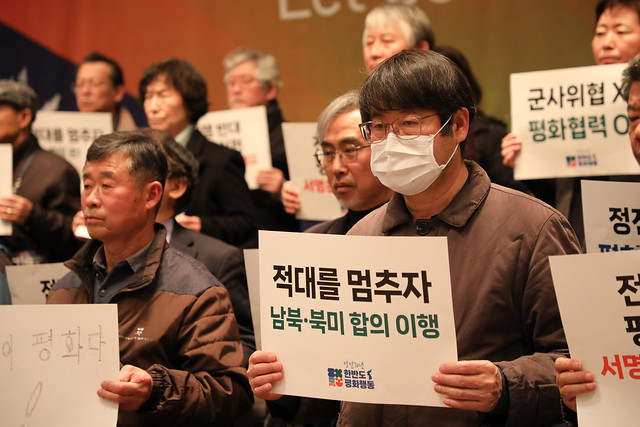
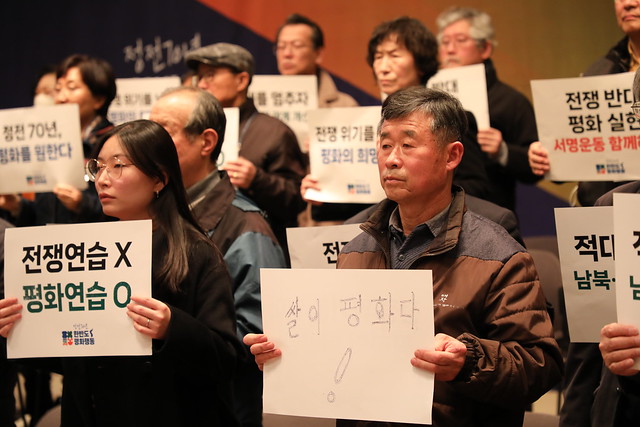
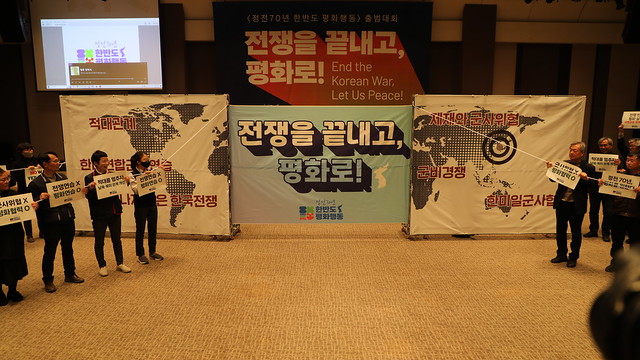
As 2023 marks the 70th anniversary of the Korean War Armistice, the <South Korean Committee on June 15th Joint Declaration> and the <Korea Peace Appeal Campaign> launched a new project <Korea Peace Action for the 70th Anniversary of the Armistice>. A press conference was held where many religious and civil society representatives, who have been endeavoring for peace in the Korean Peninsula, participated and gathered eager to rebuild hope of peace over the threat of war. 735 organizations nationwide are a part of the <Korea Peace Appeal Campaign>.

Our main goal is to resolve the threat of war and build peace. As a joint civil society, we plan to continue the signature campaign but more intensively, and organize other various peace actions. The <Korea Peace Appeal Campaign> will warn the danger of the present crisis, create domestic and foreign public opinions for the peace of the Korean Peninsula and Northeast Asia, and gather voices of opposition toward the recent rapid promotions of the military cooperation between South Korea, the US, and Japan. This year we will be manifesting the following actions:

☮ Korea Peace Appeal Signature Campaign
☮ Actions urging suspension of the ROK-US Combined Military Exercises and ROK-US-Japan Military Cooperation
☮ Korea peace actions in 300 cities worldwide comprising 100 overseas (June-July)
☮ Saturday, 22 July 2023, Massive Peace Rally and Parade
☮ Thursday, 27 July 2023, International Conference
☮ 15 August 2023 (TBD), Massive Peace Rally

20230214_정전 70년 한반도 평화행동 출범대회

Korea Peace Action for the 70th Anniversary of the Armistice Declaration

Let’s resolve the threat of war and build peace in the Korean Peninsula

70 long years have passed since the roar of gunfire coming from the three-year war in Korea stopped. The past 70 years were certainly not a peaceful period but a temporary ceasefire. Due to the fear and anxiety that the war could outbreak any time soon, the neverending hostility and military tension, and the internal and external challenges leveraging and goading these unstable conditions, everyone living on the Korean Peninsula had to cope with the immense pain and expense.

When the South and North Korean Leaders, and the North Korean and US leaders discussed a transfer to a new relationship at the Panmunjom Declaration of 27 April, the Pyongyang Joint Declaration of 19 September, the Singapore Joint Statement of 12 June, the Korean people saw a single thread of hope that the tension and danger of war, which had been crushing us, would disappear and a peacefully coexisting future unlock. Despite the North-South and North-US Agreement, dialogues were adjourned on account of the different views on corresponding measures, and as the power-to-power confrontations intensify, the present Korean Peninsula is falling into great despair. We are not even sure if the unstable ceasefire will be maintained. A sense of crisis that there is no guarantee an accidental collision could turn into a terrible disaster from a nuclear war is oppressing every life and existence on this land.

No methods of dialogue are left between the North-South and North-US. Moreover, the global environment is restraining us. Amidst the Russia-Ukraine war and the US-China conflict, the possibility of Korea being used as a proxy battlefield for international-level military tensions and new Cold War confrontations is greater than ever. However, there is no sound of a practical and active solution to ease tension, prevent armed conflict, or create dialogue conditions.

The government of Yoon Suk Yeol clarified ‘Peace through Strength’ and massively expanded the scale of military exercise, propagandizing that military force can beget surrender. However, this has only aggravated the danger of military clashes in Korea. By stating the practicality of extended deterrence against nuclear and missile threats of North Korea, the Yoon Suk Yeol government has been justifying that we jump on the United States’ strategy against China and South Korea to be subordinated to the ROK-US-Japan military cooperation system. However, the danger of a nuclear arms race and nuclear war around the Korean Peninsula is proliferating. The result of pressure through power is merely the repetition of North Korea’s advancement in nuclear power and mutual armed protests. The only thing the Yoon Suk Yeol government proved so far is that they have no practical method nor capability to manage the crisis and bring peace.

We still have time to prevent conflict and disintegration. We also have a chance for dialogue and negotiation. The reason things got worse is that even after agreeing to a new relationship, the government hesitated to take corresponding measures to build trust, such as suspending the ROK-US joint military exercises, not the insufficiency of armed protest. We must stop the outbursts of armed protests. We must open the door to peace through bolder and more flexible confidence-building measures and pre-emptive easing of tensions. We must act to build peace. The more difficult it is to talk about peace, the more we must gather willingness toward peace from all social standings and reverberate the voice of people who demand peace.

As we launch the <Korea Peace Action for the 70th Anniversary of the Armistice>, we call for the following. We call for stopping hostilities. We call for immediate and faithful action to improve relations as agreed by two Koreas and North Korea and the US. We call for an end to a 70-year-old unstable ceasefire and an agreement on the peace treaty. We call for a Korean Peninsula and a world without nuclear weapons and nuclear threats. We call for restoring trust and resolving conflicts through dialogue and cooperation, not sanctions and military threats. Particularly, we call for a halt in the large-scale ROK-US combined military exercise and opening the way for dialogue toward peace. We call for stopping military cooperation between South Korea, the US, and Japan, which will lead to a new Cold War confrontation, and instead creating an order of cooperation in which the Korean Peninsula and Asia coexist peacefully. Please, we do not call for a destructive arms race, but we call for the safety of people and cooperation to overcome the climate crisis.

We will act. We will take action in the 1 million signature campaign for the Korea Peace Appeal. We will continue the peace declaration and solidarity of people from all social standings in many parts of the world, including 200 cities in Korea and 100 cities in overseas, in the online and offline space. We will work hard to stop ROK-US joint military exercises and military cooperation between South Korea, the US, and Japan, which are escalating tensions and confrontations on the Korean Peninsula and Asia. Marking the 70th anniversary of the Korean War Armistice in July this year, we will focus our actions so that the nation calling for peace on the Korean Peninsula and the voices of peace forces from all around the world can resonate all over the Korean Peninsula and the whole world.

If we seek peace, we can open the way to peace.

We decide our future.

Join us in the <Korea Peace Appeal Campaign>.


14 February 2023

From all Korea Peace Appeal Campaign organizations (total of 735)


Korea Peace Appeal 2

? Signature Campaign to End the Korean War
Sign the Korea Peace Appeal Now ?
endthekoreanwar.net

The post ⭐️ Fresh Start of the Korea Peace Appeal Campaign appeared first on 참여연대.

금, 2023/03/03- 16:30
0
0