주요 콘텐츠로 건너뛰기

트럼프, 북미 2차 정상회담서 주한 미군 축소 선언 가능

지역

트럼프, 북미 2차 정상회담서 주한 미군 축소 선언 가능

익명 (미확인) | 월, 2019/01/07- 05:14

트럼프, 북미 2차 정상회담서 주한 미군 축소 선언 가능 -디플로마트, 방위비 분담금 타결 불발 우려 -미군 감축 사안 통과 시  동맹 관계 큰 타격 한미 방위분담금 협상에서 한미 간에 이견이 좁혀지지 않아 타결되지 않은 채 해를 넘긴 가운데 이를 두고 트럼프 미 대통령이 제2차 북미 정상회담에서 북에 대한 호의의 표시로 군병력(주한미군) 축소를 독단적으로 선언할 수도 ...

The post 트럼프, 북미 2차 정상회담서 주한 미군 축소 선언 가능 appeared first on Newspro Inc..

시민들의 의견

댓글 달기

Plain text

  • 웹 페이지 주소 및 이메일 주소는 자동으로 링크로 전환됩니다.
  • 줄과 단락은 자동으로 분리됩니다.
  • 사용할 수 있는 HTML 태그: <a href hreflang> <em> <strong> <cite> <blockquote cite> <code> <ul type> <ol start type> <li> <dl> <dt> <dd>
이미지
무제한 수의 파일을 이 필드에 업로드할 수 있습니다.
50 MB 한계입니다.
허용된 유형: png gif jpg jpeg.
Enter the YouTube URL. Valid URL formats include: http://www.youtube.com/watch?v=1SqBdS0XkV4 and http://youtu.be/1SqBdS0XkV4.
CAPTCHA
스펨 사용자 차단 질문


부재의 기억 (In the Absence, 2018)

다큐멘터리 | 이승준 감독


Copyrightⓒ 2019. Field of Vision. All rights reserved.


세월호 참사 6주기 추모를 위해, 본 영상의 시청을 선뜻 허락하여주신 이승준 감독님과 비젼필드(New York: FIELD OF VISION) 관계자 여러분들께 감사드립니다.

[Acknowledgement]: We should be obliged by your authorization for our screening this film to commemorate the 6th Anniversary of the sinking of the M.V. Sewol, a maritime disaster of the Sewol Ferry DE the never-to-be-oblivious DIE on A.D. XVI KAL. MAI. MMXIV. Thank you.


우리는 수중에서 더듬더듬해서, 머리에서 그려진다 말입니다. 머리에서 그려지는게 … 자꾸 제 머리속에서 생각나고 … 하루에 한 번 들어가야될 현장을 많게는 4~5번도 들어가는 분들도 있어요. 다른 잠수사들이 그런 얘기를 해요, 저한테. “왜 그렇게 일 했나고?” 아니 사람이 없는데 그럼 뭐 어떻게 할꺼야? … 진짜 중요한 거는 살릴 수 있던 아이들을 살릴 수 있었으면, 우리같은 사람들이 있었을 필요 없었겠지. 제대로 구할 수만 있었었다면… 그런데 그 누구도 구하지 않고, 상황보고, 보고, 보고…

김관홍 시민잠수사 인터뷰 中

“We had to grope around and imagine in the dark water. Those images in my mind are… They are stuck in my mind. I’m supposed to dive only once per day but had to dive 4, even 5 times per day. Other divers told me that I shouldn’t have worked that hard. But what could I do when there were not enough divers? The important point was that we would not have been needed if they had saved the kids they could have saved. Only if they have saved them… But they didn’t. They just kept reporting on the situation,” recalled KIM GWAN-HONG Civilian diver.


내 남편 김관홍 잠수사를 잊지 않고 기억해 주시는 모든 분들께 정말 감사합니다. 그토록 기다리던 세월호가 3년만에 깊은 바다속에서 올라왔어요. 처참한 모습으로 떠오른 그 배를 보러 목표 신항에 갔습니다. 가까이 다가가 세월호를 봤는데, 당신을 생각해 온 마음과 몸이 무너지고 아팠습니다. 거짓은 내려가고, 진실은 올라왔는데, 더 좋은 세상이 왔는데, 오고 있는데, 당신과 함께할 수 없다는 사실이 너무도 안타깝고 아쉽습니다. 이제 그곳에서 아프지 말고 편히 쉬라고 말하고 싶어요. 남편이 남긴 마지막 말 제가 다시 한 번 반복하고 싶습니다.

“뒷일을 부탁합니다”…

故 김관홍님의 아내 김혜연님의 추모사 中

“I am very much grateful to all of you who are here to commemorate my late husband. My love, the Sewol had finally emerged from the deep sea. I went to Mokop New Port to see the wrecked Sewol. The Sewol reminded me of you, and I felt sick in my heart and body. The untruth has sunk, and the truth has been salvaged. A “better” time has come, or is coming, but I am so sorry that you are not with me anymore. Please rest in peace and good health there. I would like to repeat my husband’s last words: Please take good care of future affairs,” condoled KIM HYE-YEON Wife of late KIM GWAN-HONG.


▶ 박 대통령이 퇴임 한 지 2 주 만에 세월호 구조가 시작됐다. 배가 가라 앉은 지 3 년만이다.
After five months of protests demanding the impeachment of President Park Geun-Hye, an investigation found her guilty of grand corruption, blacklisting, and misuse of power. Two weeks after President Park was removed from office, the salvage of the Sewol began. It was three years after the sinking.


배는, 바지[선]는 가만히 있고 잠수사들만 나올때 비바람 치고 파도 치고 이렇는데, 작은 새들이 날라와요… 작은 새들이… 그 주위에… 강풍에, 비바람에. 작아요, 새가 아주, 대개 예뻐요, 그 새소리도 예뻐요. 비 소리에 저들이 울부짓는게, 자기내들을 두고 떠나지 말라고…

故 김관홍 시민잠수사 (1973–2016)

When we left the scene, there were small birds in the rain and wind. Those tiny birds… were flying around… in the storm. The birds were so tiny and beautiful. And their call so touching… But it sounded like the students’ wailing, asking me not to leave them behind.”—Late KIM GWAN-HONG (1973–2016) Civilian diver.


약 4년전인 지난 2016년 6월 17일, 故 김관홍 시민잠수사님께서는 세월호 침몰 후 2년만에 사고 트라우마로 스스로 생을 마감하셨습니다.

About four years ago, on 17 June 2016, our hero, the late KIM GWAN-HONG, did away with himself two years after the Sewol ferry incident, as suffering from trauma.


모든 희생자들과 삼가고인의 명복을 빕니다.
May all the victims and souls rest in peace.


감사합니다. 잊지 않겠습니다.

경제정의실천시민연합

2020년 4월 16일

목, 2020/04/16- 09:00
4
0


국제시민사회 연명 공개서한

개발도상국 등지에서 전지구직인 코로나19 전염병에 맞서 싸우는 한국의 헌신에 대한 요구사항


문재인 대통령님께,


코로나19 유행병에 대항 한 전 세계적 투쟁에 대한 대한민국의 약속과 요청사항과 관련하여, 우리는 국제 시민 사회 단체 (CSO) / 비정부기구 (NGO)와 연합, 아시아 태평양, 아프리카, 남미, 북미, 중동 및 유럽 지역의 다른 국가의 개인을 대신하여 이 서한을 쓰고 있습니다.


코로나19 사태에 대한 한국의 신속하고 민주적인 대응에 세계가 깊은 인상을 받았다고 말하는 것은 결코 과언이 아닙니다. 주요 민주주의 가치인 언론의 자유, 정보 접근성, 투명성, 의료 테스트 및 모든 사람에 대한 관리에 우선순위를 뒀던 한국정부의 리더십을 통해 대한민국은 폐쇄조치를 통해 시민의 자유를 억누르지 않고 바이러스를 수용하는 모델이되었습니다. 이번 총선에 있어서도, 코로나 바이러스가 민주주의와 인권을 막을 수 없다는 것을 보여주는 또 다른 긍정적인 신호였습니다.


이 리더십 모델과 민주적 수단을 통해 이해관계를 떠나 시민들의 선호와 우선순위에 관한 결정은 사람들 사이의 연대와 신뢰의 감각을 조성하는 데 핵심적인 역할을 해왔으며 위기의 완화와 협력을 강화했습니다. 코로나19에 대한 한국의 성공적인 관리는 점진적인 정상화에 대한 희망이 있음을 증명했습니다. 국제사회는 한국의 경험을 통해 많은 것을 배울 수 있으며 모범 사례를 교환하는 데 더 많은 협력을 희망하고 있습니다.


또한, 국제 협력의 중요성에 중점을두고 G20 정상회의(2020 년 3 월 26 일)과 ASEAN + 3 정상회의(2020 년 4 월 14 일)에서도 코로나19 전염병에 대한 ODA (공적개발원조)를 통해 인도 주의적 지원을 약속했습니다.


코로나19와의 전쟁에서 전세계 이웃을 지원하고 지원하려는 한국의 노력에 있어서, 우리 시민사회가 필요한 원조와 서비스를 제공하고 대중의 인식과 교육을 증진하며 정부 정책을 모니터링하는 데 중요한 사전 역할을 수행 할 수 있다고 믿습니다. 그리고 코로나19에 대한 대응과 사회에서 취약하고 배제된 사람들의 인권을 옹호합니다.


전 지구적 위기의 시대에, 유엔의 기본 정신인 ‘Leaving No One Behind,’ 지속가능발전목표(SDGs), 핵심 인도주의 표준 (CHS)과 인권에 기반한 인권에 근거한 접근 방식에 따라 국제적인 흐름에 다라 사회경제적 영향에 대처하는 데 시민사회와 정부 간의 공공의 신뢰와 파트너십이 필수적이라 할 것입니다.


이와 관련하여 다음과 같이 한국정부에 촉구합니다.

1. 인권과 민주주의 원칙을 존중하면서도 코로나19 유행병에 효과적으로 대처하는 데 주도적인 역할을 수행한다.

2. ODA를 통해 인도 주의적 지원을 유지하거나 증가시켜, 특히 전 세계의 어려운 문제를 극복하는 데 가장 취약한 최빈국과 취약한 국가에서 도움을 요청한다.

3. 시민 공간을 보호하고 코로나19 유행병의 악영향을 해결하는 시민 사회의 역할을 강화하기 위해 도덕적, 정치적, 재정적 지원을 제공한다.

4. 취약한 국가에서 인간의 고통을 예방하고 줄이기 위해 시민사회단체가 지상에서 작동 할 수 있도록 구체적인 조치를 즉시 취한다.

5. 코로나19 전염병에 대항하여 전 세계에서 낙인, 이주민, 노인, 이재민, 난민 및 토착민과 같은 소수 민족 및 소수 민족 등 인종 차별주의에 대항한 범 세계적 행동을 주도한다.


우리는 정부가 코로나19의 사회적, 경제적 영향을 해결하는 데 여전히 어려움을 겪고 있음을 잘 알고 있습니다. 그러나 국제사회가 연대를 이루고, 취약한 이웃을 돕는 동시에 이 전투를 벌이는 것이 중요합니다.


전세계 시민사회단체 연합은 대한민국의 리더십과 코로나19에 대항하는 전 지구적 싸움에서의 전폭적인 지원 아래 인도적인협력의 기회를 보장하기를 희망합니다.


당신의 배려에 감사드립니다.


2020년 4월 17일

국제시민사회

(연명단체 아래 원문 참조)


Open Letter to President Moon Jae-in of

the Republic of Korea (ROK) 


April 17, 2020


H.E. Moon Jae-in
President of the Republic of Korea
Cheongwadae (Blue House)
1 Cheongwadae-ro, Jongno-gu
Seoul, 03048, Republic of Korea

RE: ROK’s Commitment to the global fight against the COVID-19 pandemic in particular, in the developing counties. 

Dear President Moon,

We are writing on behalf of the international civil society organizations (CSOs) / Non-governmental Organizations (NGOs) and coalitions, and individuals from different countries from the Asia-Pacific, Africa, South and North America, Middle East and the Europe region in regards to the Republic of Korea’s commitment to the global fight against the COVID-19 pandemic.

First of all, we would like to congratulate on the successful management of the parliamentary election concluded on 15 April 2020 despite the COVID-19 pandemic.

It is not an understatement to say that the world was impressed and encouraged at the ROK’s swift and democratic response to its COVID-19 outbreak. Through your administration’s leadership, prioritizing free press, access to information, transparency, medical testing and care for all, which are key democratic values, ROK has become a model in containing the virus without a lockdown or repressing civil liberties.  The parliamentary election was another positive sign to prove that the coronavirus cannot stop democracy and human rights.

This leadership model and the prioritizing of people regardless of their background through democratic means has played a key role in creating a sense of solidarity and trust amongst the people, increasing cooperation in mitigating the crisis. The successful management of COVID-19 by the ROK, has proven that there is hope for a slow recovery. The international community has much to learn from the ROK experience and hopes for more cooperation in exchanging best practices.

We also note that you have put emphasis on the importance of international cooperation and made a commitment to humanitarian assistance through the Official Development Assistance (ODA) at the G20 Virtual Summit (26 March 2020) and ASEAN+3 Virtual Summit (14 April 2020) on the COVID-19 pandemic.

In the ROK’s efforts to support and assist its global neighbors in the fight against COVID-19, we believe that civil society has the ability to play an important proactive role in delivering necessary aid and services, promoting public awareness and education, monitoring the government’s policy and action on the COVID-19, and advocating human rights of the vulnerable and excluded people in society. 

In a time of global crisis, public trust and partnership between civil society and government are essential in addressing the socio-economic impact of the pandemic both nationally and internationally in accordance with Core Humanitarian Standards (CHS) and human rights-based approach with the spirit of ‘leaving no one behind’ for the UN Sustainable Development Goals (SDGs).

In this regard, we would like to urge your government to:

1.      Continue to play a proactive leadership role in tackling COVID-19 pandemic effectively while respecting human rights and democratic principles.

2.      Maintain or increase humanitarian assistance through the ODA to help countries in need, especially in the least developed countries and fragile states that are the most vulnerable in overcoming unprecedented global challenges.

3.      Provide support – moral, political and financial – to protect civic space and to strengthen the role of civil society in tackling adverse consequences of the COVID-19 pandemic.

4.      Take concrete actions immediately to enable CSOs to operate on the ground to prevent and reduce human suffering in vulnerable countries.

5.      Lead a global action on stigmatization, xenophobia, racism against minorities and vulnerable populations like older persons, migrants, internally displaced persons, refugees, and indigenous peoples in the global fight against the COVID-19 pandemic.

We are aware that your government is still facing challenges in addressing the social and economic impact of the COVID-19. However, it is vital that the international community comes in solidarity and fight the battle simultaneously together in the meanwhile assisting our vulnerable neighbors.

The undersigned, a coalition of civil society organizations across the globe, would like to take this opportunity to assure you of our full support and cooperation in the global fight against the COVID-19 with the Republic of Korea’s leadership.

Thank you for your consideration. 

In solidarity,


A list of Signatories (as of 11 pm on 16 April 2020)

–          64 CSOs/NGOs

1          Action for Change (ACHA), Tanzania

2          Action For Development (AFD), Cambodia

3          Adivasi Navjeewan Gathan Navjyoti Agua (ANGNA), India

4          Afghan NGOs Coordination Bureau (ANCB), Afghanistan

5          Africa Development Interchange Network (ADIN), Cameroun

6          Asia Democracy Network (ADN)

7          Asia Development Alliance (ADA)

8          Asian Muslim Action Network (AMAN)

9          Asian Network for Free Elections (ANFREL), Bangkok

10      Camp for Peace Liberia, Liberia

11      Campaign for Good Governance, Bangladesh

12      CECADE, El Salvador

13      Center for Peace Education, Philippines

14      Centre for Environmental Justice, Sri Lanka

15      Centre for Social Policy Development, Pakistan

16      Citizens’ Coalition for Economic Justice (CCEJ), South Korea

17      CIVICUS-World Alliance for Citizen Participation, Johannesburg

18      Climate Watch Thailand

19      COAST Trust, Bangladesh 

20      Coastal Development Partnership, Bangladesh

21      Community Empowerment for Progress Organization (CEPO), South Sudan

22      Consortium Humanitarian Agency, Sri Lanka

23      Cooperation Committee for Cambodia (CCC), Cambodia

24      Dalit NGO Federation (DNF), Nepal

25      Dalit Welfare Organisation(DWO), Nepal

26      Earth Council Asia Pacific, Phils. Inc.

27      Feminist League, Kazakhstan

28      GCAP-Sénégal/POSCO Agenda 2030, Senegal

29      Global Network of Women Peacebuilders (GNWP), New York

30      Good Neighbors Cambodia

31      Hawai’i Institute for Human Rights, USA

32      Housing and Land Rights Network – Habitat International Coalition, Egypt

33      INHURED International

34      International NGO Forum on Indonesian Development (INFID), Indonesia

35      Kazakhstan International bureau for human rights and rule of law, Kazakhstan

36      Krityanand UNESCO Club Jamshedpur, India

37      Maldives Association of Persons with Disabilities, Maldives

38      Management and Sustainable Development Institute, Vietnam

39      MY World Mexico

40      National Campaign for Sustainable Development Nepal

41      National Youth Equity Forum (NYEF), India

42      NGO Education Partnership (NEP), Cambodia

43      NGO Federation of Nepal (NFN)

44      NGO Federation of Nepal (NFN)

45      Pahel Pakistan

46      Pakistan Development Alliance (PDA), Pakistan

47      Pakistan NGOs Forum, Pakistan

48      Participatory Research Action Network- PRAN, India

49      Pax Christi Philippines

50      Peace Hope Pakistan

51      Peoples Development Community (PDC), Bangladesh

52      Phare Ponleu Selpak, Cambodia

53      Reacción Climática, Bolivia

54      RED MEXICANA DE MUJERES, SC., Mexico

55      RENICC – LATINDADD- GCAP, Nicaragua

56      Sarokar Foundation, Nepal

57      Southern Africa Human Rights NGO Network, Tanzania

58      Uddipto Mohila Unnayan Sangstha, Bangladesh

59      Voices for Interactive Choices and Empowerment (VOICE), Bangladesh

60      Water, Sanitation and Hygiene Network (WASH-Net) Sierra Leone

61      World Federalist Movement – Canada

62      Young Men’s Christian Association (YMCA), Sri Lanka

63      Youth For Environment Education And Development Foundation (YFEED Foundation)

64      Youth Partnership for Peace and Development, Sierra Leone


Individual Global Citizens – 16:

1.          Akio Takayanagi, Ferris University/JANIC, Japan

2          Alvin Anthony Uy, Earth Council Asia-Pacific, Inc. Philippines

3          Antoine SONDAG, CSO Pax Romana, France

4          Gail Reyes Galang, Associate Director, Center for Peace Education, Philippines

5          Hieu Nguyen, Vietnam

6          Jeevan Baniya, Independent Scholar, Nepal

7          Martina Kabisama, Tanzania Human Rights Activits, Tanzania

8          Noor Jung Shah, Tribhuvan Universtiy, Nepal

9          Rabani, SSE, Afghanistan

10      Rajendra Suwal, Nepal Nature,

11      Santina Soares, Human rigths and gender equality activist, Timor-Leste

12      Sithuan Chin, Professor, Cambodia  

13      Sophal UY, Social Worker Staff, Cambodia

14      Sushil Pyakurel, Former Commissioner of National Human Rights Commission and Former Human Rights Advisor to the President of Nepal

15      Waheed Ahmad, Chairman Child Protection Committee of Lahore Bar Association, Pakistan

16      Zulaikha Afzali, Afghanistan


문의: 국제팀 02-766-5623 

금, 2020/04/24- 01:14
1
0


지속가능개발을 앞당기기 위한 지난 10 년간의 촉진과 변화시키는 과정, 행동, 실천, 그리고 코로나-19 긴급현안 대응

“Accelerated action and transformative pathways: realizing the decade of action and delivery for sustainable development” and the current concerns regarding “COVID-19”


오는 7월 7-16일로 예정된  고위급정치포럼(HLPF 2020) 및 7월 14-16일 고위급분과토론(HLS 2020)를 앞두고, 위 주제에 대해 유엔 경제사회이사회에 경실련의 입장을 아래와 같이 각각 전달하였습니다.

200426 [Written Statement] by CCEJ, A New Vision for the Future in Our Society

200427 [Oral Statement] Remarks by CCEJ, Stop it!—the Methods of an Infodemic


【HLPF 2020 서면 성명】

Written Statement
before
ECOSOC High-Level Segment & Political Forum in 2020

A New Vision for the Future in Our Society

Citizens’ Coalition for Economic Justice [i]
Republic of Korea

April 26, 2020


The last year fell on our 30th Anniversary, and we looked back on our historic movements over the last decades. Of significant importance to democratic and socioeconomic transformation with sustainable development in Korean society, have been three key factors: (a) Housing Price Reform: the alleviation of housing bubbles between stated value and real price; (b) Chaebol Reform: the breakup of the corporatocratic structure; and (c) Manifesto Movement by monitoring the governmental activities and evaluating their performance. These are really something many Koreans thought we’re supposed to do.

However, nothing has changed. In retrospect, the last 10 years saw political tensions and upheavals successively in our society. Such a radical change in all the state affairs of security, diplomacy, economy, society and industry, etc. has been bringing about a new order and related problems—such as the “False” industrial revolution—that cannot be resolved by traditional theories any longer and that cannot help being a real challenge for us to achieve sustainable development and economic justice. Such a road-to-Damascus conversion—“Digital” conversion—was dashed by big business and governments that maintained the status quo in the population aging and decline, in low growth and polarization, more and more. And such a socioeconomic inequality becomes fixed now, and forever. For unless we break it through this status quo, we won’t survive any longer.

Now then, we suggest you set a new vision for the future in our society on the ground of our empiricism, a new mission statement that is fixed to achieve the following six goals including twenty-two detailed targets (with over ninety methods):

A. Fair Economy

A-1.  Establish a fair market with economic orders (six methods);
A-2.  Promote innovation for inclusive growth (nine methods);
A-3.  Earn economic esteem on decent work (four methods);
A-4.  Reestablish the governmental role to realize a fair economy (four methods).

B. Social Justice

B-1.  Eradicate windfall profits out of the housing speculation (three methods);
B-2.  Establish justice and taxation (three methods);
B-3.  Reform structural corruption (three methods).

C. Community Well-being

C-1.  Secure social welfare based on the full-scale budget and fiscal soundness (three methods);
C-2.  Reinforce housing welfare (three methods).

D. Social Inclusion

D-1.  Do technological innovation for the human being (seven methods);
D-2.  Close the socioeconomic achievement gap in education (four methods);
D-3.  Realize the society without hate and discrimination (three methods);
D-4.  Narrow the development gap between local areas (three methods).

E. Democratic Communitarianism

E-1.  Reform politics and the judiciary (five methods);
E-2.  Reform the government (two methods);
E-3.  Strengthen local autonomy with decentralization (five methods);
E-4.  Strengthen CSO partnership with citizen participation (Drafts).

F. Community Peace-building

F-1.  Develop sustainable inter-Korean relations, denuclearize the Korean Peninsula and build peace regimes (six methods);
F-2.  Building a new system of peaceful coöperation in Northeast Asia (six methods);
F-3.  Toughen safeguards system (seven methods);
F-4.  Cope with disasters, climate change and environmental destruction (two methods);
F-5.  Protect food security and sustainable agriculture (three methods).


【HLS 2020 구두 성명】

Oral Statement
before
ECOSOC High-Level Segment & Political Forum in 2020

Stop it!—the Methods of an Infodemic

Citizens’ Coalition for Economic Justice  [i]
Republic of Korea

April 27, 2020


“A moldering stone façade is still lépreuse.” Have you ever heard this word? That meant, nothing is more punitive than to give a disease a meaning. Any important disease, COVID-19, whose causality is murky, without hope, without despair, and for which treatment is ineffectual, tends to be awash in significance. The one thing, the subjects of deepest dread—corruption, decay, pollution, anomie, weakness—could come over to us as an infodemic crisis. The infodemic itself might be another pandemic. In the name of “witch-hunting,” that horror but terror with prejudice and discrimination would be imposed on other people. This disease become[-s] witch-hunting, ugly-disgusting stigmatization. “It’s said to be an Adjectival disease-like,” Susan Sontag said.

In this regard, the cardinal fact upon witch-hunting with the whole blame of mass is that this stigmatization is the nature of an infodemic on today’s crisis—Jesus Christ!

So, out of the crisis, WE are NOT fighting with Asian “foes” whom we are to thrash and overcome and vanquish and punish, and then abandon them. They are to be our neighbors—NAY, they are to be our fellow-citizens. Whatever be their faults, whatever be their incidents or coincidences then and now against us, if we are to stay in our hometown at all, they also will be here; and not only so, but they are indistinguishable from the great majority of our citizens around the world.

Now anyone who rightly appreciates these facts, what will they said are to be our public enemies in the pandemic crisis which we have undertaken in Wuhan nor our hometown?

The first ought to be to impose upon our Asianphobes without racial prejudice and any discrimination. But the second is to impress upon them our ultimate and essential friendliness towards them.


             All the best. Thank you for all the medical teams.


[i] Both statements were contributed by Hochul M. Jung ([email protected]) to the United Nations Economic and Social Council for discussion in the 2020 High-Level Segment (HLS) and Political Forum (HLPF) on Sustainable Development and with respect to the theme: “Accelerated action and transformative pathways: realizing the decade of action and delivery for sustainable development.” The written statement referred to the CCEJ’s visionary statement for Korean society from 2020 to 2030. And the particular theme: the current concerns about COVID-19. You can see this information: http://sdg.iisd.org/news/hlpf-2020-to-focus-on-accelerated-action-transformative-pathways/

If you need more information:
Please, visit us: http://ccej.or.kr/eng/who-we-are/about-us/;
Refer to our Achievements (RLA, 2003): http://www.rightlivelihoodaward.org/laureates/citizens-coalition-for-economic-justice-ccej/

기타 위 행사와 관련된 정보는 다음의 링크를 직접 참조하시면 확인할 수 있습니다.
https://sustainabledevelopment.un.org/hlpf/2020


200426 [Written Statement] by CCEJ, A New Vision for the Future in Our Society

200427 [Oral Statement] Remarks by CCEJ, Stop it!—the Methods of an Infodemic

문의: 국제팀 정호철 간사 (02-766-5623)

화, 2020/04/28- 03:31
0
0


지속가능개발을 앞당기기 위한 지난 10 년간의 촉진과 변화시키는 과정, 행동, 실천, 그리고 코로나-19 긴급현안 대응

“Accelerated action and transformative pathways: realizing the decade of action and delivery for sustainable development” and the current concerns regarding “COVID-19”


■성명서 자료집:  E/2020/NGO/1_31. CCEJ.pdf  (*원문: https://bit.ly/3d1bCNf)

■프로그램 개요:  UN 2020 HPLF & HLS Programme


기타 위 행사와 관련된 정보는 다음의 링크를 직접 참조하시면 확인할 수 있습니다.
https://sustainabledevelopment.un.org/hlpf/2020

문의: 국제팀 정호철 간사 02-766-5623

월, 2020/07/20- 20:48
2
0


홍콩에서 온 편지


감사합니다.  홍콩의 평화와 안녕을 기원합니다.

多谢!  祝願(喺)香港的和平同安寧。

Appreciate it.  May we wish your welfare and peace in Hong Kong.


경제정의실천시민연합  회원일동


Contact:  International Affiars Depeartment +82-2-766-5623

수, 2020/10/21- 23:16
2
0


지속 가능한 미래를 보장하기 위해 핵무기를 폐기하라

경실련 등 RLA 수상단체 및 수상자 공동 핵무기 철폐  UN 탄원서 제출


지속 가능한 미래를 보장하기 위해 세계 미래 협의회 (World Future Council, WFC) 회원들과 대안 노벨상 (바른생활상: Right Livelihood Awards, RLA) 수상자들은 핵무기 폐기를 촉구했습니다. 1월 19일 발표 된 공동성명에서 58명의 WFC 회원들과 RLA 수상자들은 지속 가능한 미래를 보장하기 위해 정부가 핵 위험 감소 및 군축에 대한 조치를 취할 것을 촉구하였습니다.

해당 성명은, 1월 20일 조셉 바이든 미국 대통령의 취임식과 1월 22일 핵무기 금지 조약의 발효를 위한 UN 최초 성명인 제 1호 결의안의 75 주년에 맞춰 발표됐습니다. 지난 1946년 1월 24일에 채택 된 UN 총회 결의안 제1호에서 “핵무기 및 기타 대량 살상 무기 제거”라는 전 지구적인 목표를 설정한 바 있습니다.

“183개 당사국들이 참여한 ‘생물 및 독소 무기 협약 (1972)’에서 생물학무기를 폐지했으며, 193개 당사국들이 참여한 ‘화학 무기 협약 (1993)’에서 화학무기를 폐지하였습니다. 이제, 우리는 3등급 대량 살상 무기인 핵무기를 폐지 할 때입니다.”—Paul Walker (미국) 군축운동연합 부의장 / RLA 2013년 수상자

“9개의 핵무장 국가들이 보유한 14,000개의 핵무기는 인류와 미래 세대에 실존적 위협이됩니다. 핵무기는 전염병을 해결하거나, 기후변화를 안정시키고 지속가능발전 목표를 달성하는 데  필요한 재정과 인적 자원을 소비하는 데 쓸모가 없으며, 무력 사용이나 위협 없이 평화적 방법으로 UN 회원국들의 분쟁을 해결할 것을 명시하는 UN헌장에 위배되는 것입니다.”—Maria Fernanda Espinosa, WFC 회원 / 제73차 UN총회 의장

“비핵 국가는 핵무기금지조약 협상을 통해 중요한 조치를 취해 왔습니다. 우리 뉴질랜드에서는 영토, 항공, 해상에서 핵무기의 이동을 전면 금지시켜 왔고, 핵무기 산업에 대한 공공투자를 중단시켜 왔으며, 그리고 국가적 차원에서 군축 기조 수립하는 등 핵무기금지조약을 비준하기 위해 우리 뉴질랜드는 효과적인 조치들을 이행해왔습니다.”—Alyn Ware (뉴질랜드) WTF 평화군축운동 국장 / RLA 2009년 수상자

“우리 세대는 이전 세대의 지도력을 바탕으로, 지구를 위협하는 핵무기를 모두 제거 할 의무가 있습니다. 이 의무는, 관습적으로 국제법상 핵무기의 위협이나 사용을 금지하고 완전한 철폐가 요구되기 때문에, 모든 국가에 적용됩니다. 이는, 1996년 국제사법재판소와 2018년 UN 인권위원회에 의해 공표된 것입니다.”—Neshan Gunasekera, WTF 회원 / 핵무기 반대를 위한 국제 변호사 협회 이사

“트럼프는 떠났고, 이제 민주당 하원과 상원 의원들은 우리로 하여금 핵전쟁의 위험을 줄이는 데 있어서, 트럼프 전 대통령은 말할 것도 없고, 오바마 행정부를 초월하여, 조 바이든 대통령에게 압력을 가할 것을 요구합니다. 미국과 다른 핵무장 국가들은, 즉각 핵전쟁을 억제하기 위해 선제타격을 금지하거나 발사경보 체계를 구축하겠다고 약속하는 한편, 지상의 ICBM을 모두 제거하고 핵 비축량을 “최후의 심판일” 때의 능력보다 훨씬 아래로 줄이기위한 조치를 취하고 시작해야합니다. 가능한 한 빠른시일 내 이를 달성하기 위해 전 세계적인 금지 조치와 핵무기의 완전히 철폐하기 협상이 긴요합니다.”—Daniel Ellsberg, 전 미국방부 핵전쟁 기획 고문 (펜타곤 보고서 부분 공개한 공로로 RLA 수상)

“핵무기의 위협은 인류 위에 얇은 실로 매달린 다모클레스의 칼(언제 닥칠지 모를 위험)과 같습니다. 언제든지 실이 끊어지면, 인류 전체가 위험에 빠질 수 있습니다. 우리가 기후 위기, 전례없는 생물 다양성 손실, 코로나19 대유행 속에서 배운 것이 있다면, 핵무기를 포함한 군국주의는 현재와 미래에 주요한 인간안보 문제를 해결하는 데 전혀 쓸모가 없다는 것입니다.”—Kehkashan Basu, 초록희망재단 (Green Hope Foundation) 설립자 / WTF 회원, 국제 아동평화상 2016년 수상자

해당 성명서는 아래와 같이 1월 25일에 예정된 UN 결의안 제 1호 75 주년 기념식을 위한 행사(http://www.abolition2000.org/event/the-united-nations-and-nuclear-disarmament-commemoration-of-the-75th-anniversary-of-un-resolution-1-1/)와 함께 UN 회원국들에 발표 될 예정입니다.


Joint statement by World Future Council members and Right Livelihood Laureates on the occasions of the Entry-into-Force of the Treaty on the Prohibition of Nuclear Weapons and the 75th anniversary of UN Resolution 1 (1)


We, Right Livelihood Laureates and members of the World Future Council, express deep concern about the existential threat to humanity and the planet from the 14,000 nuclear weapons possessed by nine nuclear-armed States, many of them poised for use at a moment’s notice by decision of unstable leaders or through use by accident, miscalculation or crisis escalation.


The production, deployment, testing, use and threat to use nuclear weapons violate the Right to Life and other international law, threaten current and future generations, provoke international conflicts and consume resources required to address the COVID-19 pandemic and climate change, and to achieve the Sustainable Development Goals.

The very first resolution of the United Nations General Assembly, UN Res 1 (1) which was adopted by consensus on January 24, 1946, established the UN goal of the elimination of nuclear weapons and other weapons of mass destruction. It is time to fulfil that goal.

On January 22, 2021, the Treaty on the Prohibition of Nuclear Weapons (TPNW) will enter into force making it illegal for States Parties to develop, test, produce, manufacture, acquire, possess, deploy, use or threaten to use nuclear weapons or to assist or encourage such acts. The treaty is an important measure by the 51 non-nuclear countries who have ratified, and others who may subsequently join, to advance the abolition of nuclear weapons through national nuclear prohibition measures and international promotion.

We encourage all ratifying states to adopt comprehensive implementing measures, to include the prohibition of the threat, use, production, testing, transit and financing of nuclear weapons within their territorial jurisdiction. In particular, the prohibition of nuclear weapons transit and financing, including public investments in the nuclear weapons industry, would impact considerably on the nuclear arms race and on the policies and practices of the nuclear-armed states.

In addition, we encourage the ratifying states to establish ministerial positions, public advisory committees and disarmament education funds to facilitate public education and effective policy to further advance the objective of a nuclear-weapon-free world, as has already been done, for example, in New Zealand.

The nuclear armed and allied states have said that they will not join the Treaty. As such, they will not be bound by it. However, they cannot escape their individual and collective obligations to achieve nuclear disarmament. They agreed to this in UNGA Resolution 1 (1). Most of them also agreed to this in joining the Non-Proliferation Treaty, Article VI of which requires them to achieve nuclear disarmament. In addition, they are bound by customary international law prohibiting the threat or use of nuclear weapons as affirmed by the International Court of Justice in 1996 and the UN Human Rights Committee in 2018.

The Entry-into-Force of the TPNW on January 22, and the 75th anniversary of UNGA Resolution 1 (1) on January 24, 2021, provide opportune occasions for non-nuclear governments and civil society to remind the nuclear armed and allied states of the illegality of the threat or use of nuclear weapons and of their nuclear disarmament obligations, and call on them to implement these immediately.

The nuclear armed and allied states claim that they require nuclear deterrence for their security. However, they have a legal obligation under the UN Charter (Article 2) to achieve security without reliance on the threat or use of force in their international relations. In addition, the UN and many regional bodies and treaty organisations, provide mechanisms for achieving security and resolving conflicts through common security approaches including diplomacy, negotiation, mediation, arbitration and adjudication – instead of through militarism and war.

And, if we have learned anything from the climate crisis, unprecedented biodiversity loss and the COVID-19 pandemic, it is that militarism and weapons, including nuclear weapons, are useless in addressing the key human security issues of today and tomorrow.

The 1972 Biological and Toxin Weapons Convention (BTWC), with 183 States Parties, has abolished biological weapons, and the 1993 Chemical Weapons Convention (CWC), with 193 States Parties, has abolished chemical weapons.  It is now time to abolish the third class of weapons of mass destruction, nuclear weapons.

Measures the nuclear-armed and allied states should take include;

  1. Affirm that nuclear war cannot be won and must never be fought, stand down their nuclear forces and affirm policies never to initiate a nuclear war;
  2. Replace nuclear deterrence with security frameworks based on human security and common security, including acceptance of the compulsory jurisdiction of the International Court of Justice for international disputes not resolved by other means;
  3. Collectively join the TPNW, or alternatively start negotiations in a series of Summits or in a UN negotiating forum on the elimination of nuclear weapons under strict and effective international verification and enforcement;
  4. Cut nuclear weapons budgets, end investments in the nuclear weapons industry, and redirect these investments and budgets to support the United Nations, COVID-19 management and recovery, drastic reductions in carbon emissions to protect the climate, achievement of the Sustainable Development Goals, and public education for disarmament and the peaceful resolution of conflict; and
  5. Commit to achieving the complete, global elimination of nuclear weapons no later than 2045, the 100th anniversary of the United Nations.

In this way, humanity can abolish nuclear weapons and help assure a sustainable future.


Endorsed by:

  1. Ales Bialiatski, Belarus, Right Livelihood Laureate 2020
  2. Alexander Likhotal, Russia, Member, World Future Council
  3. Alexandra Wandel, Germany, Chair Management Board, World Future Council
  4. Alice Tepper Marlin, United States of America, Right Livelihood Laureate 1990
  5. Alyn Ware, New Zealand, Right Livelihood Laureate 2009
  6. Anda Filip, Romania, Member, World Future Council
  7. Anders Wijkman, Sweden, Member, World Future Council
  8. András Biró, Hungary, Right Livelihood Laureate 1995
  9. Andrea Reimer, Canada, Member, World Future Council
  10. Angelina Davydova, Russia, Member, World Future Council
  11. Angie Zelter for Trident Ploughshares, United Kingdom, Right Livelihood Laureate 2001
  12. Anwar Fazal, Malaysia, Right Livelihood Laureate 1982
  13. Ashok Khosla, India, Member, World Future Council
  14. Cherie Nursalim, Indonesia, Member, World Future Council
  15. Chico Whitaker, Brazil, Right Livelihood Laureate 2006
  16. Citizens’ Coalition for Economic Justice (CCEJ), South Korea, Right Livelihood Laureate 2003
  17. Fernando Rendón, for  Festival Internacional de Poesia de Medellin, Colombia, Right Livelihood Laureate 2006
  18. Dan Ellsberg, United States of America, Right Livelihood Laureate 2006
  19. Dipal Barua, for Grameen Shakti, Bangladesh, Right Livelihood Laureate 2007, Member, World Future Council
  20. Frances Moore Lappé, United States, Right Livelihood Laureate 1987, Member, World Future Council
  21. Gino Strada, Italy, Right Livelihood Laureate 2015
  22. Hafsat Abiola, Nigeria, Member, World Future Council
  23. Hans Herren, Switzerland, Right Livelihood Laureate 2013, Member, World Future Council
  24. Hanumappa R. Sudarshan,India, Right Livelihood Laureate 1994
  25. Helen Mack, Guatemala. Right Livelihood Laureate 1992
  26. Helmy Abouleish, Egypt, Right Livelihood Laureate 2003, Member, World Future Council
  27. Herbie Girardet, UK, Honorary Member, World Future Council
  28. Hunter Lovins, USA, Right Livelihood Laureate 1983
  29. Ida Kuklina for Committee of Soldiers’ Mothers of Russia, Russia, Right Livelihood Laureate 1996
  30. Jacqueline Moudeina, Chad, Right Livelihood Laureate 2011
  31. Jakob von Uexküll, Founder of the Right Livelihood Award and the World Future Council
  32. Jan L McAlpine, USA, Member, World Future Council
  33. Jean Ann Bellini for Comissão Pastoral da Terra, Brazil, Right Livelihood Laureate 1991
  34. Juan E. Garcés, Spain, RLA 1999
  35. Julia Marton-Lefèvre, Hungary, Member, World Future Council
  36. Kehkashan Basu, Canada, Member, World Future Council
  37. Khadija Ismayilova, Azerbaijan, Right Livelihood Laureate 2017
  38. Mageswari Sangaralingam for SAM Sarawak, Malyasia, Right Livelihood Laureate 1988
  39. Maria Fernanda Espinosa, Ecuador, Member, World Future Council
  40. Marie-Claire Cordonier Segger, Canada, UK, Switzerland, Member, World Future Council
  41. Martín von Hildebrand for COAMA, Colombia, Right Livelihood Laureate 1999
  42. Maude Barlow, Canada, Right Livelihood Laureate 2005, Member, World Future Council
  43. Neshan Gunasekera, Sri Lanka, Member, World Future Council
  44. Nnimmo Bassey, Nigeria, Right Livelihood Laureate 2010
  45. Ole von Uexküll, Executive Director, Right Livelihood Foundation
  46. Paul Walker, United States of America, Right Livelihood Laureate 2013
  47. Raul Montenegro, Argentina, Right Livelihood Laureate 2004
  48. P K Ravindran for Kerala Sastra Sahitya Parishat (KSSP), India, Right Livelihood Laureate 1996
  49. Sam Perlo-Freeman, for the Campaign Against the Arms Trade, Right Livelihood Laureate 2012
  50. Shrikrishna Upadhyay, Nepal, Right Livelihood Laureate 2010
  51. Sima Samar, Afghanistan, Right Livelihood Laureate 2012
  52. Sulak Sivaraksa, Thailand, Right Livelihood Laureate 1995
  53. Tony Colman, UK, Member, World Future Council
  54. Tony Rinaudo, Australia, Right Livelihood Laureate 2018
  55. Theo van Boven, the Netherlands, Right Livelihood Laureate 1985
  56. Walden Bello, the Philippines, Right Livelihood Laureate 2003
  57. Wes Jackson,  United States of America, Right Livelihood Laureate 2000
  58. Yetnebersh Nigussie, Ethiopia, Right Livelihood Laureate 2017


*원문: https://www.rightlivelihoodaward.org/media/petition-abolish-nuclear-weapons-to-assure-a-sustainable-future/

경실련은 지난 2003년 국내에서는 유일하게 대안 노벨상을 수상하였고 수상자들과 함께 전세계 핵군축캠페인을 전개해 왔습니다. 회원님들의 많은 관심과 성원 부탁드립니다.

문의: 국제팀 02-766-5623

금, 2021/01/22- 09:00
3
0


미-러 신전략무기감축조약(New START)
연장을 환영한다


참 잘했어요! 러시아와의 신전략무기감축조약(“New START”)의 연장에 미국이 동의함에 따라 두 국가가 보유한 전략 핵무기 자산 중 △핵탄두 총 1,550개, △발사대 총 800대, △대륙간탄도미사일(ICBM), 잠수함발사탄도미사일(SLBM), 전략폭격기 총 700기로 2026년 2월 5일까지 줄이기로 합의했다. 그들은 이 조약의 신뢰안보구축조치(CSBM), 군축, 핵비확산을 실천하여 핵 위협으로부터 인간의 안보를 지키겠다고 서약하였다. 그리고 나아가, 저러한 핵무기 국가들이 UN 핵무기 금지 조약에도 동참하기를 희망한다.


 “한 사람에게는 단지 조그만 한 발짝에 불과하지만, 전 인류에게는 하나의 큰 도약이다”—닐 암스트롱


Remarks

Welcome the New START Treaty bet. US & RU

Citizens’ Coalition for Economic Justice
Seoul, February 4, 2021


What a nice job, Uncle Sam! On the extension of the New Strategic Arms Reduction Treaty (officially, “New START”) with Russian Federation, stays the United States for reducing strategic nuclear weapons of their own to 1,550 of their heavy warheads, to 800 of their launchers and to 700 of their ICBMs, SLBMs, heavy bombers until February 5, 2026. They pledge to keep human security from nuclear threats by implementing nonproliferation, disarmament and confidence & security-building measures of this treaty. And we hope those of the nuclear-weapon states join in the Treaty on the Prohibition of Nuclear Weapons, also.


“That’s one small step for a man, one giant leap for humankind.”—Neil Armstrong


■ Please, visit us: http://ccej.or.kr/eng/who-we-are/about-us/;
■ Refer to the laureate (RLA, 2003): http://www.rightlivelihoodaward.org/laureates/citizens-coalition-for-economic-justice-ccej/


210204 [Remarks by CCEJ] Welcome the New START Treaty bet. US & RU

Contact:  International Affairs Team  +82-2-766-5623

금, 2021/02/05- 02:59
2
0

청와대가 박근혜 정부의 국정 1기 외교, 통일, 국방, 보훈 분야 주요 성과를 모은 자료집을 9월 15일 내놨다. 제목은 ‘결승점을 향해 쉽없이 달리겠습니다.’ 청와대는 다른 분야에 대해선 내놓을 만한 자료집이 없다고 밝혔다.

이번 자료집 발간은 지난달 남과 북이 극적으로 공동보도문을 타결지은 데 고무된 바 크다는 것이 전문가들의 판단이다. 전쟁 위기에 몰렸던 남북 교착 상태를 해소했던 합의를 홍보하기 위해 급히 제작했다는 것이다. 외교부, 통일부 등 관련 부처에서 작성된 문서를 묶어 낸 자료집에는 박근혜 정부가 지난 2년 간의 외교 안보 분야 성과를 스스로 어떻게 평가하는지 담겨 있다. 대통령의 속내를 들여다볼 수 있는 귀중한 자료라 할 수 있다.

<뉴스타파>는 대통령의 복심이 담겼을 자료집 내용을 꼼꼼히 살펴봤다. 어떤 것을 정권의 치적으로 생각하고 있는지, 남북관계 등 국제정세를 어떻게 평가하고 있는지 등을 확인하기 위해서였다. 그러나 놀랍게도 자료집에 담긴 내용 중 상당 부분은 사실을 왜곡하거나 불편한 진실은 아예 외면하고 있었다. 정확한 내용이라고 볼 수 없는 여론조사 결과를 버젓이 기재한 사례와 출처를 잘못 표기한 인용도 발견됐다. 자료집의 구성에 따라 외교, 통일, 국방 순으로 검증을 진행했다.

2015091702_02

[외교 분야 성과]

외교 성과에서 우선 언급된 것 중 하나는 미국과의 방위비 분담금 협상 타결이다. 지난해 1월, 한국과 미국은 주한미군 방위비분담금 특별협정(SMA)을 타결한 바 있다. 우리 측이 부담할 분담금 총액을 9200억 원(2014년)으로 한다는 게 골자. 협상 당시 미국은 9500억 원을, 우리나라는 9000억 원을 주장하며 밀고 당기는 협상을 진행했다. 우리 측이 주장한 9000억 원은 전년도 분담금 8695억 원에 물가상승률 최대치를 더한 것이었다. 따라서 9000억 원은 협상의 성패를 가늠하는 기준이나 다름 없었다. 게다가 협상 당시 미국은 2009년 이후 우리나라에서 받아간 분담금 중 5300억 원 이상을 사용하지 않고 쌓아두고 있어 분담금을 삭감해야 한다는 주장도 상당히 설득력을 얻었다. 그래서, 기준선인 9000억 원을 훌쩍 넘긴 SMA 타결 등 박근혜 정부의 지난해 대미 협상결과는 사실상 실패했다는 지적을 받았었다.

총액도 문제지만 지급방식에 있어서도 우리나라는 실리를 챙기지 못했다. 분담금을 받아간 뒤 미군이 알아서 돈을 쓸 수 있도록 하는 총액형 지급 방식을 막지 못했기 때문. 우리측은 협상 과정에서 방위비 분담금의 구체적인 소요 항목에 따라 총액을 결정하는 소요형을 주장해 왔다. 돈을 주는 입장에서는 분담금 사용에 일부나마 재량권을 가질 수 있는 ‘소요형’이 유리하다는 것은 상식으로 통한다. 방위비 분담금은 노무현 정부 때인 2002년부터 2007년까지는 때로 깎이거나 늘더라도 완만하게 증가하는 식이었다. 그러나 이명박 정부 출범 이후인 2008년부터는 한 해도 거르지 않고 꾸준히 증가했다. 박근혜 정부 출범 이후인 2013년부터는 상승률이 급격히 높아졌다. 2012년까지 2~4%대에 머물던 인상률이 2013년엔 4%, 2014년엔 5.8%로 상승했다.

방위비 분담금의 결정에는 물가가 중요한 변수가 된다. 소비자 물가 상승률에 분담금 증가율을 연동시켜 결정하는 식이다. 그런데 박근혜 정부 출범 후 방위비 분담금 증가율과 소비자물가 상승률을 비교하면, 분담금 협상이 얼마나 엉터리로 진행됐는지 알 수 있다. 이명박 정부 첫 해인 2008년의 경우 소비자물가가 4.7% 오른데 비해 방위비 분담금은 2.2%만 상승했다. 그런 추세는 2012년까지 이어졌다. 이명박 정부 5년간 방위비분담금 상승률은 소비자물가상승률과 비슷하거나 다소 낮은 수준이었다. 그러나 2013~2014년의 경우 방위비 분담금 증가율은 소비자물가 상승률(1.3%)의 3~4 배에 달했다.

대일 관계 업적으로 밝힌 대목도 석연치 않다. 자료집은 ‘투트랙 접근에 기반해 한일관계의 안정적 발전을 모색했다’며 여러 가지 성과를 기술하고 있다. 우리 정부의 원칙에 입각한 대일 외교를 통해 지난해 3월 아베 일본 총리가 무라야마 담화를 계승하겠다는 발언을 했고, 올해 4월엔 고노 담화를 계승하는 발언을 했다는 것이다. 무라야마 담화는 1995년 무라야마 당시 일본 총리가 일본이 태평양 전쟁 당시의 식민지 지배에 대해 공식적으로 사죄하는 뜻을 표명한 담화이며, 고노담화는 1993년 8월 고노 당시 일본 관방장관이 일본군 위안부에 대해 사과한 담화다.

그러나 우리 정부의 긍정적인 평가와는 달리 아베 일본 총리의 두 발언은 모두 논란을 불렀다. 2014년 3월 일본 참의원에서 한 발언의 경우 고노담화의 작성 과정을 검증하겠다고 밝힌 뒤 나온 발언이어서 진정성에 의심을 받았고, 올해 4월 하버드대에서 가진 강연에서는 일본군 위안부 피해자들을 가리켜 ‘인신매매에 희생당했다’는 표현을 쓰며 일본 정부의 책임을 인정치 않아 국제적인 논란을 부른 바 있다. 아베 정권이 위안부 문제 등 침략전쟁 시기 인권 탄압 문제 등에 대해 정부 차원의 책임을 회피하고 있다는 것은 전 세계가 알고 있는 사실이다.

자료집에는 우리나라와 러시아의 교류 협력 강화도 중요한 성과로 기술하고 있다. 특히 박근혜 정부 들어 급증한 교역규모와 나진-하산 물류사업을 근거로 든다. “남북러 3각 협력 사업을 시작했고, 양국간 사상 최대의 물적 인적 교류를 기록했다”는 것이다.그러나 나진-하산구간 철도 개보수와 나진항 현대화를 골자로 하는 나진-하산 물류협력사업은 이미 2007년 노무현 정부 때 시작된 사업이다. 2010년 천안함 사건 이후 취해진 5.24조치로 중단됐던 것이 지난해 재개됐을 뿐이다.

한국과 러시아간 총 교역규모가 박근혜 정부 들어 커진 것은 사실이다. 그러나 자세히 보면 반갑다고만 할 수 없는 결과다. 자료집이 공개한 통계에 따르면 한국은 2008년까지는 러시아와의 교역에서 무역흑자를 기록해 왔다. 그러나 2009년 이후 무역적자가 발생했고 지난해엔 최대 규모의 적자(55억불)를 기록했다. 대 러시아 수출은 이명박 정부 때인 2012년까지 매년 증가했다. 2008년 80억 달러이던 것이 2012년엔 111억 달러로 20% 이상 증가했다. 그러나 박근혜 정부 들어 수출이 급감했다. 지난해 대 러시아 수출액은 101억 달러에 불과했다. 반면 같은 기간 수입은 대폭 늘었다. 특히 2014년의 경우 전년 대비 36% 이상 증가했다. 이것을 성과라고 포장하는 게 타당한지 의문이다.

2015091702_01

대 중국 관계 성과 부분에서는 어이없는 실수까지 발견됐다. 2013년 박 대통령의 중국 방문으로 중국 국민들의 한국에 대한 호감도가 증가(87%)했다는 중국 언론의 설문조사 결과를 인용한 대목에서다. 자료집은 중국 3대 일간지 중 하나인 신경보(新京報)가 실시한 설문조사 결과라며 이런 내용을 밝히고 있는데, 확인결과 이 설문조사는 신경보가 아닌 중국 인민일보 자매지 환구시보(環球時報)의 설문조사 결과였다. 게다가 정식 설문조사도 아닌 인터넷 홈페이지에서 네티즌들을 상대로 진행한 간이조사 결과였다.

▲ 환구시보 설문조사 캡쳐

▲ 환구시보 설문조사 캡쳐

[통일 분야 성과]

통일분야에서 박근혜 정부가 내세운 가장 큰 치적은 지난 8월 24일 남북 간에 체결된 공동합의문이다. 자료집 중 가장 눈에 띄는 대목은 지뢰도발과 관련된 부분이다. 당시 남북 간 공동보도문 내용은 다음과 같다.

북측은 최근 군사분계선 비무장지대 남축에서 발생한 지뢰폭발로 남측 군인들이 부상을 당한 것에 대하여 유감을 표명하였다.

공동보도문 합의로 남과 북은 지뢰도발로 시작된 전쟁 위기 국면을 상당 부분 해소할 수 있었다. 그러나 일각에서는 지뢰도발의 주체를 북한으로 명시하지 못한 점 등은 아쉽다고 지적해 왔다. 이런 시각의 보도도 많았다.

공동보도문만 보면 유감 표명의 주체는 명확하지만 지뢰 도발의 주체는 불분명한 것도 사실이다. … 북한의 잘못된 행동에 대해 시인과 사과를 받아낸 것은 성과이지만 우리 측의 ‘완승’이라고 보기는 어렵다는 얘기다.
– 동아일보 8월 26일자

그러나 어찌된 일인지 청와대 자료집은 합의문을 제멋대로 해석하고 있다. 북한이 보도문을 통해 지뢰도발의 주체를 북한으로 명시했다는 것이다.

지뢰도발의 주체가 북한이라는 점과 이에 대한 북한의 유감표명을 남북한 합의문서에 명기했고(남북한 첫 사례), 북한으로 하여금 도발에는 반드시 책임이 따른다….
– 자료집 52쪽

공동보도문 내용을 아전인수격으로 해석한 결과라 할 수 있다.

박근혜 정부 출범 이후 개성공단 사업이 최대 생산액을 달성했다는 부분도 자료집에선 중요한 치적 중 하나로 기재돼 있다. 2013년 상반기 북한이 개성공단에서 노동자들을 일방적으로 철수시키면서 고사 위기에 처했던 것을 슬기롭게 극복했다는 식의 주장이다. 자료집에는 이렇게 적혀 있다.

가동중단 직전월(2013년 3월) 대비 2015년 5월 현재 생산액(103%), 교역액(110%), 북한근로자수(101%) 증가

자료집은 이런 내용을 설명하면서 2013~2015년까지의 통계자료만 공개하고 있다. 공개한 통계만으로 보면 큰 폭은 아니지만 개성공단 사업이 시간이 갈수록 번창하고 있는 것으로 보이는 것이 사실이다. 그러나 개성공단에서 실적이 나오기 시작한 2000년대 중반 이후 통계와 비교해 보면 해석은 딴판이 된다. 박근혜 정부 들어 사실상 개성공단 사업이 침체에 빠진 사실이 한 눈에 확인되기 때문이다.

통일부 통계자료에 따르면, 개성공단 사업이 가장 크게 성장한 때는 이명박 정부 때였다. 2007년 65개 업체, 1억 8478만 달러였던 생산액이 5년만인 2012년에는 123개 업체 4억 6950만 달러로 3배 가량(생산액 기준) 커졌다. 특히 2010년부터 2012년까지의 증가율이 가장 컸다. 2010년 전년 대비 생산액 증가율은 26%였고, 2011년에는 24%, 2012년에는 16%였다. 2010년 천안함 사고로 5.24 조치가 취해지는 등 남북관계가 경색국면으로 접어든 뒤에도 개성공단의 성장세는 전혀 꺽이지 않았다.

반면 박근혜 정부 들어 성장세는 눈에 띄게 둔화됐다. 출범 2년차였던 지난해 개성공단 생산액이 2012년과 비슷한 수준에 불과했다. 개성공단에서 일하는 북한인 노동자 수도 2011~2012년 최고 증가율을 보인 뒤 박근혜 정부 이후엔 사실상 정체됐다.

[국방 분야 성과]

국방 분야에서도 박근혜 정부는 여러가지 성과를 홍보하고 있다. 자료집엔 이런 소제목들이 달려 있다. ‘조기경보 및 위기관리체제 발전’, ‘62년만의 한국방공식별구역 확대 조정’, ‘북한의 대량살상무기 위협 대비 실질적인 억제 및 대응능력 강화’. 특히 ‘국민이 신뢰하는 열린 병영문화 추진’이란 제목 아래엔 5가지 혁신과제로 건강하고 안전한 병영, 인권이 보장되는 병영 등이 적혀 있다. 그러나 정작 박근혜 정부 출범 이후 국방 분야에서 발생한 각종 사건 사고와 비리 문제는 자료집에 아예 언급도 안 돼 있다.

최근 수년간 우리 사회는 군 관련 사건사고로 몸살을 앓아 왔다. 구타와 성폭력, 자살, 총기사고가 하루가 멀다하고 발생했다. 지난해 4월 28사단에서 벌어진 윤일병 폭행 및 사망사건, 6월 강원도 고성군 육군 22사단에서 발생한 임모 병장의 총기 난사 사건은 대표적인 경우다. 박근혜 대통령 취임 이후 군에서 발생한 주요 사건사고을 정리해도 다음과 같다.

2013년 3월, 10월 철원 GOP 초기 사망 사고

2014년 4월, 선임병에 의해 구타당하고 기도 막혀 일병 사망

6월, 공군 이병 자대 배치 5일만에 자살8월, 28사단 관심사병 2명 자살

남경필 의원 아들 후임병 성추행 사건

9월, 후임 전기고문한 특전사 중사 구속

2015년 5월 최차규 공군참모총장 공금횡령 의혹

8월, 구파발 총기사고로 의경 사망

정부가 발표한 군 사망사고 통계를 보면 박근혜 정부의 병영문화 혁신 사업이 거의 실효성이 없었다는 사실이 확인된다. 군 사망사고의 총 건수는 줄었지만, 총기사고 등 사회적으로 문제가 된 사건은 크게 는 것이다. 군에서 발생한 사망사고 통계를 보면, 2005년 124건이던 것이 2008년엔 134건으로 늘었고 2013년엔 117건, 2014년엔 101건으로 줄어 들었다. 줄어든 것은 대부분 단순 안전사고였다. 2013년 37건이던 안전사고로 인한 사망은 2014년엔 25건으로 30% 이상 감소했다. 그러나 군기 사고나 자살의 경우는 이전과 별 차이가 없었다. 특히 총기사고로 인한 사망은 2014년에만 5건이 발생했는데, 이는 2005년(8건) 이후 가장 많은 수였다.

박근혜 정부 출범 후 군 관련 사고는 여기서 그치지 않는다. 지난해 말 출범한 방산비리합동수사단의 중간 수사결과를 보면 우리 군의 총체적인 부패상이 드러나 있다. 약 8개월간의 수사를 통해 2명의 전직 해군참모총장이 구속됐고, 전 국가보훈처장, 전현직 장성 등 63명이 기소됐다. ‘국민이 신뢰하고 통일을 뒷받침할 수 있는 확고한 군비태세확립’이란 자료집의 구호와는 어울리지 않는 결과다.

2015091702_03

자료집에서 치적으로 내세운 것 중엔 ‘조건에 기초한 전작권 전환 추진 및 한미동맹 발전’이란 대목도 있다. 과거 정부에서 시기를 못 박아 추진하던 전시작전권 전환 문제를 ‘조건에 기초한 전환’으로 변경함으로써 한반도 안정에 기여했다는 게 골자다.

그런데 이 결정은 박 대통령이 대선 당시 내건 공약을 뒤집은 것이어서 내내 논란의 대상이 돼 왔다. 박 대통령은 대선 당시 전 정부에서 추진해 온 전시 작전권 반환문제를 차질없이 수행하겠다고 여러번 밝힌 바 있다. 박 대통령의 대선 당시 공약집에도 전시작전권 반환 추진문제에 대한 입장이 이렇게 기술돼 있다.

새누리의 실천
■‘韓주도-美지원’의 지휘관계를 갖는 새로운 연합방위체제 구축
■전시작전통제권 전환의 주기적 검증을 통한 차질없는 이행
– 공약집 ‘세계 속의 대한민국 – 함께 가는 큰 대한민국을 꿈꿉니다’ 369쪽

각종 비리로 얼룩진 방위산업을 성과로 둔갑시킨 부분도 자료집에 여럿 기술돼 있다. 한국형전투기(KF-X) 사업의 경우 제공국인 미국으로부터 기술이전이 되지 않는 등의 문제로 논란이 끊이질 않았고, (18조 붓는데 기술이전 안 되는 한국형전투기 사업, 2015년 7월 22일) 총 예산이 2조 7000억 원에 달하는 해군의 차기잠수함(장보고-Ⅲ) 사업은 한화, STX엔진 등 관련업체들의 담합사실이 드러나 과징금이 부과되기도 했다. 그러나 이들 사업은 자료집에 특별히 사진까지 첨부돼 중요한 홍보대상으로 등장한다.

정부는 자료집 서문에서 이번 자료집을 내는 이유를 이렇게 밝히고 있다.

우리가 과거를 돌아보는 것은 현재를 보다 정확히 알기 위함이요, 또 보다 나은 미래를 만들어 나가기 위한 교훈을 얻고자 함이다.

옳은 말이다. 더 나은 미래를 만들기 위해선 과거와 현재에 대한 철저한 반성이 전제돼야 마땅하다. 불편한 진실까지 고백하고 반성해야 더 나은 내일을 기약할 수 있다는 것은 상식이다. 정부의 입맛에 맞는 통계와 사실만을 늘어놓고, 때로는 사실을 왜곡하고, 부끄러운 사실은 감추면서 만들어진 기록은 내일을 준비하는 우리에게 아무 도움이 되지 못한다. ‘과거를 잊은 사람에게 미래는 없기’ 때문이다.

목, 2015/09/17- 08:41
411
0

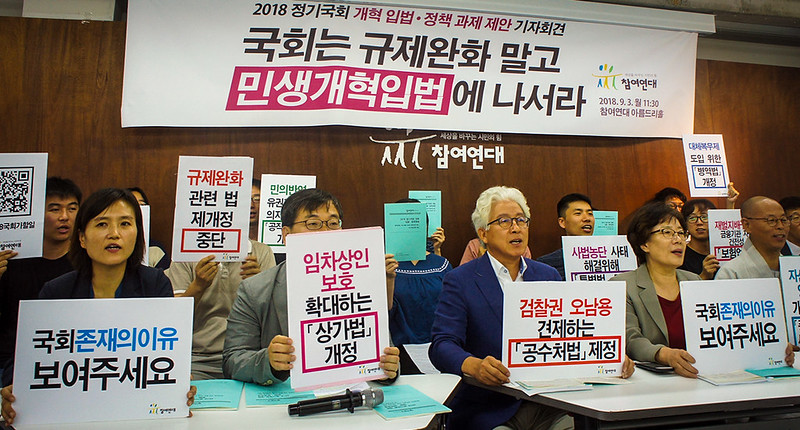
20180903_국회 개혁과제 제안 기자회견


“국회는 규제완화 말고 민생개혁입법에 나서라”

참여연대, 2018 정기국회 개혁 입법⋅정책 과제 제안

29개 과제 중 평화인권과 외교안보권력의 민주화를 위한 입법⋅정책과제


과제1. 국방개혁 2.0 수정

과제2. <판문점 선언> 비준 동의

과제3. 대체복무제 도입을 위한 「병역법」개정

과제4. 제10차 방위비분담금 협정 엄격한 심사

과제5. 위헌적 파병 철군 및 해외파병 규제완화 법안 제정 반대

과제6. ODA로 건설한 라오스 댐 사고 진상규명과 재발 방지


과제4. 제10차 방위비분담금 협정 엄격한 심사 


1) 현황과 문제점

  • 2019년부터 적용될 ‘주한미군 주둔 경비 지원금’을 결정하는 제10차 한·미 방위비분담 특별협정(SMA : Special Massures Agreement) 체결을 위한 협상이 진행 중임. 현재 6차 협상까지 진행되었으며, 9월 중 7차 협상이 열릴 예정임. 
  • 미국은 협상 과정 내내 한국의 분담금 대폭 증액과 전략자산 전개 비용 부담을 주장해왔음. 결국 5차 협상에서 전략자산 전개 비용을 한국에 부담시키기 위한 ‘작전 지원’ 항목 신설을 요구했음. 이는 주한미군 주둔 경비를 지원하는 예외적 특별 협정의 목적에서 명백히 벗어난 것으로 방위비 분담금 항목의 대상이 될 수 없음. 무엇보다 미국의 전략자산 전개는 <판문점 선언> 위반이며 한반도 평화체제 구축에 걸림돌이 되는 행위로, 이를 위한 비용을 한국이 부담할 필요는 전혀 없음. 더욱이 항목 신설은 미래 세대에 지속적인 비용 부담을 지우는 것으로 절대 허용해서는 안 됨.
  • 도널드 트럼프 미국 대통령은 취임 전부터 한국의 ‘무임승차론’을 주장해왔으나, 국방연구원(KIDA) 유준형 선임연구원이 조사한 ‘주한미군 직·간접지원 현황’에 따르면, 한국이 주한미군에 지원하는 총비용은 2015년 한 해 동안에만 5조 원이 넘음. 미국은 한국이 제공하는 분담금 일부를 사용하지 않고 적립해 두었다가 평택 미군기지 이전 사업 등에 불법으로 전용하고 이자 수익까지 챙겨왔음. 이는 한국이 주한미군 주둔 비용을 이미 충분히 부담하고 있다는 증거임. 
  • 특히 한국이 총사업비 11조 원의 92%를 부담한 평택 미군기지 이전 사업도 올해 완료되어 향후 군사시설 건설비용은 줄어들 것으로 예상됨. 증액이 아니라 오히려 대폭 삭감해야 할 시점임. 
  • 제9차 특별협정에서 한·미는 ‘협정 이행의 책임성과 투명성 제고를 위한 제도 개선에 관한 교환각서’를 채택했음. 당시 비준 동의 과정에서 국회 외교통일위원회는 '제도 개선 방안이 제대로 기능할지에 대한 면밀한 검토가 필요'하다고 지적한 바 있음. 새로운 협정 체결 비준 동의 절차에 앞서, 9차 협정 제도 개선 방안의 실효성에 대한 국회의 평가가 이루어져야 함. 


2) 정책 과제

 제10차 특별협정에 대한 엄격한 심사

  • 한반도 정세의 획기적 전환기에 진행되는 이번 특별협정 체결은 그 어느 때보다 중요하며 국회의 역할 역시 매우 중요함. 제10차 특별협정 체결을 위한 비준 동의 과정이 진행된다면, 반복적으로 제기된 문제들을 해소할 수 있도록 엄격하게 심사해야 함.  
  • 특히 협정에 미국의 일방적인 요구에 따른 과도한 증액, 2년 이상의 유효기간, 전략 자산 전개 비용 분담을 위한 ‘작전 지원’ 항목 신설 등이 포함될 경우 비준 동의를 거부해야 함. 


② 제9차 특별협정 제도 개선과 부대의견 이행 평가

  • 제9차 특별협정에서 한·미 양국이 합의한 제도 개선의 주요 내용은 ▷분담금 배정 단계에서부터 사전 조율 강화 ▷군사건설 분야의 상시 사전 협의 체제 구축 ▷군수지원 분야 중소기업의 애로사항 해소 ▷주한미군 한국인 근로자 복지 증진 노력 및 인건비 분야 투명성 제고 ▷방위비 예산 편성 및 결산 과정에 이르기까지 투명성(국회 보고) 강화 등임. 이러한 제도 개선 방안이 얼마나 실효성이 있었는지 면밀히 평가하여 소요 제기의 타당성과 집행의 투명성을 확보해야 함. 또한 제도 개선 합의 사항에 대한 국회 보고를 의무화하여 국회가 제대로 통제권을 행사할 수 있도록 해야 함. 
  • 제9차 특별협정 비준 동의안 의결 당시 국회가 제시했던 부대의견인 ▷주한 미군 평택기지 이전 사업 종료 시점에 동 사업의 종료 이후 군사건설 사업 소요에 대한 전반적인 조사 및 평가를 실시하여 국회 보고 ▷협정의 유효기간(5년)과 방위비분담금 결정 방식의 적정성 여부에 대한 연구용역을 실시하여 국회 보고 ▷국회의 예산 심의․확정권을 존중하는 차원에서 예산안 제출 이전에 협정 비준 동의안을 제출, 이상 3건에 대한 이행을 점검해야 함. 


4) 소관 상임위 및 관련부처 : 국방위원회, 외교통일위원회, 국방부, 외교부

5) 참여연대 담당부서 : 평화군축센터 (02-723-4250)


2018 정기국회 개혁 입법⋅정책 과제 >> 전체 보기


자료집 [원문보기/다운로드] bit.ly/2018국회가할일

월, 2018/09/03- 17:58
158
0

한국이 무임승차 하고 있다고?

한미 방위비분담 협상 1분 정리 


2019년부터 적용될 제10차 한-미 방위비분담 특별협정을 위한 7차 협상이 9월 19일~20일 워싱턴에서 열립니다. 

미국은 협상 시작부터 한국이 분담금을 적게 내고 있고, 미군의 전략자산 전개비용도 내야 한다는 주장을 계속해왔습니다. 결국 미국은 지난 5차 협상에서 '작전지원' 항목을 신설해달라는 어처구니 없는 요구를 했습니다.  


방위비분담금, 도대체 무엇이고, 미국의 이런 주장이 왜 말이 안되는지 알아볼까요?  


tyle-ywi-1-1537322740.png


tyle-ywi-2-1537322741.png


tyle-ywi-3-1537322742.png


tyle-ywi-4-1537322719.png


tyle-ywi-5-1537322720.png


tyle-ywi-6-1537322722.png


tyle-ywi-7-1537322723.png


tyle-ywi-8-1537322725.png


tyle-ywi-9-1537322726.png


tyle-ywi-10-1537322727.png


tyle-ywi-11-1537322729.png


tyle-ywi-12-1537322730.png


tyle-ywi-13-1537322732.png


tyle-ywi-14-1537322733.png


tyle-ywi-15-1537322734.png


tyle-ywi-16-1537322736.png


tyle-ywi-17-1537322737.png


* 제10차 방위비분담 특별협정 대응 방향에 관한 의견서 [원문보기/다운로드]


#1

한국이 무임승차 하고 있다고?

한미 방위비분담 협상 1분 정리 


#2 

"한국 방위비 안 낸다" 

- 도널드 트럼프 


#3

방위비분담금이란?

한국 국민의 세금으로 주한미군 주둔을 지원하는 경비 


#4 

한국의 2018년 방위비 분담금은 약 1조 원이야 


#5 

이에 더해 직•간접 지원까지

주한미군 주둔 경비의 65% 넘게 내고 있어


#6

2015년에는 총 5조 원 넘게 지원했지

* 한국국방연구원(KIDA), 유준형 연구 


#7 

미국은 한국이 준 분담금을 남겨 

미군기지 이전 비용으로불법 전용하고

이자수익까지 챙겼어


#8

한국은 충분하다 못해 

너무 많이 내고 있어


#9

그런데 미국은 

더 심한 걸 요구하고 있어


#10 

“새로운 항목을 만들어 

미군 전략자산 전개비용도 한국이 내줘”


#11 

하지만 이건 

주한미군 주둔 경비를 지원하는 

협정의 목적에 어긋나


#12

북한에 대한 적대행위로 간주될 수 있는 

미국의 전략자산 전개는 <판문점 선언> 위반이고


#13

한반도 평화체제에 걸림돌이될뿐

그 비용을 한국이 댈 이유가 없어


#14

게다가 항목 신설은 

미래세대에 두고두고 부담을 지우는 일이야


#15 

협상은 아직 진행 중

미국의 과도한 증액 요구나 

‘작전 지원’ 항목 신설은 

절대 받아들일 수 없어


#16

주한미군 지원금 삭감!

협정 기간 최소화!

전략자산 전개비용 NO!


새로운 평화의 시대,

미국의 요구대로 주는 

방위비 협상은 이제 그만!

수, 2018/09/19- 16:25
57
0
<div class="xe_content"><p><img alt="" src="http://www.peoplepower21.org/files/attach/images/37219/304/610/001/e8a8…; style="width:800px;height:420px;" /></p> <p> </p> <h1>삭감해야 할 방위비 분담금 증액 합의 납득할 수 없어</h1> <h2>미국 측의 근거 없는 증액 요구 관철, 합리적이지도 호혜적이지도 않아 </h2> <h2>한⋅미 방위비분담 특별협정(SMA) 근본적인 검토 시작해야</h2> <p> </p> <p>올해부터 적용될 한국의 주한미군 주둔 경비 지원금인 ‘방위비 분담금’ 협상이 최소 10억 달러 지원과 유효 기간 1년으로 타결될 것으로 예상된다. 어제(2/7) 국회 외교통일위원회 민주당 간사인 이수혁 의원은 한⋅미 방위비 분담금 협상이 타결 국면에 접어들었다며 “금년도분만 우선 결정키로 협의 중이며, 국방비 인상률 8.2%를 반영해 1조 500억 원 미만으로 합의되는 과정에 있다”고 밝혔다. 과도한 비용 부담과 미군의 불법 전용, 1조에 달하는 미집행액 등을 고려했을 때 대폭 삭감해야 마땅할 방위비 분담금이 미국의 일방적인 증액 요구에 따라 또 다시 인상되는 합의에 이른 것이다. 객관적인 소요 제기가 아닌 아무런 연관이 없는 한국 국방비 인상률을 반영하여 증액하기로 한 합의를 도저히 납득하기 어렵다.    </p> <p> </p> <p>지난해 3월부터 시작된 협상 기간 내내, 미국은 방위비 분담금 대폭 증액과 더불어 전략자산 전개 비용 부담까지 요구해왔다. 그러나 한국은 이미 한해 1조 원에 달하는 방위비 분담금 외에도 직⋅간접 지원을 통해 주한미군의 주둔 경비를 부담해왔다. 국방연구원(KIDA) 조사에 따르면 한국이 주한미군에 지원하는 총비용은 2015년 한 해에만 5조 원이 넘는다. 사용하지 않고 쌓여있는 미집행액도 1조 원에 달한다. 미국은 한국이 제공하는 분담금 일부를 사용하지 않고 적립해두었다가 군사건설비로 불법 전용하기도 했다. 이러한 방식으로 총 사업비의 92%를 부담한 평택 미군기지 이전 사업도 대부분 완료되어 향후 대규모 건설 사업 소요도 사라진 상황이다. 2017년 12월 참여연대가 ‘평택 기지 이전 사업 종료 이후 추가로 소요될 사업의 목록, 이에 대한 국방부의 타당성 검토 의견’에 대해 정보공개 청구한 결과, 국방부는 ‘평택 미군기지 이전 사업 종료 이후 미국 측의 전체사업 소요는 확인된 바 없다’고 답변한 바 있다. 방위비 분담금을 인상해야 할 아무런 이유가 없는 것이다. </p> <p> </p> <p>지난해 2월 강경화 외교부 장관은 “우리 국민의 지지를 얻을 수 있는 합리적이고 호혜적인 협상 결과를 도출하도록 노력하겠다”고 밝힌 바 있다. 그러나 미국측의 압박에 의해 근거없이 방위비 분담금을 증액하기로 한 이번 협상 결과는 결코 ‘합리적이고 호혜적인’ 것이라 볼 수 없다. 최근 한 여론조사에서 미국의 방위비 분담금 인상 요구 수용을 반대한다는 응답은 58.7%로, 찬성 응답의 2배 이상으로 나타났다. 미국이 주한미군 감축이나 철수로 압박한다고 가정했을 때도, 응답자의 절반 이상이 미국의 인상 요구 수용을 반대한다고 답했다. 불평등한 한미관계는 시정되어야 한다는 시민들의 광범위한 인식이 확인되고 있는 상황에서 또다시 방위비 분담금 인상을 합의한 현재 협상안이 ‘국민의 지지’를 얻을 수 있을지 의문이다. </p> <p> </p> <p>급변하는 한반도 정세를 고려할 때 협정 유효기간을 길게 잡는 것은 적절치 않다. 지난 8, 9차 협정의 5년 유효기간은 상황 변화에 따른 조정이나 집행에 대한 정확한 평가와 검증이 어렵고, 국회가 1조에 달하는 지출에 대해 실질적인 통제권을 행사할 수도 없어 문제였다. 또한 한반도와 동북아시아의 평화체제 구축을 위해 향후 주한미군의 역할과 성격에 대한 재검토가 불가피하다. 상황 변화에 유연하게 대응하기 위해서라도 협정의 유효기간은 짧게 설정하는 것이 낫다. 그런 면에서 현재 합의된 1년이 적절할 수도 있다. 하지만 이번에 한⋅미간의 기울어진 협상력이 다시 확인된 바, 근거 없는 증액 요구에 휘둘려 1년 유효기간의 협정이 반복된다면 그것 역시 문제가 아닐 수 없다. 협정의 유효기간을 짧게 하는 것은 방위비분담금의 대폭 삭감을 전제로 하는 것이어야 한다.</p> <p> </p> <p>다시 강조하지만, 방위비 분담금을 매년 인상하는 것은 절대로 당연한 것이 아니다. 제10차 협정의 금액이 1조원을 넘어야 할 어떠한 이유도 없다. 도리어 대폭 줄여야 할 이유는 차고도 넘친다. 한⋅미 주둔군지위협정(SOFA) 상 주한미군 주둔 경비는 원칙적으로 미국이 부담해야 하며 방위비분담 특별협정은 예외적인 조치일 뿐이다. 예외적인 조치가 이토록 과도하고도 근거 없이 30년 가까이 지속되어 온 것이다. 게다가 미국과 이런 식의 협정을 맺고 있는 나라는 일본과 한국 뿐이다. 이제 한⋅미 방위비분담 특별협정(SMA)에 대한 근본적인 검토가 이루어져야 한다. 그리고 이번 한·미 합의안은 반드시 재조정되어야 한다.</p> <div> </div> <div> </div> <div><strong>* 논평 [<a href="https://docs.google.com/document/d/1YA5RVdvy0TM-QPIsUmSHBPPUzreRiY_dI54…; rel="nofollow"><span style="color:#3498db;">원문보기 / 다운로드</span></a>]</strong> </div> <h2> </h2></div>
금, 2019/02/08- 10:57
29
0
<div class="xe_content"><h1>제10차 한미 방위비분담 특별협정 국회 공청회 진술자료</h1> <p> </p> <h2>제10차 SMA 협정안 이대로 비준동의해서는 안되는 이유</h2> <p> </p> <p style="text-align:right;">박정은 참여연대 사무처장</p> <p> </p> <p> </p> <p>10차 방위비 분담금 특별협정과 이행약정에 대해 정부와 국회 일각에서는 미 측의 주요 요구사항이었던 전략자산 전개비용 등이 포함된 ‘작전지원’ 부문 신설 요청을 철회시킨 것, 박근혜 정부가 이면합의를 통해 군사건설 분야의 예외적 현금지원이 가능하게 한 규정을 폐기한 것, 군수비용으로 지원된 미집행 현물의 이월요건 강화 등을 성과로 내세우고 있음. </p> <p> </p> <p>이는 SMA 협정의 취지와 목적에 부합하지 않는 요구이거나 규정이었기 때문에 당연히 시정되어야 할 사항들이었음. 그러나 SMA 협정과 이행약정을 둘러싼 오랜 문제제기나 우려들이 여전히 해소되지 않은 부분들이 많음. 특히 이행약정에는 지난 9차 협정의 문제점이 제대로 제거되지 않았거나, 미 측이 요구한 작전지원 항목을 대체할 수 있는 조항도 추가되어 있음. 국회 비준동의 이전에 반드시 삭제를 요구하거나 시정해야 할 부분임. </p> <p> </p> <p>SMA의 문제점들은 한미간의 기울어진 협상력에 기인하는 바이기도 하지만, 국회 스스로 제대로 점검하거나 통제하려는 노력이 충분치 않았기 때문임. 한국의 과도한 부담에도 불구하고 미 측이 한국 방어에 한국이 ‘무임승차’하고 있다는 허구적인 주장을 방어하는 가장 좋은 방법은 국회가 민주적 법절차를 통해 통제하고 견인하는 것임. 한미동맹 유지와 지속이라는 명분을 앞세워 미흡하고 잘못된 협정안을 제대로 시정하지 않고 비준동의 하는 일이 더 이상 반복되어서는 안 됨.</p> <p> </p> <h2>연간 5조 원 이상 지원, 막대한 미집행금에도 불구 대폭 인상 </h2> <p>이번 협정안의 가장 큰 문제는 한국이 부담해야 하는 분담금이 또다시 근거 없이 대폭 증액되었다는 것임. 2019년 한 해에만 SMA를 통한 지원액이 1조 389억 원으로 작년 9,602억 원보다 787억 원(8.2%) 증가함. 그러나 비용 증액의 타당한 근거를 찾을 수가 없음.</p> <p> </p> <p>이미 한국은 한 해 1조 원에 달하는 방위비 분담금 외에도 직⋅간접 지원을 통해 매년 5조 원이 넘는 주한미군 주둔 경비를 부담해왔음. (2018. 국방연구원) 반면 미국은 막대한 미집행액을 쌓아두고 이자 수익까지 챙겨왔음. 지난해까지 쌓여 있는 미집행액은 1조 원이 넘음. 군사건설비 불법 전용 등으로 한국이 총사업비의 92%를 부담한 평택 미군기지도 매우 호화롭게 조성되어 기지확장사업은 종료되었음. </p> <p> </p> <p>2018년 말 기준, 군사건설 항목 미집행 현물 지원분은 9,302억원, 비집행 현금 2,884억원(2018년 6월 기준), 군수비용 항목 미집행 현물 지원분은 562억원임. 1조 원을 훨씬 넘는 미집행금이 남아 있는 상태임. 군사건설 분야가 현물지원 체제로 전환됨에 따라 미집행 현금 규모가 2008년 약 1조 1,193억원에서 점차 감소함. 이는 미 측의 천문학적인 증액 요구나, 8.2% 증액해준 이번 협상 결과가 얼마나 불합리한지를 보여줌. 미집행 현금으로 여전히 이자소득이 발생하고 있으며, 이에 대해 한국 정부가 회수 방안을 마련하지 않는 등 아무런 조치를 취하지 않고 있는 것도 문제임. </p> <p> </p> <p>또한 한국의 국방비가 대폭 인상된 만큼 주한미군에 대한 의존도를 줄이고, 그에 따른 분담 비용도 축소되는 것이 마땅함에도 전체 비용이 한국 국방비 인상률을 반영하여 인상된 것은 납득하기 어려움. </p> <p> </p> <p>앞서 국방부는 SMA 협상을 앞두고 주한미군에 대한 직간접지원 규모를 조사, 연구하여 협상에 활용하겠다고 했고, 5조 원 이상 한국이 매년 직간접적으로 지원하고 있음을 확인한 바 있음. 또한 한국이 일본에 비해 병력대비 높은 수준으로 주한미군을 지원하고 있으며, 이는 SMA 협정상 뿐만 아니라 직간접 비용과 지속적/한시적 비용 등 모든 항목에서 높은 지원 규모라는 것이 드러남. 주둔병력 대비 한국인 노동자의 비율도, 건물면적 등 모든 면에서 일본을 추월하고 있음. 한국은 전 세계 유일하게 주한미군의 통신선과 연합C4I 체계 사용비와 KATUSA를 지원하고 있음.</p> <p> </p> <p>이번 협정안이 결코 성과라고 볼 수 없는 이유임. 애초 미국이 부담하게 되어있는 주둔경비를 한국이 지원하도록 한 특별조치로서 SMA 협정이 체결되어 왔음. 미 측의 정보 미공개로 주한미군 경비 전체를 제대로 파악할 수 없는 가운데, 동맹이라는 이름으로 지원금 규모가 이 정도로 계속 증액되는 것을 문제의식 없이 수용해서는 안 됨. </p> <p> </p> <h2>작전지원 항목 신설 대신 이행약정으로 군수 지원 항목에 반영</h2> <p>정부가 미 측의 작전지원 항목 신설 요구를 명시적으로 수용하지 않았지만, 대신 이행약정을 통해 미군의 작전상 일시적 주둔의 경우에도 추가적인 현물 군수지원을 하기로 합의함. 이는 비용 증액의 한 요소가 되고 있음. 협상 내내 분담금 대폭 증액을 요구한 미 측의 의사가 반영된 부분임. </p> <p> </p> <p>미 측이 요구했던 작전지원 항목 신설은 주한미군의 안정적인 주둔을 위한 비용 분담이라는 특별협정의 취지와 목적에 부합하지 않지만, 정부는 미 측의 입장을 고려하여, 이행약정 제5절 제2호에 “주한미군의 상시적 또는 일시적 주둔 지원을 위해”, “기지운영지원의 일부(공공요금 중 전기·천연가스·상수도·하수도 요금, 저장, 위생·세탁·목욕·폐기물 처리 용역)”를 제공하기로 함. 이는 미 측이 애초 요구한 전략자산 전개 비용, 연합훈련 비용, 순환배치 비용 등에 쓰인다는 것을 의미함. 이는 시설과 부지를 공여받아 주둔하는 주한미군만이 아니라 작전상 한국에 들어오는 해외미군의 활동도 지원하겠다는 것으로 해석될 수 있음. </p> <p> </p> <p>이는 SMA 취지에 맞지 않을 뿐만 아니라 향후 해외미군 활동지원 비용 부담으로 이어지고 확대되는 계기가 될 것임. 또한 성주에 배치된 사드도 “한국이 부지만 제공하고 운영유지 비용은 미 측이 부담한다”던 정부의 공언과는 달리 운영유지 비용도 한국이 부담하는 조항으로 이용될 가능성을 배제할 수 없음. 이행약정에서 해당 조항은 반드시 삭제되어야 함. </p> <p> </p> <h2>미 측 군사적 필요에 따른 ‘특정시설’ 건설 지원의 문제점</h2> <p>협정안은 박근혜 정부가 이면합의해 준 바 있는 특정 군사건설 사업에 대한 예외적인 현금 지원 가능 조항을 삭제, 설계·감리비 외에는 모두 현물로 지원하도록 한 점을 강조하고 있음. 이행약정 제4절 제4호에 “특정 시설이 미국의 군사적 소요로 인해 필요하며, 동 목적을 위해 가용한 현금 보유액이 부족하다고 한국 국방부와 주한미군사가 협의를 통해 합의하는 예외적인 경우에만 특정 시설 건설을 위해 비한국 업체 이용이 가능하다”는 조항을 두었음.</p> <p> </p> <p>미 측의 군사적 필요에 따라 미군기지에 건설하는 특정 시설의 성격이 무엇인지 반드시 검토해야 할 사안임. 또한 현금 지원 조항을 삭제했다고 하나, 한국이 설계, 시공감리에 현금을 지원하고, 이를 제외하고 현물을 지원한다는 점에서 크게 달라지지 않았음. 검토보고서가 지적한대로, 가용현금 보유액 부족 여부에 대한 판단은 한국 측이 판단하기 어렵고 미 측의 자체적인 현금 사용계획 등에 따를 수밖에 없음. </p> <p> </p> <p>김경협 의원실이 밝힌대로, 외교부 자체 조사 결과 지난 9차 협정에서 국내 중요시설을 도·감청할 수 있는 정보시설 건설에 현금지원을 할 수 있도록 하는 합의가 국회 비준동의 과정에 보고되지 않은 채 이루어졌음. 10차 협정의 이행약정은 국가 중요시설까지 도·감청할 수 있는 '민감특수정보시설(Sensitive Compartmented Information Facility, SCIF)'을 미군 단독으로 건설하는데, 한국 정부가 공식적으로 설계, 시공감리에는 현금 지원을, 나머지는 현물 지원을 한다는 것임.  </p> <p> </p> <p>한국 국민의 세금으로 여전히 SCIF 사업을 지원할 가능성을 배제할 수 없는 상황에서, 이면합의로 한 현금 지원이 아니기 때문에 방위비 분담금 집행의 투명성을 제고한 것이라고 주장할 수는 없음. 한국이 개입할 수 없고, 경우에 따라 감시를 당할 수 있는 장치를 위한 시설을 미군이 단독으로 건설하는 것이 과연 타당한지, 이에 대한 한국 측의 지원이 타당한지 반드시 점검되어야 함. </p> <p> </p> <p>군사건설 지원에 있어 한국 정부가 사업 선정 단계에서부터 협의할 장치를 두었다고는 하나. 주한미군사령관이 최종 사업들을 선정하는 등 군사건설 계획 수립과 집행에 있어 한국 정부의 개입 없이 전적으로 주한미군 측이 결정하게 되어 있는 점도 짚어야 할 부분임.</p> <p> </p> <h2>협정과 이행약정 연장조항, 국회 비준동의권 배제 가능</h2> <p>협정안 7조는 “이 협정은 당사자의 상호 서면 합의에 의해 연장되지 않는 한, 2019년 12월 31일까지 유효”하다고 밝히고 있음. 이는 2019년 협정이 종료되지 않으면 국회 비준동의와 관계없이 정부의 서면 합의로 연장 가능하다는 것으로, 방위비 분담금 액수 등을 변경할 수 있는 것처럼 해석될 수 있음. 경우에 따라 위헌 소지가 발생할 수 있음. 자동연장에 합의하는 마감 시한 규정도 없어 미국의 일방적인 요구에 끌려다닐 가능성을 배제할 수 없음. </p> <p> </p> <p>또한 이행약정 또한 국회의 동의 여부와 관계없이 “외교경로를 통하여 상호합의에 의해 수정 및 개정” 될 수 있도록 했음. 정부는 특별협정과 이행약정을 함께 국회에 제출하여 투명성을 증진하였다고 주장하고 있는데, 이 말대로라면, 협정안에 담지 못한 미 측의 요구가 반영된 이행약정에 대한 국회의 심사와 동의가 필수적임. 국회 통제 밖에서 한미 당국이 언제든지 이행약정의 수정이나 개정을 가능하게 해서는 안 됨.</p> <p> </p> <p> </p> <p><strong>* 참고자료 : 제10차 한미 방위비분담 특별협정 국회 공청회 자료집 [<a href="https://drive.google.com/file/d/1pAtO9u6b6zrpUVBWsCkP51QdC3gdT0Jn/view?…; rel="nofollow">원문보기 / 다운로드</a>]</strong></p></div>
목, 2019/04/04- 21:36
2
0

The United States should stop pressing for an unreasonable share of the cost of the U.S. military presence in South Korea

We will never concede to the obligations to participate and support the American performance of its military strategies

Rather than to discuss more contribution, the U.S. should get hands-on coordinating the imbalanced US-ROK alliance


Starting from today (December 17, 2019), the fifth round of the 11th ROK-U.S. Special Measures Agreement (SMA) negotiations will take place in Seoul for two days. The U.S. has been pushing in for an absurd amount and a new establishment of a category that exceeds boundaries of the Status of Forces Agreement(SOFA) and SMA. Under the nominal call of "alliance", this is an act to impute all costs of U.S. army stations in the Republic of Korea and its India-Pacific strategy. We strongly rebuke the pressure of Trump administration for ROK to take on excessive defense spending share.


Describing ROK a "very wealthy nation", the U.S. has demanded ROK pay $5 billion (6 trillion Korean won), which is six times its current amount (1.04 trillion won). However, ROK has been affording an increasing portion of costs to keep U.S. military personnel in ROK. Including the cost of the U.S. military presence, the direct and indirect monetary support summed up to 5 trillion won (2015 statistics). It is a mutually recognized fact for both ROK and the U.S. that ROK has been affording more than half (maximum of 65%) of the expenses. The U.S. had not even employed the full budget, and illegally redirected it to fund the Pyeongtaek base transition plan and got benefits from generated interest. The National Assembly's screening for the tenth negotiation estimates the unexecuted sum amounts to 1.3 trillion won, which is greater than this year's share of cost. Moreover, because the expansionary relocation plan of Pyeongtaek base (which ROK afforded 90% of the total expense, 11 trillion won) has been completed, there are no looming demands for large scale constructions. This is not a time to ask for an increase, but to go the opposite direction.


Adding on to the figure increase, the U.S. is requesting that ROK start paying for new categories of costs. The Trump administration is now asking Seoul to cover U.S. costs for personnel and their families, joint training sessions, equipment operations like THAAD, rotation of deployment, and exercises outside of ROK but related to the defense of the Korean peninsula. The United States wanted ROK to pay for more categories of expenses that have not been agreed in the previous tenth negotiation. This kind of demand from the U.S. break bounds of SOFA that regulates ROK to only supply the facilities and land while the maintenance fee of the US army is on the US, and SMA which framework covers labor costs, logistics costs, and construction cost only. Besides, we cannot overlook the attempt to dump US's expenses according to its Indo-Pacific strategies. The strategy to keep China and Russia in check does not help the establishment of a peace regime on the Korean peninsula nor peace for East Asia in general. There is no reason for ROK to participate in the militaristic strategy or take up the expenses of the U.S. The ROK government should refuse the U.S. government's request flatly. 


The arrogance of the U.S. precisely reveals the reason why we need to look back on where this alliance stands and to make this straight. The U.S. is pressing for an extension of General Security of Military Information Agreement (GSOMIA), asking for the deployment of troops to Hormuz of Iran, and is refusing to bear the responsibilities for base decontamination in recent negotiation for military bases return. Washington is neglecting its duty when it is demanding ROK for "contributions as an ally". Moreover, ROK is providing the U.S. with an army base of the biggest size and also purchased about 35 trillion won worth of American weapons from 2006 until 2018. Due to the disproportionately large supply of American weapons, the South Korean army system of weapon operation and military strategies are critically subordinated to those of the American troops stationed in ROK are already performing roles of rapid maneuver corps in the Asia-Pacific region, which lies beyond the protection of the Korean peninsula. This can be again confirmed from the letter sent by the chairmen of diplomacy and defense from the chamber to Pompeo Secretary of State and Mark Esper Secretary of Defense, which mentioned: "the troops in ROK, around 28 thousand 500 US army are not just there to protect ROK, but to increase national interest". Here and now is a time to restore the balance of this significantly tilted alliance relationship rather than to increase ROK's burden.


A share of 6 trillion won exceeds ROK's 2020 budget designated for diplomacy and unification categories. We cannot possibly pay the U.S. an amount that exceeds our diplomacy conduct. Both governments of Seoul and Washington should be mindful of the meanings of a recently conducted survey that found seven among ten South Korean people answered they cannot accept such an increase in the cost of stationing, even if the troops are downsized. SMA, an exceptional measure of SOFA clause that agrees stationary fees to be responsible to the U.S. in principle, should no longer be exercised to cause offense and increase burdens to the ROK people. Most importantly, there needs to be a fundamental rethink of characteristics, the size, and the share of costs of the stationed troops.


December 17, 2019

This statement endorsed by : 

Civil Peace Forum

Green KOREA

Korea Women's Associations United

Korean's Meeting for Prepared Unification(KMPU)

MINBYUN Committee on U.S. Military Issues

National Council of YMCA'S of Korea (NCYK)

Networks for Green transport

One Korea Tree

Peace Network

People's Solidarity for Participatory Democracy (PSPD)

Reconciliation and Reunification Committee, NCCK (The National Council of Churches in Korea)

Women Making Peace


Joint Statement [https://docs.google.com/document/d/1TAIxwiWt8jShXm_0xxg-VtFYzEENy1019kqR... rel="nofollow">See / Download]

화, 2019/12/24- 23:49
1
0
Cruel, deadly repression by south Korean riot police Dear friend, Og Lim Over 150K workers, farmers, students and ordinary citizens, some with children and family members, joined a peaceful and massive rally in Seoul on November 14. The rally has been prepared by the Korean Confederation of Trade Union for more than 1 year. It ...
화, 2015/11/17- 14:56
292
0

논평] 백남기 씨의 쾌유를 기원하며 – 백 씨의 아픔, 개발독재 미몽에 사로잡힌 결과 Wycliff Luke 기자 출처 : 김상호(신비) 페이스북 한반도는 대륙과 해양을 잇는 지정학적 위치와 어정쩡한 크기 때문에 늘 주변 강대국들의 이해다툼의 희생양 신세를 감수해야 했다. 이런 질곡은 근현대로 이어지면서 더욱 깊어져 이 땅의 민초들은 기구한 인생을 살아야 했다. 하근찬은 단편소설 <수난 이대>를 통해 ...

화, 2015/11/17- 19:03
557
0