지역
[자료] 2014 세계 군사비 지출 경향
스톡홀름평화연구소(SIPRI)에서 2015년 4월 13일 발표한 <2014년 세계 군사비 지출 경향> 보고서 한국어 번역본입니다.
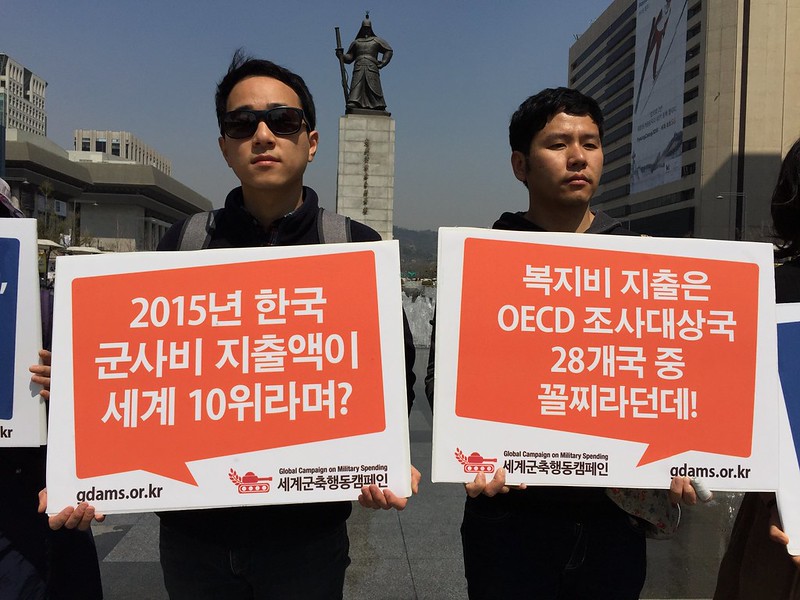
The Stockholm International Peace Research Institute (SIPRI) has released the 2015 annual world military expenditure figures today (4 May). There is a country which has been once again ranked as the world No. 10. It is, while being the tenth biggest global military spender, also recorded as the lowest welfare spender with the highest suicide rate among the 28 OECD countries. That nation is South Korea. The South Korean government has been spending 15% of its budget on military expenditure, which is 2.5 times bigger than the OECD average. The South Korean government has been pouring in 6 billion dollars over its acquisition of 40 F-35 fighter jets, the center of controversies over cost and technical problems. This is the reality of our nation, 'Hell Chosun', an infernal feudal kingdom.
Korea, breaking its usual record of world's top 10 arms importer became the world's biggest arms importer. The annual CRS (Congressional Research Service) report on Arms Transfers, published in December 2015, shows that the South Korean government bought arms and defense equipment worth 7.8 billion dollars in 2014, making it the number 1 weaponry importer in the world. About $7 billion of South Korea's contracts were made with the United States. Now South Korea has become the most lucrative client of the world's largest defense company, Lockheed Martin. This has been attributed to the South Korean government's decision to buy the fighters whose capabilities haven't yet been verified, even after the US refusal to allow core technologies' transfer to South Korea. Also, there's more good news for Lockheed Martin, which is that the US has reportedly agreed to deploy THAAD to South Korea.
Is the huge military expenditure justified? The nation, with an annual defence budget of $9.6 billion, has so far been discovered to have spent $876 million in defence industry corruption by a joint investigative team which was launched in 2014. According to the joint investigative team, there has been a continuous flow of bribes, the falsifying of public documents, shady arms acquisition processes etc. throughout the Army, Air force, and Navy. The 2014 National Defence Annual Reports says that within 10 years defence spending doubled from $4 billion to $8 billion. Anyone can guess that this figure is not healthy at all.
Then have our 630 thousand soldiers been benefiting from this military spending? The biggest item in South Korea's military budget is labour costs, most of which has been spent on commissioned officers. Only 9% of the military labour cost budget has been allocated to enlisted soldiers, who make up 70% of the entire military force, while the commissioned officers, who only make up 11% of the military force, take 42% of the entire labour costs. The enlisted soldiers are on less than one seventh of the nation minimum income. Is this treatment fair and just?
Some may say that "we can't possibly reduce military spending while facing the North Korean threat". The fact that South Korea's military power is far superior to that of North Korea has already been acknowledged by the government. South Korea has been spending on its military budget an amount almost equivalent to North Korea's national GDP, without even factoring in expenditure on American army bases in South Korea. Unable to match that amount, North Korea may have had to focus on weapons of mass-destruction. The key to solving the inter-Korean tension is trust-building, not military spending increases. The recent news on North Korea's 4th nuclear test caused many South Korean politicians to propose developing our own nuclear weapons. Without stopping this vicious competition of military spending and force increases on the Korean peninsula, the necessary dialogue cannot be initiated, hence peace will remain unreachable.
The world of arms, of which American President Eisenhower once said "Every gun that is made, every warship launched, every rocket fired signifies, in the final sense, a theft from those who hunger and are not fed, those who are cold and are not clothed." still persists now. This year the United Nations Office for the Coordination of Humanitarian Affairs (OCHA) will issue an estimated $20.1 billion needed to provide humanitarian assistance to countries around the globe, including Syria, Afghanistan, and Iraq. We need to remind ourselves that last year alone the world spent $1.8 trillion on defence. Just 1% of the total international military spend would make so much difference if it were to be spent on humanitarian purposes and the eradication of poverty.
More military spending will never bring in peace and safety to the world, but rather causes neighboring countries to increase their own military funding, therefore ending up enriching arms companies. Now is the time for us to rethink our priorities. The change we are hoping for will be brought forward by those who cry out "tax money for our lives, not for weapons" and the national assembly, which reviews and votes for bills based on our nation's voice. The 20th national assembly will have to allocate taxes to help its citizens facing hardship from cradle to grave. On the 5th of April 2016, celebrating the 6th Global Day of Action on Military Spending, we propose to enter into such a paradigm shift in our escape from 'Hell Chosun'.
April 5, 2016
The GDAMS Preparatory Committee of Korea
For more information
The GDAMS website http://demilitarize.orgThe GDAMS Korea website http://gdams.or.kr
The GDAMS Preparatory Committee of Seoul
People’s Solidarity for Participatory Democracy +82-2-723-4250, [email protected]
번역 : 윤현희 (참여연대 평화군축센터 자원활동가)
스톡홀름평화연구소(SIPRI)에서 2016년 4월 5일 발표한 <2015 세계 군사비 지출 경향> 보고서입니다. 첨부 파일을 확인해주세요.
(2016 년 4 월 5 일, 스톡홀름) 오늘 스톡홀름 국제 평화 연구소(Stockholm International Peace Research Institute, SIPRI)에서 발표된 데이터에 의하면 전세계 국가들의 2015 년 군비 지출 총액은 1 조 7 천억 달러에 달했으며, 이는 2014 년 대비 1%의 실질 증가율을 나타내는 수치이다. 이 데이터는 안보 및 개발에 대한 스톡홀름 포럼(Stockholm Forum on Security and Development) 개최에 맞추어 배포되었다. 매년 발표되는 전체 SIPRI 군비 데이터는 현시간 이후로 www.sipri.org 에서 확인 가능하다.
전세계 군비 지출액은 2015 년에 들어서 전년 대비 1% 증가하였으며, 이는 2011 년 이후 처음으로 나타난 군비 증가 현상이다.* 이러한 변화는 아시아 및 오세아니아, 동유럽, 그리고 일부 중동 국가들의 지속적인 군비 지출 증가를 반영하고 있다. 한편 서방 국가들의 군비 감소 추세는 예년에 비해 주춤하는 양상을 보였다. 아프리카와 라틴 아메리카 및 카리브해 연안 국가들의 군비 지출액은 전반적으로 감소하여, 전세계 국가들의 군비 지출 현황은 다소 혼합된 양상을 보이고 있다.
미국의 군비 지출액은 총 5,960 억 달러로, 전년도 대비 2.4% 감소한 수치에도 불구하고 최대 군비 지출국의 지위를 유지했다. 그 뒤를 이어 중국이 7.4% 증가한 2,150 억 달러, 사우디 아라비아가 5.7% 증가한 842 억 달러, 러시아가 7.5% 증가한 664 억 달러의 지출을 기록하였으며, 2015 년 기준 사우디 아라비아의 군비 지출 규모는 세계 3 위 수준으로 상승하였다.
유가 하락, 군비 절감의 신호
지난 수십년 간 높은 유가와 새로운 유전의 발견 및 시추는 전세계 많은 국가의 군비 지출을 큰 폭으로 확대시키는 데에 기여한 바 있다. 하지만 2014 년 말 시작된 유가 폭락으로 원유 수출국들의 군비 지출이 감소세로 돌아섰으며, 현재와 같은 상황은 2016 년에도 지속될 것으로 보인다.
2015 년에 원유 수입과 관련하여 가장 극적인 군비 지출 감소를 보인 국가는 베네수엘라(전년도 대비 총 64% 감소)와 앙골라(전년도 대비 총 42% 감소)였다. 마찬가지로 바레인, 브루나이, 차드, 에콰도르, 카자흐스탄, 오만, 남수단 등에서도 유사한 군비 절감 현상이 나타났다.
그러나 일부 다른 원유 수출국들은 원유 수출을 통한 수익 감소에도 불구하고 2015 년 군비 지출이 지속적으로 증가하였다. 이들은 대부분 분쟁이나 주요 지역적 갈등에 연루되어 있는 국가들로, 알제리, 아제르바이잔, 러시아, 사우디 아라비아, 베트남 등이 이에 해당된다. 한편 러시아는 기존에 편성했던 예산안보다 군비를 오히려 적게 지출한 것으로 나타났으며, 사우디 아라비아의 경우 예멘의 내전 개입 비용으로 53 억 달러의 추가 지출이 발생했음에도 불구하고 전반적인 군비 지출 규모는 감소하였다. 러시아와 사우디 아라비아는 모두 2016 년 군비 절감을 목표로 하고 있다.
서구의 군비 지출 축소 추세는 끝날 것인가
전세계적 경제 위기, 그리고 이라크와 아프가니스탄에서의 미군 및 연합군의 철수로 인해 북아메리카와 중서부 유럽 국가들의 군비 지출은 2009 년 이후 지속적으로 감소하는 추세가 나타났다. 하지만 2015 년에 들어서 이러한 추세가 종결될 것이라는 조짐이 보이고 있다.
미국의 군비 지출은 2015 년에 전년도 대비 2.4% 감소하였는데, 이는 최근 몇 년 간의 감소폭에 비하면 상당히 낮은 수치였다. 이는 미 국회가 기존에 합의된 정부지출 적자 감소 법안에서 군비 지출 사안을 일부 제외시키는 법안을 통과시킨 결과로 볼 수 있으며, 2016 년 미국의 군비 지출액은 실질 금액 기준으로 예년과 비슷한 수준을 유지할 것으로 예측된다.
전체적으로 2015 년 중서부 유럽 국가들의 군비 지출액은 전년 대비 겨우 0.2% 감소하였다. 그러나 중부 유럽 국가들의 경우만 보면 이들의 총 군비 지출은 오히려 13%가 상승한 것을 볼 수 있다. 특히 러시아 및 우크라이나와 국경을 맞대고 있는 에스토니아, 라트비아, 리투아니아, 폴란드, 루마니아, 슬로바키아의 군비 지출 상승폭이 높았으며, 이들 국가는 모두 우크라이나 사태 이후 러시아의 움직임을 크게 경계하고 있는 것으로 나타났다. 반대로 서부 유럽 국가들의 군비 지출은 전체적으로 1.5%가 감소하였으나, 이는 2010 년 군비 지출액이 감소하기 시작한 이래로 가장 낮은 감소폭이었다. 영국, 프랑스, 독일 등은 모두 러시아에 대한 우려 및 IS 에 의한 테러 위협의 대응을 이유로 향후 수 년 동안 군비 예산을 일부 확대 편성할 계획을 발표한 바 있다.
SIPRI 군비 지출 프로젝트 책임자 Sam Perlo-Freeman 박사는 ‘2015 년의 군비 지출 경향은 모순적인 양상을 보이고 있다. 한편으로는 군비 지출 추세가 전세계 각지에서 가속화되고 있는 갈등 및 긴장 상태를 반영하고 있으며, 다른 한편으로는 오일머니를 기반으로 한 지난 10 여 년 간의 군비 지출 확장 추세가 중단될 조짐을 보이고 있다. 이처럼 변동적인 정치, 경제 상황은 (관련 문제에 대한) 향후 전망을 불확실하게 만들고 있다.’ 고 밝혔다.
기타 괄목할 만한 변화
* 모든 수치 변화는 (2014 년 고정환율 기준) 실질 금액에 기반하여 표기하였다.
SIPRI 군비 지출 데이터
SIPRI 는 전세계의 군비 지출 현황을 감시하며, 이에 대해 가장 광범위하고 종합적이며, 지속적인 데이터를 확보하고 있다. 군비 지출은 현재 군사력 및 군사 활동에 쓰이는 모든 정부 지출을 의미하며, 여기에는 군인들의 급료와 보조금, 작전 수행 비용, 무기 및 관련 설비 구입 비용, 군사 시설 건축 비용, 연구 개발 비용, 중앙 관리, 지휘, 지원 부서에 투입되는 비용 등이 포함된다. 이처럼 전체 군비 지출에서 무기 구입에 사용되는 비용은 일부에 불과하므로, SIPRI 는 군비를 언급하는 경우에서의 ‘무기 지출’이라는 용어의 사용을 권장하지 않고 있다. 모든 변화 수치는 2014 년 고정환율 기준 실질 금액에 기반하여 표기되었다.
본 자료는 6 월 발행 예정인 SIPRI 세계 원자력 수치, 그리고 9 월 발행 예정인 SIPRI 연감 2016 이전에 공개되는 주요 데이터 보도자료 중 세 번째에 해당한다.

또다시 세계 10위를 기록했다. 오늘(4/5) 스톡홀름국제평화연구소(SIPRI)가 2015년 세계 군사비 현황을 발표했다. 세계에서 10번째로 많은 군사비를 지출하는 이 나라는 복지비 지출에서 OECD 조사 대상국 28개국 중 꼴찌, 자살률은 OECD 1위를 기록하고 있다. 그 나라의 이름은 대한민국이다. 한국은 매년 정부 재정의 약 15%가량을 군사비로 쓰고 있는데, 이는 OECD 회원국 평균 대비 2.5배나 된다. 과잉 투자 논란에 성능 결함이 산적한 F-35 40대를 도입하는 데는 7조 원을 아낌없이 쓰면서, 누리과정 예산 4조 원에는 전전긍긍하는 정부. 이것이 바로 ‘헬조선’의 현주소다.
한국의 무기 수입액은 세계 10위 수준을 유지해왔지만, 2014년에는 무려 세계 1위를 기록하기도 했다. 2015년 12월에 발표된 미 의회조사국(CRS) 연례 무기 거래 보고서에 따르면, 한국은 2014년 78억 달러의 무기 도입 계약을 체결해 당당히 1위에 올랐다. 그중 70억 달러는 미국 무기 수입이었다. 그래서 무기 판매 세계 1위 기업인 록히드 마틴에게 한국은 최고의 고객이다. 아시아의 이 작은 국가는 성능도 검증되지 않은 무기를 묻지도 따지지도 않고 덥석덥석 구매하기 때문이다. 차기 전투기 핵심기술 이전이 거부되고도 말이다. 그리고 곧 한국에 배치될지 모르는 주한미군의 사드(THAAD) 덕분에 록히드 마틴은 또다시 웃는다.
이 많은 군사비가 제대로 사용되고는 있는가? 방위력 개선비로 연 11조 원가량씩 지출하는 국가에서 2014년 출범한 방위사업비리합동수사단이 수사한 비리사업 규모만 약 1조 원이다. 합수단에 따르면 육·해·공군을 가리지 않고 광범위한 분야에서 뇌물수수, 허위공문서작성, 납품비리 등 각종 유형의 비리가 지속적으로 발생했다. 2014년 국방통계연보에 따르면, 최근 10년간 방산부문 매출액은 4조 6,440억 원에서 9조 3,429억 원으로 약 2배 증가했다고 한다. 이게 건강한 수치가 아니라는 사실을 우리는 충분히 짐작할 수 있다.
군사비가 많다고 해서 63만 군인들의 생활은 안녕한가? 국방비 중 가장 큰 비중을 차지하는 인건비는 대부분 장교 인건비로 지출되고 있다. 병력의 70%를 차지하는 사병 인건비는 전체 인건비 중 약 9%인 반면, 병력의 11% 수준인 장교 인건비가 전체 인건비 중 약 42%를 차지한다. 징집된 사병들은 2016년 최저임금 기준으로 따지면 1/7에도 못 미치는 급여를 받고 있다. 이것이 여전히 당연하고 온당한 처우인가?
이쯤에서 항상 나오는 ‘북한의 위협이 심각한데 군사비를 줄이면 어떻게 하냐’는 질문에도 답할 수 있다. 남한의 군사력이 북한에 비해 월등히 앞선다는 사실은 이미 정부도 인정한 바 있다. 남한은 북한의 총 GDP 규모에 달하는 군사비를 지출하고 있으며, 이것은 주한미군의 군사비는 제외한 수치다. 북한이 핵무기 같은 대량살상무기에 집착하는 이유는 도저히 군사비 경쟁이 안 되기 때문이다. 문제는 신뢰이지, 더 많은 군사비가 아닌 것이다. 최근 북한의 4차 핵실험 이후 남한에서도 다수의 정치인들이 핵무장을 주장하고 있으나, 이는 또 다른 악순환을 낳을 뿐이다. 한반도를 둘러싸고 각국이 벌이는 군비 경쟁과 군사력 과시를 멈추지 않고는 대화를 시작할 수 없으며 평화도 요원할 수밖에 없다.
“만들어진 모든 총과 진수된 모든 전함과 발사된 모든 로켓은, 굶주려도 먹지 못하고 헐벗어도 입지 못한 사람들로부터 빼앗은 것”이라는 오래된 이야기는 지금 이 순간에도 반복된다. 유엔인도주의업무조정국(OCHA)은 올해 시리아, 아프가니스탄, 이라크 등 각국의 사람들에게 원조를 제공하기 위한 인도주의 자금으로 ‘201억 달러’가 필요하다고 발표했다. 우리는 작년 한 해 전 세계가 군사비로만 무려 ‘1.8조 달러’를 써버린 것을 상기할 필요가 있다. 전 세계 군사비의 1%만이라도 빈곤퇴치와 인도주의 목적으로 사용한다면, 많은 것을 바꿀 수 있다.
더 많은 군사비는 평화와 안전이 아니라 주변국의 더 많은 군사비, 그리고 무기회사의 수익으로 귀결될 뿐이다. 이제는 답안지를 바꾸고 우선순위를 다시 매길 시간이다. 변화의 가능성은 ‘우리 세금을 무기 대신 우리의 삶에’ 사용하라고 외치는 시민들, 그리고 이들의 목소리를 반영해 정부 예산을 심의·의결하는 국회에 있다. 20대 국회는 세금을 군사비에 쏟아 붓는 대신, 요람에서 무덤까지 위태롭게 살아가는 시민들의 삶을 회복하는 데 사용해야 한다. 2016년 4월 5일, 제6회 세계군축행동의 날을 맞아, 작금의 ‘헬조선’을 탈출할 열쇠는 바로 이 발상의 전환에 있다고 제안한다.
2016 세계군축행동의 날 준비위원회
남북평화재단, 시민평화포럼, 열린군대를위한시민연대, 전쟁없는세상, 참여연대, 평화교육프로젝트 모모, 평화도서관 나무, 평화바닥, 평화를만드는여성회
☮ 세계군축행동캠페인 웹사이트 http://gdams.or.kr
세계 군사비 현황, 한국 군사비 현황 등 다양한 자료가 망라된 GDAMS 한국 웹사이트에 세계군축행동주간(4/5~4/18) 동안 군축 관련 다양한 컨텐츠를 지속적으로 업데이트할 예정입니다.
참여연대의 2018년 상반기(2018년 6월 현재) 활동을 평가하고 하반기 활동방향에 대한 회원의 의견을 수렴하고자 2018년 2차 회원모니터단 설문조사를 진행했습니다. 설문조사에 참여해주시고 귀한 의견 주신 회원님께 감사드립니다. 보내주신 의견 바탕으로 더욱 열심히 뛰겠습니다.
회원모니터단이란?
참여연대 의사결정, 소통 구조 강화와 혁신을 위해 2010년에 도입한 제도입니다. 참여연대 회원들을 성별, 지역, 연령, 회원가입 기간 등에 따라 24개의 그룹으로 나누고 각 그룹의 분포 비율에 따라 500여 명을 선정합니다. 현재 4기 회원모니터단이 활동을 하고 있으며 임기는 2년입니다.
설문개요
● 조사 시기 2018년 7월 2일 ~ 7월 6일(총 7일)
● 조사 방법 구조화된 질문지를 활용한 이메일/휴대폰 링크 방식의 온라인 설문조사● 조사 대상 참여연대 4기 회원모니터단 483명(2018년 7월 2일 현재)
● 설문 응답 총 255명(총 483명 중 52.8% 응답)
● 설문 분석 한규용 여론조사 전문가
2018년 상반기 가장 잘한 참여연대 활동을 여쭤보았습니다. 복수응답(2개)으로 의견을 확인한 결과, '사법행정권 남용·재판거래 의혹에 대한 대응 등 법원 개혁 운동'(41.2%)과 '삼성바이오로직스 분식회계, 현대모비스 분할·합병 비율 문제제기 등 재벌개혁운동'(38.8%)에 대한 높은 관심을 확인했습니다. 재판거래 의혹 등에 대해서는 2001-2007년 사이 가입하신 회원님의 응답이, 재벌개혁에 대해서는 2014년 이후 가입한 회원님의 응답이 상대적으로 높게 나타났습니다.

2018년 하반기 참여연대가 집중해야 할 사업에 대해, '재벌대기업 불공정 근절과 경제민주화를 위한 입법정책 캠페인'이라는 답변(52.5%, 복수응답(2개))이 가장 많았습니다. 검찰개혁과 자산불평등을 위한 세제개편이 그 다음으로 높게 응답되었습니다. 혁신성장으로 명명된 규제완화, 공개될수록 충격이 더해지고 있는 양승태 사법부의 재판거래 등 관련 이슈가 계속 이어지고 있습니다. 더 열심히 뛰겠습니다.

과거의 잘못을 확인하고 이를 해소, 청산하는 소위, 적폐청산이 이어지고 있습니다. 그중 그 개혁이 가장 시급한 권력기관이 무엇인지 여쭤보았습니다. 복수응답(2개)의 결과, '검찰'이라는 답변이 60.8%로 가장 많았습니다. 재판거래의 진상을 밝혀야 하는 '법원'(45.9%)과 특수활동비 등 그 불투명한 운영이 드러난 '국회·정당'(45.9%)이에 대한 개혁도 필요하다고 답변도 작지 않았습니다. 검찰, 국가정보원 등에 대한 불가역적인 개혁, 국회와 법원의 특수활동비 문제 해결 등을 위해 권력기관을 철저하게 감시하겠습니다.

3차례에 걸쳐 공개된 문건이 담고 있는 내용은 말 그대로 충격적입니다. 시민의 기본권까지 거래의 대상으로 삼았던 사실이 드러났지만 의혹의 실체를 밝히기에는 여전히 부족합니다. 사법행정권 남용·재판거래 의혹 진상규명을 위한 적절한 방안에 대해(복수응답(2개)), '고위공직자비리수사처(공수처) 설치 통한 별도의 수사'라는 답변이 60.8%, '특별법 등에 따른 진상조사와 의혹 재판에 대한 재심'이라는 답변이 51.8%로 나타났습니다.

이 문제를 해결하기 위해 참여연대가 가장 집중해야 하는 사안으로는 '진상규명과 책임자 처벌(검찰 수사와 국회 국정조사 등 요구)'이라는 답변이 39.6%로 가장 높게 나타났습니다. 그 다음으로는 '법원 개혁'에 대한 응답도 높게 나타났고 재판거래의 피해자에 대한 연대에 대한 의견(19.6%)도 확인되었습니다.

2018년 3월 대통령이 개헌안을 발의했지만 결국, '지방선거와의 동시 개헌'은 무산되었습니다. 그러나 개헌에 대한 시민의 요구는 적다고 할 수 없는데요. 개헌의 재추진 시기에 대해 절반에 가까운 49.4%의 회원님이 '2019년 상반기 이내'라고 답변해주셨습니다. '2020년 총선과 동시 개헌'은 39.2%로 그 다음으로 높게 응답되었습니다.

특히, 남·북 정상은 <판문점 선언>에서 '군사적 신뢰 구축에 따른 단계적 군축에 합의하기도 했습니다. '과감한 군축을 목표로 한 국방개혁이 필요'한 시점이 아닐까 싶습니다. 설문결과, 과감한 군축을 목표로 한 국방개혁의 필요성에 대해, 회원모니터단 중 54.1%가 '매우 찬성' 36.9%가 '찬성하는 편'이라고 답변해주셨습니다. 9%의 '반대'의견도 있었습니다. 30대 이하 응답자에서 전체 평균을 다소 상회하는 13.0%의 '반대'의견이 확인되었습니다.

2019년 적용할 최저임금이 결정되었습니다. 최근의 사회현안 중 가장 첨예한 이슈이지 않을까 싶습니다. 정부는 2020년까지 시급 기준 1만 원으로 인상하겠다는 계획을 국정과제 등을 통해 밝힌 바 있는데요. 이 계획은 사실상 어려워진 상황입니다. 설문결과, 2020년 최저임금 1만원에 대해 '92.9%('매우 찬성' 55.7% + '찬성하는 편' 37.3)의 '찬성'의견이 확인되었습니다. 성별로는 여성(97.9%)에서 '찬성'의견이 더 높았습니다. 30대 이하 층에서 15.2%의 '반대'의견이 확인되어 전체 평균 보다 높게 나타났습니다.

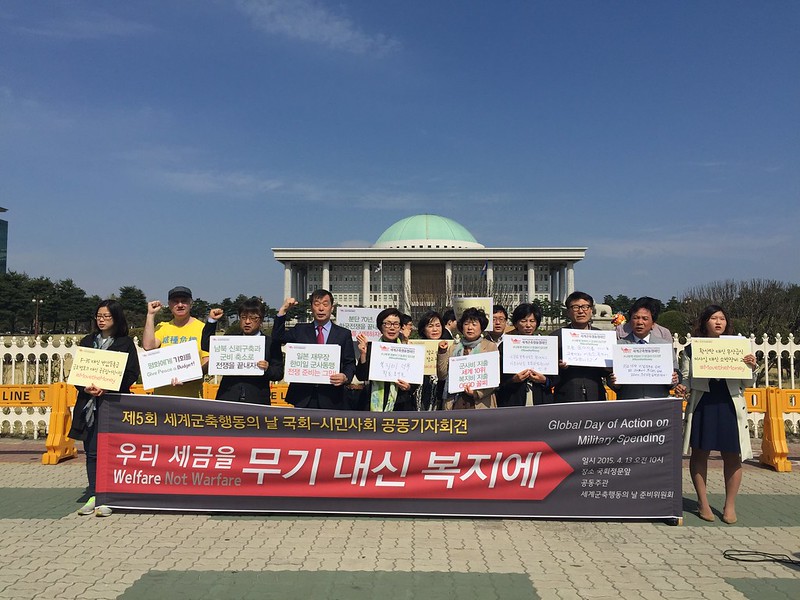
Today on the Global Day of Action on Military Spending, we stand here to be with about 320 organizations from about 70 nations around the world. We should reflect on our reality that peace and safety of citizens worldwide are far from being established even when an astronomical amount of money is spent on military. We demand that our taxes be spent on restoring social justice and building a sustainable and peaceful world. This year, marking the one-year anniversary of the Sewol-ferry tragedy, voices desiring a safe nation have grown louder than ever, and the criticism of the ineffective investment in defense industry in the name of 'national security' is also growing stronger. It is time to change the priorities of the national policy and shift the focus from materialistic national security and military buildup to safety of people and peaceful cooperation.
According to 'Trends in World Military Expenditure, 2014' published by Stockholm International Peace Research Institute (SIPRI), the worldwide military spending last year amounted to 1.8 trillion dollars (about 1,968 trillion won), a little less than the last year's. Korea entered the top 10 for the first time last year and ranked 10th this year.
Korea's military spending in 2015 amounts to 37.456 trillion won, increased by about 4.9% or 1.7504 trillion won from last year. This is excessive, taking up 14.5% of the government budget.
While a large sum of military spending is being spent, our society is becoming more extremely socially polarized. Uneasiness from everyday life caused by issues in education, child care, health care, and housing encroaches on our lives, but welfare budget to expand social safety net is not nearly enough. The total amount of university student loan is now over 10 trillion won. The university tuition could be subsidized and cut by half if we decide not to use 7 trillion won of budget on purchasing 40 fighter aircrafts, F-35's, which are the most ineffective and unreasonable among the military weapons to be purchased from the U.S. by the Korean army. 1,400 public daycare centers, which President Park Geun-hye promised to provide during her presidential campaign but failed to fulfill, could be built with 880 billion won of budget set aside for 4 unmanned aerial reconnaissance drones called 'Global Hawk'. Also the budget deficit of 65.5 billion won in 34 local medical centers could be covered for the next 90 years if we do not spend 6 trillion won on operating and maintaining Global Hawk's. Students in South Gyeongsang Province, who had to put up with such remark "a school is not the place you come to eat", could have school lunches for free for the next 30 years if 3.3415 trillion won of budget is not spent on the cluster bomb units and the multiple launch rocket systems, both of which indiscriminate murder weapons banned by international law. All the firefighting equipment which is old to such an extent as to threaten the lives of firefighters could be replaced if we do not spend 1.5233 trillion won on purchasing interceptor missiles such as PAC-3. In retrospect, what we lack is not the budget. Where we allocate finances is important. We should face the threat to our lives, and reprioritize the budget.
How about the Sewol-ferry tragedy? We had to witness 304 people being buried at sea because the country, which spends about 35 trillion won every year to protect citizens from outside threat and ranks 10th in military spending, did not have basic rescue equipment. The Blue House National Security Office denied being the so-called "control tower" for the Sewol-ferry disaster. If so, for whom is the national security if the disaster which could have resulted in deaths of 470 citizens is not a matter of national security? Moreover, the Tongyeong naval rescue ship which proved to be utterly useless at the time of Sewol-ferry disaster showed rampant corruption in the nation's defense industry. If we were to talk about society after the Sewol-ferry tragedy, we should start by dealing with this glaring contradiction.
Someone might raise a question about decreasing the military expenditure when there is a serious threat from North Korea. South Korea spends an amount, almost equal to North Korea's GDP, on military. This amount does not even include the military spending by the United States Forces Korea. North Korea is obsessed with weapons of mass destruction such as nuclear weapons because it knows its military spending is no match for South Korea's. Thus it is not a matter of amount of military expenditure, but a matter of trust.
In the East Asian region, there is a fierce competition on military spending among countries such as the United States, China, Russia and Japan. Some claim that South Korea should increase the military spending in order not to fall behind these nations. However, South Korea, as a middle power country responsible for initiating a peaceful unification on the Korean peninsula, should avoid confrontation based on South Korea-the U.S.-Japan military alliance but should demonstrate leadership for peace, cooperation, coexistence and common security. The recent controversy over the U.S. deploying a Terminal High-Altitude Area Defense (THAAD) missile defenses in South Korea directly shows 'Asian paradox', the disconnect between deep economic interdependence and a serious conflict in military diplomacy.
There are 20 nations worldwide whose military expenditures take up over 4% of their GDP's in 2014. This number is greater than that in the early 1990's right after the Cold War. If the world had spent even 5% of its military spending on combatting poverty, we could have realized the United Nations Millennium Development Goals (MDGs) that promised to halve global poverty rates by the year 2015. However as the world went through two great wars in Iraq and Afghanistan, the promise could not be kept. Korean government also promised to provide 0.25% of its GNI as Official Development Assistance (ODA) by the year 2015 to eradicate poverty but it allocated vastly insufficient amount and ended up breaking its promise to the international society. The new Sustainable Development Goals (SDGs) which is to be proposed in September, 2015 cannot be achieved without fundamental changes and reflection on military expenditure in each country.
The 5th Global Day of Action on Military Spending should not be the anniversary full of empty promises but should be a milestone to change. Thus, to the government and citizens of Korea which ranks 10th in military spending in the world and ranks last in welfare spending among 28 OECD countries, we suggest the following:
1. We demand that the military spending be reduced to alleviate social bipolarization, to expand social safety net, and to build safe society without disasters. Increasing military spending means taking away other opportunities under a limited government budget. Finances obtained by decreasing military expenditure should be used to remove any urgent threats that citizens face in their daily life.
1. This year, the 70th anniversary of the division of Korea, we demand that the efforts be put to end the Korean war and create a peace regime. The Korean government should reflect on the large amount of direct and indirect expenses spent to keep the unstable armistice regime during the past years. The nuclear threat in the Korean peninsula, which is the main reason behind the increase in the military spending, is also the result of this armistice regime and arms race. We should devise measures to recover mutual trust and start conversations instead of purchasing offensive weapons and increasing military expenditure every year. The first step towards achieving this is to lift the May 24th measures which stands between the inter-Korean relations.
1. We express our deep concerns over the situation where the preparation for war comes before peace and where military alliance comes before cooperation in the Asia-Pacific region. We demand that Korea put efforts to change relations based on various disputes and military conflicts into cooperative ones. Appealing to the military means or strengthening military alliances to antagonize a specific country cannot resolve the conflicts. We should protect the Japanese pacific constitution, a bastion of peace in East Asia, and should not allow the right of collective self-defense. We should not allow the deployment of the U.S. missile defense system in South Korea and break away from the South Korea-U.S.-Japan military ties.
1. In order to establish peace we need participation of citizens and solidarity of people across borders. A mature sense of citizenship is more effective than any weapons to protect the community. Understanding each other and cooperation across borders are faster ways to solve conflicts than using fighter aircrafts and missiles. We should not stand by and watch the government make decisions on whether a nation exaggerates an outside threat it claims to exist, and on whether our taxes should be used for purchasing military weapons or for building a sustainable society. Decisions on and execution processes of national security matters, including conclusion of various security treaties, development of military cooperation, execution of military exercises, and purchase of expensive and offensive weapons, must be transparent and controlled democratically, considering their enormous effects on society. Priorities in foreign policies and national security policies should be determined by citizens as it is done in other fields.
Disarmament is not a story of a distant future but an imminent and real issue. We demand that the government, the national assembly and all the citizens show wisdom to establish peace together.
April 13, 2015
Participants of the 5th Global Day of Action on Military Spending
For more information
The GDAMS website http://demilitarize.orgThe GDAMS Korea website http://gdams.or.kr
The GDAMS Preparatory Committee of Seoul
People’s Solidarity for Participatory Democracy +82-2-723-4250, [email protected]
시민들의 의견
댓글 달기