주요 콘텐츠로 건너뛰기

[GDAMS] [Statement] How long should South Korea stay as an international loser?
지역

[GDAMS] [Statement] How long should South Korea stay as an international loser?

익명 (미확인) | 화, 2016/04/05- 22:56

2016 GDAMS 캠페인


Global Day of  Action on Military Spending (GDAMS)
How long  should South Korea stay as an international loser?

With the lowest welfare spending and highest suicide rate among OECD members, 
South Korea was ranked as the world's No. 10 military spender this year and No. 1 arms importer in 2014.


The Stockholm International Peace Research Institute (SIPRI) has released the 2015 annual world military expenditure figures today (4 May). There is a country which has been once again ranked as the world No. 10. It is, while being the tenth biggest global military spender, also recorded as the lowest welfare spender with the highest suicide rate among the 28 OECD countries. That nation is South Korea. The South Korean government has been spending 15% of its budget on military expenditure, which is 2.5 times bigger than the OECD average. The South Korean government has been pouring in 6 billion dollars over its acquisition of 40 F-35 fighter jets, the center of controversies over cost and technical problems. This is the reality of our nation, 'Hell Chosun', an infernal feudal kingdom.


Korea, breaking its usual record of world's top 10 arms importer became the world's biggest arms importer. The annual CRS (Congressional Research Service) report on Arms Transfers, published in December 2015, shows that the South Korean government bought arms and defense equipment worth 7.8 billion dollars in 2014, making it the number 1 weaponry importer in the world. About $7 billion of South Korea's contracts were made with the United States. Now South Korea has become the most lucrative client of the world's largest defense company, Lockheed Martin. This has been attributed to the South Korean government's decision to buy the fighters whose capabilities haven't yet been verified, even after the US refusal to allow core technologies' transfer to South Korea. Also, there's more good news for Lockheed Martin, which is that the US has reportedly agreed to deploy THAAD to South Korea.


Is the huge military expenditure justified? The nation, with an annual defence budget of $9.6 billion, has so far been discovered to have spent $876 million in defence industry corruption by a joint investigative team which was launched in 2014. According to the joint investigative team, there has been a continuous flow of bribes, the falsifying of public documents, shady arms acquisition processes etc. throughout the Army, Air force, and Navy. The 2014 National Defence Annual Reports says that within 10 years defence spending doubled from $4 billion to $8 billion. Anyone can guess that this figure is not healthy at all. 


Then have our 630 thousand soldiers been benefiting from this military spending? The biggest item in South Korea's military budget is labour costs, most of which has been spent on commissioned officers. Only 9% of the military labour cost budget has been allocated to enlisted soldiers, who make up 70% of the entire military force, while the commissioned officers, who only make up 11% of the military force, take 42% of the entire labour costs. The enlisted soldiers are on less than one seventh of the nation minimum income. Is this treatment fair and just?


Some may say that "we can't possibly reduce military spending while facing the North Korean threat". The fact that South Korea's military power is far superior to that of North Korea has already been acknowledged by the government. South Korea has been spending on its military budget an amount almost equivalent to North Korea's national GDP, without even factoring in expenditure on American army bases in South Korea. Unable to match that amount, North Korea may have had to focus on weapons of mass-destruction. The key to solving the inter-Korean tension is trust-building, not military spending increases. The recent news on North Korea's 4th nuclear test caused many South Korean politicians to propose developing our own nuclear weapons. Without stopping this vicious competition of military spending and force increases on the Korean peninsula,  the necessary dialogue cannot be initiated, hence peace will remain unreachable.


The world of arms, of which American President Eisenhower once said "Every gun that is made, every warship launched, every rocket fired signifies, in the final sense, a theft from those who hunger and are not fed, those who are cold and are not clothed." still persists now. This year the United Nations Office for the Coordination of Humanitarian Affairs (OCHA) will issue an estimated $20.1 billion needed to provide humanitarian assistance to countries around the globe, including Syria, Afghanistan, and Iraq. We need to remind ourselves that last year alone the world spent $1.8 trillion on defence. Just 1% of the total international military spend would make so much difference if it were to be spent on humanitarian purposes and the eradication of poverty. 


More military spending will never bring in peace and safety to the world, but rather causes neighboring countries to increase their own military funding, therefore ending up enriching arms companies. Now is the time for us to rethink our priorities. The change we are hoping for will be brought forward by those who cry out "tax money for our lives, not for weapons" and the national assembly, which reviews and votes for bills based on our nation's voice. The 20th national assembly will have to allocate taxes to help its citizens facing hardship from cradle to grave. On the 5th of April  2016, celebrating the 6th Global Day of  Action on Military Spending, we propose to enter into such a paradigm shift in our escape from 'Hell Chosun'.


April 5, 2016

The GDAMS Preparatory Committee of Korea


For more information


The GDAMS website http://demilitarize.org

The GDAMS Korea website http://gdams.or.kr
The GDAMS Preparatory Committee of Seoul
People’s Solidarity for Participatory Democracy +82-2-723-4250, [email protected]


번역 : 윤현희 (참여연대 평화군축센터 자원활동가)

시민들의 의견

댓글 달기

Plain text

  • 웹 페이지 주소 및 이메일 주소는 자동으로 링크로 전환됩니다.
  • 줄과 단락은 자동으로 분리됩니다.
  • 사용할 수 있는 HTML 태그: <a href hreflang> <em> <strong> <cite> <blockquote cite> <code> <ul type> <ol start type> <li> <dl> <dt> <dd>
이미지
무제한 수의 파일을 이 필드에 업로드할 수 있습니다.
50 MB 한계입니다.
허용된 유형: png gif jpg jpeg.
Enter the YouTube URL. Valid URL formats include: http://www.youtube.com/watch?v=1SqBdS0XkV4 and http://youtu.be/1SqBdS0XkV4.
CAPTCHA
스펨 사용자 차단 질문

Joint Statement of 102 Peace Activists

Now Is the Time for Dialogue on Denuclearization and Not Military Action That Will Escalate the Crisis on the Korean Peninsula


We, undersigned peace-loving people around the world, are deeply concerned about the current escalating tension in Northeast Asia and urge governments to have peaceful dialogues among each other rather than taking military actions.


The state of affairs on the Korean Peninsula is more volatile than ever, now that President Park has been impeached and new government is to be constituted through an early presidential election in South Korea. The Trump administration, in the meantime, is fueling the escalating tension even further with messages that it will not rule out a preemptive strike on North Korea, and that it will redeploy strategic nuclear warheads to South Korea if necessary. The situation is further destabilized by the Trump administration’s decision to send an aircraft carrier to waters near the Korean Peninsula. The latest military stance and strategy of Washington, however, completely overlooks the desire of Koreans for peace. The Kim Jong-un government in Pyongyang meanwhile has warned of another upcoming nuclear test it intends to conduct, poised as it is to show off its growing nuclear capabilities. An existing crisis is already escalating in Northeast Asia over the Terminal High Altitude Area Defense (THAAD) system that the South Korean and U.S. governments have decided to deploy in South Korea. All these acts of military bravado, taking hostage the lives and peace of Koreans, must cease now. It is time for policymakers to be responsible and return to dialogue and negotiations and stop fueling the growing tensions.


Therefore, we exhort the US administration and political leaders of North and South Korea. 


Withdraw the decision to deploy the THAAD system, part of the U.S.-South Korea-Japan Missile Defense system, in South Korea.
The South Korean and U.S. governments have decided heavy-handedly, without the consent of the Korean legislatures and despite strong public objections, to deploy the THAAD system to Seongju, South Korea. The two governments claim that such a decision is necessary to protect South Koreans against possible nuclear strikes by North Korea, but the claim is backed by little realistic evidence. South Korea is too close to North Korea for THAAD to be effective. The North only needs low-altitude missiles, to hit and destroy the South in a matter of a few minutes, and these missiles could not be intercepted by THAAD. Moreover, the THAAD system has never been proven effective in actual battle. The deployment of THAAD by the U.S. Army in South Korea represents the South Korea-U.S.-Japan alliance against China and effectively symbolizes South Korea siding with the Americans over the Chinese. The presence of such an openly hostile missile defense system gravely disrupts the prospects for peace in Northeast Asia. Beijing and Moscow have already warned that they would take “corresponding measures” in response to the deployment, with the Chinese government and businesses now engaged in unofficial but retaliatory economic sanctions against South Korea. The growing instability and arms race in Northeast Asia will only undermine international efforts for a peaceful resolution of the nuclear crisis on the Korean peninsula.


What we need now is to resume dialogue towards denuclearization of the Korean Peninsula and a genuine end to the Korean War.

Pyongyang must desist from further testing of its missiles and nuclear capabilities. We cannot support the development of weapons that directly contradict international efforts for nuclear disarmament and that hold the lives and safety of innocent people hostage. It is critical to resume dialogue and negotiations to root out the nuclear threats to the entire region and to achieve the much-needed transition from the Armistice’s ceasefire to a peace regime on the Korean Peninsula. In doing so, we ought to admit the failure of the past sanction- and neglect-centered policies that insisted, unrealistically, that the government in Pyongyang either renounce its nuclear program prior to negotiations or collapse. With the end of nuclear diplomacy, the Kim government did nothing but augment its nuclear and missile capabilities, complicating the situation still further. We realize that countless military drills and the acquisition of cutting-edge weapon systems no longer guarantee peace and security. The perpetual political tension and military hostility can end only through dialogue and negotiation. Honest talks hold the only wise solution to the current predicament.


The Korean Peninsula can no longer afford to exist as a powder keg waiting to be ignited by the chronic military tensions and the constant arms race. This is among the first and foremost place where international efforts to tackle the nuclear problem and overcome the old Cold War legacy should begin. We need to start making serious efforts for peace, not only for the two Koreas, but also for Northeast Asia and the world at large. We urge the Trump administration, the Kim government, and the newly elected President of South Korea to listen to the desire of people worldwide for peace and resist the temptation to ratchet up military tensions on the Korean Peninsula for political gain.


May 16th, 2017


Akiko Yoshizawa(The Association for military base free peaceful Okinawa in Japan, Co-chair), Akira Asada(Sinsyu University, Professor Emeritus), Alfred L. Marder(US Peace Council, President), Alice Slater(Nuclear Age Peace Foundation, New York Representative), Ann Wright(Veterans for Peace, Colonel), Arnie Saiki(Moana Nui Alliance, Coordinator), Ayumi Temlock(Member of New Jersey Peace Action), Bruce K. Gagnon(Global Network Against Weapons & Nuclear Power in Space, Coordinator), Bruce Kent(Pax Christi UK, Vice President), Changsoon Chang(Musician), Chiaki Lee(The citizens of Matsue in Japan), Christine Ahn(Women Cross DMZ, International Coordinator), Colin Archer(International Peace Bureau, Retired Secretary-General), Corazon Valdez Fabros(International Peace Bureau, Co-Vice President), Daisuke Yamaguchi(Peace Depot Japan, Researcher), David McReynolds(War Resisters International, Former Chair), David Otieno(The Global Campaign on Military Spending Africa, Convener), David Swanson(World Beyond War, Director), David Webb(Campaign for Nuclear Disarmament, Chair), Dieter Deiseroth(IALANA Germany, Member of the Academic Council), Ellen-Rae Cachola(Women's Voices Women Speak, Organizer), Harumi Ishino(Osaka International University, Professor Emeritus), Hiroki Tanaka(Blue Legion), Hiroko Suzuki(Montreal Save Article 9), Hiromichi Umebayashi(Peace Depot Inc, Special Advisor), Hitomi Taniguch(Anti-War Committee of Yawata), Ichiro Yuasa(Peace-Depot, Vice-President), IWAKAWA Yasuhisa(Interpreter/translator), Iwase Hiroko, J. Enkhsaikhan(Blue Banner, Chairman), Jacqueline Cabasso(Western States Legal Foundation, Executive Director), Janis Alton(Canadian Voice of Women for Peace, Co-Chair), Jim Albertini(Malu ‘Aina Center for Non-violent Education & Action), Julia Matsui Estrella(Pacific Asian Center for Theologies and Strategies(PACTS)), Juliane Drechsel-Grau(IALANA Germany, Board Member), Jun Tisaka(Japan Peace Committee, Secretary General), Kataoka Akira(Peace Committee of Kyoto, Chair of the board), Kawasaki Akira(Peace Boat, Executive Committee Member), Kazuhiro Furuoya, Kazuyuki Yamada(The Wind from Yonaguni Island), Kenji Ago(Seinan Gakuin University / Japanese and Korean Citizens’ Peace Solidarity against Nukes, Professor Emeritus), Kevin Zeese(Popular Resistance, Co-Director), Kip Goodwin(Kauai Alliance for Peace and Social Justice, Communications Director), Kitamura Megumi(Hiroshima religious peace council affiliation), Kiyoko Takahashi(Article9 Association group in Hadano/Peace Depot), Koji Sugihara(Network Against Japan Arms Trade, representative), Koohan Paik(International Forum on Globalization, Asia-Pacific Program Director), Kouitirou Toyosima, Kristine Karch(International Network No to War - No to NATO, Co-Chair), Kuni Nagatomo(Japanese Constitution Article9), Kyle Kajihiro(Hawai'i Peace and Justice, Board member), Leah Bolger(World Beyond War, Chair Coordinating Committee), Lucas Wirl(International Association of Lawyers against Nuclear Arms(IALANA) Germany, Executive Director), Lynette Cruz(Hui Aloha Aina o Ka Lei Maile Alii, President), Maki Sasaki, Makoto Yanagida(No-Nukes Plaza Tanpopo-sya, Co-Representative), Margaret Flowers(Popular Resistance, Co-Director), Masako Watanabe, Masami Ono(Retired Teachers), Meri Joyce(Global Partnership for the Prevention of Armed Conflict, (GPPAC), Northeast Asia Regional Liaison Officer), Michael Pulham(Christian Campaign for Nuclear Disarmament), Michie Ichihara(Gallery of Life, President), Mitsumasa Ohta(Wind of Citizens toward Uniting for Peace), Monique Salhab(Veterans For Peace, Secretary, National Board of Directors), Muto, Ichiyo(People’s Plan Study Group), Nagase Riei(Board Member, Board Member), Nami Morita(KAFTI, Director), Naomi Klein(Author), Noam Chomsky(MIT, Retired Instituted Professor), Nomura Osami, Noriko Kuju(Peace-Life-Ignatio-A9), Otto Jaeckel(IALANA Germany, Chair), Patricia Pulham(Christian Campaign for Nuclear Disarmament), Pete Shimazaki Doktor(Hawai`i Okinawa Alliance, Co-Founder), Peter Becker(International Association of Lawyers Against Nuclear Arms (IALANA), Co-President), Phyllis Creighton(Hiroshima/Nagasaki Day Coalition, Board member), Reiner Braun(International Peace Bureau, Co-President), Ronald Fujiyoshi(Ohana Ho`opakele, Treasurer), Sachiko Mikami, Sato Daisuke(No Nukes Asia Forum Japan, General Secretary), Shigehiro Terajima (Labornet-TV), Shigeru Nakamura(Article9 Association group in Hadano), Shimazu Rumi(The One Thousand Against War Committee), Shin Chiba(International Christian University, Professor), Shizue Tomoda, Suda Minoru(Ritsumeikan University, Professor Emeritus), Sukla Sen(EKTA (Committee for Communal Amity), Activist), Sumi Hasegawa(McGill University, Retired Faculty), Taikei Kokubu(Shinshuu Ōtani-ha Ansenji Priesthood, Shinshuu Ōtani-ha), Takeda Takao(NIPPONZANMYOHOJI), Tarak Kauff(Veterans for Peace, Board of Directors), Taro Abe(Nagoya Gakuin University, Professor), Tutihashi Ryoko, Wataru Mikami, Will Griffin(The Peace Report), Wolfgang Alban(IALANA Germany, Board Member), Yasunari Fujimoto(Forum for Peace, Human Rights and Environment (Peace Forum), Co-President), Yasuo Takagi, Yayoi Tsuchida(Japan Council against A and H Bombs (Gensuikyo), Assistant General Secretary), Yoshinobu Toyoda, Yoshioka Tatsuya(Global Partnership for the Prevention of Armed Conflict, Northeast Asia Regional Representative), Yoshiyuki Ishino(Anti-War Committee of Yawata Kyoto)

화, 2017/05/16- 11:17
369
0

solidarity message


Solidarity Message to <Anti-War Coalition In Solidarity to Protect Article 9>

People's Solidarity for Participatory Democracy(PSPD) has opposed the amendment of peace constitution and rearmament of Japan by Abe administration. We are very concerned about national security bills in a bid to be passed at the National Diet of Japan.


Japan must be prevented from exercising the right of collective self-defense. This will nullify the Japanese peace constitution, particularly article 9, which has served as an anchor of peace in East Asia.


This year is the 70th anniversary of the end of WWII. The memories of the atrocious Japanese colonial rule and aggression in the past in many of its neighboring countries cannot be simply erased.


Japan must stop military buildup and preserve its peace constitution.

We will continue to stand in solidarity with those who are concerned about and marching for peace across Asia-pacific.


Peace & Solidarity


Peace and Disarmament Center, PSPD


call for support


금, 2015/06/12- 21:08
200
0

대한민국, 언제까지 '글로벌 호구' 노릇 하나

한국 군사비 지출 올해도 세계 10위... 무기수입, 2014년 세계 1위


숲이아 (평화를 만드는 여성회 활동가)


2016년 4월 5일, 평화활동가들이 광화문에 모였다. 그들이 모인 이유는 올해로 6회째를 맞이하는 세계 군사비 축소를 위한 행동의 날(Global Day of Action on Military Spending, GDAMS)을 알리기 위해서였다.


매년 스톡홀름국제평화연구소(SIPRI)에서는 <전 세계 군사비 지출 현황에 대한 보고서>를 발표한다. 세계군축행동캠페인은 매년 4월 보고서 발간에 맞춰 '군사비를 줄이고 평화를 선택하자'는 메시지를 전하기 위해 진행하는 국제 캠페인이다. 올해도 전 세계 70개국 수백 개 평화단체들이 캠페인에 함께하고 있다.


올해 캠페인은 4월 5일부터 18일까지 진행된다. 한국의 평화활동가들도 첫날인 4월 5일, 광화문에서 "우리 세금을 무기 대신 우리의 삶에!"라는 주제로 직접행동을 진행했다. 남북평화재단, 전쟁없는세상, 참여연대, 평화교육프로젝트 모모, 평화를만드는여성회 등에서 함께 준비했다.


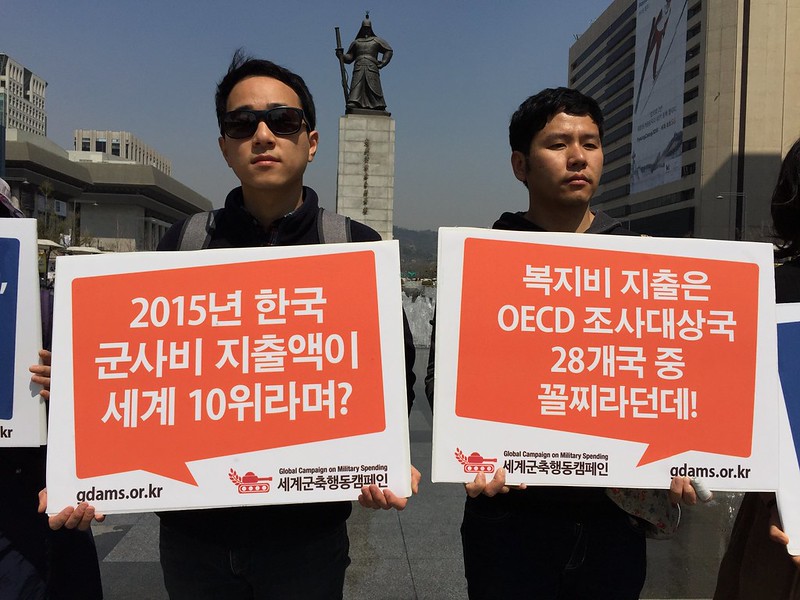
광화문 사거리, 사람들이 많이 다니는 점심시간 즈음 피케팅을 시작했다. 10여 명의 캠페인 참가자들은 사거리 곳곳으로 흩어졌다. 말풍선 피켓을 들고 두 명씩 짝을 지어 시민들을 만났다.


▲ 세계군축행동의날 캠페인 <세계 군사비 축소를 위한 행동의 날>을 맞아 진행한 거리 캠페인 ⓒ 참여연대    
 

"2015년 한국 군사비 지출액이 세계 10위라며?"
"복지비 지출은 OECD 조사대상 28개국 중 꼴찌라던데!"


"2015년 전 세계가 사용한 군사비가 무려 1.7조 달러(1,950조 원)이라며?"
"전 세계 군사비의 1%만 있으면, 긴급한 인도주의적 지원을 바로 할 수 있다며?"


2015년 한 해 전 세계가 군사비로 지출한 비용은 1조 6,760억 달러다. UN에서 발간한 새천년개발목표보고서(2015)에 따르면, 전 세계 8억 3천 6백만 명 이상이 절대 빈곤에 시달리고 있다. 한편 같은 기간 전 세계가 공적개발원조(ODA)로 지출한 금액은 1,352억에 불과하다. 군사비 지출 대비 8%(2014년 기준)에 불과한 금액이다.


"만들어진 모든 총과 진수된 모든 전함과 발사된 모든 로켓은, 굶주려도 먹지 못하고 헐벗어도 입지 못한 사람들로부터 빼앗은 것"이라는 오래된 이야기는 지금 이 순간에도 반복된다. 


유엔인도주의업무조정국(OCHA)은 올해 시리아, 아프가니스탄, 이라크 등 각국의 사람들에게 원조를 제공하기 위한 인도주의 자금으로 '201억 달러'가 필요하다고 발표했다. 우리는 작년 한 해 전 세계가 군사비로만 무려 '1.8조 달러'를 써버린 것을 상기할 필요가 있다. 전 세계 군사비의 1%만이라도 빈곤퇴치와 인도주의 목적으로 사용한다면, 많은 것을 바꿀 수 있다.


▲ 세계군축행동의날 캠페인 <세계 군사비 축소를 위한 행동의 날>을 맞아 진행한 거리 캠페인 ⓒ 참여연대 


1조가 넘는 금액이 계산이 안 되고, 전 세계 군사비 지출은 너무 멀게 느껴진다면? 한국의 국방비를 살펴보자. 한국은 많은 군사비를 지출하는 국가 중 하나로, 작년에 이어 올해에도 10위를 기록했다. 2016년 한국의 국방 예산은 38조 7,995억 원, 한국은 전체 예산의 14.5%를 국방비에 들이고 있다.


한편 복지비 지출은 OECD 조사 대상국 28개국 중 가장 낮은 수치를 기록했다. 복지비 지출은 OECD 꼴찌, 자살률 OECD 1위 국가에서 군사비 지출은 올해도 세계 10위, 무기 수입 2014년 세계 1위를 기록한 대한민국. 갈수록 살기 팍팍해지는 현실, 이제는 군사비에 세금을 쏟아부을 것이 아니라, 요람에서 무덤까지 위태롭게 살아가는 시민들의 삶을 회복하는 데 사용해야 하지 않을까.


▲ 세계군축행동의날 캠페인 <세계 군사비 축소를 위한 행동의 날>을 맞아 진행한 거리 캠페인 ⓒ 참여연대    


나는 평화활동가이면서 아직 대학교를 다니는 학생이다. 박근혜 대통령은 후보 시절 반값등록금 공략을 내걸었다. 졸업을 위해 총 3과목을 더 들어야 하는 상황에서, 이번 학기에 나는 2과목만 등록할 수밖에 없었다. 활동하고 공부하면서 아르바이트 해서 모아놓은 돈으로는 2,145,000원이라는 등록금을 모두 낼 수가 없었기 때문이다. 다 내고자 했다면 빚쟁이가 되어야 했을 것이다.


반값등록금 공약만 제대로 지켜졌어도, 나는 이번 학기에 3과목 모두 등록하고 졸업을 할 수 있었을 것이다. 정부가 비효율적이고 타당성 없는 F-35 전투기를 도입하면서 들여야 하는 비용은 7조 3,418억이다. 7조면 전국 대학생에게 조건 없는 반값등록금을 지원하는 게 가능하다.


박근혜 대통령 취임 2년째가 되는 2015년, 대학생의 등록금 대출 총액은 드디어 10조를 넘어섰다. 왜 대학생들 등록금 빚은 자꾸 늘어가는데 과도한 군사비 지출을 계속해야 하는 걸까? 무엇이 진짜 우리 삶의 '위협'일까?


이게 바로 내가 매연을 마시며 광화문 한복판에서 피켓을 들고 서 있던 이유다. 우리의 세금을 무기 대신 제발 우리의 삶을 위해 써주면 좋겠다. 등록금 지원, 신∙재생 에너지 지원, 보육 예산 확보, 노령연금 등 정부 예산을 쓸 곳은 너무 많다. 더 많은 군사비는 평화와 안전이 아니라 주변국의 더 많은 군사비, 그리고 무기회사의 수익으로 귀결될 뿐이다. 이제는 답안지를 바꾸고 우선순위를 다시 매길 시간이라고 생각한다.


☮ 세계군축행동캠페인 웹사이트 http://gdams.or.kr
세계 군사비 현황, 한국 군사비 현황 등 다양한 자료가 망라되어 있습니다.
 

오마이뉴스에서 보기 >> 

월, 2016/04/18- 10:49
184
0

South Korea: Reopen Kaesong Industrial Complex Immediately


(Seoul, 11 February 2016) On 10 February 2016, the South Korean government announced the closure of Kaesong Industrial Complex, citing North Korea’s 4th nuclear test and launching of a long-range rocket as reasons. However, South Korean civil society organisations emphasise that closure of Kaesong Industrial Complex is an absolutely improper measure. We call on the South Korean government to immediately reopen Kaesong Industrial Complex. It is not a time to immediately end relations with North Korea. Instead, we must find wise solutions to escape this cold period. 


We note with concern that the closure of Kaesong Industrial Complex goes completely against the 2013 agreement between the two Koreas in which they each committed to continue operations at Kaesong Industrial Complex regardless of the political situation. This recent unilateral decision by the South Korean government is also a violation of the Economic Partnership Agreement between the two countries, which is a de facto international treaty. 


The South Korean government argues that approximately 120 billion KRW (around 120 million USD) in wages paid to workers at Kaesong Industrial Complex has been used in development of nuclear weapons and missiles. This accusation has no grounds because most wages paid to North Korean workers are in the form of social and cultural policy funds and gift cards. 


We deplore the South Korean government actions, which ignore the lives of the North Korean workers and difficulties faced by South Korean companies, around 120 of whom face bankruptcy as a result of the closure. While the South Korean government is discussing an alternative site for a factory and financial support, nothing can replace Kaesong Industrial Complex to companies. At the same time, the approximately 54,000 North Korean workers and their families are now at the edge of a precipice. They are not at all related to North Korea’s nuclear testing or long-range rocket launch. 


It is obvious that additional sanctions will not resolve North Korea’s nuclear ambitions, as the past 20 years of sanctions against it have not been successful. It is clear that establishing a peace system and denuclearisation is the only effective solution, not simply repeating already-failed policies of sanctions. The South Korean government must reopen Kaesong Industrial Complex immediately.  /END/


Endorsed by below 69 civil society organisations and networks: 
Busan Counseling Center Against Sexual Violence, Busan Women's Association United, Cheonan Women's Association, Chungbuk Civil Society Organizations Network in Korea, Chungnam Civil Society Organizations Network in Korea, Citizens Coalition for Democratic Media, Civil Peace Forum, Civil Society Organizations Network in Korea, Cultural Action, Daegu Citizens Union for Peaceful Reunification, Daegu Gyeongbuk Women's Association United, Daegu Women's Association, Daejeon Civil Society Organizations Network in Korea, Daejeon Women's Association for Democracy, Daejeon Women's Association United, Eco Horizon Institute, Eco Justice, Goyang Peace Nuri, Green Korea United, Green Transport Movement, Gwangju Jeonnam Women's Association United, Gyeonggi Civil Society Organizations Network in Korea, Gyeonggi Women's Association United, Gyeongnam Civil Society Organizations Network in Korea, Gyeongnam Women's Association, Gyeongnam Women's Association United, Housewives Association, Jeju Women's Association, Jeju Women's Human Rights Solidairty, Jeonbuk Civil Society Organizations Network in Korea, Jeonbuk Women's Association United, Jeonnam Civil Society Organizations Network in Korea, Korea Association of Christian Women for Women Minjung, Korea Sexual Violence Relief Center, Korea Single Parent United, Korea Women's Hot Line, Korea Women's Political Solidarity, Korea Women's Studies Institute, Korea YMCA, Korea Youth Corps, Korean Association of Women Theologians, Korean Catholic Women's Community for a New World, Korean Differently Abled Women United, Korean Federation for Environmental Movement, Korean Sharing Movement, Korean Women Workers Association, Korean Women's Association United, Korean Women's Environmental Network, National Solidarity for Solving Prostitution Issues, Network for Gender Sensitive Budget, Peace Ground, Peace Network, Peace3000, People's Solidarity for Participatory Democracy, Pohang Women's Association, Pusan Women Education Center, Research Institute of the Differently Abled Person's Rights in Korea, Reunification Tree, Saewoomtuh, Suwon Women's Association, The National Association of Parents for Cham Education, Tongilmaji, Transparency International Korea, Ulsan Women's Association, Women Education Center, Women Making Peace, Women Migrants Human Rights Center of Korea, WomenLink, Young Korean Academy
 

목, 2016/02/11- 19:55
168
0

국방비 증액 외치는 대선 후보들, 군비경쟁의 악순환 끊어낼 전략 내놓아야

2017 세계군축행동의 날 즈음한 시민단체 공동입장
SIPRI 2016년 세계군비 현황 발표, 
더 많은 군사비가 평화를 가져오지 않는다는 사실 재확인


오늘(유럽 현지시간 4/24) 스톡홀름국제평화연구소(SIPRI)가 2016년 세계 군사비 현황을 발표했다. 한국은 여전히 세계에서 10번째로 많은 군사비를 지출하는 국가로 기록되었다. SIPRI에 따르면, 한반도를 둘러싼 아시아·태평양 지역은 전 세계에서 군사비가 가장 집중되어 있는 곳이다. 군사비 지출 세계 1위 미국, 2위 중국, 3위 러시아, 8위 일본, 10위 한국이 포진해있다. 한편 인도, 베트남 등을 중심으로 전체 아시아의 군비는 계속 늘어나는 추세다. 모두가 ‘국가 안보’를 외치며 군사비에 세금을 쏟아 붓고 있는데 왜 ‘안보 위협’은 나날이 더 심각해질까?


최근의 사드 배치 결정은 이 모순을 극단적으로 보여준다. 북한의 위협을 명분으로 한미 정부가 사드 한국 배치를 결정하자, 중국은 이에 맞서 새로운 미사일 부대를 창설하겠다고 발표했다. 러시아 역시 미사일 부대를 극동으로 배치할 수 있다고 경고한 바 있다. 북한은 사드 따위는 얼마든지 무력화할 수 있다는 듯 미사일 시험 발사를 이어가고 있다. 이대로 사드 배치가 강행된다면, 동북아에서는 질적으로 다른 군비 경쟁이 진행될 것이다. 북한의 핵과 미사일 개발도, 한국의 군비증강도, 나아가 한미일 MD(미사일방어체제)를 포함한 군사협력과 중국과 러시아의 군사적 대응도 서로를 핑계 삼아 무럭무럭 키우고 있는 형세이다. 


한국의 군사비도 북핵·미사일 등 이른바 ‘비대칭 위협’을 명분 삼아 매년 증액되어왔다. 올해는 사상 최초로 국방 예산이 40조 원을 넘었다. 군은 ‘비대칭 위협’ 대비를 명목으로 첨단 전력 예산을 늘리는 한편, 육군 중심의 재래식 전력 투자도 동시에 늘려왔다. 남한은 이미 주한미군의 군사비를 제외하고도 북한의 총 GDP 규모보다 더 많은 군사비를 지출하고 있다. 북한이 대량살상무기에 집착하는 이유는 도저히 군사력 경쟁이 안 되기 때문이다. 하지만 군 당국의 자의적인 위협분석에 근거한 불필요한 과잉 투자는 매년 반복되고 있다. 


이러한 상황은 방어를 명분으로 한 군비증강은 상대의 군사적 대응을 불러와 결국에는 그 누구도 승자가 없는 안보딜레마에 빠지게 한다는 것을 보여준다. 지금 군비경쟁의 끈을 놓지 않고 있는 한반도와 동북아 사정이 그러하다. 그렇다면 문제해결의 방향은 더 많은 군사비가 아니다. 끝이 보이지 않는 군비증강에 편승하면서 군사적 긴장을 고조시키는 것이 아니라 어렵더라도 대화와 협상을 통해 서로간의 신뢰를 쌓아가는 노력을 기울이면서 이 악순환을 끊어내기 위한 담대한 평화제안이 필요하다. 하지만, 지금 문재인, 안철수, 유승민 등 주요 대선 후보들은 모두 한 목소리로 국방비 대폭 증액을 외치고 있을 뿐이다. 한반도 평화를 원하는 대선 후보라면, 군사력 증강에만 골몰한 지난 정권들의 실패에서 배워야 한다. 그리고 그것을 답습하지 않겠다고 선언해야 한다.


평화는 군사비로 지켜질 수 없고 만들어낼 수도 없다. 국방비 증액으로 문제를 해결할 수 있었다면 이미 지구는 평화로운 곳이었을 것이다. 압도적인 군비를 지출하고 있는 미국도, 한반도도, 동북아도 마찬가지이다. 한반도 핵갈등도 이미 해결되었을 것이다. 결국 문제해결의 키는 대화와 협상임을 인정하고, 주변국의 협력을 이끌어내는 정치와 외교력이다. 한정된 국가예산을 어떤 우선순위로 사용할지도 근원적으로 돌아보아야 한다. 자살률과 노후 빈곤률이 부동의 세계 1위, 출산률 최하위인 나라에서 사람들에게 당면한 위협은 불안한 일자리와 실업, 보육의 어려움과 노후불안, 높은 교육비 등과 같은 일상의 어려움들이다. 이러한 위협들은 한반도 방어에 효용성이 없는 최첨단 무기를 도입한다고 해소되는 것이 아니다.


2017년 세계군축행동의 날을 맞아, 우리는 평화가 더 많은 군비 지출로 지켜지지 않는다는 사실을 재확인하며, 대선 후보자들에게 군비증강이라는 악순환의 고리를 끊어내기 위해 노력을 기울일 것과 한정된 예산의 우선순위에 대해 진지하게 재검토할 것을 강력히 요구한다. 


2017년 4월 24일


대전평화여성회, 시민평화포럼, 여성사회교육원, 열린군대를위한시민연대, 전쟁없는세상, 참여연대, 팔레스타인평화연대, 평택평화센터, 평화네트워크, 평화도서관 나무, 평화를만드는여성회, 평화바닥, 피스모모, 통일맞이, 한국여성단체연합


월, 2017/04/24- 15:20
163
0