주요 콘텐츠로 건너뛰기

NGO Oral Statement to the UN Human Rights Committee

지역

NGO Oral Statement to the UN Human Rights Committee

익명 (미확인) | 월, 2015/10/19- 08:46

115th Session of the Human Rights Committee
19 October 2015 – 6 November 2015


NGO Briefing on the Republic of Korea


Oral Statement Delivered by Ms. Gayoon Baek(People’s Solidarity for Participatory Democracy) and Mr. Youngsoug Chang(MINBYUN-Lawyers for a Democratic Society) 
on Behalf of South Korean Human Rights Organizations Network (83 NGOs)


We are presenting this statement on behalf of 83 civil society organizations in the Republic of Korea who jointly submitted the report to the Committee. All the rights mentioned in the Covenants are our areas of focus.


Human rights were once a pride for Koreans. But today, we are grieved to present the report with shame. Civil and political rights in the Republic of Korea have been drastically deteriorating year after year. We fear that the Republic of Korea is reverting to the dark era of authoritarian regime that we believed to have overcome. One can easily find human rights defenders in the Republic of Korea, on the streets, on top of factory chimneys, in front of the court, and in prison. Sewol ferry victims’ families have been living on the streets to protest for more than a year, workers have been on a hunger strike for more than 45 days, and villagers have been protesting against the naval base construction for more than 9 years.  As we speak today, hundreds of high school students are protesting on the streets opposing the Government’s plan to impose state history textbooks, which is suspected to idealize past military dictatorship. The Government has failed to protect people’s civil and political rights and people are compelled to run to the streets with candles. 


Although rule of law, freedom of expression and independence of judiciary are guaranteed in the Constitution, the laws have been used as tools to justify restriction and suppression of human rights and people have lost their freedom after expressing their views. The judiciary no longer defends human rights defenders, and is no longer a safeguard for human rights victims. The National Human Rights Commission of Korea also cannot play an active role in monitoring implementation of the Covenant and we have a serious concern that transparent and independent selection process of the Commissioners are not yet guaranteed which brings doubts on human rights competency and expertise of commissioners. 


The number of people who have been charged and indicted for violating the National Security Act, which the Committee and other UN human rights mechanisms have repeatedly recommended to amend or repeal, has increased threefold in 2013 compared to 2008. Government officials and agencies consistently punish people for defamation  or insult  who criticize the Government, sometimes even those who state facts or simply express feelings or opinions. On the other hand, human rights defenders and social minorities become targets of incitement to discrimination, hostility or violence. However, there is no legal framework nor gestures from the Government showing any political will to protect them. The society is now at a critical juncture. 


People who gather to peacefully protest against Government policies or development projects are being arrested, detained and indicted. The police use excessive force against barehanded protesters to suppress assemblies, such as water cannons loaded with capsaicin and tear gas liquid and bus barricades to block assemblies. Even human rights lawyers and journalists have been arrested during protests. Around 550 people including family members of the victims were arrested during the Sewol ferry related protests from April 2014 to May 2015. We are not allowed to stand in solidarity with our friends, not to mention participating in assemblies. One worker who visited labor strike sites to deliver support statements has been punished for aid and abetment of Obstruction of Business. 


The Republic of Korea has the highest Internet penetration rate and the fastest wireless broadband in the world. With this technology, the Government is watching and intervening in people’s private lives. The police can identify those who are at protests by seizing and analyzing all phone call histories from the nearby base stations. Phone or internet users’ personal information can be seized without warrants, and such seizure is significantly increasing, amounting to about 13 million accounts in 2014 in a country with just 50 million people. Children under 19 years old must use mobile phones equipped with applications enabling the parents and service providers to monitor and remotely control their phones. 


We are also subject to human rights violations under the name of counter-terrorism. All currently pending counter-terrorism bills grant excessive authority to the National Intelligence Service (NIS) which is notorious for its abuse of power and human rights violations. The NIS systematically intervened in the 2012 Presidential Election by posting and tweeting 786,000 online messages. Also, the NIS was found fabricating evidence of an espionage case.   


In face of gross violation of civil and political rights in the country, people cannot gain full access to justice and are unfairly treated during investigations. Only 0.2% of investigators are indicted of maltreating the accused.  Even though lawyer’s participation is crucial to prevent such harassment, the police and prosecutor’s office arbitrarily interpret the Criminal Procedural Act to minimize lawyers’ participation. Generally, lawyers are limited in presenting their views during the interrogation and sometimes, lawyers are even threatened by the investigators.   

The human rights situation in detention centers is also problematic. The disciplinary punishment committees of prisons are not guaranteed of their independence and fairness, as the prison warden appoints members of the committee. Almost 90% of the actual punishment in the prison has been executed in the form of solitary confinement, which is the most severe disciplinary measure. 


In particular, children, transgenders and foreigners in detention centers are facing more serious human rights violations. Children are denied protective measures under relevant regulations in the criminal procedures. Moreover, detention centers have no guidelines on the treatment of transgenders.  Because of this, transgender inmates are denied underwear of their own choice and there was a case where a transgender inmate was punished for refusing to get a haircut.  Furthermore, foreigners detained in detention centers may be subject to indefinite detention due to lack of legal regulation on maximum detention periods. In the event the Minister of Justice commenced detention that is not subject to independent judicial review, the detainees are prevented from disputing the legality of the detention. The deportation rooms at Incheon International Airport practically function as detention centers since detainees are restrained from outside contact and denied access to attorney.


Recently in 2014, the existence of the DPRK Defector Protection Center (former Central Joint Interrogation Center) was widely known by testimony of one detainee. When DPRK defectors come to the Republic of Korea, they are sent to the center for interrogation, but nobody knows what exactly is happening inside. We do not know how many DPRK defectors are being detained for how long, and whether they are being deported or not. Access to the center is strictly regulated by the NIS. Also, there are some DPRK defectors in the Republic of Korea who wish to go back to the DPRK, but their return is not allowed by the Government on grounds of violations of the National Security Act.  


The military, where all Korean men are mandated to serve, is another blind spot for human rights violations. Almost 3,600 human rights violations such as assault and other cruel acts have been reported in the last five years, but only 1.4% of perpetrators were sentenced to imprisonment. The Military Court, which deals with assault and cruel acts in the military, is not independent because commissioned officers and commanders, who are not judges, exercise judicial power. Soldiers may be detained for up to 15 days in military prison as disciplinary action without a warrant and judicial scrutiny. The decision for detainment is not even made by the military court, but only by military superiors. 


When a country’s human rights situation regresses, marginalized groups become even more marginalized. Women, persons with disabilities, LGBTIs and people with HIV/AIDS, and children continue to be discriminated against. Since the last review in 2006, the gender wage gap still remains the highest among OECD countries and more than half of female workers are non-regular workers. The right to equal recognition before the law of persons with disabilities’ continues to be greatly affected.


We have two LGBTI friends in this room. They experience discrimination on a daily basis. They are discriminated against when they go to the police to report their annual pride parade, when they become victims of rape, when they want to enjoy same rights as heterosexual couples, and even when they want to set up an NGO to advocate their own rights. They are even punished under sodomy provisions in the Military Criminal Act. Persons with HIV/AIDS are suffering from stigma and discrimination when they receive medical services. The Government is turning a blind eye to this injustice and homophobic/transphobic groups who incite hatred against LGBTIs and persons with HIV/AIDS, and do not show any political will to legislate a comprehensive Anti-Discrimination Act. 


Even though UN human rights mechanisms such as the Committee on the Rights of the Child has repeatedly recommended to the Government to abolish corporal punishment, it is still prevalent in schools and at homes. Examples of these punishments include staying down in push-up position for hours, repeatedly sitting up and down 100 times, or raising one’s arms above the head for one hour. These severe punishments can be explained in line with widespread military culture in the society. 


Finally, the rapid economic growth of the Republic of Korea has expanded the geographical boundaries of human rights violations. Many companies from the Republic of Korea are responsible for forced labour in Uzbekistan and violation of indigenous people’s rights in India. However, the Government does not provide legal framework for the implementation of extra-territorial obligations under the Covenant. Narrow definitions of human trafficking in the Criminal Act limit protection of victims, as seen in the incident of abuse of disabled men and homeless in the salt farm, sexual exploitation of foreign women, and exploitation of migrant farm workers.  


As is clear from our presentation, the Government of the Republic of Korea does not comply with the Covenant and does not fulfill its commitment as a member of the Human Rights Council. We do not wish to go back to the time when we could not speak out freely. To bring people on the streets back to their normal lives, we hope our areas of concerns will be reflected in the Committee's concluding observations. 


We thank you. 


Concluding Remarks by the Chairperson of the Human Rights Committee Fabián Omar Salvioli


Obviously a great number of issues have been raised, and I’m not going to give you an exhaustive list, but I’d like to highlight that we’d like to see the withdrawal of the reservation of art. 22, just as we’ve seen the withdrawal of reservation under art. 15; because we don’t really see from the dialogue why you need to maintain the reservation. Now your Excellency said that you are going to give the highest priority to the HRCttee’s observations and comments. So we very much hope that you will do this through effective mechanism in order to be able to comply with our recommendations and the provisions of the optional protocol, particularly when it comes to conscientious objection. Here the Committee has a very clear stance on this issue. And for me, I’ve had trouble hearing conscientious objectors described as criminals when really they are exercising a right. So, we very much hope that you will be able to comply with the provisions of the Covenant in this area, and also to ensure that the human rights provisions are aligned with the principles. And when it comes to the operations of Korean businesses abroad, want to ensure that they comply with human rights. Mr. Iwasawa raised the issue of equality and nondiscrimination when it comes to various groups of people, particularly LGBTI population. Counter-terrorism measures must also effectively comply with the provisions enshrined in the Covenant as Mr. Shany articulated in his concern. Regarding torture and mistreatment, this is another issue of concern, the use of certain protective measures sometimes as a form of punishment is not compatible with the Covenant. Obviously the right to integrity is crucial. Legal aid, access to lawyer, I would refer you to our General Comment 32 which provides very helpful guidelines for the state to be able to bear in mind the need for the exercise of defense. 


Freedom of assembly and freedom of expression are crucial in a democratic society. We have had difficulties during this dialogue to ensure that this issue is fully understood. We very much hope that after this dialogue you will take legislative measures and other measures necessary to ensure that these rights are fully given effect to. Finally, groups that are particularly vulnerable that require attention, like those living with HIV, and the need not to stigmatize these individuals based on the various measures my colleagues referred to. And of course the migration population, due to their various situations, needs more protection in general in order to ensure that their human rights are guaranteed and upheld. I’d like to thank you all very much.

시민들의 의견

댓글 달기

Plain text

  • 웹 페이지 주소 및 이메일 주소는 자동으로 링크로 전환됩니다.
  • 줄과 단락은 자동으로 분리됩니다.
  • 사용할 수 있는 HTML 태그: <a href hreflang> <em> <strong> <cite> <blockquote cite> <code> <ul type> <ol start type> <li> <dl> <dt> <dd>
이미지
무제한 수의 파일을 이 필드에 업로드할 수 있습니다.
50 MB 한계입니다.
허용된 유형: png gif jpg jpeg.
Enter the YouTube URL. Valid URL formats include: http://www.youtube.com/watch?v=1SqBdS0XkV4 and http://youtu.be/1SqBdS0XkV4.
CAPTCHA
스펨 사용자 차단 질문

유엔 의사·표현의 자유 특별보고관의

통신자료 제공 제도 반대의견서를 환영한다

표현의 자유 특보 데이비드 케이, 통신자료 제공 헌법소원에 대해 의견서 제출

“국가기관의 무영장 이용자 정보 취득은 익명 표현 및 통신의 자유 침해”


6월 8일 유엔(UN) 의사 ·표현의 자유 특별보고관 데이비드 케이(David Kaye)는 현재 진행중인 통신자료 제공 제도에 대한 헌법소원과 관련해, 이 제도가 국가기관이 영장 없이 이용자의 정보를 취득하게 함으로써 익명 표현 및 통신의 자유 침해한다는 내용의 제3자 의견서를 헌법재판소에 제출했다.

<데이비드 케이, 유엔 표현의 자유 특별보고관>

통신자료 제공 제도란 수사기관 등이 전기통신사업자에게 이용자의 성명, 주민등록번호, 주소, 전화번호 등 통신자료의 제공을 요청할 수 있다고 규정한 전기통신사업법 제83조 제3항 및 제4항을 말한다. 이 제도는 수사기관이 압수수색 영장을 받지 않고도 이용자의 개인정보를 무단으로 취득할 수 있게 하고 있어 헌법상 영장주의 원칙의 우회 수단으로 남용되어 왔다. 2016 5월 18일 시민 500명은 해당 전기통신사업법 조항들에 대해 헌법소원을 청구했으며, 이에 대해 지난 4월 19일 국제적 인권단체인 아티클19(ARTICLE19)과 프라이버시인터내셔널(PRIVACY INTERNATIONAL)이 먼저 제3자 의견서를 제출했고, 이번에 유엔 특별보고관이 세 번째로 의견서를 제출한 것이다.

사단법인 오픈넷은 2016년 3월에 샌프란시스코에서 열린 라이츠콘(RightsCon)에서 케이 특별보고관을 초청하여 무영장 통신자료 제공의 문제점에 대한 패널토론 세션을 개최한 바 있다. 또한 오픈넷은 2017 3월에 이루어진 아티클19의 세계 표현의 자유와 프라이버시 원칙의 발표에 자문단체로 참여하였다. 이 원칙은 표현의 자유와 프라이버시가 상호 지지적인 관계임을 천명하고 있다. 오픈넷은 2015년초부터 프라이버시인터내셔널과 통신자료제공제도의 문제점에 관한 UN기관 제출 문서에 공동작업을 한 바 있다.

헌법소원에 제출된 세 의견서 모두 한국에서 통신 감시가 광범위하게 이루어지고 있음에 우려를 표하면서, 통신자료 제공 제도가 명백한 국제인권법 위반이라는 점에 목소리를 같이 하고 있다. 구체적으로 아티클19의 의견서는 ‘통신자료 제공 관련 조항은 요청 이유에 대한 명확성이 결여되어 있고 영장이나 정보 주체에 대한 통지 등 아무런 절차적 제약이 없기 때문에 필요성과 비례성이 충족되지 않아 인권침해’라는 점을 강조하고 있고, 프라이버시인터내셔널의 의견서는 ‘익명성도 개인신상정보에 대한 일종의 프라이버시권이기 때문에 단 한 명에 대한 익명성 침해라도 다른 프라이버시권 침해과 마찬가지로 법원 등 독립적인 기관의 명령이 필요하다’는 점을 강조하고 있다.

데이비드 케이 특별보고관은 ‘시민적·정치적 권리에 관한 국제규약(이하 “자유권 규약”)’ 제19조 제2항이 익명 표현 및 통신의 자유를 보장하고 있음을 지적하고, 제19조 제2항 및 제3항에 따라 자유권 규약의 당사국인 대한민국은 국가기관이 이용자 정보를 취득할 때 익명 표현 및 통신의 자유를 과도하게 침해하지 않도록 보장해야 함을 분명히 했다. 결론적으로는 ‘국가기관이 영장 제시 없이 이용자 정보를 취득할 수 있게 하는 통신자료 제공 제도는 자유권 규약으로 인한 대한민국의 의무와 국제적인 합의에 위반하여 익명 표현과 통신의 자유를 침해하고 있을 뿐만 아니라 국민 1인당 정보 요청 건수가 다른 나라에 비해 이례적으로 높은 현실은 표현의 자유에 대한 위험을 악화시킨다’고 하면서, 헌법재판소가 이러한 우려를 신중하게 고려해 판단할 것을 촉구했다.

오픈넷은 2015년 1월부터 참여연대와 함께 이통사 통신자료 제공 알권리 찾기 캠페인을 진행했으며, 2016년 6월에는 시민 22명을 대리하여 국정원 등 수사기관을 상대로 위법한 통신자료 취득에 대해 국가배상 청구 소송을 제기했다. 이러한 시민사회의 노력의 결과로 통신자료 제공 건수는 감소하는 추세다. 6월 5일 미래부가 발표한 2016년 하반기 통신자료 등 현황자료를 보면 통신자료 제공은 전화번호수 기준으로 알 권리 찾기 캠페인이 시작된 2015년 상반기를 기점으로 소폭이지만 지속적으로 감소하고 있다.


2015년

2016년

상반기

하반기

상반기

하반기

전화번호수

5,901,664

4,675,415

4,480,266

3,792,238

문서수

560,027

564,847

574,769

534,845

문서1건당 전화번호수

10.5

8.3

7.8

7.1

현재 국회에는 통신자료 제공 제도 개선을 위한 다수의 통신비밀보호법과 전기통신사업법 개정안이 발의되어 있다. 오픈넷은 2014년 12월 민주당 정청래 전 의원과 함께 통신자료 제공 폐지를 포함한 사이버사찰방지법을 발의하기도 했다. 그러나 언제쯤 관련 논의가 시작되고 입법이 이루어질지는 기약이 없는 상황이다.

하지만 아직도 연간 800여만 명에 달하는 시민들의 개인정보가 제공되고 있다는 것은 심각한 문제이다. 2016년 한 해 국민 6명당 1건의 통신자료 제공이 있었던 것인데, 의견서에서도 지적된 바와 같이 유사한 제도가 있는 다른 나라들과 비교했을 때 압도적으로 높은 비율이다.

위헌임이 명백한 제도에 대한 가장 궁극적인 해법은 제도 자체의 폐기이다. 헌법재판소는 국제인권법과 헌법에 위배되는 통신자료 제공 제도에 대해 과감하게 위헌결정을 내리기 바란다.


2017년 6월 13일

사단법인 오픈넷


첨부. 미래부 보도자료-16년 하반기 통신자료 및 통신사실확인자료 제공 등 현황

문의: 오픈넷 사무국 02-581-1643, [email protected]


[관련 글]

화, 2017/06/13- 15:53
210
0

Letter to Member States of the UN Human Rights Council

Re: Civil society organisations urge States to support Human Rights Council resolution on “the promotion and protection of human rights in the context of peaceful protests” (HRC/31/L.21)


18 March 2016


Your Excellency,


The undersigned non-governmental organisations write to express our strong support for the draft resolution on “the promotion and protection of human rights in the context of peaceful protests” (HRC/31/L.21), and call for its adoption by consensus with broad co-sponsorship at the 31st Session of the UN Human Rights Council (HRC).


This initiative remains a timely response to serious and multiple violations of human rights in protests globally, on which the HRC has made a notable contribution to setting out critical aspects of the applicable international human rights law framework. In an important effort to build on this, the HRC tasked the Special Rapporteur on the right to freedom of peaceful assembly and of association, and the Special Rapporteur on extrajudicial, summary or arbitrary executions, to prepare a “compilation of practical recommendations for the proper management of assemblies” (the Compilation), which was presented at this 31st Session of the HRC.


The Compilation was prepared on the basis of extensive cross-regional consultations with over 50 States and more than 100 experts. It provides practical recommendations for the management of assemblies that reflect States’ obligations under international human rights law, and should therefore be warmly welcomed. We fully support the Compilation’s recommendations that bring together a variety of best practices, and call on all States to implement them at the national and operational levels, including through the development of National Plans of Actions developed with the full and effective participation of all relevant stakeholders.


As guidance to the implementation of States’ international human rights obligations, and the commitments set out in HRC Resolution 25/38, the Compilation is a tool that if effectively utilised could significantly enhance protection of human rights during assemblies, including protests, in all parts of the world. HRC/31/L.21 presents an opportunity to give encouragement to States in this regard, as the onus is on them to ensure that the HRC lives up to its mandate “as a platform for action” against all violations of human rights, in connection with assemblies including protests.


We respectfully urge your delegation to cosponsor and support the consensus adoption of draft Resolution HRC/31/L.21 at the 31st Session, and to vote against any proposed amendment that does not receive the support of the co-sponsors. We look forward to the HRC remaining prised on the issue of human rights in protests, and also to the dissemination and implementation of the Compilation at the national level.


Yours Sincerely,


1. The Advocacy and Policy Institute (API), Cambodia
2. American Civil Liberties Union (ACLU)
3. Amnesty International
4. ARTICLE 19 Global Campaign for Free Expression (ARTICLE 19)
5. Asian Forum for Human Rights and Development (FORUM-ASIA)
6. Association for Free Thought and Expression (AFTE), Egypt
7. Association for Progressive Communications (APC)
8. Boat People SOS (BPSOS)
9. Cairo Institute for Human Rights Studies (CIHRS)
10. Canadian Civil Liberties Association (CCLA)
11. Centre for Human Rights Studies of University of Surabaya, Surabaya-Indonesia
12. Centro de Derechos Humanos “Fray Francisco de Vitoria OP”, A.C. (CDHFFV), Mexico
13. Centro de Derechos Humanos Miguel Agustin Pro Juarez, A.C. (Centro Prodh), Mexico
14. Centre for Internet and Society (CIS)
15. Centro de Investigacion y Capacitacion Propuesta Civica A.C. (CIC-PC)
16. CIVICUS World Alliance for Citizen Participation (CIVICUS)
17. Coalition to Abolish Modern-day Slavery in Asia (CAMSA)
18. Colectivo de Abogadas y Abogados Solidarios CAUSA (CAUSA)
19. Colectivo Resonar (RESONAR)
20. Defend Defenders (East and Horn of Africa Human Rights Defenders Project)
21. Electronic Frontier Finland (Effi)
22. European Center for Not-for-Profit Law (ECNL)
23. Egyptian Initiative for Personal Rights (EIPR)
24. Espacio Libre Independiente Marabunta A.C. (ELIM)
25. Fortify Rights
26. Fundar, Centro de Analisis e Investigacion (FUNDAR)
27. Global Indigenous Youth Caucus, Asia
28. Human Rights House Foundation (HRHF)
29. Hungarian Civil Liberties Union (HCLU)
30. International Center for Not-for-Profit Law (ICNL)
31. International Service for Human Rights (ISHR)
32. Instituto Mexicano de Derechos Humanos y Democracia (IMDHD)
33. Lebanese Physically Handicapped Union (LPHU)
34. Nazra for Feminist Studies
35. Omega Research Foundation (ORF)
36. People’s Solidarity for Participatory Democracy (PSPD)
37. Punto24 (P24)
38. Radanar Ayar Rural Development Association, Myanmar
39. Red Nacional de Organismos Civiles de Derechos Humanos “Todos los Derechos para Todas y Todos” (conformada por
79 organizaciones en 21 estados de Mexico):
40. Vietnam Committee on Human Rights (VCHR)
41. Web Foundation
42. World Movement for Democracya


수, 2016/03/23- 10:10
204
0

Police Raided the Citizen’s Network for General Election of 2016 for alleged violation of Public Official Election Law

21 June 2016

1. Background 
On 16 June 2016, offices and staffs of the Citizen’s Network for General Election of 2016 (Change 2016) were seized and searched by the police, for the alleged violation of Public Official Election Law. The investigated organisations include People’s Solidarity for Participatory Democracy (PSPD), an NGO with ECOSOC consultative status, and South Korean Civil Society Organizations Network, which consists of more than 500 South Korean NGOs. They were leading organisations of the Change 2016. Below is the list of police confiscation. 


During the General Election of April 2016, more than 1,000 South Korean civil society organizations collectively established Change 2016 to conduct online blacklist campaigns and to encourage voters to participate in the election. Change 2016 conducted online campaign where voters could identify 10 worst candidates and choose 10 most urging pledges during election. Also, Change 2016 held a series of press conferences in front of the offices of the worst candidates selected by the voters. Below is the list of police confiscation.


900ba87ad839050c3f2ab55e96401ea8.jpg


On 24 April 2016, Seoul Election Commission filed a complaint against Change 2016 for violating Article 93(1) and Article 108(1) of Public Official Election Law. The search and seizure of 16 June were conducted based on this complaint with search warrant. The latest attack on Change 2016 in the form of sudden police search and seizure is rather arbitrary and clearly has the ulterior political motive of threatening and repressing the works of the South Korean civil society. On 21 June 2016, the Commissioner General of Korean National Police Agency, Sin-myeong KANG, said as below at the press briefing: “Regarding allegations of violating Public Official Election Act, it is important to identify conspiracy and joint principal offenders, who actually initiated and instigated such an action. Therefore, we searched and seized relevant people’s house and offices as a minimum measure to find out abovementioned issues.”. 


2. Relevant Domestic Laws 
In the Republic of Korea, freedom of expression offline during the election campaign period (180 days before election) is not fully guaranteed. Initially, the law even prohibited freedom of expression both offline and online, but in 2011, the Constitutional Court ruled that this article is partially unconstitutional, and freedom of expression online during the election campaign period should be guaranteed. The law was then revised according to the ruling, but freedom of expression offline is still restricted. Article 93(1) of the Public Official Election Act reads as follow.

Public Official Election Act Article 93(1) Prohibition of Unlawful Distribution or Posting, etc. of Documents and Pictures
(1) No one shall distribute, post, scatter, play, or run an advertisement, letter of greeting, poster, photograph, document, drawing, printed matter, recording tape, video tape, or the like which contains the contents supporting, recommending or opposing a political party (including the preparatory committee for formation of a political party, and the platform and policy of a political party; hereafter the same shall apply in this Article) or candidate (including a person who intends to be a candidate; hereafter the same shall apply in this Article) or showing the name of the political party or candidate with the intention of influencing the election, not in accordance with the provisions of this Act, from 180 days before the election day (the time when the reason for holding the election becomes final, in case of a special election) to the election day: Provided, That the same shall not apply to acts falling under any of the following subparagraphs: <Amended by Act No. 5412, Nov. 14, 1997; Act No. 5537, Apr. 30, 1998; Act No. 6663, Mar. 7, 2002; Act No. 7189, Mar. 12, 2004; Act No. 7681, Aug. 4, 2005; Act No. 9974, Jan. 25, 2010>
1. Cases where any candidate or any person falling under any of the subparagraphs of Article 60-3 (2) (including the chief of an election campaign liaison office, in cases falling under subparagraph 2, and, in such cases, "preliminary candidates" shall be deemed "candidates") personally hands out the name cards of a candidate under Article 60-3 (1) 2 during the election campaign period;
2. Ordinary political party activities under Article 37 (2) of the Political Parties Act during a period, other than the election period.


Also, the Public Official Election Act Article 108(1) prohibits a public opinion poll as follows:


Public Official Election Act Article 108(1) (Prohibition, etc. of Publication of Public Opinion Poll)
(1) No one shall publish or report, by quoting, the details or results of a public opinion poll (including a mock voting or popularity poll; hereafter the same shall also apply in this Article) that makes it possible to predict the approval rating of each political party or the successful candidate in an election, during a period between six days before the election day and the closing time of balloting on the election day. <Amended by Act No. 5412, Nov. 14, 1997; Act No. 7681, Aug. 4, 2005>

3. Alleged violations raised by the Election Commission
1) Violation of Article 93(1) of the Public Official Election Law

The Election Commission argues that Change 2016 violates Article 93(1) of Public Official Election Act because we held series of ‘protest’ condemning specific candidates in front of the candidate’s office. However, it was not a protest but a press conference, and we never specified the candidate’s name or used his/her picture during this press conference. To avoid violating this law that prohibits voter’s freedom of expression during the election period, we used a board with a hole replacing the candidate’s name rather than explicitly mention candidate’s name. During the press conference, we used a board with a hole, so that we can effectively express our view without explicitly mentioning the candidate’s name, within the boundaries of law. 


2) Violation of Article 108(1) of Public Official Election Law
Legal and polling experts have confirmed that the online campaign that Change 2016 conducted was indeed not a public opinion poll. Unlike the usual opinion poll targeting specific constituencies, the online campaign on the Change 2016 website allowed people to voluntarily visit the website and reply to the online campaign, and it was a legitimate exercise of voter’s freedom of expression. Therefore, it is not appropriate for Election Commission consider it a public online poll. 


4. Human Rights Violations 
1) Freedom of Expression during Election Campaign Period
Although the Public Official Election Act in its present form severely inhibits voters’ freedom of expression, Change 2016 has been organizing its campaigns within the boundaries of the law in compliance with the opinion of the National Election Commission. Legal and polling experts have confirmed that the online campaign that Change 2016 conducted was not a public opinion poll. Moreover, Change 2016 never displayed the names and photographs of the candidates in front of their campaign offices. Although the present Public Official Election Act restrains voters’ freedom of expression, Change 2016 operated within the boundaries of the law. The latest attack on Change 2016 in the form of sudden police search and seizure is rather arbitrary and clearly has the ulterior political motive of threatening and repressing the works of the South Korean civil society.


2) Collection of information which was not specified in the warrant
While confiscating the office of the South Korean Civil Society Organizations Network, the police extensively collected information, which was not even specified in the search warrant. They seized two hard disks and one external hard drive which were not used during General Election period therefore irrelevant to the current complaint. Also, the police confiscated four bank accounts related to the works of South Korean Civil Society Organizations Network without specifying the search period. Also, the tablet PC of the Secretary-General of South Korean Civil Society Organizations Network was seized as a whole without specifying relevant files. 


화, 2016/06/21- 14:54
178
0

자유권 보고대회 웹자보 1


자유권 보고대회 웹자보 2


한국 자유권 대응 시민사회 활동 보고대회

유엔, 한국 인권에 대해 말하다


2015년 11월 25일(수) 오후 7시, 서울시 시민청 워크샵룸


지난 10/22 ~23, 스위스 제네바에서 한국 자유권 심의가 10년 만에 열렸습니다. 유엔 자유권위원회가 한국의 전반적인 시민적, 정치적 권리 실태를 점검하고, 한국 정부에 권고를 내리는 것이지요. 그리고 지난 11/5 "성소수자들에 대한 차별 철폐, 양심적 병역 거부자 전원 즉각 석방 및 사면, 평화로운 집회결사의 자유 보장" 등을 포함한 유례없이 강력한 최종 권고가 발표되었습니다. 


국제사회에서 바라보는 한국 인권 실태는 어떠할까요? 유엔에서 내린 권고는 국내에서 어떤 의미가 있을까요? 심의 대응을 위해 제네바에 다녀온 권고사냥꾼(!) 한국 NGO 대표단이 그 생생한 이야기를 전하는 자리를 마련했습니다.


흔치 않은 기회, 보고대회를 놓치지 마세요! I. CCPR. U.


프로그램 


사회 : 김태석 (대한변호사협회 국제인권특별위원회 위원)


자유권 대응 시민사회 활동 전반 소개  : 백가윤 (참여연대 국제연대위원회)


자유권 권고 분석


1. 차별금지와 성소수자의 권리 : 류민희 (공익인권변호사모임 희망을 만드는 법, 성소수자 차별반대 무지개행동)


2. 이주민 권리와 인신매매: 정신영 (공익법센터 어필)


3. 표현의 자유와 프라이버시 : 박경신 (오픈넷, 참여연대, 고려대학교)


4. 국가보안법과 북한인탈주민보호센터 : 김기남 (민주사회를위한변호사모임)


제네바 현지에서의 만남들 : 홍승기 (유엔인권정책센터)


참가신청 >> 클릭


주최 : 유엔 자유권 심의 대응 한국 NGO 모임

문의 : 참여연대 국제연대위원회 (02-723-5051, [email protected])


목, 2015/11/12- 15:47
172
0

UN 사회권위원회 최종권고, 그 의미와 실현방안

UN 사회권규약위원회 4차 최종견해 평가 및 이행방안 토론회


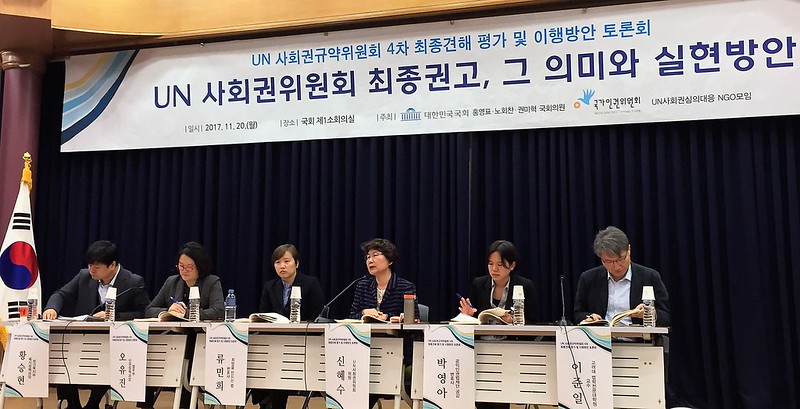
20171120_사진_UN사회권위원회권고토론회

<2017.11.20. UN 사회권위원회 2차 세션에서 참석자들의 발언이 진행 중이다.>


  • 지난 10월 9일, UN 사회권위원회는 한국 정부에 대한 심의 이후 4차 최종권고를 내렸다. 이번 4차 최종권고는 지난 2009년 이후 8년 만에 내려진 것으로, 한국 사회의 사회권 현황을 점검하고 그 개선방안을 구체적으로 제시했다는 것에서 큰 의미가 있다. 이에 UN 사회권위원회의 심의 과정에 참여한 국가인권위원회와 NGO들이 사회권위원회 심사와 최종권고의 의미를 공유하고, 핵심 권고를 중심으로 각 정부 부처의 이행계획와 실현방안을 확인하는 자리를 마련하고자 국회 토론회를 개최하였다.

  • 토론회는 이성호 국가인권위원회 위원장, 홍영표, 노회찬, 권미혁 의원의 인사말(1부)로 시작하였다. 2부에서는 김남희 참여연대 복지조세팀장이 4차 사회권 심의 관련한 한국 NGO의 활동을 소개하며 최종권고 이행과 관련한 한국 정부(행정부, 입법부, 사법부)의 적극적인 노력을 촉구하였으며, 이동우 국가인권위원회 사무관이 국가인권위원회의 활동을 소개하였다.

  • 3부는 신혜수 UN사회권위원회 위원의 사회로 진행되었으며 류민희 희망을만드는법 변호사가 ‘포괄적 차별금지 제정 및 성소수자 인권 개선 방안’을 주제로 발표하였다. 비범죄화, 사회복지권이 혼인을 중심으로 되어 있어 동성커플에게 차별적인 점을 개선해야 한다는 점, 성소수자의 정신건강 문제 등을 지적하였으며, 사회권이 차별없는 보편적 권리로 작동하고 있는지를 점검해야 한다고 주장하였다. 이어 발제를 맡은 박영아 공감 변호사는 세모녀 사건과 같이 한국 열악한 사회보장권의 현실을 보여주는 실제 사례를 설명하고 최종권고를 구체적으로 설명하면서 정부에 대하여 부양의무자기준 폐지를 위한 구체적 로드맵, 의료급여 사각지대, 외국인의 사회권 문제, 홈리스 탈출을 위한 장기적 대책, 사회권 이행에 관한 인권지표 개발 및 적용 계획 등 관련 정책에 대한 질의를 하였다.
    토론을 맡은 이준일 교수는 헌법 제11조의 평등권이 법앞의 평등을 넘어 실질적 평등을 추구해야 한다는 내용으로 개헌 과정에 반영되어야 한다고 지적하였으며, 차별금지 관련 혐오표현(hate speech) 문제도 제기하였다. 또한 사회권의 최우선 보장 주체는 경제적 약자임을 강조하며 개헌 과정에서 사회권의 체계화와 추가가 필요하고 한국 헌법재판소가 사회권을 권리로서 인정하지 않는 문제를 지적하였다. 오유진 법무부 국제인권과장은 국제인권기구에서 주제별로 권고가 나오고 있어서, 정부가 기능 중심으로 편재되어 있어 이행확인이 어렵다고 하였으며, 차별금지법을 어떻게 다시 추진할 것에 대하여 논의를 하며 방안을 모색하겠다고 하였다. 황승현 보건복지부 복지정책과장은 문재인 케어 등 보장성 확대 방안, 치매국가책임제, 아동수당 신설, 기초노령연금 인상, 부양의무자 단계적 폐지 등이 계속 발표가 되고 진행 중이라고 하며 최종권고와 맥락을 같이 하고 있다고 하였다. 또한 정부 정책의 방향성을 소득주도 성장, 사람중심 성장으로 포용적 복지로 잡고 있으며, 사회보장권을 실질적 권리로 실현하기 위한 노력을 하고 있다고 하였다. 예산확보의 문제와 사각지대 해소 및 권리성 보장 사이의 균형 문제에 대해도 얘기하였다.

  • 4부는 조영선 국가인권위원회 사무총장의 사회로 진행되었다. 발제를 맡은 류미경 민주노총 국제국장은 한국에서 노조할 권리가 일상적으로 침해되고 있다는 점을 지적하고 200만 명이 넘는 특수고용노동자 등 모든 사람이 누려야 할 노조할 권리가 보장되지 않은 점을 강력하게 전달하였다. 기업이 비용을 줄이기 위해 비정규직 고용 등을 늘려온 상황을 지적하면서 기업이 어떻게 이에 대하여 책임을 지게 할 것인지 법 개정이 필요하다는 점을 강조하였다. 또한 노동권 앞에 중립은 없으며, 정부는 모든 사람이 누려야 할 노동권을 누리기 위해 적극적으로 역할을 해야 한다는 점을 지적하였다. 다음 발제를 맡은 나현필 국제민주연대 사무국장은 한국 정부가 노동자가 아니라 기업을 보호하는 태도를 가지고 있다는 점을 지적하면서, 인도네시아에서 한국 기업이 노동자 몰래 폐업을 하고 사라지는 사례, 방글라데시에서 라나 플라자 공장 붕괴 참사 이후 공장의 안전기준을 통과하지 못하면 EU에 수출하지 못하는 규제가 발생하였으나 한국 기업들이 이에 적응하지 못하는 상황 등 국제 사회에서 한국 기업의 인권 문제가 중요하게 부각된다는 점을 설명하였다. 또한 UN사회권위원회 최종 권고의 핵심 권고와 같이 정부가 기업의 인권 이행 상황에 대하여 개입을 해야한다는 의무가 국제적으로도 인정되고 있으며, 한국 정부도 시급하게 대응해야 할 상황이라는 점을 지적하였다.
    토론을 맡은 강성태 교수는 한국 정부가 규범적 판단보다는 애국적 판단, 특히 단기적인 이익에 집착하여 왔다는 점을 지적하였으며, 김지은 고용노동부 사무관은 ILO 핵심협약 내용 이행 등 향후 노력하겠다고 답변하였다.

 <UN 사회권위원회 최종권고, 그 의미와 실현방안> 토론회 자료집 (링크)


토론회 개요

-일정 : 2017. 11. 20(월). 09:30-13:00

-장소 : 국회 제1소회의실

-주최: 국가인권위원회, 홍영표(더불어민주당, 환경노동위원회), 노회찬(정의당, 법제사법위원회), 권미혁(더불어민주당, 보건복지위원회) 국회의원, UN사회권심의대응 NGO모임


토론회 순서

<개회식>

-인사말: 홍영표, 노회찬, 권미혁 의원, 이성호 국가인권위원회 위원장

-축사: 참석의원 및 주요인사


<세션1. UN 사회권 규약 제4차 최종견해에 대한 평가>

-좌장: 이경숙 국가인권위원회 상임위원

-발표1: UN 사회권 심의 NGO 대응활동 소개 | 김남희 참여연대 복지조세팀장

-발표2: UN 사회권위원회 제4차 최종견해 분석 및 향후 과제_국가인권위의 대응을 중심으로 | 이동우 국가인권위원회 국제인권과 사무관


<세션2. 포괄적 차별금지법 제정과 사회보장권 개선 방안>

-좌장: 신혜수 UN 사회권위원회 위원

-발표1: 포괄적 차별금지 및 성소수자 인권 개선 방안 | 류민희 희망을만드는법 변호사

-발표2: 사회보장권 개선방안 | 박영아 공익인권법재단 공감 변호사

-토론: 이준일 고려대 법학전문대학원 교수 | 법무부 인권정책과장 | 보건복지부 복지정책과장


<세션3. 노동권 보장 및 기업의 인권이행의무 실행방안>

-좌장: 조영선 국가인권위원회 사무총장

-발표1: 노동권 보장 방안 | 류미경 민주노총 국제국장

-발표2: 기업의 인권이행의무 강화 방안 | 나현필 국제민주연대 사무국장

-토론: 강성태 한양대 법학전문대학원 교수 | 고용노동부 국제협력담당관

월, 2017/11/20- 16:37
170
0