주요 콘텐츠로 건너뛰기

NGO Oral Statement to the UN Human Rights Committee

지역

NGO Oral Statement to the UN Human Rights Committee

익명 (미확인) | 월, 2015/10/19- 08:46

115th Session of the Human Rights Committee
19 October 2015 – 6 November 2015


NGO Briefing on the Republic of Korea


Oral Statement Delivered by Ms. Gayoon Baek(People’s Solidarity for Participatory Democracy) and Mr. Youngsoug Chang(MINBYUN-Lawyers for a Democratic Society) 
on Behalf of South Korean Human Rights Organizations Network (83 NGOs)


We are presenting this statement on behalf of 83 civil society organizations in the Republic of Korea who jointly submitted the report to the Committee. All the rights mentioned in the Covenants are our areas of focus.


Human rights were once a pride for Koreans. But today, we are grieved to present the report with shame. Civil and political rights in the Republic of Korea have been drastically deteriorating year after year. We fear that the Republic of Korea is reverting to the dark era of authoritarian regime that we believed to have overcome. One can easily find human rights defenders in the Republic of Korea, on the streets, on top of factory chimneys, in front of the court, and in prison. Sewol ferry victims’ families have been living on the streets to protest for more than a year, workers have been on a hunger strike for more than 45 days, and villagers have been protesting against the naval base construction for more than 9 years.  As we speak today, hundreds of high school students are protesting on the streets opposing the Government’s plan to impose state history textbooks, which is suspected to idealize past military dictatorship. The Government has failed to protect people’s civil and political rights and people are compelled to run to the streets with candles. 


Although rule of law, freedom of expression and independence of judiciary are guaranteed in the Constitution, the laws have been used as tools to justify restriction and suppression of human rights and people have lost their freedom after expressing their views. The judiciary no longer defends human rights defenders, and is no longer a safeguard for human rights victims. The National Human Rights Commission of Korea also cannot play an active role in monitoring implementation of the Covenant and we have a serious concern that transparent and independent selection process of the Commissioners are not yet guaranteed which brings doubts on human rights competency and expertise of commissioners. 


The number of people who have been charged and indicted for violating the National Security Act, which the Committee and other UN human rights mechanisms have repeatedly recommended to amend or repeal, has increased threefold in 2013 compared to 2008. Government officials and agencies consistently punish people for defamation  or insult  who criticize the Government, sometimes even those who state facts or simply express feelings or opinions. On the other hand, human rights defenders and social minorities become targets of incitement to discrimination, hostility or violence. However, there is no legal framework nor gestures from the Government showing any political will to protect them. The society is now at a critical juncture. 


People who gather to peacefully protest against Government policies or development projects are being arrested, detained and indicted. The police use excessive force against barehanded protesters to suppress assemblies, such as water cannons loaded with capsaicin and tear gas liquid and bus barricades to block assemblies. Even human rights lawyers and journalists have been arrested during protests. Around 550 people including family members of the victims were arrested during the Sewol ferry related protests from April 2014 to May 2015. We are not allowed to stand in solidarity with our friends, not to mention participating in assemblies. One worker who visited labor strike sites to deliver support statements has been punished for aid and abetment of Obstruction of Business. 


The Republic of Korea has the highest Internet penetration rate and the fastest wireless broadband in the world. With this technology, the Government is watching and intervening in people’s private lives. The police can identify those who are at protests by seizing and analyzing all phone call histories from the nearby base stations. Phone or internet users’ personal information can be seized without warrants, and such seizure is significantly increasing, amounting to about 13 million accounts in 2014 in a country with just 50 million people. Children under 19 years old must use mobile phones equipped with applications enabling the parents and service providers to monitor and remotely control their phones. 


We are also subject to human rights violations under the name of counter-terrorism. All currently pending counter-terrorism bills grant excessive authority to the National Intelligence Service (NIS) which is notorious for its abuse of power and human rights violations. The NIS systematically intervened in the 2012 Presidential Election by posting and tweeting 786,000 online messages. Also, the NIS was found fabricating evidence of an espionage case.   


In face of gross violation of civil and political rights in the country, people cannot gain full access to justice and are unfairly treated during investigations. Only 0.2% of investigators are indicted of maltreating the accused.  Even though lawyer’s participation is crucial to prevent such harassment, the police and prosecutor’s office arbitrarily interpret the Criminal Procedural Act to minimize lawyers’ participation. Generally, lawyers are limited in presenting their views during the interrogation and sometimes, lawyers are even threatened by the investigators.   

The human rights situation in detention centers is also problematic. The disciplinary punishment committees of prisons are not guaranteed of their independence and fairness, as the prison warden appoints members of the committee. Almost 90% of the actual punishment in the prison has been executed in the form of solitary confinement, which is the most severe disciplinary measure. 


In particular, children, transgenders and foreigners in detention centers are facing more serious human rights violations. Children are denied protective measures under relevant regulations in the criminal procedures. Moreover, detention centers have no guidelines on the treatment of transgenders.  Because of this, transgender inmates are denied underwear of their own choice and there was a case where a transgender inmate was punished for refusing to get a haircut.  Furthermore, foreigners detained in detention centers may be subject to indefinite detention due to lack of legal regulation on maximum detention periods. In the event the Minister of Justice commenced detention that is not subject to independent judicial review, the detainees are prevented from disputing the legality of the detention. The deportation rooms at Incheon International Airport practically function as detention centers since detainees are restrained from outside contact and denied access to attorney.


Recently in 2014, the existence of the DPRK Defector Protection Center (former Central Joint Interrogation Center) was widely known by testimony of one detainee. When DPRK defectors come to the Republic of Korea, they are sent to the center for interrogation, but nobody knows what exactly is happening inside. We do not know how many DPRK defectors are being detained for how long, and whether they are being deported or not. Access to the center is strictly regulated by the NIS. Also, there are some DPRK defectors in the Republic of Korea who wish to go back to the DPRK, but their return is not allowed by the Government on grounds of violations of the National Security Act.  


The military, where all Korean men are mandated to serve, is another blind spot for human rights violations. Almost 3,600 human rights violations such as assault and other cruel acts have been reported in the last five years, but only 1.4% of perpetrators were sentenced to imprisonment. The Military Court, which deals with assault and cruel acts in the military, is not independent because commissioned officers and commanders, who are not judges, exercise judicial power. Soldiers may be detained for up to 15 days in military prison as disciplinary action without a warrant and judicial scrutiny. The decision for detainment is not even made by the military court, but only by military superiors. 


When a country’s human rights situation regresses, marginalized groups become even more marginalized. Women, persons with disabilities, LGBTIs and people with HIV/AIDS, and children continue to be discriminated against. Since the last review in 2006, the gender wage gap still remains the highest among OECD countries and more than half of female workers are non-regular workers. The right to equal recognition before the law of persons with disabilities’ continues to be greatly affected.


We have two LGBTI friends in this room. They experience discrimination on a daily basis. They are discriminated against when they go to the police to report their annual pride parade, when they become victims of rape, when they want to enjoy same rights as heterosexual couples, and even when they want to set up an NGO to advocate their own rights. They are even punished under sodomy provisions in the Military Criminal Act. Persons with HIV/AIDS are suffering from stigma and discrimination when they receive medical services. The Government is turning a blind eye to this injustice and homophobic/transphobic groups who incite hatred against LGBTIs and persons with HIV/AIDS, and do not show any political will to legislate a comprehensive Anti-Discrimination Act. 


Even though UN human rights mechanisms such as the Committee on the Rights of the Child has repeatedly recommended to the Government to abolish corporal punishment, it is still prevalent in schools and at homes. Examples of these punishments include staying down in push-up position for hours, repeatedly sitting up and down 100 times, or raising one’s arms above the head for one hour. These severe punishments can be explained in line with widespread military culture in the society. 


Finally, the rapid economic growth of the Republic of Korea has expanded the geographical boundaries of human rights violations. Many companies from the Republic of Korea are responsible for forced labour in Uzbekistan and violation of indigenous people’s rights in India. However, the Government does not provide legal framework for the implementation of extra-territorial obligations under the Covenant. Narrow definitions of human trafficking in the Criminal Act limit protection of victims, as seen in the incident of abuse of disabled men and homeless in the salt farm, sexual exploitation of foreign women, and exploitation of migrant farm workers.  


As is clear from our presentation, the Government of the Republic of Korea does not comply with the Covenant and does not fulfill its commitment as a member of the Human Rights Council. We do not wish to go back to the time when we could not speak out freely. To bring people on the streets back to their normal lives, we hope our areas of concerns will be reflected in the Committee's concluding observations. 


We thank you. 


Concluding Remarks by the Chairperson of the Human Rights Committee Fabián Omar Salvioli


Obviously a great number of issues have been raised, and I’m not going to give you an exhaustive list, but I’d like to highlight that we’d like to see the withdrawal of the reservation of art. 22, just as we’ve seen the withdrawal of reservation under art. 15; because we don’t really see from the dialogue why you need to maintain the reservation. Now your Excellency said that you are going to give the highest priority to the HRCttee’s observations and comments. So we very much hope that you will do this through effective mechanism in order to be able to comply with our recommendations and the provisions of the optional protocol, particularly when it comes to conscientious objection. Here the Committee has a very clear stance on this issue. And for me, I’ve had trouble hearing conscientious objectors described as criminals when really they are exercising a right. So, we very much hope that you will be able to comply with the provisions of the Covenant in this area, and also to ensure that the human rights provisions are aligned with the principles. And when it comes to the operations of Korean businesses abroad, want to ensure that they comply with human rights. Mr. Iwasawa raised the issue of equality and nondiscrimination when it comes to various groups of people, particularly LGBTI population. Counter-terrorism measures must also effectively comply with the provisions enshrined in the Covenant as Mr. Shany articulated in his concern. Regarding torture and mistreatment, this is another issue of concern, the use of certain protective measures sometimes as a form of punishment is not compatible with the Covenant. Obviously the right to integrity is crucial. Legal aid, access to lawyer, I would refer you to our General Comment 32 which provides very helpful guidelines for the state to be able to bear in mind the need for the exercise of defense. 


Freedom of assembly and freedom of expression are crucial in a democratic society. We have had difficulties during this dialogue to ensure that this issue is fully understood. We very much hope that after this dialogue you will take legislative measures and other measures necessary to ensure that these rights are fully given effect to. Finally, groups that are particularly vulnerable that require attention, like those living with HIV, and the need not to stigmatize these individuals based on the various measures my colleagues referred to. And of course the migration population, due to their various situations, needs more protection in general in order to ensure that their human rights are guaranteed and upheld. I’d like to thank you all very much.

시민들의 의견

댓글 달기

Plain text

  • 웹 페이지 주소 및 이메일 주소는 자동으로 링크로 전환됩니다.
  • 줄과 단락은 자동으로 분리됩니다.
  • 사용할 수 있는 HTML 태그: <a href hreflang> <em> <strong> <cite> <blockquote cite> <code> <ul type> <ol start type> <li> <dl> <dt> <dd>
이미지
무제한 수의 파일을 이 필드에 업로드할 수 있습니다.
50 MB 한계입니다.
허용된 유형: png gif jpg jpeg.
Enter the YouTube URL. Valid URL formats include: http://www.youtube.com/watch?v=1SqBdS0XkV4 and http://youtu.be/1SqBdS0XkV4.
CAPTCHA
스펨 사용자 차단 질문

© MONUSCO/Sylvain Liechti


안토니오 구테헤스(António Guterres) 유엔 신임 사무총장이 성착취 및 성폭력 예방 특별조치에 관한 연례보고서를 지난 9일 발표했다.

그동안 평화유지군을 비롯한 유엔 관계자들의 공공연한 성폭력이 유엔 전체의 평판을 깍아내리고 있었다. 국제앰네스티는 조사를 통해 유엔에서 성폭력을 처벌하지 않는 관행이 성폭력을 더욱 부추기는 핵심적인 문제임을 확신하게 됐다. 성폭력 형사용의자로 지목된 유엔 평화유지군과 관계자들 중 실제로 형사기소되는 상황까지 이른 사람은 거의 없었다.

국제앰네스티 조안 마리너(Joanne Mariner) 국제앰네스티 위기대응 상임고문은 이와 관련해 다음과 같이 말했다.

유엔의 폐해를 인식하고 대대적인 개혁을 실시하려는 신임 사무총장의 노력을 환영한다

-조안 마리너(Joanne Mariner), 국제앰네스티 위기대응 상임고문

이어 “유엔 신임 사무총장은 자국군의 성폭력 의혹을 빠른 시일 내에 조사하지 못한 국가는 지원금을 삭감하고, 대신 피해 생존자를 후원하는 신탁기금에 투자하겠다고 제안했다. 이 제안은 실망스러운 현재 상황에서 매우 고무적이다. 국제앰네스티는 유엔 총회에 이 제안을 지지하고, 회원국에 시행토록 권고할 것을 촉구한다.”

국제앰네스티는 게테레스 사무총장의 성폭력 대책을 긍정적으로 평가한다. 대책 내용은 다음과 같은 내용을 골자로 한다. ▲성폭력 피해자 자력화를 위한 새로운 방향성을 제시 ▲유엔 인사 심사 강화 ▲피해자 인권 보호를 전담하는 부서 마련 ▲성폭력 및 성착취 예방을 위한 ‘특별 의정서’ 수립 ▲유엔의 성폭력 및 성착취 대응책 개선에 관한 특별 조정관 확대 ▲각국 정상들로 구성된 ‘리더십 서클’ 마련 ▲폭력 예방을 위한 시민사회 대표자와 전문가로 구성된 특별자문위원회 창설 등이다.

그럼에도 이 제안은 유엔 회원국에 압력이 되기엔 충분하지 않다는 점이 아쉬움으로 남는다.

마리너 상임고문은 “이처럼 광범위한 개혁안이 필요한 자원과 정치적 의지를 바탕으로 진일보하는 데 유엔 및 회원국들과 협력하기를 기대한다”고 밝혔다.

월, 2017/03/20- 17:00
228
0

11 January 2016


United Nations Secretary General Ban Ki-moon
UN Headquarters
405 East 42nd Street
New York, NY 10017
USA    


Cc : Zainab Hawa Bangura, UN Special Representative on Sexual Violence in Conflict
Zeid Ra’ad Al Hussein, UN High Commissioner for Human Rights
Rashida Manjoo, UN Special Rapporteur on Violence against Women
Pablo de Greiff, UN Special Rapporteur on the Promotion of Truth, Justice, Reparation, and Guarantees of Non-recurrence
H.E. Choi Kyong-lim, President of the UN Human Rights Council
Members of the UN Committee against Torture
Members of the UN Human Rights Committee 
    

Re: Clarification on the UN Secretary-General’s Position on the Recent Republic of Korea-Japan Agreement on Wartime “Comfort Women”


People's Solidarity for Participatory Democracy (PSPD) is a non-governmental organization based in Seoul, the Republic of Korea (ROK) with United Nations(UN) ECOSOC consultative status. We are writing to you today to seek clarification of the Secretary-General's position on the recent ROK-Japan agreement on wartime “comfort women”. We express our concern on your recent congratulatory remarks on the agreement, because we view that the agreement was not made in a way to implement the values and principles put forth by the UN, which has emphasized a victim-centered approach.


In the official statement regarding the recent agreement between the ROK and Japan on issues related to “comfort women” from the ROK which was released on 28 December 2015, you welcomed “that the Governments of Japan and the Republic of Korea have reached an agreement,” and hoped “that the agreement will contribute to improving the bilateral relationship between the two countries.” Following your statement, the ROK President’s Office (Blue House) released a briefing on 1 January 2016, saying that you congratulated President Park Geun-hye, via telephone, on reaching the agreement with Japan, and stated that “history will laud President Park’s courageous decision based on her vision.”   


Yet, the latest agreement between the ROK and Japan hardly reflects the wishes of the victims themselves, nor did the process involve any participation by the victims. Lee Yong-soo, one of the few surviving victims of Japan’s wartime sexual slavery policy, harshly criticized the agreement, saying “The agreement does not reflect the views of former ’comfort women’. I will ignore it completely.”  Ms. Lee condemned the deal as amounting to “a second death of the victims.” The latest agreement indeed does not incorporate any of the demands which include official apologies, legal reparations, and guarantees of non-recurrence. The victims have consistently put forward these demands since making their past agony public for the first time in 1991. According to the recent agreement, the Japanese government did promise to provide JPY 1 billion (around 8.3 million USD) for a new special fund to be set up for a foundation for the surviving “comfort women”. However, Mr. Fumio Kishida, Japanese Minister of Foreign Affairs, made it clear that the money was not legal reparation , and still refuses to recognize Japan’s legal responsibility for wartime sexual slavery. However, the governments of both countries have concluded that the latest agreement will be the “final and irreversible” resolution to the “comfort women” issues, thus inviting mounting criticism from inside and outside the ROK.


We would like to remind you that the latest agreement on “comfort women” does not even satisfy the UN recommendations regarding Japan’s wartime sexual slavery and related issues which were made in the past. Different human rights mechanisms of the UN have condemned the acts of wartime sexual slavery committed by Japan as “crimes against humanity,” and recommended that the Japanese government acknowledge its legal responsibility, make formal reparations to the victims, and prosecute the parties responsible for such crimes. During its review on Japan in July 2014, the UN Human Rights Committee noted that most “comfort women” were recruited by, transported to, and managed at Japanese military bases or agencies working on behalf of the Japanese military through force and coercion, and expressed concerns at the Japanese government’s continued denial that these women were “ever mobilized or migrated by force” (CCPR/C/JPY/CO/6, para 11). In August 2014, the UN Committee on the Elimination of Racial Discrimination expressed its concerns that the Japanese government had not recognized nor apologized to “comfort women”, and urged the Japanese government to immediately conclude investigations and bring to justice those responsible for human rights violations (CERD/C/JPN/CO/7-9, para 18).


We would also like to point out that the UN and the international community at large uphold a consistent set of victim-centered principles and standards with respect to the rights of victims of human rights violations.


In February 2005, the UN Commission on Human Rights (now the UN Human Rights Council) adopted “Principles for the protection and promotion of human rights through action to combat impunity” (E/CN.4/2005/102/Add.1), followed by “Basic Principles and Guidelines on the Right to a Remedy and Reparation for Victims of Gross Violations of International Human Rights Law and Serious Violations of International Humanitarian Law” (A/60/509/Add.1) adopted by the UN General Assembly in December 2005. These two documents endorse the “victim-centered perspective” in international human rights law, and emphasize the victims’ right to justice, right to reparation, and right to know. These documents also stress as essential principles the need to give victims restitution, compensation, rehabilitation, reparation, and redress.


Since its establishment in 2002, the International Criminal Court has also stressed the need for victim participation in all phases of investigation and judicial procedures. “The Chicago Principles on Post-Conflict Justice 2001-2008”, which provide basic guidelines on the handling of atrocities perpetrated under authoritarian rule and amid armed conflicts, also emphasize: “Policies that seek justice for past violations should be victim-centered and should address victims’ rights to remedies and reparations.”


We note with serious concern that your remarks on "welcoming" the recent agreement between the ROK and Japan, and lauding it as a “courageous decision” by the South Korean President are not in line with the human rights principles and positions the UN and the international community have accumulated so far. 


We would therefore like to request your response to the following questions to further clarify your position. 


1. Do you think that the recent agreement between South Korea and Japan satisfy the UN-emphasized principles of the rights of the victims of human rights violations and properly address war crime legacies and past recommendations made by the UN human rights mechanisms to Japan?


2. According to the briefing issued by the Presidential Blue House of the ROK, you phoned the President of the ROK to discuss the recent agreement. Have you done the same with the Prime Minister of Japan? If so, what exactly was discussed or remarked in the latter conversation? If no such conversation took place with the Prime Minister of Japan, why have you had such a conversation with the President of the ROK and not with the Prime Minister of Japan?


3. The UN Secretary-General is obligated to make efforts to promote human rights in all Member States. Therefore, some argue that the UN Secretary-General should help invalidate the recent agreement between the ROK and Japan that seems to condone war crimes. What do you think of this argument?


4. Is the Secretary-General inclined to urge both the government of the Republic of Korea and Japanese governments to resolve the “comfort women” issues through official apologies, legal reparations, and guarantees of non-recurrence from the Japanese state through processes that are actually based upon victim participation?


We thank you for your reply in advance and look forward to hearing back from you at the earliest possible time. If you have any questions or would like clarification, please do not hesitate to contact us at [email protected] or +82 (0)2 723 4250. 

Yours sincerely,


Ms. Hyunback Jung
Co-Representative
People's Solidarity for Participatory Democracy 


월, 2016/01/11- 10:24
225
0

20대 국회 입법·정책과제 제안 기자회견

2016. 5. 30. 참여연대는 20대 국회의 임기 시작을 맞아 20대 국회에서 우선 다뤄야 할 입법과제 69개와 정책과제 15개를 제안했습니다. ⓒ 참여연대


20대 국회는 달라져야 합니다

20대 국회 입법·정책과제 제안 및 국회 개혁 촉구


참여연대(공동대표 법인·정강자·하태훈)는 20대 국회의 임기가 시작되는 오늘(5/30, 월) 20대 국회에서 우선 다뤄야 할 입법과제 69개와 정책과제 15개를 제안하고 국민에게 열린 국회로의 변화를 촉구하는 기자회견을 개최했습니다. 참여연대는 20대 국회가 413 총선에서 나타난 국민의 뜻에 따라 이명박 정부와 박근혜 정부가 일방적으로 추진한 잘못된 입법을 바로잡고, 실패한 정책과 국가기관의 권한남용 문제에 대해 책임을 물을 것을 촉구했습니다. 


참여연대 국제연대위원회는 원조 투명성과 국제 인권기준의 국내화를 위한 입법·정책과제를 아래와 같이 제안했습니다. 


입법과제. 원조의 투명성 제고 등을 위한 「국제개발협력법」 개정

정책과제. 국제 인권기준의 국내 주류화를 위한 국회 특별위원회 설치


입법과제. 원조의 투명성 제고 등을 위한 「국제개발협력법」 개정


1) 현황과 문제점

  • 국제원조투명성캠페인 조직인 ‘Publish What You Fund’가 최근 발표한 자료에 따르면 한국 무상원조 기관인 한국국제협력단(KOICA)의 원조투명성지수는 전세계 46개 기관 중 41위로 ‘하위’그룹에 속함. 규모가 지속적으로 확대되고 있는 한국의 공적개발원조(ODA)에 대한 투명성 요구는 커지고 있으나 정부의 제도 개선 노력은 미흡한 상황임. 
  • 정부는 지난 2014년 3월, 국제원조투명성이니셔티브(IATI) 가입 방침을 확정하고 2016년 가입한다는 계획을 국제사회에 이를 공표함. 그러나 국무조정실 산하 국제개발협력위원회는 이에 대한 이행계획에서 정보공개를 순차적으로 실시한다는 기본방향을 정하고 IATI 기준 38개 항목 중 13개 필수 항목부터 우선적으로 공개를 추진할 예정임을 밝히고 있음. 그러나 13개 항목에는 기관명, 사업명, 사업현황 및 날짜, 수원국명, 사업대상지역 등 가장 기본적인 정보만이 포함될 뿐, ODA 사업이 효과적이고 체계적으로 집행되는지 확인할 수 있는 사업예산, 집행계획, 사업결과, 구속성(조건부 원조) 현황 등의 정보는 공개대상에서 빠짐. 
  • 또한 한국 정부의 유상원조가 대폭 확대됨에 따라 한국 기업의 협력대상국 진출 및 대규모 건설사업 수주 사례가 증가하고 있음. 대규모 건설사업의 경우 주변지역 환경과 원주민 주거지 및 공동체에 미치는 영향이 지대함에도 피해를 예방하기 위한 인권‧환경 세이프가드 제도는 아직까지 도입되지 않고 있음. 2012년 세이프가드 초안이 마련되었다고 알려졌으나 지금까지 시범사업에 적용‧검토하고 있다는 이유로 공개되지 않고 있음. 

2) 입법과제
① 국제개발협력기본법 개정 

  • 국제개발협력의 투명성을 높이기 위해 유무상원조사업 관련 정보를 국제기준(IATI 정보 공개기준 38개 항목)에 맞춰 공개해야한다는 조항을 추가해야 함. 
  • 국제개발협력기본법 시행령 제13조(정보공개)에서는 △위원회의 심의·조정 결과 중 중요한 사항, △국제개발협력평가 결과, △민간국제개발협력단체 등에 대한 지원에 관한 사항, △그 밖에 국제개발협력에 관한 주요정책 및 통계에 관한 정보를 공개범위로 밝히고 있으나, 공개될 경우 외교관계 등에서 국가의 이익을 해칠 우려가 있다고 인정되는 정보는 공개하지 아니할 수 있다고 밝힘. 국제개발협력기본법 시행령도 국제기준에 맞춰 공개범위를 확대하도록 수정함.(국제개발협력기본법 시행령 제13조) 
  • 유무상원조 사업이행에서 세이프가드 전면 도입 의무화하는 조항을 추가함.

3) 소관 상임위 : 외교통일위원회


정책과제. 국제 인권기준의 국내 주류화를 위한 국회 특별위원회 설치


1) 현황과 문제점

  • 유엔 인권이사회 등 국제인권기구의 권고가 구속력이 없는 만큼 정부가 권고 이행의 의지가 없는 경우 제대로 이행되지 않는 경우가 대부분임. 한국의 경우도 양심적 병역거부자들을 위한 대체복무제 도입, 포괄적 차별금지법 제정, 사형제 폐지 등과 같은 권고를 1990년대부터 꾸준히 받고 있으나 국내 사정과 일치하지 않는다는 이유로 아직까지 이행의 노력조차 보이지 않고 있음. 한국이 가입한 국제인권조약은 헌법 상 국내법으로 인정됨에도 이를 제대로 이행하지 않고 있는 것임. 
  • 한국은 주요 인권 규약 중 시민적·정치적 권리규약, 경제적·사회적·문화적 권리규약, 인종차별철폐협약, 여성차별철폐협약, 고문방지협약, 아동권리협약, 장애인권리협약을 비준했으며 아직 이주노동자권리협약과 강제실종협약은 비준하지 않았음. 
  • 한국은 2016년 유엔 인권이사회 의장국 직을 수행하는 등 국제사회에서 한국 정부에게 거는 기대가 높음. 유엔 차원에서도 유엔 인권이사회 10주년, 사회권, 자유권 규약 50주년을 맞아 국제 인권 기준들과 유엔에서의 권고의 국내 이행을 강조하고 있음. 한국은 4.5년에 한 번씩 국내 인권상황을 주기적으로 검토받는 유엔 국가별 인권상황정기검토 (Universal Periodic Review, UPR) 심의를 2008년과 2012년에 각각 받았으며 다가오는 2017년에 3차 심의가 예정되어 있음. 
  • 최근 한국을 공식 방문하는 유엔 특별절차 담당관이 늘어나고 있으며 이는 한국 인권상황에 대한 국제사회의 우려를 반영하고 있음. 한국은 유엔 특별절차 담당관들의 방한 요청을 언제나 받아들이겠다는 상시 초청(standing invitation)을 선언한 바 있음. 
  • 국제 인권기준의 국내 이행을 위해서는 행정부뿐만 아니라 입법부, 사법부 모두 국제 인권기준에 대한 이해와 이행 의지가 있어야 함. 현재 한국에서는 국가인권위원회가 옴부즈만의 기능을 하고 있지만 행정부를 직접적으로 견제하기 어렵고, 입법 기능이 없다는 한계가 있음. 
  • 따라서 국제 인권기준의 국내 이행을 감시하고 촉진하기 위해 국회의 역할이 요구됨. 실제 영국에서는 상하원 공동으로 꾸려진 인권위원회가 상설위원회로 기능하고 있으며 개인 인권침해를 조사하는 사안을 제외하고 영국 내 인권 관련 이슈들을 검토하는 역할을 가짐. 인권에 대한 내용 관련 국회 차원의 조사, 법안 검토, 인권 관련 법원 판결에 대한 정부 답변 모니터링, 그리고 국제인권기준에 따른 영국 정부의 인권 의무 모니터링 등의 활동을 펼침. 

2) (과제)내용

  • 국제인권기준의 국내 이행은 수많은 상임위원회 소관과 관련되어 있기 때문에 특별위원회를 설치해 행정부처의 전반적인 국제인권법 준수 및 인권권고 이행 여부를 안정적으로 감시할 수 있어야 함. 
  • 해당 특별위원회는 국회에 발의된 법안들이 국제인권기준에 위배되지 않는 것인지를 검토한 후 의견을 제출해야 함. 또한 각 정부부처의 유엔 인권 권고의 이행 상황에 대한 정기 보고서 제출을 요구할 수 있어야 함. 
  • 국회 내 특별인권위원회를 신설하게 되면 국정감사 등을 통해 주기적으로 정부의 국제인권법 준수 및 인권권고 이행 여부를 모니터링 할 수 있고 이에 대한 예산도 배정할 수 있어 국제 인권기준의 국내 주류화를 이루는데 기여할 것임. 

3) 소관 상임위 : 법제사법위원회, 정무위원회, 기획재정위원회, 미래창조과학방송통신위원회, 교육문화체육관광위원회, 외교통일위원회, 국방위원회, 안전행정위원회, 농림축산식품해양수산위원회, 산업통상자원위원회, 보건복지위원회, 환경노동위원회, 국토교통위원회, 정보위원회, 여성가족위원회

월, 2016/05/30- 19:53
216
0

16 October 2015


Urgent Appeal to
- The UN Special Rapporteur in the Field of Cultural Rights


Re: Republic of Korea - Government-issued History Textbook 


Dear Ms. Farida Shaheed,


We are writing to you today to express our grave concerns over the announcement made by the Government of the Republic of Korea on 12 October 2015 that the Government will issue middle school history textbook and high school Korean history textbook from 2017. Currently, there are eight different types of history textbooks and they are examined by the National Institute of Korean History before being published. We note with serious concern that the Government-issued history textbook will result the history being written in a way to idealize the history of military dictatorships and indoctrinate people with a standardized history.  


The current Minister of Education, Hwang Woo-yea, said that “it was an inevitable choice in order to eventually realise national cohesion by ending social disputes based on ideological bias and to correct the history”. However, we are all well aware that it is a misconception that there is only one objective truth concerning history. In 1992, the Constitutional Court of the Republic of Korea also ruled that “in the case of Korean history, it is difficult to confirm that one theory is an absolute truth, and when different interpretations exist with valid background, it is essential to present different views.” Article 31(4) of the Constitution stipulates “Independence, professionalism and political impartiality of education and the autonomy of institutions of higher learning shall be guaranteed under the conditions as prescribed by law.”


The Government-issued history textbook create more confusion and ideological conflicts in a society. Most historians announced that they oppose the Government-issued history book and refuse to be authors of the textbook. As a result, only Government friendly historians will be authors. In response to the Government’s decision, history and social science professors, teachers of elementary school, middle school and high school, politicians, 14 Superintendents of Education out of 17, and civil society organisations officially and heavily criticised the Government’s plan to issue official history textbook. In addition, on 12 October 2015, around 15 university students were arrested by the police while protesting against Government-issued history textbook. 


We would like to draw the special attention of the Special Rapporteur on this issue. As you pointed out in the report presented to the 68th Session of the UN General Assembly in 2013, the accreditation of one single history textbook is problematic and State-sponsored textbook carry the risk of being highly politicized. We would appreciate it if you could strongly remind the Government of the Republic of Korea of the importance of diverse history textbook and urge them to withdraw their decision on the Government-issued history textbook.


If you have any questions or need clarifications, please do not hesitate to contact Ms. Gayoon Baek ([email protected], +82 (0)2 723 4250) at any time. We hope this will help in your work.


Yours Sincerely,


CHUNG Hyun-back
Co-Representative 
People’s Solidarity for Participatory Democracy 


People’s Solidarity for Participatory Democracy (PSPD)
PSPD is a non-governmental organization based in Seoul, South Korea. We were founded in 1994 and has been working on promoting people’s participation in government’s decision making process and socio-economic reforms. PSPD has ECOSOC consultative status since 2004.


금, 2015/10/16- 12:25
215
0

인간다운 생활을 할 권리 보장할 구체적인 개헌안 마련해야


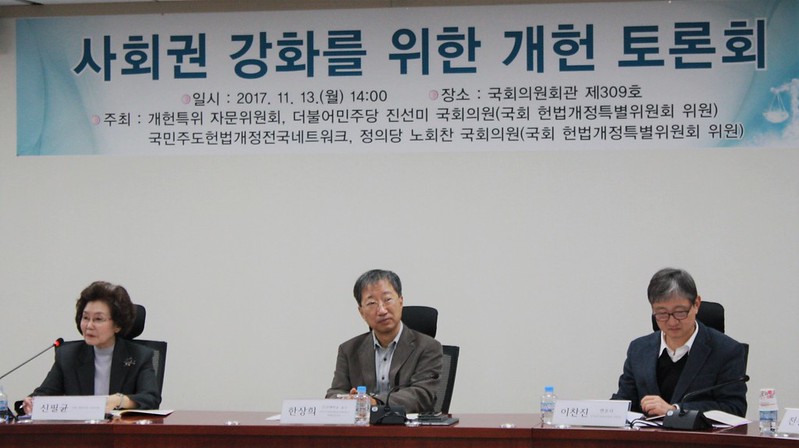
20171113_토론회_사회권강화를위한개헌

<2017.11.13. "사회권 강화를 위한 개헌" 토론회에 참석한 신필균 자문위원, 한상희 교수, 이찬진 변호사 (좌측 순서)>


최근 국회에서 논의하고 있는 개헌 방안에 시민들의 사회적 권리를 강화할 수 있는 구체적인 내용을 마련하기 위해, 국민주도헌법개정네트워크, 국회 헌법개정특별위원회 자문위원회, 더불어민주당 진선미 의원, 정의당 노회찬 의원은 2017년11월13일 오후2시 국회의원회관 제309호에서 <사회권 강화를 위한 개헌> 토론회를 개최했다.


토론회의 첫 발제 순서를 맡은 신필균 국회 헌법개정특별위원회 자문위원은 현행 헌법체계의 사회보장권의 한계를 지적하며, “30년만에 이루어질 헌법 개정안에 시민들이 인간다운 생활을 할 권리와 사회보장을 받을 권리를 구체적으로 명시해야 한다”고 말했다. 또한 신필균 자문위원은 “사회권은 단지 정치적 구호나 입법 방침이 되어선 안 된다”는 점을 강조하며, 개헌의 목표가 “모든 구성원이 인간적 존엄과 가치를 지키면서 건강하고 문화적인 삶을 누릴 수 있는 사회를 만드는 것”이 되어야 한다고 말했다.


두 번째 발제를 맡은 이찬진 참여연대 사회복지위원회 실행위원은 “심각한 수준에 다다른 우리 사회의 양극화와 불평등을 완화하기 위한 실천적 과제가 반드시 개헌안에 담겨야 한다”며, “인간다운 생활을 할 권리를 보장하기 위해 사회보장 예산의 우선 편성권을 정립하고, 주거권, 보건권, 문화향유권 등을 개헌안에 구체적으로 명시해야 한다”고 말했다. 특히 이찬진 실행위원은 청년층에게 가장 심각한 문제로 대두된 주거권을 보장하기 위해 “최저주거기준의 설정 등의 국가의 보장 의무를 명시하고, 다주택 보유 규제 등을 통해 불로소득을 환수하도록 하는 주택공개념을 도입할 필요가 있다”고 강조했다. 또한 이찬진 실행위원은 “사회보장권을 실질적으로 강화하기 위해서는 차별금지와 평등권을 강화해야 한다”며, “인간의 존엄을 보장하고 지속가능한 공동체를 만들기 위한 방향으로 사회권은 다시 정립되어야 한다”고 말했다.


토론자로 나선 이정우 경북대학교 교수는 “개헌 과정의 주요 쟁점인 권력구조 개편뿐만 아니라 사회보장권 강화가 반드시 필요하다”며, “사회보장 예산의 우선권을 확립하고 주택,토지에 대한 공개념을 도입해야 한다”라고 말했다. 한편, 전광석 연세대학교 교수는 “헌법재판소가 사회적 약자의 사회권을 적극적으로 보장할 수 있도록 헌법 조문을 개정해야 한다”며, 그 중에서도 “가장 시급한 빈곤 문제를 해결하기 위한 최저 생활을 보장하기 위한 조항을 강화해야 한다”고 말했다. 또한 김지혜 강릉원주대학교 교수는 “영토 내에서 공동의 생활을 영위하는 모든 ‘사람’에게 사회보장권, 주거권, 건강권, 문화향유권을 보장해야 한다”고 강조했고, “식량에 대한 권리도 건강권 또는 안전권의 일부로 정의해 모든 사람의 기본권으로 보장할 필요가 있다”고 말했다. 마지막으로 장지연 한국노동연구원 연구위원은 “헌법이 사회 구성원들의 정체성과 눈높이에 맞는 권리로 작용할 수 있게 해야 한다”며, “사회보장기본법 등이 정의한 구체적 권리를 누락하지 않아야 하며 개인의 권리를 보장하기 위한 국가의 의무를 명시해야 한다”고 말했다. 좌장을 맡은 한상희 건국대학교 교수는 토론회를 맺으며, “자유권을 보장하기 위한 구체적인 헌법 조항처럼, 사회권을 보장하기 위한 조항 역시 개헌안에 구체적으로 담을 필요가 있다.”라고 말했다.


올해 10월 UN 사회권위원회가 발표한 한국 정부 심의의 최종 권고에 따르면, 한국의 개헌 과정에서 헌법 조문에 사회권 규약에 보장된 사회권을 반영하라는 내용이 포함되어 있다. 국회 헌법개정특별위원회에서도 기본권 실현을 위한 개헌안을 준비하고 있지만, 사회권 보장과 관련한 내용은 미흡하다. 이번 토론회를 계기로, 국회 헌법개정특별위원회는 시민들의 사회권을 강화하기 위한 구체적인 개헌안을 마련해야 한다. 끝.


▶ <사회권 강화를 위한 개헌> 토론회 자료집 [원문보기/다운로드]

▶ 보도자료 [원문보기/다운로드]


SW20171113_웹자보_사회권실현토론회2.png


▶ 토론회 개요

  • 제목: 사회권 강화를 위한 개헌
  • 일시 장소 : 2017. 11. 13. (월) 14:00 / 국회의원회관 제309호
  • 주최 : 국민주도헌법개정네트워크, 국회 헌법개정특별위원회 자문위원회, 더불어민주당 진선미 국회의원(개헌특위), 정의당 노회찬 국회의원(개헌특위)
  • 참가자
    • 사회 : 한상희_건국대학교 교수, 국민주도헌법개정전국네트워크 정책자문단장
    • 발제1: 개헌특위에서 사회권 보장을 위한 제안_ 신필균 국회 개헌특위 자문위원
    • 발제2: UN 사회권 규약을 반영한 사회권 강화 개헌방안_이찬진 변호사, 참여연대 사회복지위원회 실행위원
    • 토론1: 이정우_경북대학교 교수
    • 토론2: 전광석_연세대학교 교수
    • 토론3: 김지혜_강릉원주대학교 교수
    • 토론4: 장지연_한국노동연구원 연구위원
월, 2017/11/13- 15:15
215
0