주요 콘텐츠로 건너뛰기

[Joint Statement] Reopen Kaesong Industrial Complex Immediately

지역

[Joint Statement] Reopen Kaesong Industrial Complex Immediately

익명 (미확인) | 목, 2016/02/11- 19:55

South Korea: Reopen Kaesong Industrial Complex Immediately


(Seoul, 11 February 2016) On 10 February 2016, the South Korean government announced the closure of Kaesong Industrial Complex, citing North Korea’s 4th nuclear test and launching of a long-range rocket as reasons. However, South Korean civil society organisations emphasise that closure of Kaesong Industrial Complex is an absolutely improper measure. We call on the South Korean government to immediately reopen Kaesong Industrial Complex. It is not a time to immediately end relations with North Korea. Instead, we must find wise solutions to escape this cold period. 


We note with concern that the closure of Kaesong Industrial Complex goes completely against the 2013 agreement between the two Koreas in which they each committed to continue operations at Kaesong Industrial Complex regardless of the political situation. This recent unilateral decision by the South Korean government is also a violation of the Economic Partnership Agreement between the two countries, which is a de facto international treaty. 


The South Korean government argues that approximately 120 billion KRW (around 120 million USD) in wages paid to workers at Kaesong Industrial Complex has been used in development of nuclear weapons and missiles. This accusation has no grounds because most wages paid to North Korean workers are in the form of social and cultural policy funds and gift cards. 


We deplore the South Korean government actions, which ignore the lives of the North Korean workers and difficulties faced by South Korean companies, around 120 of whom face bankruptcy as a result of the closure. While the South Korean government is discussing an alternative site for a factory and financial support, nothing can replace Kaesong Industrial Complex to companies. At the same time, the approximately 54,000 North Korean workers and their families are now at the edge of a precipice. They are not at all related to North Korea’s nuclear testing or long-range rocket launch. 


It is obvious that additional sanctions will not resolve North Korea’s nuclear ambitions, as the past 20 years of sanctions against it have not been successful. It is clear that establishing a peace system and denuclearisation is the only effective solution, not simply repeating already-failed policies of sanctions. The South Korean government must reopen Kaesong Industrial Complex immediately.  /END/


Endorsed by below 69 civil society organisations and networks: 
Busan Counseling Center Against Sexual Violence, Busan Women's Association United, Cheonan Women's Association, Chungbuk Civil Society Organizations Network in Korea, Chungnam Civil Society Organizations Network in Korea, Citizens Coalition for Democratic Media, Civil Peace Forum, Civil Society Organizations Network in Korea, Cultural Action, Daegu Citizens Union for Peaceful Reunification, Daegu Gyeongbuk Women's Association United, Daegu Women's Association, Daejeon Civil Society Organizations Network in Korea, Daejeon Women's Association for Democracy, Daejeon Women's Association United, Eco Horizon Institute, Eco Justice, Goyang Peace Nuri, Green Korea United, Green Transport Movement, Gwangju Jeonnam Women's Association United, Gyeonggi Civil Society Organizations Network in Korea, Gyeonggi Women's Association United, Gyeongnam Civil Society Organizations Network in Korea, Gyeongnam Women's Association, Gyeongnam Women's Association United, Housewives Association, Jeju Women's Association, Jeju Women's Human Rights Solidairty, Jeonbuk Civil Society Organizations Network in Korea, Jeonbuk Women's Association United, Jeonnam Civil Society Organizations Network in Korea, Korea Association of Christian Women for Women Minjung, Korea Sexual Violence Relief Center, Korea Single Parent United, Korea Women's Hot Line, Korea Women's Political Solidarity, Korea Women's Studies Institute, Korea YMCA, Korea Youth Corps, Korean Association of Women Theologians, Korean Catholic Women's Community for a New World, Korean Differently Abled Women United, Korean Federation for Environmental Movement, Korean Sharing Movement, Korean Women Workers Association, Korean Women's Association United, Korean Women's Environmental Network, National Solidarity for Solving Prostitution Issues, Network for Gender Sensitive Budget, Peace Ground, Peace Network, Peace3000, People's Solidarity for Participatory Democracy, Pohang Women's Association, Pusan Women Education Center, Research Institute of the Differently Abled Person's Rights in Korea, Reunification Tree, Saewoomtuh, Suwon Women's Association, The National Association of Parents for Cham Education, Tongilmaji, Transparency International Korea, Ulsan Women's Association, Women Education Center, Women Making Peace, Women Migrants Human Rights Center of Korea, WomenLink, Young Korean Academy
 

시민들의 의견

댓글 달기

Plain text

  • 웹 페이지 주소 및 이메일 주소는 자동으로 링크로 전환됩니다.
  • 줄과 단락은 자동으로 분리됩니다.
  • 사용할 수 있는 HTML 태그: <a href hreflang> <em> <strong> <cite> <blockquote cite> <code> <ul type> <ol start type> <li> <dl> <dt> <dd>
이미지
무제한 수의 파일을 이 필드에 업로드할 수 있습니다.
50 MB 한계입니다.
허용된 유형: png gif jpg jpeg.
Enter the YouTube URL. Valid URL formats include: http://www.youtube.com/watch?v=1SqBdS0XkV4 and http://youtu.be/1SqBdS0XkV4.
CAPTCHA
스펨 사용자 차단 질문

Launch of GPPAC Publication

Reflections on Peace and Security in Northeast Asia

– Perspectives on the Ulaanbaatar Process


The publication Reflections on Peace and Security in Northeast Asia - Perspectives on the Ulaanbaatar Process was launched in Ulaanbaatar, Mongolia on August 29, on the occasion of the third meeting of the Ulaanbaatar Process, a civil society-led dialogue for peace and stability in Northeast Asia. The publication is a collection of essays which capture the diverse and uncompromised opinions, concerns, tensions and contradictions of a region in turmoil at the time of the 3rd Ulaanbaatar Process Meeting held on August 29–30, 2017.


Articles of the printed publication are made available online at https://medium.com/reflections-on-peace-and-security-in-northeast. Please visit this site. 


Reflections on Peace and Security in Northeast Asia - Perspectives on the Ulaanbaatar Process explores the contentious issue of nuclear weapons in the region, the current security climate on the Korean Peninsula which is frozen in a fragile armistice, as well the successes and challenges faced by non-governmental organizations in the context of peacebuilding in Northeast Asia. It features articles by the participants of the Ulaanbaatar Process; representatives of civil society from China, Japan, the Democratic People's Republic of Korea, the Republic of Korea, the United States of America, the Russian Federation as well as Mongolia.


The Ulaanbaatar Process, launched by the Global Partnership for the Prevention of Armed Conflict (GPPAC) in June, 2015, aims to support the creation of conditions of peace and stability in Northeast Asia through the promotion of greater civil society dialogue and interaction. It is hosted by Mongolian NGO Blue Banner in cooperation with GPPAC Northeast Asia, and with the support of the Mongolian Ministry of Foreign Affairs.


The third Ulaanbaatar Process meeting provided an opportunity for sincere and open civil society dialogue on the current peace and security situation in Northeast Asia, and particularly the crisis on the Korean Peninsula. The previous two meetings, similarly held in Ulaanbaatar, also saw the participation of civil society representatives of all the Six Party Talks countries and Mongolia. 


For more information about the Ulaanbaatar Process, please visit the GPPAC Northeast Asia as well as Facebook page  https://www.peaceportal.org/web/ulaanbaatar-process/home

For more information on GPPAC, please visit http://www.gppac.net/.


<Photo from GPPAC NEA, Aug 29-30, 2017>

금, 2017/09/01- 13:33
128
0

We Oppose THAAD System Deployment in South Korea


(Seoul, 16 February 2016) After North Korea conducted its 4th nuclear test and launched a long-range rocket, the governments of South Korea and the US officially announced plans to deploy the Terminal High Altitude Area Defense (THAAD) system in South Korea. We are gravely concerned about the negative impact of this planned deployment in South Korea, and strongly urge both governments to avoid deploying this weapon as it will escalate tension on the Korean Peninsula and in Northeast Asia, and create further problems related to the North Korean nuclear issue. 


The problems we foresee include:


1. Escalation of Military Tension in Northeast Asia 
We note with concern that deployment of THAAD in South Korea will make this nation officially part of the Northeast Asia Missile Defense system, led by the US and Japan. This will inevitably escalate military tension between the US-South Korea-Japan and North Korea-China-Russia and the nuclear arms race in the region.


The US and South Korean governments continue to argue that deployment of the THAAD system in South Korea is a response to the existence of North Korean nuclear weapons and missiles. However, THAAD is not an effective tool to defend against North Korean ballistic missiles targeting South Korea, due to its short range and low peak altitude.


Both governments also insist that China has no need to worry as THAAD radars can be fixed towards North Korea and deployed in terminal mode with low detectable range. However, a multitude of experts contend that it is easy to change terminal mode to forward-based mode, putting most Chinese territory under detectable range, regardless of THAAD’s location in South Korea. 


We believe the main purpose of THAAD in South Korea will be to use the AN/TPY2 radar to identify and trace in the early stages any mid- to long-range ballistic missile from China or North Korea heading to the US mainland or US army bases in Japan or Guam. Based on information provided by the South Korean government to the US and Japan, the rate of interception by the US Missile Defense strategy will increase. 


2. More Difficulty in Resolving Nuclear Issues on the Korean Peninsula 
We emphasize that deployment of the THAAD system in South Korea will make it more difficult to resolve nuclear issues on the peninsula, especially due to the strong opposition from China. China has been managing North Korea’s brinkmanship diplomacy through coordination of the Six-Party Talks and support for or even pressure on North Korea. Deployment of THAAD in South Korea will remove the motivation for China to play an active role in continuing to manage North Korea’s nuclear activity or play a constructive role in reopening the 6-party talks. In addition, rather than resolving the North Korean nuclear issue, deploying THAAD in South Korea will justify to North Korea the importance of developing the quality and increasing the numbers of its nuclear weapons to overwhelm the missile defense system. 


Fundamentally, the North Korean nuclear crisis is the result of hostile relations between North Korea and the US. These hostile relations on the Korean peninsula can be resolved through dialogue and negotiations between the relevant stakeholders, including North Korea and the US.  /END/
 

화, 2016/02/16- 19:57
120
0

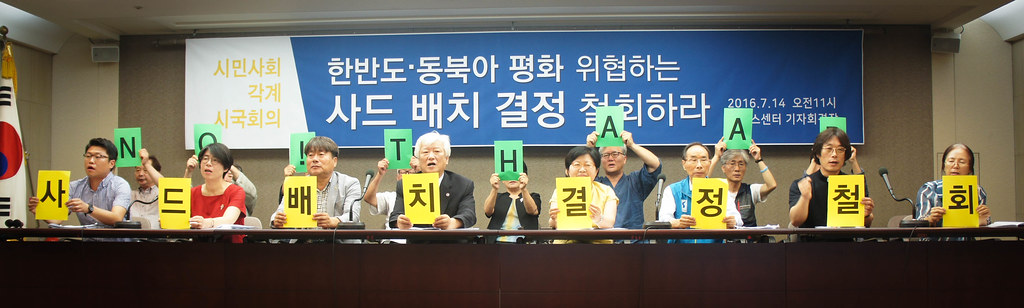
사드 배치 결정 철회 촉구 시국회의


The decision to place THAAD in South Korea, which threatens peace in the Korean Peninsula and Northeast Asia and violates the residents’ right to live peacefully, must be rescinded. 


The entire country is being shaken, and the already-dangerous political situation in the Korean Peninsula and Northeast Asia is becoming even more unpredictable because on July 8, 2016, South Korea and the U.S. announced that they are deploying THAAD to South Korea. Up until South Korea and the U.S. officials announced Seongju, North Gyeongsang Province as the location for THAAD deployment, this process had been entirely ambiguous and one-sided. Even though a plethora of concerns regarding the use, the efficiency, the military/diplomatic prices, and the side effects of THAAD were raised, the South Korean government, behind the curtains, decided to follow the request of the U.S. Now, in Seongju, the anger and the resistance of its residents, who have suddenly been notified of the deployment of THAAD, are growing rapidly. 
 
THAAD is not a weapons system for the residents of the Korean peninsula or for their defense. 

THAAD is essentially a part of the U.S. Missile Defense System (MD). It will be the U.S. military and government that will be running THAAD. MD is an aggressive weapons system, based on the “absolutely stubborn” idea, which aims to incapacitate the missile attacks of the countries against the U.S. and enable the U.S. to launch missiles whenever they want to. The South Korean government is insisting that the deployment of THAAD is to defend the Korean Peninsula from North Korean nuclear weapons and missiles. However, recently, the government has admitted that THAAD cannot defend Seoul and its metropolitan area. The South Korean government is still advertising as if THAAD can at least defend the area within its 200km radius, but this is not true. 200km is nothing but a number to describe the range of the intercept missile attached to THAAD. But, the detectable range of the radar on THAAD theoretically reaches at most a few thousand kilometers. This is why there has been criticism that the main purpose of the frontline deployment of THAAD is to detect medium- to long-range missiles flying over the Korean Peninsula and nearby skies according to the U.S. military strategy. Therefore, there is no such thing as an “adequate” location to place THAAD in this country. The decision of South Korea and the U.S. to place THAAD in Seongju must be rescinded. 


THAAD deployment is militarily and diplomatically self-destructive measure, which will threaten the safety of South Korean citizens and become a severe obstruction in peace and prosperity of the Korean Peninsula and Northeast Asia.

South Korean THAAD is closely related to the missile defense system that was introduced to Japan. Deployment of THAAD to South Korea signifies that South Korea will be sucked into the U.S.-Japan MD, which targets not only North Korea but also China, as a subsidiary partner, and that the Korea-U.S.-Japan military cooperation system will become official. No matter how much South Korean government claims that this is essential to the South Korean sovereignty, the international society and neighboring countries will not accept it. The “strategic companion” relationship with China has become a meaningless term, and the basis of economic cooperation and the friendly relationship between the citizens of both countries can be at risk. China and Russia have already announced that they will be “taking correspondent measures.” It is obvious that this will also negatively affect the international cooperation to solve the nuclear problem in the Korean Peninsula. This is why THAAD can never be a tool to protect the safety of South Korean citizens and peace in the Korean Peninsula. The decision to place THAAD, the “real danger,” which brings threats and conflicts instead of peace, in South Korea must be rescinded.   


We also protest against the undemocratic and non-transparent decision process. 

Before facilitating THAAD deployment, exhibitions, discussions, and evaluations of its use, effects, and military/diplomatic significance should have been carried out. The information about the negotiation process must have been transparently released. However, the South Korean government skipped all these procedures and simply controlled all information. There was not enough discussion even within the related organizations. They treated this important matter, which puts the future of peace in the Korean Peninsula at stake, as if they are carrying out a military strategy. The South Korean national assembly, which represents all of South Korean citizens, never received any substantial reports. The character, the content, and the discussion process of “South Korea-U.S. joint working group for the discussion of THAAD deployment” were not shared with the National Assembly. Even after the decision to deploy THAAD in South Korea, the South Korean government is insisting that this does not require the agreement of the National Assembly. In the case of Seongju, which was decided as the location for THAAD deployment, the residents and the military officials received the unexpected news without any explanation. They were not notified of the negative effects on the environment surrounding the THAAD base and health of the residents. The undemocratic and non-transparent decision of the South Korean government to place THAAD must be rescinded immediately.  


THAAD deployment must receive the consent of the representative body, which in this case, is the National Assembly.

THAAD deployment is directly related to the lives and the safety of South Korean citizens and is a critical matter, which will influence the friendly cooperative relationship with neighboring countries. It may also cost an astronomical amount of money. Therefore, this matter cannot be solely decided by the administrative body; it needs the agreement of the National Assembly. More than anything, the dangerous practice of the South Korean government, which ignores the discussion process and treats this issue like a secret military strategy to avoid the regulation of the National Assembly, cannot be left uncontrolled. If the National Assembly represents all of South Korean citizens, they must stop the one-sided push of THAAD deployment and exercise their right to consent. If the government never asks for the agreement of the National Assembly, the National Assembly must restrain the government’s abuse of its authorities through every measure, such as an investigation in relation to government, an adaptation of the resolution to oppose, and a demand for jurisdiction dispute.  


We are going to start a pan-national peace action to rescind the decision to place THAAD in South Korea. 

We are going to start a pan-national peace action that gathers people from various backgrounds and publicizes the problems of this decision to rescind the decision to place THAAD in South Korea and to stop South Korea from being sucked into the U.S.-Japan missile defense system. We are going to form solidarity to prevent Seongju, North Gyeongsang Province from becoming another victim of state violence, like Pyeongtaek Deachuri or Jeju Gangjeong village. In addition, we are going to fight with all of South Korean citizens, so that THAAD will not be placed in Seongju or any other parts of South Korea. To accomplish this, we are going to actively try to convince and pressure local governments, the National Assembly, and related government organizations and will convey our message to governments and civil societies of neighboring countries, including the U.S. and japan. We will surely punish any abuse of power that undemocratically pushes for the placement of THAAD. Moreover, we are going to form solidarity to facilitate the reconciliation and the cooperation of North and South Korea and to form a peaceful system. The Korean Peninsula should no longer become an explosive warehouse, which is swayed and used by the arms race of the neighboring powers, but should transform as the stepping stone of Northeast Asian peace and cooperation. We are going to actively spread civil resistance and actions for the withdrawal of the decision to place THAAD and for peace in the Korean Peninsula and Northeast Asia. 


July 14, 2016


번역 : 목지수 (참여연대 평화군축센터 자원활동가)

목, 2016/07/14- 23:23
105
0

Human extinction weapon means no peace, no safety

Strongly denounces "hydrogen bomb testing of North Korea"


The Chosun Central Broadcasting of North Korea claimed through a special major report that it has successfully carried out its first hydrogen bomb test on 6 January. It is the 4th nuclear test. This time, the North Korea announced that it was hydrogen bomb, a more powerful weapon. The success of the test has yet to be confirmed but the North Korea clearly expressed its will to keep the regime with human extinction weapons by this test. It is very sad and miserable that North Korea relies on threatening not only the Korean Peninsula but also international society with mass destruction development in order to keep its regime. PSPD strongly denounces nuclear test of North Korea endangering the peace and the safety of whole Korean peninsula.


The North Korean government absurdly insists that a test is an arbitrary measure to secure the peace and the safety of the peninsula and the region. However, no state has the right to possess and test inhuman nuclear which is mass destructive and unlawful. As seen in the nuclear history, its development in the name of nuclear deterrence simply has accelerated nuclear race and endangered the peace and the security of human races. Without exception, nuclear tests of North Korea put the region in jeopardy and increase the probability of breakout of nuclear war.
 
In addition, we should question whether our current government has put diplomatic efforts and played a role to resolve nuclear matters of North Korea while the situation is getting worse up today. The government keeps saying nuclear of North Korea is a threat but it has failed to suggest a realistic measure to stop it. It has insisted and sustained that hostile disregard, sanctions and oppressions could deter but they haven’t worked out. Moreover, the argument that funding North Korea of past governments was led to nuclear development proves to be unpersuasive. The government easily mentions sanctions against North Korea but there is no good measure in fact. 


Serious situation of nuclear tests of North Korea suggests that radical discussions are required to denuclearize the Korean Peninsula even if it is difficult. In other words, the Korean government and states in concerns should stop repeating current policies which have failed and urgently resume six party talk for the purpose of denuclearization of Northeast Asia.

일, 2016/01/31- 16:49
94
0

STATEMENT OF THE VANCOUVER WOMEN’S FORUM

ON PEACE AND SECURITY ON THE KOREAN PENINSULA

>>> Statement [Download]


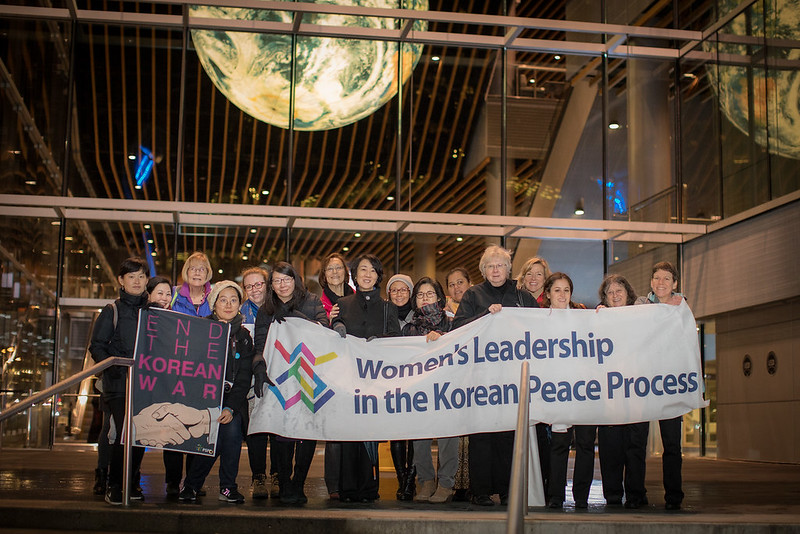
As sixteen delegates representing peace movements from all over the world, we have traveled from Asia, Pacific, Europe, and North America to convene the Vancouver Women’s Forum on Peace and Security on the Korean Peninsula, an event held in solidarity with Canada’s Feminist Foreign Policy to promote a peaceful resolution to the crisis on the Korean Peninsula. Sanctions and isolation have failed to curb North Korea’s nuclear weapons program and instead severely harm the North Korean civilian population. A Korean Peninsula free of nuclear weapons will only be achieved through genuine engagement, constructive dialogue, and mutual cooperation. We issue the following recommendations to the Foreign Ministers participating in the January 16 Summit on Security and Stability in the Korean Peninsula: 


Immediately engage all relevant parties in dialogue, without preconditions, to work toward achieving a nuclear-free Korean peninsula;


Abandon support for the strategy of maximum pressure, lift sanctions which have deleterious effects on the North Korean people, work toward the normalization of diplomatic relations, remove barriers to citizen-to-citizen engagement, and strengthen humanitarian cooperation;


Extend the spirit of the Olympic truce and affirm the resumption for inter-Korean dialogue by supporting:

i) negotiations for the continued suspension of joint US-ROK military exercises in the south, and the continued suspension of nuclear and missiles tests in the north,

ii) a pledge not to conduct a first strike, nuclear or conventional, and 

iii) a process to replace the Armistice Agreement with a Korea Peace Agreement;


Adhere to all the Security Council recommendations on Women, Peace, and Security. In particular, we urge you to implement United Nations Security Council Resolution 1325, which acknowledges that the meaningful participation of women in all stages of conflict resolution and peacebuilding strengthens peace and security for all. 


These recommendations are based on our long experience engaging with North Koreans through citizen diplomacy and humanitarian initiatives, and from our collective expertise on militarism, nuclear disarmament, economic sanctions, and the human cost of the unresolved Korean War. The Summit is a sobering reminder that the gathered nations have a historic and moral responsibility to formally end the Korean War. A pledge not to conduct a first strike can de-escalate tensions by significantly reducing the apprehension of an attack and the risk of miscalculation that could result in an intentional or an inadvertent nuclear launch. Resolving the Korean War can be the single most effective action to halt the intense militarization of Northeast Asia, which gravely threatens the peace and security of 1.5 billion people in the region. The peaceful resolution of the Korean nuclear crisis is the key step toward the total global elimination of nuclear weapons.


January 15, 2018

Vancouver Women's Forum on Peace and Security on the Korean Peninsula

Christine Ahn, Women Cross DMZ

Kozue Akibayashi, WILPF

Lisa Natividad Guahan. Coalition for Peace and Justice

Ewa Eriksson, Fortier Women Cross DMZ

Yehjung Yi, Korean Sharing Movement

Mihyeon Lee, People’s Solidarity for Participatory Democracy

Liz Bernstein, Nobel Women’s Initiative

Moon-sook Lee, National Council of Churches in Korea

Susan Bazilli, Women Peace Security Network

Nan Kim, Alliance of Scholars Concerned about Korea

Ellen Judd, Canadian Voice of Women for Peace

Ann Wright, Women Cross the DMZ & Veterans for Peace

Patti Talbot, United Church of Canada

Mary-Wynne Ashford, International Physicians for the Prevention of Nuclear War

Erica Fein, Win Without War

Lyn Adamson, Canadian Voice of Women for Peace 


Jan 16th CC (644 of 654)-X2

<사진 = 밴쿠버여성포럼>

월, 2018/01/15- 13:52
93
0