주요 콘텐츠로 건너뛰기

[Joint Statement] Reopen Kaesong Industrial Complex Immediately

지역

[Joint Statement] Reopen Kaesong Industrial Complex Immediately

익명 (미확인) | 목, 2016/02/11- 19:55

South Korea: Reopen Kaesong Industrial Complex Immediately


(Seoul, 11 February 2016) On 10 February 2016, the South Korean government announced the closure of Kaesong Industrial Complex, citing North Korea’s 4th nuclear test and launching of a long-range rocket as reasons. However, South Korean civil society organisations emphasise that closure of Kaesong Industrial Complex is an absolutely improper measure. We call on the South Korean government to immediately reopen Kaesong Industrial Complex. It is not a time to immediately end relations with North Korea. Instead, we must find wise solutions to escape this cold period. 


We note with concern that the closure of Kaesong Industrial Complex goes completely against the 2013 agreement between the two Koreas in which they each committed to continue operations at Kaesong Industrial Complex regardless of the political situation. This recent unilateral decision by the South Korean government is also a violation of the Economic Partnership Agreement between the two countries, which is a de facto international treaty. 


The South Korean government argues that approximately 120 billion KRW (around 120 million USD) in wages paid to workers at Kaesong Industrial Complex has been used in development of nuclear weapons and missiles. This accusation has no grounds because most wages paid to North Korean workers are in the form of social and cultural policy funds and gift cards. 


We deplore the South Korean government actions, which ignore the lives of the North Korean workers and difficulties faced by South Korean companies, around 120 of whom face bankruptcy as a result of the closure. While the South Korean government is discussing an alternative site for a factory and financial support, nothing can replace Kaesong Industrial Complex to companies. At the same time, the approximately 54,000 North Korean workers and their families are now at the edge of a precipice. They are not at all related to North Korea’s nuclear testing or long-range rocket launch. 


It is obvious that additional sanctions will not resolve North Korea’s nuclear ambitions, as the past 20 years of sanctions against it have not been successful. It is clear that establishing a peace system and denuclearisation is the only effective solution, not simply repeating already-failed policies of sanctions. The South Korean government must reopen Kaesong Industrial Complex immediately.  /END/


Endorsed by below 69 civil society organisations and networks: 
Busan Counseling Center Against Sexual Violence, Busan Women's Association United, Cheonan Women's Association, Chungbuk Civil Society Organizations Network in Korea, Chungnam Civil Society Organizations Network in Korea, Citizens Coalition for Democratic Media, Civil Peace Forum, Civil Society Organizations Network in Korea, Cultural Action, Daegu Citizens Union for Peaceful Reunification, Daegu Gyeongbuk Women's Association United, Daegu Women's Association, Daejeon Civil Society Organizations Network in Korea, Daejeon Women's Association for Democracy, Daejeon Women's Association United, Eco Horizon Institute, Eco Justice, Goyang Peace Nuri, Green Korea United, Green Transport Movement, Gwangju Jeonnam Women's Association United, Gyeonggi Civil Society Organizations Network in Korea, Gyeonggi Women's Association United, Gyeongnam Civil Society Organizations Network in Korea, Gyeongnam Women's Association, Gyeongnam Women's Association United, Housewives Association, Jeju Women's Association, Jeju Women's Human Rights Solidairty, Jeonbuk Civil Society Organizations Network in Korea, Jeonbuk Women's Association United, Jeonnam Civil Society Organizations Network in Korea, Korea Association of Christian Women for Women Minjung, Korea Sexual Violence Relief Center, Korea Single Parent United, Korea Women's Hot Line, Korea Women's Political Solidarity, Korea Women's Studies Institute, Korea YMCA, Korea Youth Corps, Korean Association of Women Theologians, Korean Catholic Women's Community for a New World, Korean Differently Abled Women United, Korean Federation for Environmental Movement, Korean Sharing Movement, Korean Women Workers Association, Korean Women's Association United, Korean Women's Environmental Network, National Solidarity for Solving Prostitution Issues, Network for Gender Sensitive Budget, Peace Ground, Peace Network, Peace3000, People's Solidarity for Participatory Democracy, Pohang Women's Association, Pusan Women Education Center, Research Institute of the Differently Abled Person's Rights in Korea, Reunification Tree, Saewoomtuh, Suwon Women's Association, The National Association of Parents for Cham Education, Tongilmaji, Transparency International Korea, Ulsan Women's Association, Women Education Center, Women Making Peace, Women Migrants Human Rights Center of Korea, WomenLink, Young Korean Academy
 

시민들의 의견

댓글 달기

Plain text

  • 웹 페이지 주소 및 이메일 주소는 자동으로 링크로 전환됩니다.
  • 줄과 단락은 자동으로 분리됩니다.
  • 사용할 수 있는 HTML 태그: <a href hreflang> <em> <strong> <cite> <blockquote cite> <code> <ul type> <ol start type> <li> <dl> <dt> <dd>
이미지
무제한 수의 파일을 이 필드에 업로드할 수 있습니다.
50 MB 한계입니다.
허용된 유형: png gif jpg jpeg.
Enter the YouTube URL. Valid URL formats include: http://www.youtube.com/watch?v=1SqBdS0XkV4 and http://youtu.be/1SqBdS0XkV4.
CAPTCHA
스펨 사용자 차단 질문

2015 International Conference for Peace in East Asia


Program of 2015 International Conference for Peace in East Asia


2015 East Asia Peace Declaration


The year 2015 marks the 70th anniversary of the world’s liberation from the military aggression and colonialism of Nazi Germany and imperial Japan. The 2015 also marks the 70th year since the horrors of the atomic bomb inflicted devastation on humanity for the first time. 


Although East Asia endured continuous warfare and the Cold War tensions over the past seven decades, East Asia as a region went through a most dramatic transformation and achieved unprecedented development and prosperity in history. In spite of these accomplishments, however, potentials and possibilities of East Asia now face critical challenges—an ongoing war in the Cold War standoff, and reinforced arms race. In particular, unsolved North Korea’s nuclear problems not only destabilize the Korean armistice, but accelerate the regional nuclear and conventional arms race. Furthermore, despite the fact that Japan was the principal aggressor in East Asia throughout the early 20thcentury, its recent attempts to reemerge as a military power without making clear amends to the past, further destabilizing East Asia’s volatile peace. As Japan attempts to revise its Peace Constitution that has been the cornerstone for peace in the postwar East Asia, we cannot help but be concerned.


Increasingly fractious hegemonic competition in the East Asia–Pacific region today are also worsening wounds of the past. If we continue to resort to militarism and nationalism without a reliable regional peace mechanism that can resolve such sensitive regional issues in a nonviolent and mutually-beneficial manner, East Asia may degenerate from its mutual prosperity into a melee for hegemony. We must learn from our past—two World Wars stemmed from our inability to control such hegemonic rivalry.


Furthermore, the East Asia–Pacific region has directly suffered from massive casualties incurred by a series of nuclear catastrophes: atomic bombs dropped on Hiroshima and Nagasaki, nuclear tests conducted in places such as the Bikini Atoll, and the recent Fukushima nuclear disaster. As demonstrated by the 2011 Fukushima nuclear disaster caused by an earthquake along Japan’s east coast, nuclear catastrophes do not exclusively result from the weapons of foreign countries, but can be triggered by nuclear facilities any country in the region. Forging a world without nuclear weapons, that is, building a world free of nuclear threats, has become the earnest desire and sincere hope of all East Asians. As is clear from the seriousness of the Fukushima nuclear disaster, nuclear power is the energy of the past and therefore, each country should suggest a goal to create a nuclear phase-out society. 


East Asia has become a tangled intersection of superpowers and home to a fierce arms race, making it one of the world’s most volatile regions. It is also the region most vulnerable to potential human and ecological disasters inflicted by nuclear weapons and accidents. Europe has been the center of the global movement to create, maintain and consolidate peace in the post-World War II era, and it is now East Asia’s turn to do the same. In this vein, to forge a lasting peace in East Asia and contribute to peace for all humanity, we of this conference declare the following.


Article 9 of the Japanese Constitution is the Cornerstone for Peace in East Asia
Article 9 of the Japanese Constitution is the cornerstone for peace in East Asia and a failsafe that prevents us from repeating past mistakes. We believe the biggest contribution Japan can make to regional peace and prosperity is to adhere to its commitment to global peace as stated in its constitution and flourish as an exemplar for peaceful development. For a long time, a number of Japanese intellectuals strived to uphold the peace provision outlined in the Japanese Constitution. Civil society organizations across Japan and East Asia proposed and supported the movement to award the Nobel Peace Prize to the Japanese Peace Constitution. This movement also has received international attention and support. Along with those who represent Japan’s voice of conscience, we solemnly state Article 9 of the Japanese Constitution must be upheld as an expression of humanity’s noblest goal—world peace. Nuclear threats and ecological crisis threats future of human beings. Now, it is time to expand our international peace movement to reflect universal pacifism which is stipulated in the Japanese Peace Constitution to other countries' constitutions.


Peace in East Asia Cannot be achieved without Ending the Korean War
The existing armistice and division of the Korean Peninsula are the unfortunate outcome of the World War II and the Cold War. The armistice system of the Korean peninsula not only caused pains of the Koreans but also is a fundamental cause of unstable peace in the region. The divided Korean peninsula is the world’s most heavily militarized zone and the powder keg in East Asia where the world’s largest military exercises are conducted. North Korea’s recent nuclear developments have exacerbated vicious cycle of an arms race in and surrounding of the Korean peninsula. The Korean War needs to end for peace in the Korean peninsula and East Asia. The four key parties—the United States, China, North and South Korea—must immediately convene a peace talk to replace the current armistice treaty with a peace treaty. The recent normalization of the U.S.-Cuba relations can serve as a benchmark for the future normalization of the U.S.–North Korea relations.


Denuclearization of the Korean Peninsula and ‘Nuclear Safety’ will create a Nuclear-Free World 
North Korea’s development and sophistication of its nuclear weapons programs can no longer be ignored. The Six-Party Talks, which aim to denuclearize the Korean Peninsula and establish peace, must be resumed at the earliest possible time. To this end, the threshold for resuming dialogue and negotiation must be lowered. To weaken North Korea’s motives to develop its nuclear weapons and to minimize the threat of another Korean conflict, the United States, South Korea, and Japan, that enjoy asymmetric military advantages over North Korea, should take the initiative in relieving tensions in Korea. First and foremost, transforming the unstable armistice system into a peace system, normalizing the US-North Korea, Japan-North Korea relations, denuclearizing the Korean peninsula and negative security assurance on North Korea should be discussed with a bolder and more comprehensive approach. To expedite this process, the contribution of the United State is crucial in normalizing its relations with North Korea and signing the Peace Treaty to denuclearize North Korea and reduce arms in both countries. In response, both North and South Korea must abide by the promises made in the 1992 Joint Declaration on the Denuclearization of the Korean Peninsula. 


To be truly free from all nuclear threats, it is also imperative to respond and provide alternative measures for the threats posed by the “peaceful” use of nuclear energy. Establishing joint safety measures for nuclear power plants in Japan, China, and North and South Korea—in operation, under construction, and scheduled for construction—has become a pressing matter. Full cooperation among concerned countries is one of the most urgent tasks. 


The Roles of Women and Civil Societies should be emphasized for Peace and Cooperation 
We cannot blame governments only for all the threats to peace in East Asia. Political parties, legislatures, and civil societies too are responsible and should work together to influence public opinion and advise the governments to make laws and policies that promote peace. For a harmonious and sustainable future, we must strive to bolster and facilitate understanding and cooperation between people beyond our borders, and build solidarity for peace and justice, so that we do not repeat the unfortunate history of our past. In particular, as rightfully advised by the United Nations Security Council Resolution 1325, the importance of expanding the role and participation of women in redefining security and establishing a lasting peace should be emphasized.
 
Solidarity for peace towards a new East Asia has already begun to form. Until this solidarity becomes an ‘East Asian Peace Community of Nations’, let us never stop our march for peace. 


13 August 2015
Participants, 2015 International Conference for Peace in East Asia


수, 2015/08/19- 21:21
151
0

2016 GDAMS 캠페인


Global Day of  Action on Military Spending (GDAMS)
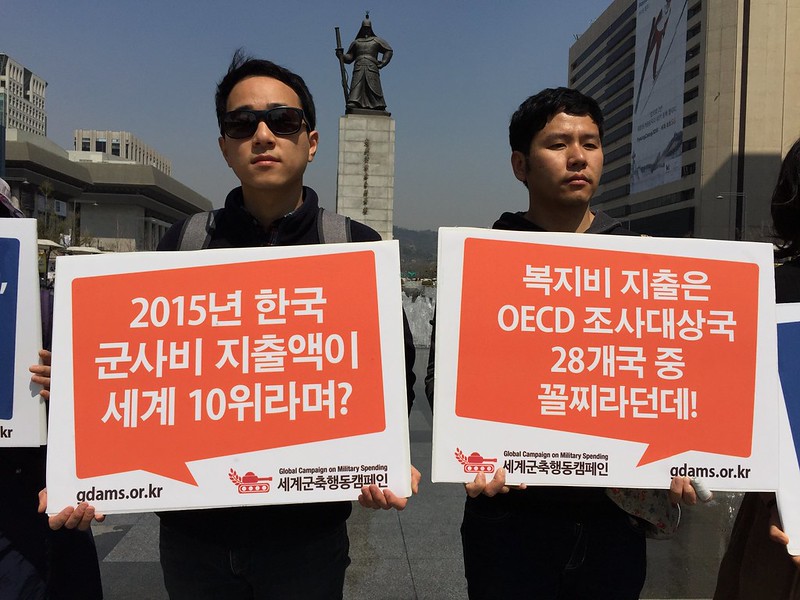
How long  should South Korea stay as an international loser?

With the lowest welfare spending and highest suicide rate among OECD members, 
South Korea was ranked as the world's No. 10 military spender this year and No. 1 arms importer in 2014.


The Stockholm International Peace Research Institute (SIPRI) has released the 2015 annual world military expenditure figures today (4 May). There is a country which has been once again ranked as the world No. 10. It is, while being the tenth biggest global military spender, also recorded as the lowest welfare spender with the highest suicide rate among the 28 OECD countries. That nation is South Korea. The South Korean government has been spending 15% of its budget on military expenditure, which is 2.5 times bigger than the OECD average. The South Korean government has been pouring in 6 billion dollars over its acquisition of 40 F-35 fighter jets, the center of controversies over cost and technical problems. This is the reality of our nation, 'Hell Chosun', an infernal feudal kingdom.


Korea, breaking its usual record of world's top 10 arms importer became the world's biggest arms importer. The annual CRS (Congressional Research Service) report on Arms Transfers, published in December 2015, shows that the South Korean government bought arms and defense equipment worth 7.8 billion dollars in 2014, making it the number 1 weaponry importer in the world. About $7 billion of South Korea's contracts were made with the United States. Now South Korea has become the most lucrative client of the world's largest defense company, Lockheed Martin. This has been attributed to the South Korean government's decision to buy the fighters whose capabilities haven't yet been verified, even after the US refusal to allow core technologies' transfer to South Korea. Also, there's more good news for Lockheed Martin, which is that the US has reportedly agreed to deploy THAAD to South Korea.


Is the huge military expenditure justified? The nation, with an annual defence budget of $9.6 billion, has so far been discovered to have spent $876 million in defence industry corruption by a joint investigative team which was launched in 2014. According to the joint investigative team, there has been a continuous flow of bribes, the falsifying of public documents, shady arms acquisition processes etc. throughout the Army, Air force, and Navy. The 2014 National Defence Annual Reports says that within 10 years defence spending doubled from $4 billion to $8 billion. Anyone can guess that this figure is not healthy at all. 


Then have our 630 thousand soldiers been benefiting from this military spending? The biggest item in South Korea's military budget is labour costs, most of which has been spent on commissioned officers. Only 9% of the military labour cost budget has been allocated to enlisted soldiers, who make up 70% of the entire military force, while the commissioned officers, who only make up 11% of the military force, take 42% of the entire labour costs. The enlisted soldiers are on less than one seventh of the nation minimum income. Is this treatment fair and just?


Some may say that "we can't possibly reduce military spending while facing the North Korean threat". The fact that South Korea's military power is far superior to that of North Korea has already been acknowledged by the government. South Korea has been spending on its military budget an amount almost equivalent to North Korea's national GDP, without even factoring in expenditure on American army bases in South Korea. Unable to match that amount, North Korea may have had to focus on weapons of mass-destruction. The key to solving the inter-Korean tension is trust-building, not military spending increases. The recent news on North Korea's 4th nuclear test caused many South Korean politicians to propose developing our own nuclear weapons. Without stopping this vicious competition of military spending and force increases on the Korean peninsula,  the necessary dialogue cannot be initiated, hence peace will remain unreachable.


The world of arms, of which American President Eisenhower once said "Every gun that is made, every warship launched, every rocket fired signifies, in the final sense, a theft from those who hunger and are not fed, those who are cold and are not clothed." still persists now. This year the United Nations Office for the Coordination of Humanitarian Affairs (OCHA) will issue an estimated $20.1 billion needed to provide humanitarian assistance to countries around the globe, including Syria, Afghanistan, and Iraq. We need to remind ourselves that last year alone the world spent $1.8 trillion on defence. Just 1% of the total international military spend would make so much difference if it were to be spent on humanitarian purposes and the eradication of poverty. 


More military spending will never bring in peace and safety to the world, but rather causes neighboring countries to increase their own military funding, therefore ending up enriching arms companies. Now is the time for us to rethink our priorities. The change we are hoping for will be brought forward by those who cry out "tax money for our lives, not for weapons" and the national assembly, which reviews and votes for bills based on our nation's voice. The 20th national assembly will have to allocate taxes to help its citizens facing hardship from cradle to grave. On the 5th of April  2016, celebrating the 6th Global Day of  Action on Military Spending, we propose to enter into such a paradigm shift in our escape from 'Hell Chosun'.


April 5, 2016

The GDAMS Preparatory Committee of Korea


For more information


The GDAMS website http://demilitarize.org

The GDAMS Korea website http://gdams.or.kr
The GDAMS Preparatory Committee of Seoul
People’s Solidarity for Participatory Democracy +82-2-723-4250, [email protected]


번역 : 윤현희 (참여연대 평화군축센터 자원활동가)

화, 2016/04/05- 22:56
146
0

Situation of Farmer Baek Nam-gi in the Republic of Korea

26 September 2016

People's Committee for Farmer Baek Nam-gi and Condemning State Violence


A farmer, who was shot by police's water cannon on 14 November 2015 during his protest calling for just rice price, was passed away after 317 days of remaining unconscious. Unfortunately, no perpetrator was properly punished nor proper investigation has been conducted until today. As soon as Farmer Baek passed away, the police tried to seize his body, saying that autopsy is necessary when cause of death is not clear. Families and supporters strongly protest against this attempt since they believe that it is clear that Farmer Baek's death is caused by the police's brutality. The police and Prosecutor’s Office even re-quested for a warrant for an autopsy, but the court denied to issue it. The police and the Prosecutor’s Of-fice may reapply for a warrant.


1. Background: People’s Mass Mobilisation on 14 November 2015

  • Farmer Baek Nam-gi joined the People's Mass Mobilisation on 14 November 2015 to demand that rice prices for 2015 be guaranteed. On the day, around 130,000 people joined the rally against the govern-ment's anti-people and anti-democracy policies. They came from different groups including workers, farmers, students and urban poor to raise their voices for a society where people's rights and demo-cratic principles are fully guaranteed.
  • During a protest, Farmer Baek Nam-gi was struck in the head by police water cannon. He was struck by direct spray which continued after he had been knocked to the ground and was taken to the emer-gency room of Seoul National University Hospital. Since then he remains unconscious. 
     

2. Medical Condition

  • Because of a brain haemorrhage due to a fractured nose, optic nerve damage, and a concussion, the medical staff in the emergency room said that after undergoing brain surgery that day, further surgery would be pointless for such a serious injury and would only help to extend his life but not lead to re-covery.
  • By February of 2016, more than 50% of his cerebrum, brain stem damage and still unconscious, he re-mained in this state from which he was unable to recover reliant on an artificial respirator until he was taken to the intensive care unit where he lies 317 days after the initial injury.
  • 24 September 2016: Despite being administered a concentrated diuretic, his condition was very seri-ous as he was unable to pass urine, received a transfusion or have antibiotics or nutrients adminis-tered. 
  • 25 September 2016: On the 317th day of his injury, he passed away. 
  • For further information about the medical opinion, please see the statement released by Association of Physicians for Humanism which is attached to this document.
     

3. Investigation Process

  • After Farmer Baek collapsed because of police's water cannon, the police and Prosecutor's Office did not conduct a proper investigation.
  • On 18 November 2015, Baek's family filed a criminal complaint to the Prosecutor's Office on seven al-leged perpetrators including the then National Police Agency Commissioner General Kang Sin-myung and Chief of Seoul Metropolitan Police Agency Koo Eunsoo. Since then, the Prosecution’s office did nothing but have interview with his daughter as a complainant. Until today for 10 months, the Prose-cutor's Office is saying that the case is still under ‘investigation’.
  • Kang's term ended in August, without any official response to the family’s call for an apology.
  • On 22 March 2016, Baek's family filed a compensation suit against the Government and the police.
  • On 12 September 2016, hearing was held at the National Assembly. Even though abuse of police forces and excessive use of police power was confirmed, the main responsible person, the then Police Commissioner General Kang Sin-myung refused to. He said it was 'inappropriate' to issue an apology for every injury or death during crackdowns of demonstrations and causes and legal responsibilities must be clearly defined beforehand. Also, evidence and documents against the police were not sub-mitted. No truth was found.
     

4. Current situation (as of 26 September 2016)

  • After Farmer Baek passed away at 4pm, the police tried to seize the body for autopsy, arguing cause of death is not clear. The police even blocked roads going to the hospital and did not allow people to enter. 
  • On the other hand, Baek's families and his supporters are strongly opposing the idea of autopsy. They believe that the police and Prosecutor's Office try to argue different cause of his death, such as chron-ic disease, not the water cannon shooting. 
  • Around 6:30pm, the Prosecutor's Office, Farmer Baek's lawyer, doctors, parliamentarians joined post-mortem examination. A large number of people gathered in front of the hospital and around the time that they started post-mortem examination, the police opened a small way, so that people can pay their respect to Farmer Baek. 
  • At 9:17pm, the People’s Committee held a press conference and made it clear that the cause of his death is a ‘cerebral haemorrhage’, not an acute renal failure and an autopsy is not necessary. 
  • Nevertheless, at 0:10am on 26 September the Prosecutor’s office made a request for a warrant of au-topsy to the court and If a warrant is issued, the Prosecutor's Office can conduct autopsy without con-sent of the family. 
  • On 26 September 2016, the court refused to issue a warrant but the police and the Prosecutor’s Office may reapply for a warrant. 
     

5. Our Call

  • Guarantee freedom of peaceful assembly of all people! 
  • End impunity! Punish responsible person for Farmer Baek Nam-gi's Death!
  • Hold special prosecutor to end impunity! 
  • President Park should make an official apology! 
  • Legislate a strong regulation on the use of water cannon!
     

Reference 1. Medical Opinion by Association of Physicians for Humanism 


Patient: Baek Nam-gi (male, 69)


The patient lost consciousness as he fell down by the force of a police water cannon on 14 November 2015. He was moved to the emergency room of Seoul National University Hospital. Testing revealed a traumatic subdural haemorrhage and subarachnoid haemorrhage resulting from a brain haemorrhage and multiple fractures across a large region of his skull and eye socket.


The results of the initial neurological examination and video inspection indicated that his condition would not improve and that surgery would also be meaningless so he could be discharged from the hospital. The patient is currently in the intensive care unit 317 days after receiving life-saving surgery.

Following surgery, the patient has remained in a coma and reliant on an artificial respirator unable to breath by himself. Having had repeated complications including pituitary function loss of the entire brain, pneumonia, fungemia, bedsores, a pulmonary embolism and septicaemia, and currently suffering multi-ple organ failures including renal failure and a pulmonary edema, the patient is receiving intensive treat-ment in the intensive care unit but it is not likely that he can be kept alive much longer.


The causes of the patient's condition are the brain haemorrhage and skull fracture sustained due to the power and pressure of the police water cannon. These can be confirmed in the CT scan recorded on the same day and surgery log. In the process of being moved to the intensive care unit 317 days after sustain-ing the injuries, complications and multiple organ failures caused by a common infection and being admin-istered medicine. Due to treatment of the wounded area and physical deterioration, there is a very high possibility of his condition worsening in light of the patients' likely death an autopsy is deemed unneces-sary. In addition, if the family does not wish for there to be an autopsy after the patients' death is an-nounced, the cause of death is the aforementioned underlying medical condition and there is no reason for this to be doubted.


25 September 2016


Association of Physicians for Humanism

Kim Gyeong-il, Specialist Neurosurgeon 
Lee Hyeon-eui, Specialist Neurosurgeon
Lee Bora, Internal Medicine Specialist


Reference 2. Oral Statement delivered by Ms. Baek Minjuwha, a daughter of Farmer Baek Nam-gi at the 32nd Session of the UN Human Rights Council

 >> Pleae click here


월, 2016/09/26- 17:47
142
0


PSPD’s position on President impeachment bill by National Assembly

National Assembly approving impeachment, an obvious result reflecting people’s demand


(9 December 2016, Seoul) People had won. Today (9 December 2016), the President Park Geun-hye’s impeachment indictment has been passed with approval of 235 out of 300 incumbent National Assembly. The National Assembly’s impeachment bill passing is an obvious result to meet the demands of people calling for an immediate resignation of the President. The President, who is impeached from both people and national assembly, should not stand against the people and resign immediately 
 
The President’s impeachment bill approved by the National Assembly proved that all power comes out from the people. While the politicians were perplexed and calculating their political interests in this unprecedented state of President’s constitutional violation and monopolization of state affairs, it was people who was always stayed firm and led to passing of impeachment. Although impeachment has been passed, it is still a matter of fact that people’s scar, anger and despair is in incalculable situation. 

The National Assembly’s impeachment passing today is just a starting point of judging powers who were monopolizing state affairs including Park Geun-hye. As people’s will, constitutional order must be back on track and state running must be normalized. To start, Park Geun-hye who was unaware of the President’s role and cannot be expected of any sort must resign from that position and be investigated as suspect. The Prime Minister, Hwang Kyo-ahn who will be next in line from today’s impeachment must also immediately resign. He is also a person who shares direct responsibility with Park regime’s failure of state affairs. Also, officials including Special Prosecutor’s Office must not delay investigation on the President’s all forms of illegal activities and allegations and must implement forced investigation. The Constitutional court must finalize the review as soon as possible and respond to people’s demands.
 
As it was confirmed today, even when people who are vested with sovereign rights have no less of a clear opinion, there are still political powers present to guard powers that had monopolized state of affairs and against impeachment. These people who were entrusted with power temporarily to represent people are only pursuing their own individual political interests and colluding with specific political powers like the President to maintain their power. Such political forces should be eliminated. This is the reason why Sanuri Party must be dismantled. 
 

금, 2016/12/09- 12:35
140
0

3f8bcf799ac9d72d6f83ee3d8aba127b.jpg


32nd Regular Session of the UN Human Rights Council
Item 3: Promotion and Protection of all Human Rights, Civil, Political, Economic, Social and Cultural Rights, including the Right to Development


Interactive Dialogue with the UN Special Rapporteur

on the rights to freedom of peaceful assembly and of association


Oral Statement Delivered by Ms. Minjuwha Baek on Behalf of
People’s Solidarity for Participatory Democracy (PSPD)
Korean Center for United Nations Human Rights Policy (KOCUN)
MINBYUN-Lawyers for a Democratic Society


Friday, 17 June 2016

 
Thank you, Mr. President.
 
My name is Minjuwha Baek, and I am the daughter of the 69 year-old farmer Namgi Baek in the Republic of Korea who was mentioned in the Special Rapporteur’s report. My father was targeted and knocked down by the police’s water cannon on 14 November last year, during a protest for the increase in rice prices. He remains in coma for more than 200 days due to severe brain damage.
 
The Government imposed an arbitrary ban on the protest, claiming it was not an assembly but a crime. They named the protest unlawful and not peaceful, even before it took place. The police arrested or summoned more than 500 protesters. This includes Mr. Sang-kyun Han, the president of Korean Confederation of Trade Unions(KCTU), facing up to 8-year imprisonment for organizing the protest.
 
The police blocked main roads and streets with hundreds of bus barricades and thousands of police forces, even hours before the protest. The police shot water cannons with capsaicin to protesters indiscriminately for hours.
 
No apology, No investigation, No justice.
The government of the Republic of Korea insisted on having a thorough investigation. For 7 months, all they did was summoning my sister once. If you hit someone who is not attacking you, you should apologize and do everything to fix it. Every human being knows this.
 
We want a sincere apology, thorough investigation, and justice for my family and for all.
 
Mr. President,
If you allow me for 5 seconds I would like to invite my father to speak for himself. (Holding Mr. Baek's photo)
 
Thank you, Mr. President


토, 2016/06/18- 15:43
138
0