주요 콘텐츠로 건너뛰기

[Joint Statement] Reopen Kaesong Industrial Complex Immediately

지역

[Joint Statement] Reopen Kaesong Industrial Complex Immediately

익명 (미확인) | 목, 2016/02/11- 19:55

South Korea: Reopen Kaesong Industrial Complex Immediately


(Seoul, 11 February 2016) On 10 February 2016, the South Korean government announced the closure of Kaesong Industrial Complex, citing North Korea’s 4th nuclear test and launching of a long-range rocket as reasons. However, South Korean civil society organisations emphasise that closure of Kaesong Industrial Complex is an absolutely improper measure. We call on the South Korean government to immediately reopen Kaesong Industrial Complex. It is not a time to immediately end relations with North Korea. Instead, we must find wise solutions to escape this cold period. 


We note with concern that the closure of Kaesong Industrial Complex goes completely against the 2013 agreement between the two Koreas in which they each committed to continue operations at Kaesong Industrial Complex regardless of the political situation. This recent unilateral decision by the South Korean government is also a violation of the Economic Partnership Agreement between the two countries, which is a de facto international treaty. 


The South Korean government argues that approximately 120 billion KRW (around 120 million USD) in wages paid to workers at Kaesong Industrial Complex has been used in development of nuclear weapons and missiles. This accusation has no grounds because most wages paid to North Korean workers are in the form of social and cultural policy funds and gift cards. 


We deplore the South Korean government actions, which ignore the lives of the North Korean workers and difficulties faced by South Korean companies, around 120 of whom face bankruptcy as a result of the closure. While the South Korean government is discussing an alternative site for a factory and financial support, nothing can replace Kaesong Industrial Complex to companies. At the same time, the approximately 54,000 North Korean workers and their families are now at the edge of a precipice. They are not at all related to North Korea’s nuclear testing or long-range rocket launch. 


It is obvious that additional sanctions will not resolve North Korea’s nuclear ambitions, as the past 20 years of sanctions against it have not been successful. It is clear that establishing a peace system and denuclearisation is the only effective solution, not simply repeating already-failed policies of sanctions. The South Korean government must reopen Kaesong Industrial Complex immediately.  /END/


Endorsed by below 69 civil society organisations and networks: 
Busan Counseling Center Against Sexual Violence, Busan Women's Association United, Cheonan Women's Association, Chungbuk Civil Society Organizations Network in Korea, Chungnam Civil Society Organizations Network in Korea, Citizens Coalition for Democratic Media, Civil Peace Forum, Civil Society Organizations Network in Korea, Cultural Action, Daegu Citizens Union for Peaceful Reunification, Daegu Gyeongbuk Women's Association United, Daegu Women's Association, Daejeon Civil Society Organizations Network in Korea, Daejeon Women's Association for Democracy, Daejeon Women's Association United, Eco Horizon Institute, Eco Justice, Goyang Peace Nuri, Green Korea United, Green Transport Movement, Gwangju Jeonnam Women's Association United, Gyeonggi Civil Society Organizations Network in Korea, Gyeonggi Women's Association United, Gyeongnam Civil Society Organizations Network in Korea, Gyeongnam Women's Association, Gyeongnam Women's Association United, Housewives Association, Jeju Women's Association, Jeju Women's Human Rights Solidairty, Jeonbuk Civil Society Organizations Network in Korea, Jeonbuk Women's Association United, Jeonnam Civil Society Organizations Network in Korea, Korea Association of Christian Women for Women Minjung, Korea Sexual Violence Relief Center, Korea Single Parent United, Korea Women's Hot Line, Korea Women's Political Solidarity, Korea Women's Studies Institute, Korea YMCA, Korea Youth Corps, Korean Association of Women Theologians, Korean Catholic Women's Community for a New World, Korean Differently Abled Women United, Korean Federation for Environmental Movement, Korean Sharing Movement, Korean Women Workers Association, Korean Women's Association United, Korean Women's Environmental Network, National Solidarity for Solving Prostitution Issues, Network for Gender Sensitive Budget, Peace Ground, Peace Network, Peace3000, People's Solidarity for Participatory Democracy, Pohang Women's Association, Pusan Women Education Center, Research Institute of the Differently Abled Person's Rights in Korea, Reunification Tree, Saewoomtuh, Suwon Women's Association, The National Association of Parents for Cham Education, Tongilmaji, Transparency International Korea, Ulsan Women's Association, Women Education Center, Women Making Peace, Women Migrants Human Rights Center of Korea, WomenLink, Young Korean Academy
 

시민들의 의견

댓글 달기

Plain text

  • 웹 페이지 주소 및 이메일 주소는 자동으로 링크로 전환됩니다.
  • 줄과 단락은 자동으로 분리됩니다.
  • 사용할 수 있는 HTML 태그: <a href hreflang> <em> <strong> <cite> <blockquote cite> <code> <ul type> <ol start type> <li> <dl> <dt> <dd>
이미지
무제한 수의 파일을 이 필드에 업로드할 수 있습니다.
50 MB 한계입니다.
허용된 유형: png gif jpg jpeg.
Enter the YouTube URL. Valid URL formats include: http://www.youtube.com/watch?v=1SqBdS0XkV4 and http://youtu.be/1SqBdS0XkV4.
CAPTCHA
스펨 사용자 차단 질문

On December 8 2022, in partnership with the Permanent Mission of Mongolia to the United Nations, the Global Partnership for the Prevention of Armed Conflict (GPPAC) organised a roundtable discussion titled Building and Sustaining Peace at the Regional Level: The Network Approach to Regional Coordination in Northeast Asia during an advocacy visit of Ulaanbaatar Process participants to New York City.

This discussion was an informal dialogue to share the learning from the Ulaanbaatar Process with global peacebuilding policy experts within the United Nations, Member States and regional organisations. The conversation outlined critical avenues to support regional peacebuilding coordination in policy and shared practical experiences for practical action. The discussion also outlined persistent challenges of regional peacebuilding coordination, and discussed recommendations to develop solutions to strengthen peacebuilding work in Northeast Asia.

During the roundtable, remarks were shared by Ulziibayar Vangansuren, Permanent Mission of Mongolia to the United Nations; Ambassador Enkhsaikhan Jargalsaikhan, Chair of NGO Blue Banner and former Mongolian Permanent Representative to the UN; Sonja Bachmann, Teamleader Northeast Asia and Pacific, UN Department of Peacebuilding Political Affairs (DPPA); Kajita Natsuha, learning designer and facilitator; Kim Jeongsoo, Standing Representative, Women Making Peace and Hwang Sooyoung, Manager, Centers for Peace and Disarmament and for International Solidarity, People’s Solidarity for Participatory Democracy (PSPD).

Based on the experiences from Northeast Asia, the following key elements build an effective regional peacebuilding architecture:

  • Multi-stakeholder coordination is required and must be based on complementarity among partners.
  • The network approach to peacebuilding must be at the core of regional coordination.
  • Inclusivity is key for effective regional peacebuilding networks.

The following recommendations have thus been identified for the strengthening of the regional peacebuilding mechanisms:  

  • The UN should take a more active convening role to bring together regional actors, the UN, national governments, and civil society, among others, to coordinate actions better and ensure a stronger impact of peacebuilding activities.  Where regional peacebuilding networks play an essential role in building the foundation for regional dialogue, the UN should provide technical and political accompaniment to ensure the commitment to action. 

  • Improved funding mechanisms are needed to support the civil society organizations’ network approach. A network approach creates empowering and equitable spaces for exchanging expertise for more impactful and informed action, sharing resources and access points at various levels, and enabling and supporting communities committed to peace. Donors should reflect on how to improve funding mechanisms to support better civil society organizations engaged in regional peacebuilding networks, allowing them, through effective funding, to fill the gaps in the regional peacebuilding infrastructure. It is crucial to ensure that all regions are fairly represented in the international discussion on peacebuilding and are given international attention, as this also impacts funding availability. 

  • The inclusion of women and youth is key in regional peacebuilding networks and should be supported. Although women are strongly affected by conflicts, they are often excluded from negotiations and peace processes, especially in highly patriarchal contexts. The inclusion of local women within peacebuilding initiatives is essential to ensure that their unique perspectives can have a real impact at the decision-making level. Likewise, the meaningful participation of young people in dialogue on equal terms is essential to achieve and sustain peace. Young people in all their diversities should be considered as drivers for change, and their contributions should be held as relevant and valuable. Donors should prioritise supporting regional peacebuilding dialogues that ensure the meaningful participation of women and youth at all stages of the process.  The UN and its Member States should use their influence and international platforms to  ensure that the unique perspectives of local women and youth peacebuilders are heard and taken into account in the decision-making processes.

This is an article for Global Partnership for the prevention of Armed Conflict (GPPAC) Northeast Asia News, Jan 2023

Summary Document [See/Download]

The post Building and Sustaining Peace at the Regional Level appeared first on 참여연대.

월, 2023/01/30- 15:02
1
0
20230214_정전 70년 한반도 평화행동 출범대회
2023.02.14 Korea Peace Appeal Campaign

⭐ End The Korean War, Let Us Peace!

Tuesday, 14  February, 2023, Korea Press Foundation

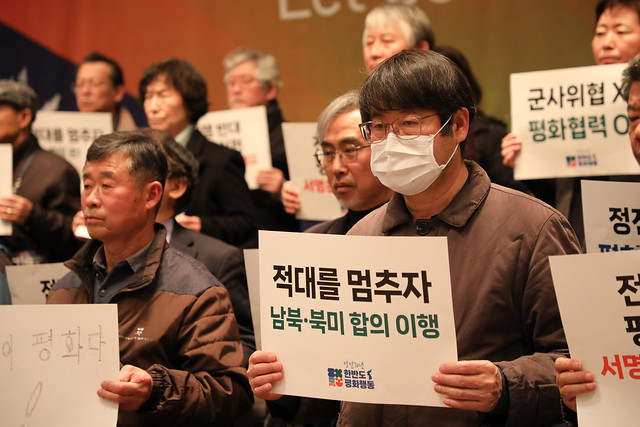
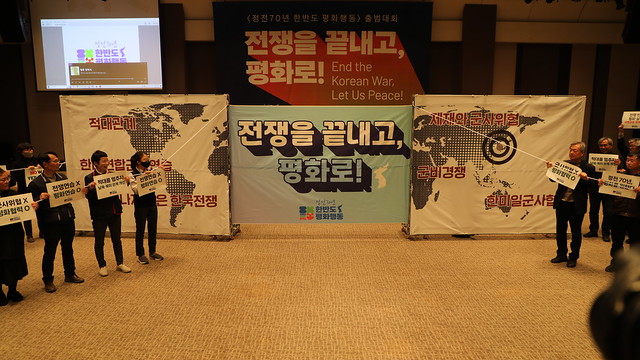
As 2023 marks the 70th anniversary of the Korean War Armistice, the <South Korean Committee on June 15th Joint Declaration> and the <Korea Peace Appeal Campaign> launched a new project <Korea Peace Action for the 70th Anniversary of the Armistice>. A press conference was held where many religious and civil society representatives, who have been endeavoring for peace in the Korean Peninsula, participated and gathered eager to rebuild hope of peace over the threat of war. 735 organizations nationwide are a part of the <Korea Peace Appeal Campaign>.

Our main goal is to resolve the threat of war and build peace. As a joint civil society, we plan to continue the signature campaign but more intensively, and organize other various peace actions. The <Korea Peace Appeal Campaign> will warn the danger of the present crisis, create domestic and foreign public opinions for the peace of the Korean Peninsula and Northeast Asia, and gather voices of opposition toward the recent rapid promotions of the military cooperation between South Korea, the US, and Japan. This year we will be manifesting the following actions:

☮ Korea Peace Appeal Signature Campaign
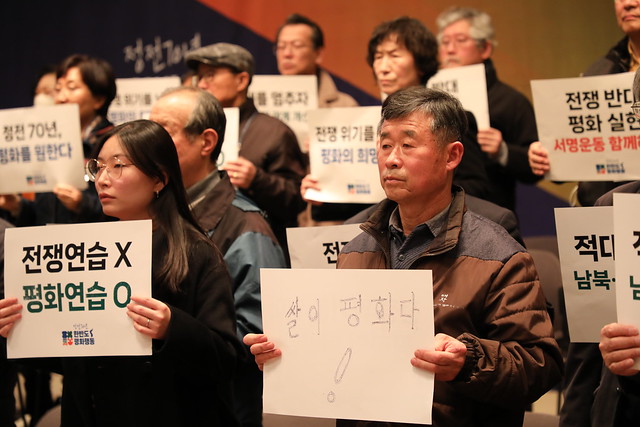
☮ Actions urging suspension of the ROK-US Combined Military Exercises and ROK-US-Japan Military Cooperation
☮ Korea peace actions in 300 cities worldwide comprising 100 overseas (June-July)
☮ Saturday, 22 July 2023, Massive Peace Rally and Parade
☮ Thursday, 27 July 2023, International Conference
☮ 15 August 2023 (TBD), Massive Peace Rally

20230214_정전 70년 한반도 평화행동 출범대회

Korea Peace Action for the 70th Anniversary of the Armistice Declaration

Let’s resolve the threat of war and build peace in the Korean Peninsula

70 long years have passed since the roar of gunfire coming from the three-year war in Korea stopped. The past 70 years were certainly not a peaceful period but a temporary ceasefire. Due to the fear and anxiety that the war could outbreak any time soon, the neverending hostility and military tension, and the internal and external challenges leveraging and goading these unstable conditions, everyone living on the Korean Peninsula had to cope with the immense pain and expense.

When the South and North Korean Leaders, and the North Korean and US leaders discussed a transfer to a new relationship at the Panmunjom Declaration of 27 April, the Pyongyang Joint Declaration of 19 September, the Singapore Joint Statement of 12 June, the Korean people saw a single thread of hope that the tension and danger of war, which had been crushing us, would disappear and a peacefully coexisting future unlock. Despite the North-South and North-US Agreement, dialogues were adjourned on account of the different views on corresponding measures, and as the power-to-power confrontations intensify, the present Korean Peninsula is falling into great despair. We are not even sure if the unstable ceasefire will be maintained. A sense of crisis that there is no guarantee an accidental collision could turn into a terrible disaster from a nuclear war is oppressing every life and existence on this land.

No methods of dialogue are left between the North-South and North-US. Moreover, the global environment is restraining us. Amidst the Russia-Ukraine war and the US-China conflict, the possibility of Korea being used as a proxy battlefield for international-level military tensions and new Cold War confrontations is greater than ever. However, there is no sound of a practical and active solution to ease tension, prevent armed conflict, or create dialogue conditions.

The government of Yoon Suk Yeol clarified ‘Peace through Strength’ and massively expanded the scale of military exercise, propagandizing that military force can beget surrender. However, this has only aggravated the danger of military clashes in Korea. By stating the practicality of extended deterrence against nuclear and missile threats of North Korea, the Yoon Suk Yeol government has been justifying that we jump on the United States’ strategy against China and South Korea to be subordinated to the ROK-US-Japan military cooperation system. However, the danger of a nuclear arms race and nuclear war around the Korean Peninsula is proliferating. The result of pressure through power is merely the repetition of North Korea’s advancement in nuclear power and mutual armed protests. The only thing the Yoon Suk Yeol government proved so far is that they have no practical method nor capability to manage the crisis and bring peace.

We still have time to prevent conflict and disintegration. We also have a chance for dialogue and negotiation. The reason things got worse is that even after agreeing to a new relationship, the government hesitated to take corresponding measures to build trust, such as suspending the ROK-US joint military exercises, not the insufficiency of armed protest. We must stop the outbursts of armed protests. We must open the door to peace through bolder and more flexible confidence-building measures and pre-emptive easing of tensions. We must act to build peace. The more difficult it is to talk about peace, the more we must gather willingness toward peace from all social standings and reverberate the voice of people who demand peace.

As we launch the <Korea Peace Action for the 70th Anniversary of the Armistice>, we call for the following. We call for stopping hostilities. We call for immediate and faithful action to improve relations as agreed by two Koreas and North Korea and the US. We call for an end to a 70-year-old unstable ceasefire and an agreement on the peace treaty. We call for a Korean Peninsula and a world without nuclear weapons and nuclear threats. We call for restoring trust and resolving conflicts through dialogue and cooperation, not sanctions and military threats. Particularly, we call for a halt in the large-scale ROK-US combined military exercise and opening the way for dialogue toward peace. We call for stopping military cooperation between South Korea, the US, and Japan, which will lead to a new Cold War confrontation, and instead creating an order of cooperation in which the Korean Peninsula and Asia coexist peacefully. Please, we do not call for a destructive arms race, but we call for the safety of people and cooperation to overcome the climate crisis.

We will act. We will take action in the 1 million signature campaign for the Korea Peace Appeal. We will continue the peace declaration and solidarity of people from all social standings in many parts of the world, including 200 cities in Korea and 100 cities in overseas, in the online and offline space. We will work hard to stop ROK-US joint military exercises and military cooperation between South Korea, the US, and Japan, which are escalating tensions and confrontations on the Korean Peninsula and Asia. Marking the 70th anniversary of the Korean War Armistice in July this year, we will focus our actions so that the nation calling for peace on the Korean Peninsula and the voices of peace forces from all around the world can resonate all over the Korean Peninsula and the whole world.

If we seek peace, we can open the way to peace.

We decide our future.

Join us in the <Korea Peace Appeal Campaign>.


14 February 2023

From all Korea Peace Appeal Campaign organizations (total of 735)


Korea Peace Appeal 2

? Signature Campaign to End the Korean War
Sign the Korea Peace Appeal Now ?
endthekoreanwar.net

The post ⭐️ Fresh Start of the Korea Peace Appeal Campaign appeared first on 참여연대.

금, 2023/03/03- 16:30
0
0