주요 콘텐츠로 건너뛰기

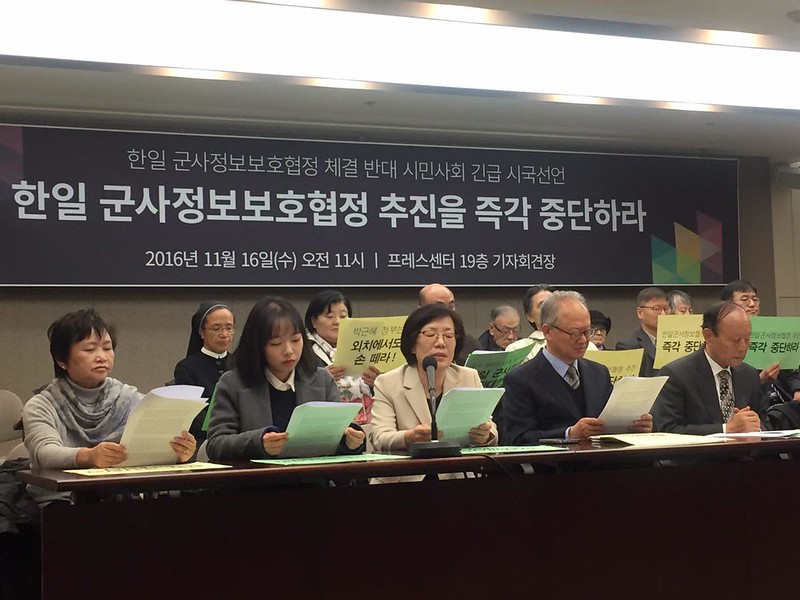
Civil Society’s Declaration against GSOMIA between South Korea and Japan
지역

Civil Society’s Declaration against GSOMIA between South Korea and Japan

익명 (미확인) | 수, 2016/11/16- 14:48

22842681698_f1ca94abab_c.jpg

South Korean Civil Society’s Declaration against the General Security of Military Information Agreement (GSOMIA) between the Government of the Republic of Korea and the Government of Japan 

Immediately cease the GSOMIA negotiation


(16 November 2016, Seoul) We, 225 public figures and 113 civil society organisations, call upon Park Geun-hye administration to stop the signing of dogmatic, undemocratic and unpeaceful General Security of Military Information Agreement (GSOMIA) between the Government of the Republic of Korea and the Government of Japan. Both governments held the first meeting in Tokyo on 1st of November, the second meeting in Seoul on 9th of November, the third meeting in Tokyo on 14th of November and tentatively initialed the GSOMIA. The Park administration has already requested the legislative office for examination in an aim to ratify the GSOMIA within this month. We strongly condemn the government’s undemocratic decision and warn the Government to immediately stop negotiation on the GSOMIA.


We strongly protest against the way how negotiation process has been carried out in an unfair and non-transparent manner. As we all recall, this Agreement was secretly carried out to the point of initialing by Lee Myung-bak administration in 2012 and was ceased due to the strong opposition from the people. People were outraged by the fact that the government pushed ahead with the agreement without consensus from the general public with the power vested and the national assembly as the representative body of the government.  


This undemocratic behavior is repeated and getting even worse. The Ministry of National Defense, which is mainly responsible for the GSOMIA has vowed until recently that forming general public consensus is crucial and that the “signing the GSOMIA can only be proceeded with conditions established.” Regardless, the Park Geun-hye administration has disregarded such conditions and without any attempt to reach a general public’ s consensus, it has decided to continue signing the GSOMIA like a military operation. 
 
While South Korean people are angered and shocked by the recent Presidential scandal, the GSOMIA is being enforced. As proved by a million protesting on 12th of November, majority of people are calling for the President’s immediate resignation. As the Park administration has failed to carry out the constitutional responsibility bestowed by the people, it is not qualified to proceed the GSOMNIA. Paradoxically speaking, this GSOMIA negotiation clearly proves that the President must not be involved both in domestic and international affairs. 
 

We are extremely concerned about the negative impact of the GSOMIA. The government has granted indulgence through abruptly settling on the Agreement on ‘comfort women’ to Abe Shinzo administration in Japan, which has been right wing-led and distorted its history of aggression. Signing the GSOMIA will rather encourage Japan’s remilitarization and exercise of collective self-defense. As the most affected victims of Japanese imperialism, we will not accept the government to blindly take such actions.  


The GSOMIA will instigate the possible new cold war in Northeast Asia. Republic of Korea is the closest neighboring country to North Korea, an explicit enemy of the US-Japan alliance, and China and Russia, strategic competitor countries of US. The reason for the US-Japan alliance to include South Korea in their military strategy largely lies in geopolitical factor. The Korean Peninsula will be a strategic advantage as battle front and troop as the last resort. The South Korea-US-Japan Military Information Sharing Pact signed in 2014 and Terminal High Altitude Area Defense (THAAD) deployment decision made in this July are in the same context. Such South Korea’s trilateral alliance may raise increasing concern in strengthening the trilateral alliance between North Korea, China and Russia. The result will be a new cold war in Northeast Asia and exacerbation of arms race as well as permanent loss of peace on the Korean Peninsula. As the victim of cold war, we will not allow the re-emergence of a new cold war. 


Some may assert that military cooperation with Japan is necessary in a pragmatic approach against the acceleration of North Korea’s missile and nuclear weapon threats. Nevertheless, the GSOMIA for trilateral missile defense system establishment will not assure South Korea’s safety. According to a report published by the US Congress Research Service (CRS) in June, 2013, it is assured that “South Korea might not benefit as much, because it is so close to North Korea that incoming missiles would likely fly on a lower trajectory and could arrive in a matter of minutes.” Considering our reality that we are still under ceasefire, this is a valid criticism. 


Military approach like the GSOMIA will clearly not stop North Korea’s nuclear development. This is just expansive reproduction of a failed policy. This will only lead to self-harm result in the Korean Peninsula. This will erupt cold war in Northeast Asia in reality and waste valuable resources that should be utilized for welfare and proliferation of humanity not for military competition.


The cooperation between South Korea-Japan and South Korea-US-Japan should not head in such direction. The objective of cooperation should be focused on peace and the means should be through diplomatic channels. Six-party talks should be resumed as it has been discontinued for about past eight years and relations between North and South Korea, North Korea and the US as well as North Korea and Japan should be resolved.


However, the Park administration has clearly proved that it has no will or capability to do so. It is gradually being disclosed that a shadowy advisor who is at the center of the corruption scandal has exerted extensive influence on domestic and international affairs but the government is still attempting to sign the GSOMIA. '


We will never accept such a historical regression. We can no longer trust the government that has lost ability to realize the seriousness of the issue and the President Park Geun-hye has no credibility, qualification or capability as a leader of this country. 


시민들의 의견

댓글 달기

Plain text

  • 웹 페이지 주소 및 이메일 주소는 자동으로 링크로 전환됩니다.
  • 줄과 단락은 자동으로 분리됩니다.
  • 사용할 수 있는 HTML 태그: <a href hreflang> <em> <strong> <cite> <blockquote cite> <code> <ul type> <ol start type> <li> <dl> <dt> <dd>
이미지
무제한 수의 파일을 이 필드에 업로드할 수 있습니다.
50 MB 한계입니다.
허용된 유형: png gif jpg jpeg.
Enter the YouTube URL. Valid URL formats include: http://www.youtube.com/watch?v=1SqBdS0XkV4 and http://youtu.be/1SqBdS0XkV4.
CAPTCHA
스펨 사용자 차단 질문

‘comfort women’ victims by the japanese army

This is an English version of “Sorrowful Homecoming” a documentary produced by “Team Witness” and uploaded twice on the website of the Korea Center for Investigative Journalism (Newstapa) on Mar. 2016.

This documentary include testimony as North Korean ‘comfort women’ victim who was raped by japanese military during the japanese colonial Rule.

Mr.Dakashi Ito who is japanese journalist shooted twice in 1999, 2015 when he visited North Korea.

Part 2

Korean Version

수, 2016/03/30- 17:23
210
0

참여연대 평화군축센터는 뉴욕 유엔 본부에서 열리는 2015 핵확산금지조약 검토회의(NPT Review Conference)에 참가해 시민사회 단체들이 각국 대표부에게 공식적으로 의견을 개진할 수 있는 구두발언 자리에서 아래와 같은 구두발언문을 발표했습니다. (2015년 5월 1일)

영문 구두발언 바로가기 >> http://bit.ly/1AGR3M0 


2015 핵확산금지조약 검토회의 (NPT Review Conference)

참여연대 백가윤 간사 시민사회 구두발언

2015년 5월 1일(금)


의장님, 각국 대표님들, 그리고 시민사회 여러분 

저는 대한민국 서울에 있는 참여연대 백가윤 간사입니다. 이 발언문은 참여연대와 평화와통일을여는사람들(평통사)가 공동으로 작성하고 전세계 300여명이 넘는 개인들과 100여개가 넘는 단체들이 연명한 공동 선언문을 요약한 것입니다. 

참여연대는 현재 한반도에서 지속되고 있는 정전체제에 깊은 우려를 표하며 관련 정부들에게 핵없는 동북아시아를 실현하기 위해 한국 전쟁을 끝낼 것을 촉구합니다. 

지난 20여년간 한반도 핵문제를 평화롭게 해결하기 위한 다양한 추가적인 합의가 있었지만 제대로 이행되지 않았습니다. 결과적으로 북한은 3차례의 핵실험을 강행하였습니다. 한반도 핵 위기는, 적어도 어느 일방이 아니라 미국과 북한, 남한과 북한, 주변국과 북한 사이의 누적된 불신에 의해 악화되어 왔다고 볼 수 있습니다. 이는 단순히 한 국가의 문제가 아닙니다. 모든 국가들이 책임을 져야 합니다. 

지난 20여년간 미국의 동맹국과 파트너들이 주로 동원해온 압박과 봉쇄, 핵우산과 재래식 군비의 강화 같은 일방적 대북정책 수단들은 북한 핵문제를 둘러싼 갈등의 해결에 전혀 효과적으로 작동하지 않았습니다. 적어도 협상과 대화가 진행되는 동안은 북한의 핵무기 개발이 중단되었습니다. 반면, 적대적인 정책과 제재가 가해지는 동안에는 북한은 핵 능력을 키워갔습니다. 특히 체제 붕괴 혹은 전환 같은 주관적인 기대를 품은 채 대화를 배제하는 정책은 사태를 크게 악화시켰습니다.

북한으로부터 긍정적인 답변을 이끌어내기 위해서는 양쪽 모두가 동의할 수 있는 새로운 형태의 대화, 대담하고도 건설적인 제안이 이뤄져야 합니다. 이 새롭고 포괄적인 해결책은 한반도의 평화 체제 구축, 북미‧북일 관계의 정상화, 그리고 동아시아의 핵위협을 제거하는 것에 바탕을 두어야 합니다. 

이에 저희는 다음과 같이 제안합니다.

  • 한반도 핵 위기 해결을 위하여 2005년 9.19합의에 입각한 6자회담을 조속히 재개해야 한다.
  • 정전체제 종식과 새로운 평화협정 체결을 위한 남‧북‧미‧중 등 관련당사국간의 회담을 6자회담과 동시에 혹은 선제적으로 추진해야 한다.
  • 북미, 북일 관계의 포괄적 관계 개선을 위한 양자대화를 6자회담과 동시에 혹은 선제적으로 추진해야 한다.
  • 남과 북은 대화와 협력을 확대하고 주변국은 이를 적극 지원해야 한다.
  • 한반도와 동아시아의 군비경쟁을 촉발하는 미사일 방어 협력을 비롯한 한미일 군사협력/동맹 추진을 중단해야 한다.
  • 동아시아 평화의 보루인 일본 평화헌법을 무력화하는 일본의 집단적 자위권 추구를 허용하지 말아야 한다.
  • 한반도 비핵화 논의는 한반도 혹은 동북아시아 차원의 비핵지대 건설의 전망 속에 이루어져야 한다. 
  • 한반도 평화협정 체결과 병행하여 남북이 각각 맺은 상호적대적인 군사동맹을 단계적으로 해소하고, 한반도와 동아시아의 공동안보에 기여하는 호혜적이고 평화적인 관계로 전환해야 한다.

이제는 한국전쟁을 끝내고 핵무기 없는 동북아시아로 한걸음 나아가야 할 때입니다. 우리는 여기 계신 여러분 모두가 핵무기 없는 동북아시아를 만들기 위해 우리의 제안에 동의하고 연의 마음으로 함께 해 주시기를 촉구합니다.

감사합니다. 

금, 2015/05/01- 14:36
203
0

solidarity message


Solidarity Message to <Anti-War Coalition In Solidarity to Protect Article 9>

People's Solidarity for Participatory Democracy(PSPD) has opposed the amendment of peace constitution and rearmament of Japan by Abe administration. We are very concerned about national security bills in a bid to be passed at the National Diet of Japan.


Japan must be prevented from exercising the right of collective self-defense. This will nullify the Japanese peace constitution, particularly article 9, which has served as an anchor of peace in East Asia.


This year is the 70th anniversary of the end of WWII. The memories of the atrocious Japanese colonial rule and aggression in the past in many of its neighboring countries cannot be simply erased.


Japan must stop military buildup and preserve its peace constitution.

We will continue to stand in solidarity with those who are concerned about and marching for peace across Asia-pacific.


Peace & Solidarity


Peace and Disarmament Center, PSPD


call for support


금, 2015/06/12- 21:08
200
0

GPPAC Northeast Asia Statement Welcoming the 2018 Inter-Korean Summit

Supporting new hope for peace on the Korean Peninsula,

towards a peaceful, nuclear-weapons free Northeast Asia


April 28, 2018


The Global Partnership for the Prevention of Armed Conflict (GPPAC) Northeast Asia, a network of civil society organizations working for peace and dialogue in the region, wholeheartedly congratulates the leaders of the DPRK and the ROK, as well as the Korean people, for the historic achievement of the “Panmunjeom Declaration for Peace, Prosperity and Unification of the Korean Peninsula” issued following the Inter-Korean Summit of April 27, 2018 at the Peace House on the southern side of Korea's Demilitarized Zone (DMZ). The Summit contributed to a significant reduction of tensions and indeed avoidance of the catastrophe of a potential nuclear war. Furthermore, it showed the world the true impact of committed leadership and diplomacy, and the direct, personal meeting between the leaders of both Koreas sent a powerful wave of emotion around the world.


The landmark steps of goodwill and promises for action shown on this day mark a historic moment, and the beginning of a “new era of peace” for the Korean Peninsula and Northeast Asia. A peaceful resolution of the ongoing tensions on the Korean Peninsula, and a shift from the current Armistice regime to a permanent peace regime, is vital for the security not only of both Koreas, but for the Northeast Asia region as a whole. We strongly welcome the declaration to bring a swift end to the war on the Korean Peninsula, and realize a peace treaty, as well as the concrete steps outlined to end hostilities and encourage active cooperation. Concrete steps including the establishment of a joint liaison office, continued high-level dialogue, and active contacts will mark the historic start of this new area.


Reaffirmation of the common goal of attaining a nuclear-free Korean Peninsula through “complete denuclearization” is greatly encouraging. We also share the view that the DPRK's measures to cease nuclear and missile tests are important steps for reducing tensions. We sincerely hope that these developments will be followed by clear commitments for the denuclearization of the Korean Peninsula and for nuclear disarmament by all related parties. Both Koreas could celebrate complete denuclearization by together signing the Treaty on the Prohibition of Nuclear Weapons. We call on other parties in the region to also do so, as a step towards the future establishment of a Nuclear-Weapon-Free-Zone in Northeast Asia.


The encouragement of more active cooperation in social, economic and cultural fields is also significant, as are the steps outlined regarding practical implementation of previous agreements. We underline the role played by cultural exchange in creating the positive environment for the Inter-Korean Summit. Having organized regional civil society meetings at joint sites such as Mt Kumgang and the Kaesong Industrial Complex, we can directly testify to their significance as symbolic spaces for interaction between people from both Koreas and internationally, as well as for concrete cooperation and the development of joint inter-Korean institutions – important steps towards eventual unification. We therefore welcome commitments to expand such activities, such as on June 15 and other upcoming events. The clear declaration to restart reunions for tragically separated families, and solve humanitarian issues on the peninsula, are also crucial steps forward.


GPPAC Northeast Asia, with members from throughout the region including both Koreas, pledges to continue to do all we can to support diplomacy and the creation of an environment in which the Panmunjeom Declaration, as well as past agreements and future efforts to build peace, can be realized. In 2018, we will continue to convene the Ulaanbaatar Process, our civil society dialogue for regional peace and stability, to complement official processes towards the development of a peaceful, nuclear-free Northeast Asia.


We call upon the international community to undertake all efforts to support the implementation of the Panmunjeom Declaration, as well as previous joint agreements. The success of this Summit should be carried on to the upcoming US-DPRK discussions, which we sincerely hope will conclude with concrete steps towards denuclearization and a peace treaty for the Korean Peninsula. Space should be ensured for all stakeholders, including GPPAC members, civil society, states and the United Nations, to make utmost efforts to build on this success, and work towards the establishment of regional peacebuilding mechanisms for Northeast Asia.


The Summit is a powerful symbol of a process to overcome conflict and achieve peace through shifting from reaction to prevention. We sincerely believe that the realization of peace on the Korean Peninsula will develop into peace for the Northeast Asian region, and in turn contribute to momentum for building peace and security around the world.


>> Download


토, 2018/04/28- 19:40
172
0

Mr Baek, who was knocked down by the police water canon while taking part in a demonstration (or “an anti-government demonstration”) in Seoul, has had to undergo brain surgery at Seoul National University hospital. NEWSTAPA report which took place on November 14th.

일, 2015/11/15- 12:53
147
0