주요 콘텐츠로 건너뛰기

Civil Society’s Declaration against GSOMIA between South Korea and Japan
지역

Civil Society’s Declaration against GSOMIA between South Korea and Japan

익명 (미확인) | 수, 2016/11/16- 14:48

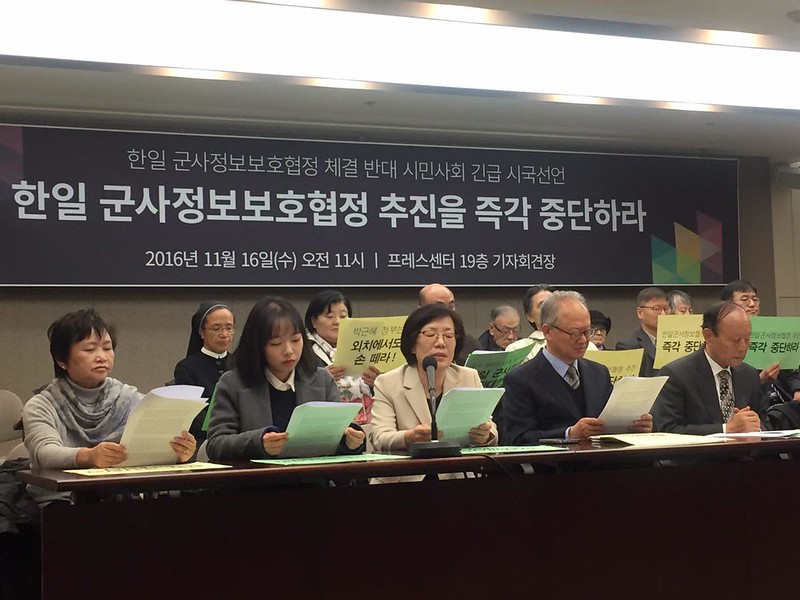
22842681698_f1ca94abab_c.jpg

South Korean Civil Society’s Declaration against the General Security of Military Information Agreement (GSOMIA) between the Government of the Republic of Korea and the Government of Japan 

Immediately cease the GSOMIA negotiation


(16 November 2016, Seoul) We, 225 public figures and 113 civil society organisations, call upon Park Geun-hye administration to stop the signing of dogmatic, undemocratic and unpeaceful General Security of Military Information Agreement (GSOMIA) between the Government of the Republic of Korea and the Government of Japan. Both governments held the first meeting in Tokyo on 1st of November, the second meeting in Seoul on 9th of November, the third meeting in Tokyo on 14th of November and tentatively initialed the GSOMIA. The Park administration has already requested the legislative office for examination in an aim to ratify the GSOMIA within this month. We strongly condemn the government’s undemocratic decision and warn the Government to immediately stop negotiation on the GSOMIA.


We strongly protest against the way how negotiation process has been carried out in an unfair and non-transparent manner. As we all recall, this Agreement was secretly carried out to the point of initialing by Lee Myung-bak administration in 2012 and was ceased due to the strong opposition from the people. People were outraged by the fact that the government pushed ahead with the agreement without consensus from the general public with the power vested and the national assembly as the representative body of the government.  


This undemocratic behavior is repeated and getting even worse. The Ministry of National Defense, which is mainly responsible for the GSOMIA has vowed until recently that forming general public consensus is crucial and that the “signing the GSOMIA can only be proceeded with conditions established.” Regardless, the Park Geun-hye administration has disregarded such conditions and without any attempt to reach a general public’ s consensus, it has decided to continue signing the GSOMIA like a military operation. 
 
While South Korean people are angered and shocked by the recent Presidential scandal, the GSOMIA is being enforced. As proved by a million protesting on 12th of November, majority of people are calling for the President’s immediate resignation. As the Park administration has failed to carry out the constitutional responsibility bestowed by the people, it is not qualified to proceed the GSOMNIA. Paradoxically speaking, this GSOMIA negotiation clearly proves that the President must not be involved both in domestic and international affairs. 
 

We are extremely concerned about the negative impact of the GSOMIA. The government has granted indulgence through abruptly settling on the Agreement on ‘comfort women’ to Abe Shinzo administration in Japan, which has been right wing-led and distorted its history of aggression. Signing the GSOMIA will rather encourage Japan’s remilitarization and exercise of collective self-defense. As the most affected victims of Japanese imperialism, we will not accept the government to blindly take such actions.  


The GSOMIA will instigate the possible new cold war in Northeast Asia. Republic of Korea is the closest neighboring country to North Korea, an explicit enemy of the US-Japan alliance, and China and Russia, strategic competitor countries of US. The reason for the US-Japan alliance to include South Korea in their military strategy largely lies in geopolitical factor. The Korean Peninsula will be a strategic advantage as battle front and troop as the last resort. The South Korea-US-Japan Military Information Sharing Pact signed in 2014 and Terminal High Altitude Area Defense (THAAD) deployment decision made in this July are in the same context. Such South Korea’s trilateral alliance may raise increasing concern in strengthening the trilateral alliance between North Korea, China and Russia. The result will be a new cold war in Northeast Asia and exacerbation of arms race as well as permanent loss of peace on the Korean Peninsula. As the victim of cold war, we will not allow the re-emergence of a new cold war. 


Some may assert that military cooperation with Japan is necessary in a pragmatic approach against the acceleration of North Korea’s missile and nuclear weapon threats. Nevertheless, the GSOMIA for trilateral missile defense system establishment will not assure South Korea’s safety. According to a report published by the US Congress Research Service (CRS) in June, 2013, it is assured that “South Korea might not benefit as much, because it is so close to North Korea that incoming missiles would likely fly on a lower trajectory and could arrive in a matter of minutes.” Considering our reality that we are still under ceasefire, this is a valid criticism. 


Military approach like the GSOMIA will clearly not stop North Korea’s nuclear development. This is just expansive reproduction of a failed policy. This will only lead to self-harm result in the Korean Peninsula. This will erupt cold war in Northeast Asia in reality and waste valuable resources that should be utilized for welfare and proliferation of humanity not for military competition.


The cooperation between South Korea-Japan and South Korea-US-Japan should not head in such direction. The objective of cooperation should be focused on peace and the means should be through diplomatic channels. Six-party talks should be resumed as it has been discontinued for about past eight years and relations between North and South Korea, North Korea and the US as well as North Korea and Japan should be resolved.


However, the Park administration has clearly proved that it has no will or capability to do so. It is gradually being disclosed that a shadowy advisor who is at the center of the corruption scandal has exerted extensive influence on domestic and international affairs but the government is still attempting to sign the GSOMIA. '


We will never accept such a historical regression. We can no longer trust the government that has lost ability to realize the seriousness of the issue and the President Park Geun-hye has no credibility, qualification or capability as a leader of this country. 


시민들의 의견

댓글 달기

Plain text

  • 웹 페이지 주소 및 이메일 주소는 자동으로 링크로 전환됩니다.
  • 줄과 단락은 자동으로 분리됩니다.
  • 사용할 수 있는 HTML 태그: <a href hreflang> <em> <strong> <cite> <blockquote cite> <code> <ul type> <ol start type> <li> <dl> <dt> <dd>
이미지
무제한 수의 파일을 이 필드에 업로드할 수 있습니다.
50 MB 한계입니다.
허용된 유형: png gif jpg jpeg.
Enter the YouTube URL. Valid URL formats include: http://www.youtube.com/watch?v=1SqBdS0XkV4 and http://youtu.be/1SqBdS0XkV4.
CAPTCHA
스펨 사용자 차단 질문

This letter, signed by civil society organizations around the world including PSPD, was released on March 25, 2016, in time for the Security Summit to be held in Washington DC on March 31-April 1.


To: Mr. Shinzo Abe
    Prime Minister of Japan


March 25, 2016


Subject: Call to help strengthen worldwide nuclear security by stopping plutonium separation


We, the undersigned, call on Prime Minister Shinzo Abe and the Government of Japan to make a strong contribution to the Nuclear Security Summit by announcing the indefinite postponement of the operation of the Rokkasho spent nuclear fuel reprocessing plant.


At the third Nuclear Security Summit held in The Hague, the Netherlands, in 2014 Prime Minister Shinzo Abe and President Barak Obama announced their agreement to:
“remove and dispose of all highly-enriched uranium (HEU) and separated plutonium from the Fast Critical Assembly (FCA) at the Japan Atomic Energy Agency (JAEA) in Japan.”
They declared that:
“this effort involves the elimination of hundreds of kilograms of nuclear material, furthering our mutual goal of minimizing stocks of HEU and separated plutonium worldwide, which will help prevent unauthorized actors, criminals, or terrorists from acquiring such materials.”


331 kilograms of plutonium from FCA are to be brought to the U.S. Department of Energy’s Savanna River Site in South Carolina. According to the Japan Atomic Energy Agency (JAEA), which operates the FCA, most of the plutonium (236 kg) is originally from the United Kingdom with 93 kg from the U.S. and the rest (2 kg) from France.


While asking the people of South Carolina to accept this material to protect the world from the possibility of theft from the JAEA’s lightly guarded Tokai-mura site, Japan is planning to begin to operate in 2018 its equally insecure Rokkasho Reprocessing plant, which is designed to separate annually up to 8,000 kilograms of plutonium from Japan’s spent nuclear fuel. The plant is currently the only reprocessing plant in a non-nuclear weapon state.


According to the US National Nuclear Security Administration’s (NNSA’s) Global Threat Reduction Initiative “Removal Program Overview” (December 3, 2014) the 331 kg of plutonium at FCA satisfies the program’s requirements for material to be sent to the United States for disposition, that:
“it must also pose a threat to national security, be susceptible to use in an improvised nuclear device, present a high risk of terrorist threat and have no other reasonable pathway to assure security from theft or diversion.”


While NNSA has been working hard to reduce this danger, it says threats still remain and calls for attention to the world-wide civilian separated plutonium problem emphasizing that:
“Global civilian plutonium inventories have risen sharply over the last 20 years” and that “Further international engagement is needed to stop plutonium accumulation and start drawing down inventories.”


After the 61st Pugwash Conference on Science and World Affairs, “Nagasaki’s Voice: Remember Your Humanity” (1-5 November 2015, Nagasaki, Japan) the Pugwash Council, sharing the same concern, declared:  
“Reprocessing to separate plutonium should end in all countries, including all nuclear weapon countries, whether for energy or weapon purposes…In view of the international security consequences of fuel cycle decisions, countries need to mutually agree to restrictions on their national sovereignty in making nuclear fuel cycle decisions.”


As of the end of 2014 Japan had 47,800 kilograms of separated plutonium: 10,800 kg in Japan, 20,700 kg in UK, and 16,300 kg in France. According to the International Panel on Fissile Material (IPFM) the amount of civilian separated plutonium worldwide as of the end of 2014 is about 270,000 kg. Three nuclear weapons states, France, the U.K., and Russia, and Japan account for most of this separated plutonium. The United States is faced with a difficulty trying to dispose of about 50,000 kg of surplus weapons plutonium. Further accumulation of nuclear-weapon-usable material is a concern for the international society and for Japan’s neighbors, who wonder why Japan is separating such huge quantities of directly weapon-useable material. Separated plutonium is a security risk. If other countries followed Japan’s example, it would increase proliferation risks. In fact, South Korea has been demanding that the United States acknowledge that the ROK has the same right as Japan to separate plutonium.


When Prime Minister Abe and President Obama announced the plan to transfer 331kg of plutonium to the U.S., they went on to:
“encourage others to consider what they can do to further HEU and plutonium minimization.”
At that time, in March 2014, operations at the Rokkasho reprocessing plant were to begin just around the time of the coming Nuclear Security Summit. This would have been a very ironic timing. The date subsequently was postponed to 2018, due to the inability of the plant’s operator to satisfy the new safety rules set by the Nuclear Regulation Authority created after the Fukushima accident. Some might be secretly hoping that this might effectively lower the profile of Japan’s plutonium separation program at a time when Japan’s Government hopes that the U.S. will agree to automatically extend, in 2018, their Agreement of Cooperation on the Peaceful Uses of Atomic Energy, which includes the U.S. acceptance of Japan’s right to separate plutonium from spent fuel irradiated in U.S. designed nuclear power plants.


We call on Japan to announce, at the Nuclear Security Summit to be held in Washington DC. March 31-April 1 2016, an indefinite postponement of its plan to start the Rokkasho reprocessing plant in order to further the mutual goal of Japan and the U.S. to minimize global stocks of separated plutonium. That would be a great contribution to the worldwide effort to strengthen nuclear security.


>>> To read this letter in Korean

화, 2016/04/05- 16:34
140
0

37th Regular Session Human Rights Council

Item 6 : Consideration of the Universal Periodic Review outcome of Republic of Korea 

Oral Statement Delivered by Ms. Rosanna Ocampo on Behalf of
South Korean NGO Coalition for the 3rd Cycle of the UPR


Mr President, FORUM-ASIA delivers this statement together with the South Korean NGO Coalition for the 3rd Cycle of the UPR. We appreciate the government of the Republic of Korea’s efforts to engage with civil society in the UPR process. However, we regret that some of our key concerns have been ignored.


Despite deep concerns expressed by numerous states, the Republic of Korea has merely noted recommendations to abolish the death penalty  and the National Security Law ; to adopt a comprehensive anti-discrimination law, which also addresses discrimination based on sexual orientation and gender identity ; and to allow civilian alternative service for conscientious objectors to military service.  Furthermore, the government has not accepted recommendations to improve the human rights of migrants and their families. 


We welcome the government’s support for recommendations on freedom of expression, and freedom of assembly and peaceful association, including to ratify four ILO core conventions.  We welcome its commitment to protect human rights defenders, and to investigate excessive use of state force against human rights defenders and trade union representatives. We also look forward to the adoption of a comprehensive strategy to prevent gender-based violence.  However, the government has yet to implement concrete measures on any of these issues.


Civil society in the Republic of Korea calls upon the government to develop a concrete and time-bound implementation plan in consultation with the national human rights institution and civil society organisations.  We look forward to further engagement with the government and the international community in following up on UPR recommendations.


Thank you.


Thursday, 15 March 2018


South Korean NGO Coalition for the 3rd Cycle of the UPR


See the video >> Click


목, 2018/03/15- 15:41
135
0

오늘의 출연자

  • 진행 : 이미현 팀장 (참여연대 평화국제팀)
  • 이슈손님 : 김창수 원장 (코리아연구원), 하주희 변호사 (민변 미군문제연구위원회)


20161122-한일군사정보보호협정.jpg


참팟 호외 18 / 한일군사정보보호협정, 나라를 팔아먹을 셈인가?


박근혜 대통령이 국정운영에서 손을 떼고 당장 물러나야 한다는 여론이 들끓는 지금, 정부는 11월 14일 한·일 군사정보보호협정(GSOMIA)에 가서명을 하고, 오늘(22일) 국무회의 의결 후 대통령 재가를 걸쳐 내일(23일) 정식 협정 체결을 진행하려 하고 있습니다.
참팟 호외는 이 협정이 이렇게 졸속적이고 국민 여론을 무시하고 강행되고 있는 배경과 의미, 그리고 협정이 실제 체결되었을 경우 예상되는 일본 자위대의 활동, 한반도를 비롯한 동북아에 미치는 영향에 관해 이야기 나눴습니다. 


* 플레이어가 보이지 않는 경우 : https://goo.gl/oDzo4H

* 아이튠즈로 듣기 : https://goo.gl/hspVgo

* 유튜브로 듣기 : https://youtu.be/hQdb40CC98w


같이보기 


화, 2016/11/22- 01:08
127
0

There was a large demonstration of around 130,000 protesters in downtown Seoul on November 14th.

Demonstrators and Police clashed near Gwanghwamoon Plaza around 5pm. Police hit back at protests with water canons. The demonstration continued into the night.

Mr Baek, an elderly protestor was knocked down by the police water cannon while taking part during the demonstration, has since had to undergo brain surgery at Seoul National University hospital.

Subtitle by : Sewol Ferry Worldwide Supporters Translation Team, John Georgie

일, 2015/11/15- 14:34
122
0

The dialogue must go on

PSPD strongly condemns the announcement of the abrupt withdrawal of the US from the DPRK-US Summit


On May 24 President Donald Trump of the United States canceled the summit scheduled to take place on June 12 in Singapore with North Korean leader Kim Jong Un, shortly after ROK-US summit in Washington DC and North Korea's destruction of its Punggye-ri nuclear test facility. This act is very rude and clearly goes against all the efforts and world’s support for the peace process on the Korean Peninsula. The People’s Solidarity for Participatory Democracy (PSPD) strongly condemns the abrupt announcement by the US on its withdrawal from the planned DPRK-US summit and urges the US to return to the summit.


President Donald Trump wrote that he was pulling out of the meeting because of North Korea’s recent “tremendous anger and open hostility.” It was, however, the US who actually provoked North Korea, by mentioning the "Libya Model" and "abandoning nuclear weapons first, compensating afterwards." The hostile communication between DPRK and US is the very reason the DPRK-US summit is necessary.


We, the Korean people, who wholeheartedly welcomed the inter-Korean summit and the Panmunjeom Declaration in April, are now deeply disappointed by the recent ROK-US “Max Thunder” joint military exercise, the cancellation of high-level inter-Korean talks, and the sudden cancellation of the DPRK-US summit. Through the inter-Korean summit, we have affirmed the power of dialogue. We believe that the only realistic way to alleviate the military tension surrounding the Korean Peninsula and to establish permanent peace and denuclearization on the Korean Peninsula is through dialogue and negotiation. The dialogue must go on.


[Statement] See / Download

Korean Version >>

금, 2018/05/25- 20:36
116
0