주요 콘텐츠로 건너뛰기

⭐️ Fresh Start of the Korea Peace Appeal Campaign

지역

⭐️ Fresh Start of the Korea Peace Appeal Campaign

admin | 금, 2023/03/03- 16:30
20230214_정전 70년 한반도 평화행동 출범대회
2023.02.14 Korea Peace Appeal Campaign

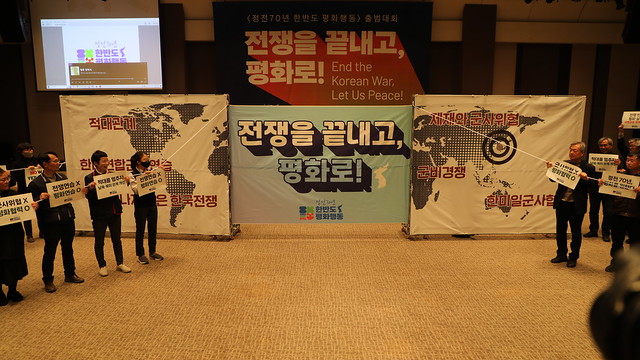
⭐ End The Korean War, Let Us Peace!

Tuesday, 14  February, 2023, Korea Press Foundation

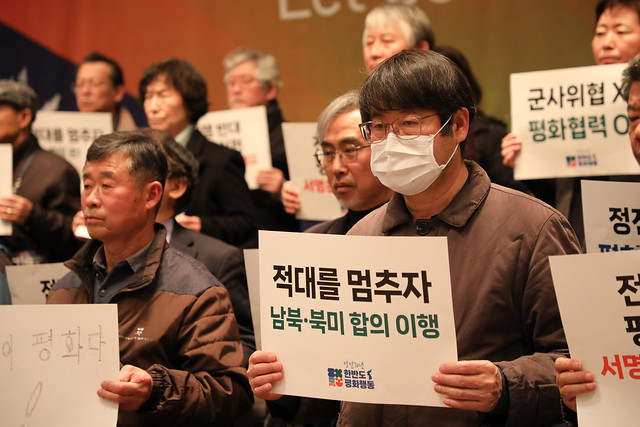
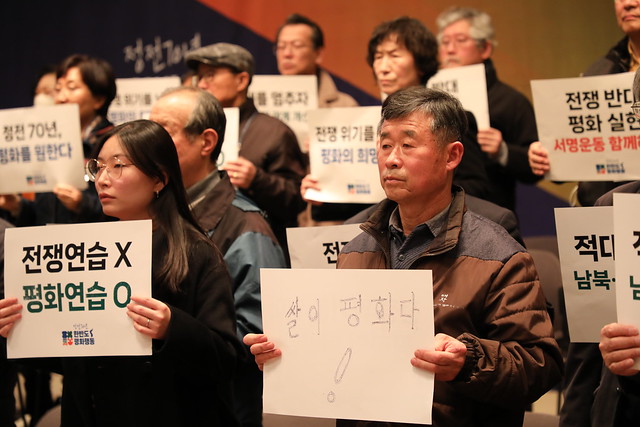
As 2023 marks the 70th anniversary of the Korean War Armistice, the <South Korean Committee on June 15th Joint Declaration> and the <Korea Peace Appeal Campaign> launched a new project <Korea Peace Action for the 70th Anniversary of the Armistice>. A press conference was held where many religious and civil society representatives, who have been endeavoring for peace in the Korean Peninsula, participated and gathered eager to rebuild hope of peace over the threat of war. 735 organizations nationwide are a part of the <Korea Peace Appeal Campaign>.

Our main goal is to resolve the threat of war and build peace. As a joint civil society, we plan to continue the signature campaign but more intensively, and organize other various peace actions. The <Korea Peace Appeal Campaign> will warn the danger of the present crisis, create domestic and foreign public opinions for the peace of the Korean Peninsula and Northeast Asia, and gather voices of opposition toward the recent rapid promotions of the military cooperation between South Korea, the US, and Japan. This year we will be manifesting the following actions:

☮ Korea Peace Appeal Signature Campaign
☮ Actions urging suspension of the ROK-US Combined Military Exercises and ROK-US-Japan Military Cooperation
☮ Korea peace actions in 300 cities worldwide comprising 100 overseas (June-July)
☮ Saturday, 22 July 2023, Massive Peace Rally and Parade
☮ Thursday, 27 July 2023, International Conference
☮ 15 August 2023 (TBD), Massive Peace Rally

20230214_정전 70년 한반도 평화행동 출범대회

Korea Peace Action for the 70th Anniversary of the Armistice Declaration

Let’s resolve the threat of war and build peace in the Korean Peninsula

70 long years have passed since the roar of gunfire coming from the three-year war in Korea stopped. The past 70 years were certainly not a peaceful period but a temporary ceasefire. Due to the fear and anxiety that the war could outbreak any time soon, the neverending hostility and military tension, and the internal and external challenges leveraging and goading these unstable conditions, everyone living on the Korean Peninsula had to cope with the immense pain and expense.

When the South and North Korean Leaders, and the North Korean and US leaders discussed a transfer to a new relationship at the Panmunjom Declaration of 27 April, the Pyongyang Joint Declaration of 19 September, the Singapore Joint Statement of 12 June, the Korean people saw a single thread of hope that the tension and danger of war, which had been crushing us, would disappear and a peacefully coexisting future unlock. Despite the North-South and North-US Agreement, dialogues were adjourned on account of the different views on corresponding measures, and as the power-to-power confrontations intensify, the present Korean Peninsula is falling into great despair. We are not even sure if the unstable ceasefire will be maintained. A sense of crisis that there is no guarantee an accidental collision could turn into a terrible disaster from a nuclear war is oppressing every life and existence on this land.

No methods of dialogue are left between the North-South and North-US. Moreover, the global environment is restraining us. Amidst the Russia-Ukraine war and the US-China conflict, the possibility of Korea being used as a proxy battlefield for international-level military tensions and new Cold War confrontations is greater than ever. However, there is no sound of a practical and active solution to ease tension, prevent armed conflict, or create dialogue conditions.

The government of Yoon Suk Yeol clarified ‘Peace through Strength’ and massively expanded the scale of military exercise, propagandizing that military force can beget surrender. However, this has only aggravated the danger of military clashes in Korea. By stating the practicality of extended deterrence against nuclear and missile threats of North Korea, the Yoon Suk Yeol government has been justifying that we jump on the United States’ strategy against China and South Korea to be subordinated to the ROK-US-Japan military cooperation system. However, the danger of a nuclear arms race and nuclear war around the Korean Peninsula is proliferating. The result of pressure through power is merely the repetition of North Korea’s advancement in nuclear power and mutual armed protests. The only thing the Yoon Suk Yeol government proved so far is that they have no practical method nor capability to manage the crisis and bring peace.

We still have time to prevent conflict and disintegration. We also have a chance for dialogue and negotiation. The reason things got worse is that even after agreeing to a new relationship, the government hesitated to take corresponding measures to build trust, such as suspending the ROK-US joint military exercises, not the insufficiency of armed protest. We must stop the outbursts of armed protests. We must open the door to peace through bolder and more flexible confidence-building measures and pre-emptive easing of tensions. We must act to build peace. The more difficult it is to talk about peace, the more we must gather willingness toward peace from all social standings and reverberate the voice of people who demand peace.

As we launch the <Korea Peace Action for the 70th Anniversary of the Armistice>, we call for the following. We call for stopping hostilities. We call for immediate and faithful action to improve relations as agreed by two Koreas and North Korea and the US. We call for an end to a 70-year-old unstable ceasefire and an agreement on the peace treaty. We call for a Korean Peninsula and a world without nuclear weapons and nuclear threats. We call for restoring trust and resolving conflicts through dialogue and cooperation, not sanctions and military threats. Particularly, we call for a halt in the large-scale ROK-US combined military exercise and opening the way for dialogue toward peace. We call for stopping military cooperation between South Korea, the US, and Japan, which will lead to a new Cold War confrontation, and instead creating an order of cooperation in which the Korean Peninsula and Asia coexist peacefully. Please, we do not call for a destructive arms race, but we call for the safety of people and cooperation to overcome the climate crisis.

We will act. We will take action in the 1 million signature campaign for the Korea Peace Appeal. We will continue the peace declaration and solidarity of people from all social standings in many parts of the world, including 200 cities in Korea and 100 cities in overseas, in the online and offline space. We will work hard to stop ROK-US joint military exercises and military cooperation between South Korea, the US, and Japan, which are escalating tensions and confrontations on the Korean Peninsula and Asia. Marking the 70th anniversary of the Korean War Armistice in July this year, we will focus our actions so that the nation calling for peace on the Korean Peninsula and the voices of peace forces from all around the world can resonate all over the Korean Peninsula and the whole world.

If we seek peace, we can open the way to peace.

We decide our future.

Join us in the <Korea Peace Appeal Campaign>.


14 February 2023

From all Korea Peace Appeal Campaign organizations (total of 735)


Korea Peace Appeal 2

? Signature Campaign to End the Korean War
Sign the Korea Peace Appeal Now ?
endthekoreanwar.net

The post ⭐️ Fresh Start of the Korea Peace Appeal Campaign appeared first on 참여연대.

시민들의 의견

댓글 달기

Plain text

  • 웹 페이지 주소 및 이메일 주소는 자동으로 링크로 전환됩니다.
  • 줄과 단락은 자동으로 분리됩니다.
  • 사용할 수 있는 HTML 태그: <a href hreflang> <em> <strong> <cite> <blockquote cite> <code> <ul type> <ol start type> <li> <dl> <dt> <dd>
이미지
무제한 수의 파일을 이 필드에 업로드할 수 있습니다.
50 MB 한계입니다.
허용된 유형: png gif jpg jpeg.
Enter the YouTube URL. Valid URL formats include: http://www.youtube.com/watch?v=1SqBdS0XkV4 and http://youtu.be/1SqBdS0XkV4.
CAPTCHA
스펨 사용자 차단 질문

37th Regular Session Human Rights Council

Item 6 : Consideration of the Universal Periodic Review outcome of Republic of Korea 

Oral Statement Delivered by Ms. Rosanna Ocampo on Behalf of
South Korean NGO Coalition for the 3rd Cycle of the UPR


Mr President, FORUM-ASIA delivers this statement together with the South Korean NGO Coalition for the 3rd Cycle of the UPR. We appreciate the government of the Republic of Korea’s efforts to engage with civil society in the UPR process. However, we regret that some of our key concerns have been ignored.


Despite deep concerns expressed by numerous states, the Republic of Korea has merely noted recommendations to abolish the death penalty  and the National Security Law ; to adopt a comprehensive anti-discrimination law, which also addresses discrimination based on sexual orientation and gender identity ; and to allow civilian alternative service for conscientious objectors to military service.  Furthermore, the government has not accepted recommendations to improve the human rights of migrants and their families. 


We welcome the government’s support for recommendations on freedom of expression, and freedom of assembly and peaceful association, including to ratify four ILO core conventions.  We welcome its commitment to protect human rights defenders, and to investigate excessive use of state force against human rights defenders and trade union representatives. We also look forward to the adoption of a comprehensive strategy to prevent gender-based violence.  However, the government has yet to implement concrete measures on any of these issues.


Civil society in the Republic of Korea calls upon the government to develop a concrete and time-bound implementation plan in consultation with the national human rights institution and civil society organisations.  We look forward to further engagement with the government and the international community in following up on UPR recommendations.


Thank you.


Thursday, 15 March 2018


South Korean NGO Coalition for the 3rd Cycle of the UPR


See the video >> Click


목, 2018/03/15- 15:41
135
0

Launch of GPPAC Publication

Reflections on Peace and Security in Northeast Asia

– Perspectives on the Ulaanbaatar Process


The publication Reflections on Peace and Security in Northeast Asia - Perspectives on the Ulaanbaatar Process was launched in Ulaanbaatar, Mongolia on August 29, on the occasion of the third meeting of the Ulaanbaatar Process, a civil society-led dialogue for peace and stability in Northeast Asia. The publication is a collection of essays which capture the diverse and uncompromised opinions, concerns, tensions and contradictions of a region in turmoil at the time of the 3rd Ulaanbaatar Process Meeting held on August 29–30, 2017.


Articles of the printed publication are made available online at https://medium.com/reflections-on-peace-and-security-in-northeast. Please visit this site. 


Reflections on Peace and Security in Northeast Asia - Perspectives on the Ulaanbaatar Process explores the contentious issue of nuclear weapons in the region, the current security climate on the Korean Peninsula which is frozen in a fragile armistice, as well the successes and challenges faced by non-governmental organizations in the context of peacebuilding in Northeast Asia. It features articles by the participants of the Ulaanbaatar Process; representatives of civil society from China, Japan, the Democratic People's Republic of Korea, the Republic of Korea, the United States of America, the Russian Federation as well as Mongolia.


The Ulaanbaatar Process, launched by the Global Partnership for the Prevention of Armed Conflict (GPPAC) in June, 2015, aims to support the creation of conditions of peace and stability in Northeast Asia through the promotion of greater civil society dialogue and interaction. It is hosted by Mongolian NGO Blue Banner in cooperation with GPPAC Northeast Asia, and with the support of the Mongolian Ministry of Foreign Affairs.


The third Ulaanbaatar Process meeting provided an opportunity for sincere and open civil society dialogue on the current peace and security situation in Northeast Asia, and particularly the crisis on the Korean Peninsula. The previous two meetings, similarly held in Ulaanbaatar, also saw the participation of civil society representatives of all the Six Party Talks countries and Mongolia. 


For more information about the Ulaanbaatar Process, please visit the GPPAC Northeast Asia as well as Facebook page  https://www.peaceportal.org/web/ulaanbaatar-process/home

For more information on GPPAC, please visit http://www.gppac.net/.


<Photo from GPPAC NEA, Aug 29-30, 2017>

금, 2017/09/01- 13:33
128
0

There was a large demonstration of around 130,000 protesters in downtown Seoul on November 14th.

Demonstrators and Police clashed near Gwanghwamoon Plaza around 5pm. Police hit back at protests with water canons. The demonstration continued into the night.

Mr Baek, an elderly protestor was knocked down by the police water cannon while taking part during the demonstration, has since had to undergo brain surgery at Seoul National University hospital.

Subtitle by : Sewol Ferry Worldwide Supporters Translation Team, John Georgie

일, 2015/11/15- 14:34
122
0

The dialogue must go on

PSPD strongly condemns the announcement of the abrupt withdrawal of the US from the DPRK-US Summit


On May 24 President Donald Trump of the United States canceled the summit scheduled to take place on June 12 in Singapore with North Korean leader Kim Jong Un, shortly after ROK-US summit in Washington DC and North Korea's destruction of its Punggye-ri nuclear test facility. This act is very rude and clearly goes against all the efforts and world’s support for the peace process on the Korean Peninsula. The People’s Solidarity for Participatory Democracy (PSPD) strongly condemns the abrupt announcement by the US on its withdrawal from the planned DPRK-US summit and urges the US to return to the summit.


President Donald Trump wrote that he was pulling out of the meeting because of North Korea’s recent “tremendous anger and open hostility.” It was, however, the US who actually provoked North Korea, by mentioning the "Libya Model" and "abandoning nuclear weapons first, compensating afterwards." The hostile communication between DPRK and US is the very reason the DPRK-US summit is necessary.


We, the Korean people, who wholeheartedly welcomed the inter-Korean summit and the Panmunjeom Declaration in April, are now deeply disappointed by the recent ROK-US “Max Thunder” joint military exercise, the cancellation of high-level inter-Korean talks, and the sudden cancellation of the DPRK-US summit. Through the inter-Korean summit, we have affirmed the power of dialogue. We believe that the only realistic way to alleviate the military tension surrounding the Korean Peninsula and to establish permanent peace and denuclearization on the Korean Peninsula is through dialogue and negotiation. The dialogue must go on.


[Statement] See / Download

Korean Version >>

금, 2018/05/25- 20:36
116
0

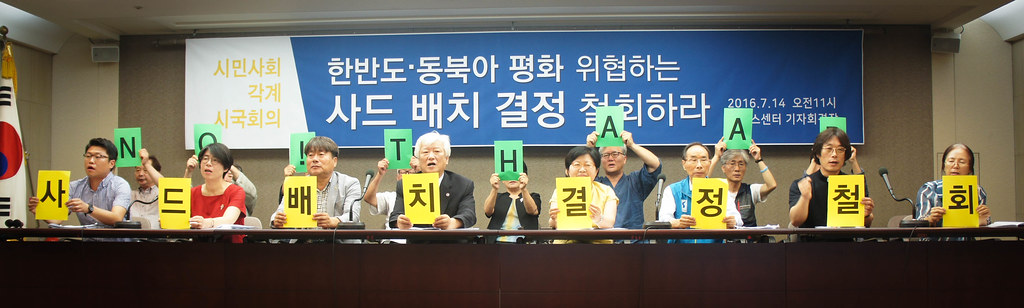
사드 배치 결정 철회 촉구 시국회의


The decision to place THAAD in South Korea, which threatens peace in the Korean Peninsula and Northeast Asia and violates the residents’ right to live peacefully, must be rescinded. 


The entire country is being shaken, and the already-dangerous political situation in the Korean Peninsula and Northeast Asia is becoming even more unpredictable because on July 8, 2016, South Korea and the U.S. announced that they are deploying THAAD to South Korea. Up until South Korea and the U.S. officials announced Seongju, North Gyeongsang Province as the location for THAAD deployment, this process had been entirely ambiguous and one-sided. Even though a plethora of concerns regarding the use, the efficiency, the military/diplomatic prices, and the side effects of THAAD were raised, the South Korean government, behind the curtains, decided to follow the request of the U.S. Now, in Seongju, the anger and the resistance of its residents, who have suddenly been notified of the deployment of THAAD, are growing rapidly. 
 
THAAD is not a weapons system for the residents of the Korean peninsula or for their defense. 

THAAD is essentially a part of the U.S. Missile Defense System (MD). It will be the U.S. military and government that will be running THAAD. MD is an aggressive weapons system, based on the “absolutely stubborn” idea, which aims to incapacitate the missile attacks of the countries against the U.S. and enable the U.S. to launch missiles whenever they want to. The South Korean government is insisting that the deployment of THAAD is to defend the Korean Peninsula from North Korean nuclear weapons and missiles. However, recently, the government has admitted that THAAD cannot defend Seoul and its metropolitan area. The South Korean government is still advertising as if THAAD can at least defend the area within its 200km radius, but this is not true. 200km is nothing but a number to describe the range of the intercept missile attached to THAAD. But, the detectable range of the radar on THAAD theoretically reaches at most a few thousand kilometers. This is why there has been criticism that the main purpose of the frontline deployment of THAAD is to detect medium- to long-range missiles flying over the Korean Peninsula and nearby skies according to the U.S. military strategy. Therefore, there is no such thing as an “adequate” location to place THAAD in this country. The decision of South Korea and the U.S. to place THAAD in Seongju must be rescinded. 


THAAD deployment is militarily and diplomatically self-destructive measure, which will threaten the safety of South Korean citizens and become a severe obstruction in peace and prosperity of the Korean Peninsula and Northeast Asia.

South Korean THAAD is closely related to the missile defense system that was introduced to Japan. Deployment of THAAD to South Korea signifies that South Korea will be sucked into the U.S.-Japan MD, which targets not only North Korea but also China, as a subsidiary partner, and that the Korea-U.S.-Japan military cooperation system will become official. No matter how much South Korean government claims that this is essential to the South Korean sovereignty, the international society and neighboring countries will not accept it. The “strategic companion” relationship with China has become a meaningless term, and the basis of economic cooperation and the friendly relationship between the citizens of both countries can be at risk. China and Russia have already announced that they will be “taking correspondent measures.” It is obvious that this will also negatively affect the international cooperation to solve the nuclear problem in the Korean Peninsula. This is why THAAD can never be a tool to protect the safety of South Korean citizens and peace in the Korean Peninsula. The decision to place THAAD, the “real danger,” which brings threats and conflicts instead of peace, in South Korea must be rescinded.   


We also protest against the undemocratic and non-transparent decision process. 

Before facilitating THAAD deployment, exhibitions, discussions, and evaluations of its use, effects, and military/diplomatic significance should have been carried out. The information about the negotiation process must have been transparently released. However, the South Korean government skipped all these procedures and simply controlled all information. There was not enough discussion even within the related organizations. They treated this important matter, which puts the future of peace in the Korean Peninsula at stake, as if they are carrying out a military strategy. The South Korean national assembly, which represents all of South Korean citizens, never received any substantial reports. The character, the content, and the discussion process of “South Korea-U.S. joint working group for the discussion of THAAD deployment” were not shared with the National Assembly. Even after the decision to deploy THAAD in South Korea, the South Korean government is insisting that this does not require the agreement of the National Assembly. In the case of Seongju, which was decided as the location for THAAD deployment, the residents and the military officials received the unexpected news without any explanation. They were not notified of the negative effects on the environment surrounding the THAAD base and health of the residents. The undemocratic and non-transparent decision of the South Korean government to place THAAD must be rescinded immediately.  


THAAD deployment must receive the consent of the representative body, which in this case, is the National Assembly.

THAAD deployment is directly related to the lives and the safety of South Korean citizens and is a critical matter, which will influence the friendly cooperative relationship with neighboring countries. It may also cost an astronomical amount of money. Therefore, this matter cannot be solely decided by the administrative body; it needs the agreement of the National Assembly. More than anything, the dangerous practice of the South Korean government, which ignores the discussion process and treats this issue like a secret military strategy to avoid the regulation of the National Assembly, cannot be left uncontrolled. If the National Assembly represents all of South Korean citizens, they must stop the one-sided push of THAAD deployment and exercise their right to consent. If the government never asks for the agreement of the National Assembly, the National Assembly must restrain the government’s abuse of its authorities through every measure, such as an investigation in relation to government, an adaptation of the resolution to oppose, and a demand for jurisdiction dispute.  


We are going to start a pan-national peace action to rescind the decision to place THAAD in South Korea. 

We are going to start a pan-national peace action that gathers people from various backgrounds and publicizes the problems of this decision to rescind the decision to place THAAD in South Korea and to stop South Korea from being sucked into the U.S.-Japan missile defense system. We are going to form solidarity to prevent Seongju, North Gyeongsang Province from becoming another victim of state violence, like Pyeongtaek Deachuri or Jeju Gangjeong village. In addition, we are going to fight with all of South Korean citizens, so that THAAD will not be placed in Seongju or any other parts of South Korea. To accomplish this, we are going to actively try to convince and pressure local governments, the National Assembly, and related government organizations and will convey our message to governments and civil societies of neighboring countries, including the U.S. and japan. We will surely punish any abuse of power that undemocratically pushes for the placement of THAAD. Moreover, we are going to form solidarity to facilitate the reconciliation and the cooperation of North and South Korea and to form a peaceful system. The Korean Peninsula should no longer become an explosive warehouse, which is swayed and used by the arms race of the neighboring powers, but should transform as the stepping stone of Northeast Asian peace and cooperation. We are going to actively spread civil resistance and actions for the withdrawal of the decision to place THAAD and for peace in the Korean Peninsula and Northeast Asia. 


July 14, 2016


번역 : 목지수 (참여연대 평화군축센터 자원활동가)

목, 2016/07/14- 23:23
105
0