주요 콘텐츠로 건너뛰기

Building and Sustaining Peace at the Regional Level

지역

Building and Sustaining Peace at the Regional Level

admin | 월, 2023/01/30- 15:02

On December 8 2022, in partnership with the Permanent Mission of Mongolia to the United Nations, the Global Partnership for the Prevention of Armed Conflict (GPPAC) organised a roundtable discussion titled Building and Sustaining Peace at the Regional Level: The Network Approach to Regional Coordination in Northeast Asia during an advocacy visit of Ulaanbaatar Process participants to New York City.

This discussion was an informal dialogue to share the learning from the Ulaanbaatar Process with global peacebuilding policy experts within the United Nations, Member States and regional organisations. The conversation outlined critical avenues to support regional peacebuilding coordination in policy and shared practical experiences for practical action. The discussion also outlined persistent challenges of regional peacebuilding coordination, and discussed recommendations to develop solutions to strengthen peacebuilding work in Northeast Asia.

During the roundtable, remarks were shared by Ulziibayar Vangansuren, Permanent Mission of Mongolia to the United Nations; Ambassador Enkhsaikhan Jargalsaikhan, Chair of NGO Blue Banner and former Mongolian Permanent Representative to the UN; Sonja Bachmann, Teamleader Northeast Asia and Pacific, UN Department of Peacebuilding Political Affairs (DPPA); Kajita Natsuha, learning designer and facilitator; Kim Jeongsoo, Standing Representative, Women Making Peace and Hwang Sooyoung, Manager, Centers for Peace and Disarmament and for International Solidarity, People’s Solidarity for Participatory Democracy (PSPD).

Based on the experiences from Northeast Asia, the following key elements build an effective regional peacebuilding architecture:

  • Multi-stakeholder coordination is required and must be based on complementarity among partners.
  • The network approach to peacebuilding must be at the core of regional coordination.
  • Inclusivity is key for effective regional peacebuilding networks.

The following recommendations have thus been identified for the strengthening of the regional peacebuilding mechanisms:  

  • The UN should take a more active convening role to bring together regional actors, the UN, national governments, and civil society, among others, to coordinate actions better and ensure a stronger impact of peacebuilding activities.  Where regional peacebuilding networks play an essential role in building the foundation for regional dialogue, the UN should provide technical and political accompaniment to ensure the commitment to action. 

  • Improved funding mechanisms are needed to support the civil society organizations’ network approach. A network approach creates empowering and equitable spaces for exchanging expertise for more impactful and informed action, sharing resources and access points at various levels, and enabling and supporting communities committed to peace. Donors should reflect on how to improve funding mechanisms to support better civil society organizations engaged in regional peacebuilding networks, allowing them, through effective funding, to fill the gaps in the regional peacebuilding infrastructure. It is crucial to ensure that all regions are fairly represented in the international discussion on peacebuilding and are given international attention, as this also impacts funding availability. 

  • The inclusion of women and youth is key in regional peacebuilding networks and should be supported. Although women are strongly affected by conflicts, they are often excluded from negotiations and peace processes, especially in highly patriarchal contexts. The inclusion of local women within peacebuilding initiatives is essential to ensure that their unique perspectives can have a real impact at the decision-making level. Likewise, the meaningful participation of young people in dialogue on equal terms is essential to achieve and sustain peace. Young people in all their diversities should be considered as drivers for change, and their contributions should be held as relevant and valuable. Donors should prioritise supporting regional peacebuilding dialogues that ensure the meaningful participation of women and youth at all stages of the process.  The UN and its Member States should use their influence and international platforms to  ensure that the unique perspectives of local women and youth peacebuilders are heard and taken into account in the decision-making processes.

This is an article for Global Partnership for the prevention of Armed Conflict (GPPAC) Northeast Asia News, Jan 2023

Summary Document [See/Download]

The post Building and Sustaining Peace at the Regional Level appeared first on 참여연대.

시민들의 의견

댓글 달기

Plain text

  • 웹 페이지 주소 및 이메일 주소는 자동으로 링크로 전환됩니다.
  • 줄과 단락은 자동으로 분리됩니다.
  • 사용할 수 있는 HTML 태그: <a href hreflang> <em> <strong> <cite> <blockquote cite> <code> <ul type> <ol start type> <li> <dl> <dt> <dd>
이미지
무제한 수의 파일을 이 필드에 업로드할 수 있습니다.
50 MB 한계입니다.
허용된 유형: png gif jpg jpeg.
Enter the YouTube URL. Valid URL formats include: http://www.youtube.com/watch?v=1SqBdS0XkV4 and http://youtu.be/1SqBdS0XkV4.
CAPTCHA
스펨 사용자 차단 질문

115th Session of the Human Rights Committee
19 October 2015 – 6 November 2015


NGO Briefing on the Republic of Korea


Oral Statement Delivered by Ms. Gayoon Baek(People’s Solidarity for Participatory Democracy) and Mr. Youngsoug Chang(MINBYUN-Lawyers for a Democratic Society) 
on Behalf of South Korean Human Rights Organizations Network (83 NGOs)


We are presenting this statement on behalf of 83 civil society organizations in the Republic of Korea who jointly submitted the report to the Committee. All the rights mentioned in the Covenants are our areas of focus.


Human rights were once a pride for Koreans. But today, we are grieved to present the report with shame. Civil and political rights in the Republic of Korea have been drastically deteriorating year after year. We fear that the Republic of Korea is reverting to the dark era of authoritarian regime that we believed to have overcome. One can easily find human rights defenders in the Republic of Korea, on the streets, on top of factory chimneys, in front of the court, and in prison. Sewol ferry victims’ families have been living on the streets to protest for more than a year, workers have been on a hunger strike for more than 45 days, and villagers have been protesting against the naval base construction for more than 9 years.  As we speak today, hundreds of high school students are protesting on the streets opposing the Government’s plan to impose state history textbooks, which is suspected to idealize past military dictatorship. The Government has failed to protect people’s civil and political rights and people are compelled to run to the streets with candles. 


Although rule of law, freedom of expression and independence of judiciary are guaranteed in the Constitution, the laws have been used as tools to justify restriction and suppression of human rights and people have lost their freedom after expressing their views. The judiciary no longer defends human rights defenders, and is no longer a safeguard for human rights victims. The National Human Rights Commission of Korea also cannot play an active role in monitoring implementation of the Covenant and we have a serious concern that transparent and independent selection process of the Commissioners are not yet guaranteed which brings doubts on human rights competency and expertise of commissioners. 


The number of people who have been charged and indicted for violating the National Security Act, which the Committee and other UN human rights mechanisms have repeatedly recommended to amend or repeal, has increased threefold in 2013 compared to 2008. Government officials and agencies consistently punish people for defamation  or insult  who criticize the Government, sometimes even those who state facts or simply express feelings or opinions. On the other hand, human rights defenders and social minorities become targets of incitement to discrimination, hostility or violence. However, there is no legal framework nor gestures from the Government showing any political will to protect them. The society is now at a critical juncture. 


People who gather to peacefully protest against Government policies or development projects are being arrested, detained and indicted. The police use excessive force against barehanded protesters to suppress assemblies, such as water cannons loaded with capsaicin and tear gas liquid and bus barricades to block assemblies. Even human rights lawyers and journalists have been arrested during protests. Around 550 people including family members of the victims were arrested during the Sewol ferry related protests from April 2014 to May 2015. We are not allowed to stand in solidarity with our friends, not to mention participating in assemblies. One worker who visited labor strike sites to deliver support statements has been punished for aid and abetment of Obstruction of Business. 


The Republic of Korea has the highest Internet penetration rate and the fastest wireless broadband in the world. With this technology, the Government is watching and intervening in people’s private lives. The police can identify those who are at protests by seizing and analyzing all phone call histories from the nearby base stations. Phone or internet users’ personal information can be seized without warrants, and such seizure is significantly increasing, amounting to about 13 million accounts in 2014 in a country with just 50 million people. Children under 19 years old must use mobile phones equipped with applications enabling the parents and service providers to monitor and remotely control their phones. 


We are also subject to human rights violations under the name of counter-terrorism. All currently pending counter-terrorism bills grant excessive authority to the National Intelligence Service (NIS) which is notorious for its abuse of power and human rights violations. The NIS systematically intervened in the 2012 Presidential Election by posting and tweeting 786,000 online messages. Also, the NIS was found fabricating evidence of an espionage case.   


In face of gross violation of civil and political rights in the country, people cannot gain full access to justice and are unfairly treated during investigations. Only 0.2% of investigators are indicted of maltreating the accused.  Even though lawyer’s participation is crucial to prevent such harassment, the police and prosecutor’s office arbitrarily interpret the Criminal Procedural Act to minimize lawyers’ participation. Generally, lawyers are limited in presenting their views during the interrogation and sometimes, lawyers are even threatened by the investigators.   

The human rights situation in detention centers is also problematic. The disciplinary punishment committees of prisons are not guaranteed of their independence and fairness, as the prison warden appoints members of the committee. Almost 90% of the actual punishment in the prison has been executed in the form of solitary confinement, which is the most severe disciplinary measure. 


In particular, children, transgenders and foreigners in detention centers are facing more serious human rights violations. Children are denied protective measures under relevant regulations in the criminal procedures. Moreover, detention centers have no guidelines on the treatment of transgenders.  Because of this, transgender inmates are denied underwear of their own choice and there was a case where a transgender inmate was punished for refusing to get a haircut.  Furthermore, foreigners detained in detention centers may be subject to indefinite detention due to lack of legal regulation on maximum detention periods. In the event the Minister of Justice commenced detention that is not subject to independent judicial review, the detainees are prevented from disputing the legality of the detention. The deportation rooms at Incheon International Airport practically function as detention centers since detainees are restrained from outside contact and denied access to attorney.


Recently in 2014, the existence of the DPRK Defector Protection Center (former Central Joint Interrogation Center) was widely known by testimony of one detainee. When DPRK defectors come to the Republic of Korea, they are sent to the center for interrogation, but nobody knows what exactly is happening inside. We do not know how many DPRK defectors are being detained for how long, and whether they are being deported or not. Access to the center is strictly regulated by the NIS. Also, there are some DPRK defectors in the Republic of Korea who wish to go back to the DPRK, but their return is not allowed by the Government on grounds of violations of the National Security Act.  


The military, where all Korean men are mandated to serve, is another blind spot for human rights violations. Almost 3,600 human rights violations such as assault and other cruel acts have been reported in the last five years, but only 1.4% of perpetrators were sentenced to imprisonment. The Military Court, which deals with assault and cruel acts in the military, is not independent because commissioned officers and commanders, who are not judges, exercise judicial power. Soldiers may be detained for up to 15 days in military prison as disciplinary action without a warrant and judicial scrutiny. The decision for detainment is not even made by the military court, but only by military superiors. 


When a country’s human rights situation regresses, marginalized groups become even more marginalized. Women, persons with disabilities, LGBTIs and people with HIV/AIDS, and children continue to be discriminated against. Since the last review in 2006, the gender wage gap still remains the highest among OECD countries and more than half of female workers are non-regular workers. The right to equal recognition before the law of persons with disabilities’ continues to be greatly affected.


We have two LGBTI friends in this room. They experience discrimination on a daily basis. They are discriminated against when they go to the police to report their annual pride parade, when they become victims of rape, when they want to enjoy same rights as heterosexual couples, and even when they want to set up an NGO to advocate their own rights. They are even punished under sodomy provisions in the Military Criminal Act. Persons with HIV/AIDS are suffering from stigma and discrimination when they receive medical services. The Government is turning a blind eye to this injustice and homophobic/transphobic groups who incite hatred against LGBTIs and persons with HIV/AIDS, and do not show any political will to legislate a comprehensive Anti-Discrimination Act. 


Even though UN human rights mechanisms such as the Committee on the Rights of the Child has repeatedly recommended to the Government to abolish corporal punishment, it is still prevalent in schools and at homes. Examples of these punishments include staying down in push-up position for hours, repeatedly sitting up and down 100 times, or raising one’s arms above the head for one hour. These severe punishments can be explained in line with widespread military culture in the society. 


Finally, the rapid economic growth of the Republic of Korea has expanded the geographical boundaries of human rights violations. Many companies from the Republic of Korea are responsible for forced labour in Uzbekistan and violation of indigenous people’s rights in India. However, the Government does not provide legal framework for the implementation of extra-territorial obligations under the Covenant. Narrow definitions of human trafficking in the Criminal Act limit protection of victims, as seen in the incident of abuse of disabled men and homeless in the salt farm, sexual exploitation of foreign women, and exploitation of migrant farm workers.  


As is clear from our presentation, the Government of the Republic of Korea does not comply with the Covenant and does not fulfill its commitment as a member of the Human Rights Council. We do not wish to go back to the time when we could not speak out freely. To bring people on the streets back to their normal lives, we hope our areas of concerns will be reflected in the Committee's concluding observations. 


We thank you. 


Concluding Remarks by the Chairperson of the Human Rights Committee Fabián Omar Salvioli


Obviously a great number of issues have been raised, and I’m not going to give you an exhaustive list, but I’d like to highlight that we’d like to see the withdrawal of the reservation of art. 22, just as we’ve seen the withdrawal of reservation under art. 15; because we don’t really see from the dialogue why you need to maintain the reservation. Now your Excellency said that you are going to give the highest priority to the HRCttee’s observations and comments. So we very much hope that you will do this through effective mechanism in order to be able to comply with our recommendations and the provisions of the optional protocol, particularly when it comes to conscientious objection. Here the Committee has a very clear stance on this issue. And for me, I’ve had trouble hearing conscientious objectors described as criminals when really they are exercising a right. So, we very much hope that you will be able to comply with the provisions of the Covenant in this area, and also to ensure that the human rights provisions are aligned with the principles. And when it comes to the operations of Korean businesses abroad, want to ensure that they comply with human rights. Mr. Iwasawa raised the issue of equality and nondiscrimination when it comes to various groups of people, particularly LGBTI population. Counter-terrorism measures must also effectively comply with the provisions enshrined in the Covenant as Mr. Shany articulated in his concern. Regarding torture and mistreatment, this is another issue of concern, the use of certain protective measures sometimes as a form of punishment is not compatible with the Covenant. Obviously the right to integrity is crucial. Legal aid, access to lawyer, I would refer you to our General Comment 32 which provides very helpful guidelines for the state to be able to bear in mind the need for the exercise of defense. 


Freedom of assembly and freedom of expression are crucial in a democratic society. We have had difficulties during this dialogue to ensure that this issue is fully understood. We very much hope that after this dialogue you will take legislative measures and other measures necessary to ensure that these rights are fully given effect to. Finally, groups that are particularly vulnerable that require attention, like those living with HIV, and the need not to stigmatize these individuals based on the various measures my colleagues referred to. And of course the migration population, due to their various situations, needs more protection in general in order to ensure that their human rights are guaranteed and upheld. I’d like to thank you all very much.

월, 2015/10/19- 08:46
151
0

2015 International Conference for Peace in East Asia


Program of 2015 International Conference for Peace in East Asia


2015 East Asia Peace Declaration


The year 2015 marks the 70th anniversary of the world’s liberation from the military aggression and colonialism of Nazi Germany and imperial Japan. The 2015 also marks the 70th year since the horrors of the atomic bomb inflicted devastation on humanity for the first time. 


Although East Asia endured continuous warfare and the Cold War tensions over the past seven decades, East Asia as a region went through a most dramatic transformation and achieved unprecedented development and prosperity in history. In spite of these accomplishments, however, potentials and possibilities of East Asia now face critical challenges—an ongoing war in the Cold War standoff, and reinforced arms race. In particular, unsolved North Korea’s nuclear problems not only destabilize the Korean armistice, but accelerate the regional nuclear and conventional arms race. Furthermore, despite the fact that Japan was the principal aggressor in East Asia throughout the early 20thcentury, its recent attempts to reemerge as a military power without making clear amends to the past, further destabilizing East Asia’s volatile peace. As Japan attempts to revise its Peace Constitution that has been the cornerstone for peace in the postwar East Asia, we cannot help but be concerned.


Increasingly fractious hegemonic competition in the East Asia–Pacific region today are also worsening wounds of the past. If we continue to resort to militarism and nationalism without a reliable regional peace mechanism that can resolve such sensitive regional issues in a nonviolent and mutually-beneficial manner, East Asia may degenerate from its mutual prosperity into a melee for hegemony. We must learn from our past—two World Wars stemmed from our inability to control such hegemonic rivalry.


Furthermore, the East Asia–Pacific region has directly suffered from massive casualties incurred by a series of nuclear catastrophes: atomic bombs dropped on Hiroshima and Nagasaki, nuclear tests conducted in places such as the Bikini Atoll, and the recent Fukushima nuclear disaster. As demonstrated by the 2011 Fukushima nuclear disaster caused by an earthquake along Japan’s east coast, nuclear catastrophes do not exclusively result from the weapons of foreign countries, but can be triggered by nuclear facilities any country in the region. Forging a world without nuclear weapons, that is, building a world free of nuclear threats, has become the earnest desire and sincere hope of all East Asians. As is clear from the seriousness of the Fukushima nuclear disaster, nuclear power is the energy of the past and therefore, each country should suggest a goal to create a nuclear phase-out society. 


East Asia has become a tangled intersection of superpowers and home to a fierce arms race, making it one of the world’s most volatile regions. It is also the region most vulnerable to potential human and ecological disasters inflicted by nuclear weapons and accidents. Europe has been the center of the global movement to create, maintain and consolidate peace in the post-World War II era, and it is now East Asia’s turn to do the same. In this vein, to forge a lasting peace in East Asia and contribute to peace for all humanity, we of this conference declare the following.


Article 9 of the Japanese Constitution is the Cornerstone for Peace in East Asia
Article 9 of the Japanese Constitution is the cornerstone for peace in East Asia and a failsafe that prevents us from repeating past mistakes. We believe the biggest contribution Japan can make to regional peace and prosperity is to adhere to its commitment to global peace as stated in its constitution and flourish as an exemplar for peaceful development. For a long time, a number of Japanese intellectuals strived to uphold the peace provision outlined in the Japanese Constitution. Civil society organizations across Japan and East Asia proposed and supported the movement to award the Nobel Peace Prize to the Japanese Peace Constitution. This movement also has received international attention and support. Along with those who represent Japan’s voice of conscience, we solemnly state Article 9 of the Japanese Constitution must be upheld as an expression of humanity’s noblest goal—world peace. Nuclear threats and ecological crisis threats future of human beings. Now, it is time to expand our international peace movement to reflect universal pacifism which is stipulated in the Japanese Peace Constitution to other countries' constitutions.


Peace in East Asia Cannot be achieved without Ending the Korean War
The existing armistice and division of the Korean Peninsula are the unfortunate outcome of the World War II and the Cold War. The armistice system of the Korean peninsula not only caused pains of the Koreans but also is a fundamental cause of unstable peace in the region. The divided Korean peninsula is the world’s most heavily militarized zone and the powder keg in East Asia where the world’s largest military exercises are conducted. North Korea’s recent nuclear developments have exacerbated vicious cycle of an arms race in and surrounding of the Korean peninsula. The Korean War needs to end for peace in the Korean peninsula and East Asia. The four key parties—the United States, China, North and South Korea—must immediately convene a peace talk to replace the current armistice treaty with a peace treaty. The recent normalization of the U.S.-Cuba relations can serve as a benchmark for the future normalization of the U.S.–North Korea relations.


Denuclearization of the Korean Peninsula and ‘Nuclear Safety’ will create a Nuclear-Free World 
North Korea’s development and sophistication of its nuclear weapons programs can no longer be ignored. The Six-Party Talks, which aim to denuclearize the Korean Peninsula and establish peace, must be resumed at the earliest possible time. To this end, the threshold for resuming dialogue and negotiation must be lowered. To weaken North Korea’s motives to develop its nuclear weapons and to minimize the threat of another Korean conflict, the United States, South Korea, and Japan, that enjoy asymmetric military advantages over North Korea, should take the initiative in relieving tensions in Korea. First and foremost, transforming the unstable armistice system into a peace system, normalizing the US-North Korea, Japan-North Korea relations, denuclearizing the Korean peninsula and negative security assurance on North Korea should be discussed with a bolder and more comprehensive approach. To expedite this process, the contribution of the United State is crucial in normalizing its relations with North Korea and signing the Peace Treaty to denuclearize North Korea and reduce arms in both countries. In response, both North and South Korea must abide by the promises made in the 1992 Joint Declaration on the Denuclearization of the Korean Peninsula. 


To be truly free from all nuclear threats, it is also imperative to respond and provide alternative measures for the threats posed by the “peaceful” use of nuclear energy. Establishing joint safety measures for nuclear power plants in Japan, China, and North and South Korea—in operation, under construction, and scheduled for construction—has become a pressing matter. Full cooperation among concerned countries is one of the most urgent tasks. 


The Roles of Women and Civil Societies should be emphasized for Peace and Cooperation 
We cannot blame governments only for all the threats to peace in East Asia. Political parties, legislatures, and civil societies too are responsible and should work together to influence public opinion and advise the governments to make laws and policies that promote peace. For a harmonious and sustainable future, we must strive to bolster and facilitate understanding and cooperation between people beyond our borders, and build solidarity for peace and justice, so that we do not repeat the unfortunate history of our past. In particular, as rightfully advised by the United Nations Security Council Resolution 1325, the importance of expanding the role and participation of women in redefining security and establishing a lasting peace should be emphasized.
 
Solidarity for peace towards a new East Asia has already begun to form. Until this solidarity becomes an ‘East Asian Peace Community of Nations’, let us never stop our march for peace. 


13 August 2015
Participants, 2015 International Conference for Peace in East Asia


수, 2015/08/19- 21:21
151
0

2016 GDAMS 캠페인


Global Day of  Action on Military Spending (GDAMS)
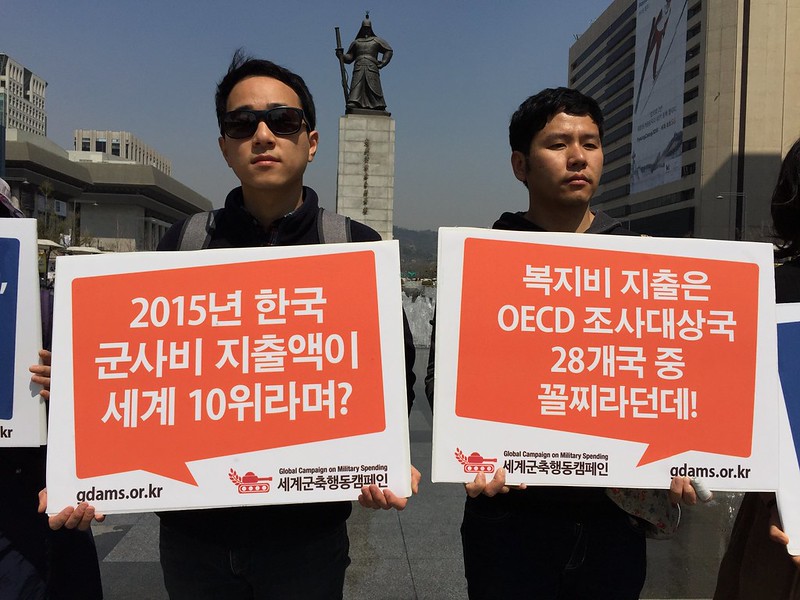
How long  should South Korea stay as an international loser?

With the lowest welfare spending and highest suicide rate among OECD members, 
South Korea was ranked as the world's No. 10 military spender this year and No. 1 arms importer in 2014.


The Stockholm International Peace Research Institute (SIPRI) has released the 2015 annual world military expenditure figures today (4 May). There is a country which has been once again ranked as the world No. 10. It is, while being the tenth biggest global military spender, also recorded as the lowest welfare spender with the highest suicide rate among the 28 OECD countries. That nation is South Korea. The South Korean government has been spending 15% of its budget on military expenditure, which is 2.5 times bigger than the OECD average. The South Korean government has been pouring in 6 billion dollars over its acquisition of 40 F-35 fighter jets, the center of controversies over cost and technical problems. This is the reality of our nation, 'Hell Chosun', an infernal feudal kingdom.


Korea, breaking its usual record of world's top 10 arms importer became the world's biggest arms importer. The annual CRS (Congressional Research Service) report on Arms Transfers, published in December 2015, shows that the South Korean government bought arms and defense equipment worth 7.8 billion dollars in 2014, making it the number 1 weaponry importer in the world. About $7 billion of South Korea's contracts were made with the United States. Now South Korea has become the most lucrative client of the world's largest defense company, Lockheed Martin. This has been attributed to the South Korean government's decision to buy the fighters whose capabilities haven't yet been verified, even after the US refusal to allow core technologies' transfer to South Korea. Also, there's more good news for Lockheed Martin, which is that the US has reportedly agreed to deploy THAAD to South Korea.


Is the huge military expenditure justified? The nation, with an annual defence budget of $9.6 billion, has so far been discovered to have spent $876 million in defence industry corruption by a joint investigative team which was launched in 2014. According to the joint investigative team, there has been a continuous flow of bribes, the falsifying of public documents, shady arms acquisition processes etc. throughout the Army, Air force, and Navy. The 2014 National Defence Annual Reports says that within 10 years defence spending doubled from $4 billion to $8 billion. Anyone can guess that this figure is not healthy at all. 


Then have our 630 thousand soldiers been benefiting from this military spending? The biggest item in South Korea's military budget is labour costs, most of which has been spent on commissioned officers. Only 9% of the military labour cost budget has been allocated to enlisted soldiers, who make up 70% of the entire military force, while the commissioned officers, who only make up 11% of the military force, take 42% of the entire labour costs. The enlisted soldiers are on less than one seventh of the nation minimum income. Is this treatment fair and just?


Some may say that "we can't possibly reduce military spending while facing the North Korean threat". The fact that South Korea's military power is far superior to that of North Korea has already been acknowledged by the government. South Korea has been spending on its military budget an amount almost equivalent to North Korea's national GDP, without even factoring in expenditure on American army bases in South Korea. Unable to match that amount, North Korea may have had to focus on weapons of mass-destruction. The key to solving the inter-Korean tension is trust-building, not military spending increases. The recent news on North Korea's 4th nuclear test caused many South Korean politicians to propose developing our own nuclear weapons. Without stopping this vicious competition of military spending and force increases on the Korean peninsula,  the necessary dialogue cannot be initiated, hence peace will remain unreachable.


The world of arms, of which American President Eisenhower once said "Every gun that is made, every warship launched, every rocket fired signifies, in the final sense, a theft from those who hunger and are not fed, those who are cold and are not clothed." still persists now. This year the United Nations Office for the Coordination of Humanitarian Affairs (OCHA) will issue an estimated $20.1 billion needed to provide humanitarian assistance to countries around the globe, including Syria, Afghanistan, and Iraq. We need to remind ourselves that last year alone the world spent $1.8 trillion on defence. Just 1% of the total international military spend would make so much difference if it were to be spent on humanitarian purposes and the eradication of poverty. 


More military spending will never bring in peace and safety to the world, but rather causes neighboring countries to increase their own military funding, therefore ending up enriching arms companies. Now is the time for us to rethink our priorities. The change we are hoping for will be brought forward by those who cry out "tax money for our lives, not for weapons" and the national assembly, which reviews and votes for bills based on our nation's voice. The 20th national assembly will have to allocate taxes to help its citizens facing hardship from cradle to grave. On the 5th of April  2016, celebrating the 6th Global Day of  Action on Military Spending, we propose to enter into such a paradigm shift in our escape from 'Hell Chosun'.


April 5, 2016

The GDAMS Preparatory Committee of Korea


For more information


The GDAMS website http://demilitarize.org

The GDAMS Korea website http://gdams.or.kr
The GDAMS Preparatory Committee of Seoul
People’s Solidarity for Participatory Democracy +82-2-723-4250, [email protected]


번역 : 윤현희 (참여연대 평화군축센터 자원활동가)

화, 2016/04/05- 22:56
145
0

3f8bcf799ac9d72d6f83ee3d8aba127b.jpg


32nd Regular Session of the UN Human Rights Council
Item 3: Promotion and Protection of all Human Rights, Civil, Political, Economic, Social and Cultural Rights, including the Right to Development


Interactive Dialogue with the UN Special Rapporteur

on the rights to freedom of peaceful assembly and of association


Oral Statement Delivered by Ms. Minjuwha Baek on Behalf of
People’s Solidarity for Participatory Democracy (PSPD)
Korean Center for United Nations Human Rights Policy (KOCUN)
MINBYUN-Lawyers for a Democratic Society


Friday, 17 June 2016

 
Thank you, Mr. President.
 
My name is Minjuwha Baek, and I am the daughter of the 69 year-old farmer Namgi Baek in the Republic of Korea who was mentioned in the Special Rapporteur’s report. My father was targeted and knocked down by the police’s water cannon on 14 November last year, during a protest for the increase in rice prices. He remains in coma for more than 200 days due to severe brain damage.
 
The Government imposed an arbitrary ban on the protest, claiming it was not an assembly but a crime. They named the protest unlawful and not peaceful, even before it took place. The police arrested or summoned more than 500 protesters. This includes Mr. Sang-kyun Han, the president of Korean Confederation of Trade Unions(KCTU), facing up to 8-year imprisonment for organizing the protest.
 
The police blocked main roads and streets with hundreds of bus barricades and thousands of police forces, even hours before the protest. The police shot water cannons with capsaicin to protesters indiscriminately for hours.
 
No apology, No investigation, No justice.
The government of the Republic of Korea insisted on having a thorough investigation. For 7 months, all they did was summoning my sister once. If you hit someone who is not attacking you, you should apologize and do everything to fix it. Every human being knows this.
 
We want a sincere apology, thorough investigation, and justice for my family and for all.
 
Mr. President,
If you allow me for 5 seconds I would like to invite my father to speak for himself. (Holding Mr. Baek's photo)
 
Thank you, Mr. President


토, 2016/06/18- 15:43
138
0

편집자 주: 8월말 큰비로 인해 황해남북도에 큰 수해가 발생했다고 한다. 유엔의 인도주의업무조정국은 신속히 이에 대한 상세한 내용을 파악하여 전세계에 실상을 알려 왔다. 종전선언과 한반도 평화체제를 논의가 진행과정에서 발생한 북한의 자연재해에 대하여 남한 사회가 도울 수 있는 방도와 경로는 없는 것일까? 북한이 이미 핵실험장을 폐쇄하고 미사일 엔진실험실과 발사대를 해체한 만큼, 북한동포가 겪는 고통을 생각하면서 이번 수해를 계기로 유엔안보리의 북한에 대한 무자비한 제재에 대한 완화조치를 본격적으로 논의해야 할 시점이 되었다고 판단된다. 마침 정상회담차 9월 18-21일 문재인 대통령의 평양 방문시, 북한당국이 동의한다면 수해현장을 돌아보는 것도 고려해 볼만하다.


칼럼_180908

개요

8월 29일과 30일, 48시간동안 지속된 끈질긴 호우로 북한 남서부 지방인 황해북도와 황해남도에서 갑작스러운 홍수가 발생했다. 정부의 자료에 따르면 10,700명에 육박하는 이재민이 발생했다. 발표된 사망자수만 최소 75명이며, 수백명 이상이 부상을 입거나 실종되었다. 앞으로 조사가 진행됨에 따라 이 수치는 더 늘어날 것으로 예상된다. 황해남북도 내 수천만개의 주택이 홍수로 인해 손상되거나 완전히 망가졌고, 주민들은 모든 가재도구를 잃은 것으로 알려졌다. 공공건물과 유치원은 물론 철도, 도로 등 사회기반시설까지 훼손돼 많은 지역이 접근이 접근하기조차 어려워졌다.


긴급 요구

최초 조사 결과, 식량, 영양공급, 보건, 식수 및 위생, 이재민 보호소, 재난위험축소가 긴급하게 필요할 것으로 보인다. 재난위험축소의 경우, 이미 피해를 입은 마을이 추가적인 호우와 홍수에 더욱 취약하다는 점에서 중요하다. 북한 정부의 보고에 따르면 황해북도와 황해남도의 농경지 중 17,000 헥타르가 홍수로 타격을 입었다. 곧 수확을 앞두고 있었던 많은 농작물이 홍수에 휩쓸려 간 결과, 식량생산에 끼칠 악영향과 북한주민의 장기적 식량안보에 대한 우려가 커졌다.

칼럼_180908(1)


칼럼_180908(2)

칼럼_180908(3)
UN이 공식적으로 본 지도에 표시되는 경계선과 지명을 지지 또는 동의하는 것은 아님. 2018년 9월 북한정부가 제공한 데이터를 기반으로 함.


토, 2018/09/08- 11:59
136
0