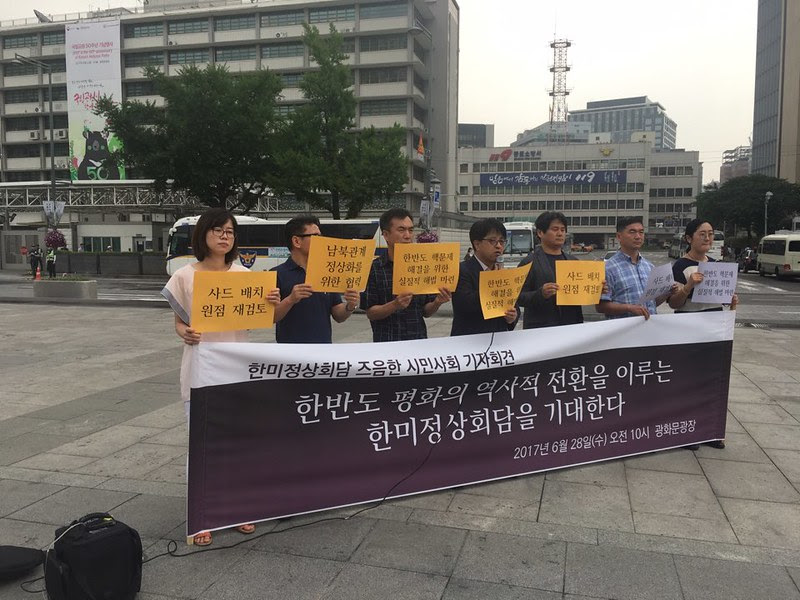
한미 정상회담(6월 29-30일)을 앞두고 오늘(6/28) 광화문광장에서 시민평화포럼, 참여연대, 평화네트워크, 흥사단 등 시민사회 단체들이 모여 한반도 평화를 위한 4가지 해법을 제시하는 기자회견을 개최했다.
이번 한미 정상회담에서 사드 한국 배치는 물론 한반도 비핵화 해법 등 여러 중차대한 문제들이 논의될 것으로 알려졌다. 오늘 기자회견은 한미 정상이 그동안 악순환을 거듭해온 한반도 문제에 중요한 전환점을 도출해 낼 수 있기를 간절히 바라는 시민사회의 뜻을 전하고자 개최되었다.
기자회견 참석자들은 한반도 평화를 위한 해법으로 한미 정상에 △사드 배치 문제를 원점에서 재검토하고 △한반도 핵문제 해결을 위한 실질적이고 담대한 해법을 제시해야 한다고 요구했다. 특히 북 핵·미사일 시험 동결과 한미 연합군사훈련 축소 또는 중단의 병행 추진과 같은 한반도의 군사적 긴장을 완화하기 위한 구체적 노력을 검토할 것을 제안했다. 그리고 △북한 변화를 촉진시키기 위해 무엇보다 남북관계 정상화와 발전 노력이 필요하다는 점을 한미 양국이 공감해야 한다고 제시하고 △평등하고 호혜적인 동맹 관계로 전환함으로써 한미가 동아시아 평화협력체제 강화에 기여해야 한다는 점을 강조했다.
기자회견 이후 참가자들은 광화문에 위치한 국민인수위에 한반도 평화를 위한 4가지 제안을 담은 입장문을 전달하였다. 오늘 기자회견에는 시민평화포럼 이승환 공동대표, 평화네트워크 정욱식 대표, 열린군대를위한시민연대 박래군 대표, 참여연대 박정은 협동사무처장, 이태호 정책위원장, 흥민통 유병수 사무처장, 은희만 고양평화누리 사무국장 등 시민사회단체 인사들이 참여한 가운데 진행되었다.
문재인 대통령과 도널드 트럼프 대통령의 첫 정상회담이 6월 29-30일 미국 워싱턴에서 열린다. 이번 정상회담에서는 사드에서부터 한반도 비핵화 해법에 이르기까지 여러 중차대한 문제들이 논의될 예정이다. 이에 우리는 이번 정상회담이 악순환을 거듭해온 한반도 문제에 중요한 전환점이 되기를 간절히 바라면서 아래와 같이 요구한다.
첫째, 양국 정상은 사드 배치 문제를 원점에서 재검토해야 한다.
문재인 정부는 박근혜 정부가 탄핵 국면에서 적법한 환경영향평가도 거치지 않은 채 사드 배치를 강행했던 문제를 제기하면서, 사드 배치 자체에 대해서는 “동맹 차원의 결정을 존중한다”는 입장을 밝히고 있다. 그러나 사드 배치 문제는 절차적 하자에 국한된 문제가 아니다. 미국은 사드 배치가 북한의 핵·미사일 개발 동기를 위축시켜 비핵화에 기여할 것이라고 주장하지만 이는 허구로 드러났다. 오히려 북한은 사드를 명분으로 한층 핵과 미사일 능력 강화에 나서고 있다. 사드가 주한미군을 포함한 한국 방어에 유용하다는 주장 역시 종심이 대단히 짧은 한반도의 지리적 조건과 사드 요격을 얼마든지 회피할 수 있는 북 측의 미사일운용 가능성 등 때문에 미국 내에서조차 부정적 의견이 제기되고 있다. 더구나 중국과 러시아의 강력한 반발은 동북아의 신냉전을 가속화하고 있다.
문재인 정부는 사드 배치 강행에 대한 한국 시민사회의 강한 반대와 우려를 가감 없이 미국에 전달해야 한다. 한국 국민들에게 사드 배치는 탄핵된 박근혜 정부가 새 정부를 압박하고 중국과의 관계에 쐐기를 박기 위해 자행한 불법적이고 부당한 행위일 뿐이다. 미 트럼프 정부 역시 한국 시민사회의 정당하고 합리적인 의견을 마땅히 수용해야 한다. 한미 양국이 사드 배치를 원점에서 재검토하는 것은 민주주의 가치를 중시하는 동맹 관계라면 당연하고도 반드시 필요한 일이다.
둘째, 한반도 핵문제를 풀 수 있는 실질적이고도 담대한 해법을 제시해야 한다.
한미 양국은 지난 10년간 실질적인 협상은 마다하면서 대북 제재와 무력시위, 그리고 북한의 국제적 고립에만 몰두해왔다. 그 결과는 북한 핵능력의 고도화였다. ‘전략적 인내’가 실패했다고 선언한 트럼프 정부와 문재인 정부는 실패한 정책과 단호히 결별하고 새롭고 담대한 해법 마련에 나서야 한다. 북핵문제는 한반도 냉전체제, 정확하게는 북미간의 적대관계를 포함한 정전체제의 비정상적인 토양에서 자라난 독버섯이다. 한반도 핵문제는 냉전의 잔재를 극복하는 과정 및 그 결과로 달성할 수 있다는 점을 분명히 인식해야 실질적인 해법이 가능하다.
따라서 한미 양 정상은 한반도의 군사적 긴장을 완화하여 북한의 핵·미사일 개발의 명분을 박탈하고 한반도의 반복되는 전쟁위기를 수습하는데 최우선의 노력을 기울여야 한다. 그 일환으로 전제조건이 아닌 협상을 통해 달성해야 할 목표로서 북한의 핵·미사일 시험 동결과 한미 군사훈련 및 미 전략자산 전개의 축소 혹은 중단을 검토해야 한다. 그래야 북한의 완전한 비핵화와 한반도 평화협정 협상과 함께 남북·북미 정상회담과 같은 최고위급 회담 개최 등이 현실 가능한 목표로 논의되는 동력을 얻게 될 것이다.
셋째, 양국 정상은 남북관계 정상화와 발전에 공감대를 이뤄야 한다.
남북관계의 발전 없이 북한의 안보와 주권에 대한 불안이 근본적으로 해결될 수 없고, 북한 핵문제의 해결과 북미관계의 진전도 궁극적으로 제약받을 수밖에 없다. 특히 남북관계의 발전은 북한에 대한 국제사회의 제재와 압박을 약화시키는 것이 아니라 오히려 북한 변화를 촉진시키는 일이다. 그리고 북한의 변화는 그 누구보다 한국 정부와 시민사회가 가장 중요한 역할을 담당할 수밖에 없다. 문재인 정부는 이러한 점들을 트럼프 정부에 정확히 전달하고 이해시킬 필요가 있다.
한미동맹이 남북관계 발전에 제동을 거는 것은 북핵문제 해결이라는 공동의 목표 달성을 위해서도 바람직하지 않다. 또한 남북관계 경색이 북한의 변화에 대한 압박이 되기 보다 오히려 북한의 위협적 행위의 명분이 되는 현실을 감안할 때 남북관계 발전에 관한 한국과 미국의 입장이 다를 수밖에 없다는 점도 분명히 해야 한다.
마지막으로 한미동맹의 평등하고 호혜적인 관계로의 전환이 미룰 수 없는 과제라는 점도 이번 정상회담에서 확실하게 천명되어야 한다.
한미동맹은 역내 미국의 패권을 강화하고 중국을 봉쇄하는 폐쇄적 군사동맹에서 벗어나, 동아시아 역내의 평화협력체제를 강화하고 평화, 인권, 환경 등 포괄적 분야에서의 선린과 우호를 강화하는데 기여해야 한다. 한미동맹이 한미일 군사동맹의 하위체제로 편입되고, 아시아에서 유럽판 NATO와 같은 체제가 성립되는 것은 냉전시대로의 회귀이지 동맹의 현대화는 결코 아니다. 호혜와 평등에 입각한 선진적 동맹관계로의 발전이라는 원칙 아래 전시작전권 환수를 비롯한 한미동맹의 각종 현안을 다루어야 한다. 이번 한미 정상회담에서는 동맹 현대화를 위한 구체적인 현안들을 다루지는 않겠지만, 한미동맹의 발전 방향에 대해서는 현대화·민주화라는 원칙적 기조가 분명히 천명되어야 할 것이다.
때마침 내년은 정전협정 체결 65주년이 되는 해이다. 우리는 내년이 평화협정 원년이 될 수 있도록 이번 한미정상회담에서 한반도 비핵화와 평화체제 병행 추진의 첫 단추를 제대로 채우기를 촉구하며, 더불어 한미관계 발전의 역사적 전환점이 되는 한미정상회담이 되기를 진심으로 기원한다.
한국탐사저널리즘센터/뉴스타파는 문재인 정부 출범 후 첫 한미 정상회담 과정과 결과를 미국 탐사전문기자 팀 셔록(Tim Shorrock)과 공동 취재해 보도합니다. 팀 셔록 기자는 1996년, 미국이 광주 학살을 묵인, 혹은 승인했다는 내용이 담긴 미국정부 기밀문건, 일명 ‘체로키 파일’을 공개해 광주 학살의 진실에 다가갈 수 있는 단초를 제공한 탐사기자이자, 한미 관계 전문 독립언론인입니다.
문재인 대통령은 도널드 트럼프 미국 대통령과 이틀 간의 정상회담을 위해 이번 주 수요일(미국 시간) 워싱턴에 도착할 예정이다. 문 대통령이 남북관계 개선을 위해 대화와 참여를 강조함에 따라 양국 정상 간 입장 차이에 관심이 쏠린 가운데, 이번 한미정상회담에서 가장 중요한 논의는 비공개로 진행될 것으로 보인다.
그 중 하나가 바로 정상회담 직후인 금요일 저녁으로 예정된 문 대통령의 CSIS(Center for Strategic and International Studies;전략국제연구센터) 방문인데, 문 대통령은 워싱턴의 가장 유력한 싱크탱크 중 하나인 CSIS에서 이 날 중요한 정책 연설을 할 예정이다. 미국, 일본 정부뿐만 아니라 사드 제조업체인 록히드 마틴과 같은 주요 방위산업체에서 거액의 후원금을 받은 것으로 알려진 CSIS는 수십 년 간 미국의 한반도 정책 형성에 핵심적인 역할을 해 왔다.
미 국방부 부장관을 지낸 CSIS의 CEO 존 햄리는 지난해 가을 한국의 진보 성향 정당들의 약진에 대해 공개적으로 깊은 우려를 표명한 바 있다. 그는 지난해 10월 우익 성향의 헤리티지 재단(Heritage Foundation)이 개최한 포럼에서 “(한국의) 다음 대선에서 우리가 이슈가 되지 않으려면 뭔가 해야 한다”며 “한국의 진보 성향 정당 내에서는 미국이 문제라고 여기는 시각이 존재한다”고 말했다.
8개월 뒤, CSIS와 미국 외교정책 기득권층은 과거 한국의 보수 정권과는 확연히 다른 의제를 가진 한국의 새롭고, 독립적인 지도자를 받아들일 수밖에 없었다. 이 새로운 상황은 과거 부시 정권에서 아시아 담당 국장을 지낸 CSIS의 빅터 차 선임고문이 지난 26일 서울에서 개최된 중앙일보-CSIS 포럼에서 한미동맹에 대해 언급하면서 더욱 분명하게 드러났다. (중앙일보는 삼성과 더불어 CSIS의 주요 후원기관이다.)
차기 주한 미국 대사로 거론되는 빅터 차 선임고문은 한국이 박근혜 전 대통령 탄핵심판 과정의 ‘위기’를 ‘민주주의 작동의 놀라운 발현’으로 극복했다며 말문을 열었다. 그러나 그는 곧바로 문재인 정부가 북한에 대해 ‘일방적인 행동’을 하지 말 것을 경고하고, 유엔이 승인한 현재의 대북 제재 조치를 위반할 수 있는 ‘무조건적인’ 경제 원조를 하지 말아야 한다고 훈계조로 이야기했다.
차 선임고문은 새 정부가 한미동맹을 “북한 위협을 다루는 데 있어 필수적인” 우선순위로 다뤄야 할 것이라며, 남북 관계 개선을 강조하는 문 대통령의 정책을 우회적으로 비판했다. 그는 또 한미 양국 간 입장 차이는 양자 간 “진실되고 완벽한, 거의 일상적인 정책 조율”을 통해서만 해결할 수 있다고 주장했다. 그의 발표는 차기 주한 미 대사 데뷔 연설에 가까운 느낌이었으나, 일부 한국인들에겐 ‘총독’이 더 적합한 용어로 받아들여졌을 수 있다.
차 선임고문의 발언은 문 대통령이 이번 방미 기간에 강경하고 군사적인 대북정책을 중심으로 뭉친 워싱턴의 정치적 기득권층으로부터 공개적인 비판과 의심의 눈초리를 받을 가능성이 높다는 것을 보여준다. 지난 2년 간 민주당과 공화당 내부에서는 북한 정권 교체와 대북 선제공격에 대한 논의가 거의 일상화되었고, 진보와 보수 언론 모두 이와 관련된 내용을 열심히 보도해 왔다.
북한에 대한 미국의 적개심은 최근 발생한 오토 웜비어 사망사건 때문에 더욱 확산되었다. 버지니아 대학교 학생이었던 오토 웜비어는 2015년 북한 당국에 체포되었다가 올해 6월 급작스럽게 혼수상태로 석방되어 미국으로 송환됐다. 그를 진찰한 의료진은 북한 측 주장대로 그가 보툴리눔독소증(botulism)에 걸린 뒤 수면제를 복용하면서 뇌손상이 생겼다는 점을 뒷받침할만한 증거가 없다고 밝혔다. 하지만 워싱턴포스트에 따르면, 의료진은 웜비어 가족이 주장하는 구타나 고문 흔적도 찾지 못했다.
▲ 지난 2015년 북한에 체포된 오토 웜비어. 올해 6월 혼수상태로 석방된 뒤, 엿새 만에 사망했다
송환 후 며칠 만에 웜비어가 사망하면서 트럼프 대통령과 내각, 그리고 많은 의원들이 북한에 대해 맹렬한 비난을 퍼부었다. 한국 문제를 거의 항상 미-중 관계 속에서만 바라보는 CNN은 “웜비어의 죽음은 도널드 트럼프 대통령이 북한에 대해 더욱 강경한 입장을 취할 수밖에 없는 상태에 놓이게 했는데, 이 때문에 중국과의 긴장이 높아질 수 있다”고 보도했다. 일부 하원 및 상원 의원들은 공무상 목적을 제외한 자국민의 북한 여행을 금지하는 법안 마련을 추진하겠다고 밝혔다(이상하게도 웜비어의 가족은 웜비어에 대한 부검을 거부하면서 그의 사인이 영영 밝혀지지 못하게 되었다).
한편, 김대중 전 대통령의 햇볕 정책을 수용하겠다는 문 대통령의 의지에 동요한 미국의 우익 세력은 문 대통령을 위험한 좌파로 몰기 위한 여론전을 펼치기 시작했다. 그들이 최근 표적으로 삼은 것은 문 대통령의 통일외교안보특보를 맡은 문정인 연세대 교수였다. 문 특보는 지난 6월 16일 워싱턴에서 열린 한 포럼에서 북한이 핵·미사일 도발을 중단한다면 한미 군사훈련과 미국의 “전략 자산” 전개를 축소할 수 있다고 발언했다.
문 특보의 이와 같은 발언이 파장을 일으키자 청와대는 문 특보에게 따로 연락을 취해 발언에 신중을 기해달라는 취지로 당부했다고 밝혔다. 헤리티지 재단에서 한반도 정책을 총괄하고 있는 전직 CIA 출신 브루스 클링너 선임연구원은 “문정인의 방미는 문재인 정부의 대북 정책, 한미 동맹, 그리고 사드 배치에 대한 미국의 우려를 가중할 수 있다”는 트윗을 날렸다. 며칠 뒤, 북한정권 교체에 광적인 조슈아 스탠튼은 문 대통령을 맹렬하게 비난하는 글을 올렸다.
그는 편파적인 것으로 악명 높은 자신의 블로그 ‘통일자유대한민국 (One Free Korea)’에 “문 대통령은 정치 경력의 전부를 미국보다 북한에 더욱 강한 유대감을 보여 온 한국 극좌파의 전문가 집단에서 보냈다”고 적었다. 문 대통령에 대한 이러한 공격은 조선일보와 같은 일부 한국 매체로 하여금 문 특보의 ‘온건한’ 발언이 미국 측의 “격분을 자아냈다”고 보도할 빌미를 제공했다.
그러나 이것은 분명 과장된 것이다. 실제로 미국 국가안보 당국의 핵심 인사들은 문재인 대통령의 당선과 북한에 대한 문 대통령의 입장이 한미 군사동맹에 어떠한 위협도 되지 않는다고 보고 있기 때문이다.
스콧 브레이 미 국가정보국(DNI) 동아시아 담당관은 6월 26일 흔치 않은 공개연설을 통해 미 정보당국이 대북 감시에 엄청난 자원을 투입하고 있다고 밝혔다. 그는 “정부 최고위급에서 북한 문제와 같은 수준의 주목을 받는 이슈는 거의 없다”고 말했다. 그러나 문 대통령의 당선과 한국에서의 사드 반대 집회가 미국의 대북정책에 걸림돌이 되냐는 질문에 그는 아니라고 대답했다.
브레이 담당관은 “트럼프 대통령이 문 대통령의 방문을 기대하고 있고, 북한에 대해서뿐만 아니라 다른 많은 이슈에 대해서 의견을 나눌 것”이라며 “한국의 국내 환경 변화에도 불구하고, 한미 동맹은 여전히 매우 건재하다”고 답했다. 그는 또 “때때로 미국이 더 강경한 조치를 선호하고 한국이 포용 정책을 선호하는 등 양국의 접근법이 조금 다를 수는 있겠지만, 궁극적으로 우리는 모두 같은 목표를 향해 노력하고 있다”고 덧붙였다.
이 발언이 사실일 수도 있고 아닐 수도 있지만, 적어도 미국 내 우익 세력의 생각을 바로잡아 줄 수 있을 것이다. 이번 한미정상회담이 매우 흥미롭게 전개될 것으로 예상된다.
President Moon Jae-in arrives in Washington this Wednesday for two days of talks with US President Donald J. Trump. While political observers will be watching closely for any signs of disagreement over Moon’s desire to improve intra-Korean relations through dialogue and engagement, the most significant discussions are likely to take place out of the public eye.
One of those events will be on the Friday night after the summit, when President Moon delivers an important policy speech to the Center for Strategic and International Studies (CSIS), one of Washington’s most powerful think tanks. Funded heavily by the US and Japanese governments as well as major defense contractors such as Lockheed Martin, the manufacturer of the THAAD system, the organization has played a key role in shaping US policy towards Korea for decades.
Last fall, John Hamre, the CEO of CSIS and a former deputy secretary of defense, made public comments expressing deep concern over the rising strength of South Korea’s left-leaning political parties. “We have to do something so we don’t become an issue in [Korea’s] next election,” he told a forum at the right-wing Heritage Foundation in October. “There’s a strong strain in the left parties that America is the problem.”
Eight months later, CSIS and the US foreign policy establishment have been forced to accept a new, independent South Korean leader with an agenda markedly different than his conservative predecessors. The new reality was clear on Monday, when Victor Cha, a CSIS senior adviser and the former director of Korean affairs for the George W. Bush administration, addressed a Seoul conference on the US-Korean alliance co-sponsored by CSIS and Joongang Ilbo (with Samsung, it is a major donor to the think tank).
Cha, who is about to be named the next US ambassador to South Korea, began his speech by praising the “extraordinary demonstration of democracy at work” during what he called the “crisis” over the impeachment of Park Geun-hye. But he quickly shifted into lecture mode, warning the Moon government not to take “unilateral action” on North Korea and to avoid “unconditional” economic assistance that could violate the current sanction regime endorsed by the UN.
In a subtle dig at Moon’s strong emphasis on North Korea, Cha insisted that the new government should prioritize the US-ROK alliance as “critical to dealing with the North Korean threat.” He argued that differences between Seoul and Washington could only be managed with “true, seamless, almost daily policy coordination” between the two sides. His speech sounded much like a practice run for his term as US ambassador, although some Koreans might wonder if “governor-general” might be a better term.
Cha’s comments underscored that Moon will likely face open criticism and skepticism in Washington, where the political establishment is united behind tough, militaristic policies towards North Korea. Over the last two years, discussions about regime change and pre-emptive strikes have become almost routine in both Democratic and Republican circles, and eagerly reported on by journalists of both liberal and conservative bent.
The latest trigger for US hostility is the strange case of Otto Warmbier, the Virginia college student who was arrested in 2015 by North Korean authorities and suddenly returned to the United States in June in a coma. His doctors quickly dismissed North Korean claims that his brain damage was induced when he contracted botulism and then took a sleeping pill. But according to the Washington Post, doctors did not find any evidence that he was beaten or tortured, as alleged by his family.
Warmbier’s death several days after his return triggered angry denunciations of Pyongyang from Trump, his cabinet and many lawmakers. “The young Ohioan’s death may force President Donald Trump to take a tougher line with North Korea, a shift that could increase tensions with Beijing,” declared CNN, which typically views Korea only in terms of US relations with China. Several House and Senate lawmakers said they would push for a new law banning Americans from traveling to the North except in official capacities.
Meanwhile, US right-wingers disturbed by President Moon’s embrace of Kim Dae Jung’s Sunshine Policies, have started a relentless campaign to paint the new president as a dangerous leftist. Their latest target was Moon Chung-In, the president’s special advisor on foreign policy. Earlier this month, he told a Washington forum that US-South Korean military exercises, including the use of “strategic assets” such as aircraft carriers and nuclear submarines, could be scaled back if North Korea suspended its nuclear and missile tests.
This apparently irritated President Moon, whose office issued a terse statement asking the adviser to “exercise restraint.” In response, Bruce Klingner, a former CIA officer who directs Korea policy at Heritage, tweeted that “Moon Jung-in’s visit only exacerbated US concerns about Moon Jae-in’s policies on North Korea, US alliance, and THAAD.” A few days later, Joshua Stanton, a fanatical champion of regime change in North Korea, wrote a blistering attack on the South Korean president.
“Moon has spent his entire political career in the brain trust of South Korea’s hard left, among those who’ve shown more solidarity with North Korea than with America,” he wrote in his notoriously slanted blog, FreeKorea. These attacks prompted several Korean media outlets, such as the Chosun Ilbo, to declare that Moon Chung-In’s “dovish” comments had “raised hackles” in Washington.
But that was an exaggeration. In fact, key players in the US national security state have decided that Moon’s election, and his positions on North Korea, pose no threat to the US-Korean military alliance.
In an unusual public speech on Monday, Scott Bray, the National Intelligence Manager for East Asia at the Office of the Director of National Intelligence, told a conference at Heritage that US spying agencies are spending enormous resources on North Korea. “There are few issues that garner the same level of attention at the highest levels of government” than North Korea, he said. But, asked if Moon’s election and anti-THAAD protests in Korea posed a problem for the United States as it confronts the North, he said no.
“I know that President Trump is looking forward to Moon’s visit, and know they will have a lot to talk about on North Korea and broader issues,” Bray replied. “I also know that, even with the changed domestic environment in South Korea, our alliance remains remarkably strong.” He added: “Even if at times our approach is somewhat different – if we prefer stronger measures and South Korea prefers engagement – ultimately we’re both dedicated to the same outcome.”
That may or may not true, but should set the right-wingers straight. This week’s visit could prove to be very interesting indeed.
미국 취재: 팀 셔록 한국 취재: 임보영 촬영: 신영철 영상편집: 박서영
※ 팀 셔록은 워싱턴에서 활동하는 기자로, 1970년대부터 한국에 대해 보도해 왔다. 그는 유년기의 일부를 서울에서 보냈으며 한국에 자주 방문한다.
오랜만에 운전대에 앉았다. 모든 것이 낯설다. 차도 사양이 바뀌었고 도로는 더욱 복잡하다. 건너편 차선의 운전자는 왜 이렇게 난폭하고 거친가. 불만족스러운 표정과 언사로 훈수를 두는 옆 자리 앉은 사람은 또 어떤가. 한미정상회담 이후 '운전석'에 앉게 된 문재인 정부의 상황이 딱 이렇다.
이번 한미정상회담에 대한 평가는 둘로 나뉜다. 하나는 한반도 문제에 있어서 한국 정부가 운전석에 앉아 주도권을 행사해 나가겠다고 천명한 것을 긍정적으로 보는 입장이다. 한편 한미 동맹 강화와 군비 증강, 대북 제재 유지 및 강화 방침을 재확인한 자리가 아니었냐는 비판의 목소리도 나온다. 한미의 "모든 국가 역량을 활용하여" 북한에 대한 확장억제력 강화 방침을 밝히면서 북한에는 도리어 핵미사일을 포기하라는 것이 과연 현실적인 접근법이냐는 질문이다.
문재인 정부가 인수위 기간조차 없이 당선 직후 출범했다는 점, 취임한 지 두 달 만에 이뤄진 조기 정상회담이라는 점 등을 감안할 때 이번 정상회담에 대한 비판과 부정적 평가가 성급할 수 있다. 그러나 한미정상회담 직후 이어진 북한의 대륙간탄도미사일(ICBM) 시험 발사는 '운전수' 문재인 정부가 앞으로 당면할 한반도의 위기가 먼 훗날의 일이 아님을 보여준다. 그리고 자신들의 계획에 따라 핵미사일 능력을 고도화하는 북한에 한미정상회담의 결과가 별다른 영향을 미치지 못한다는 사실도 드러낸다.
문재인 대통령은 한미정상회담과 신베를린구상에서 일관되게 대화를 강조하는 만큼 제재와 압박에도 무게를 싣고 있다. 한미 정상은 대화와 제재 등 모든 수단을 활용하여 비핵화를 추진해 나가겠다고 밝혔다. '신베를린선언'에서 문재인 대통령은 대화의 필요성이 더욱 절실해졌다고 강조하는 한편 "북한이 핵 도발을 중단하지 않는다면 더욱 강한 제재와 압박"에 나설 것이라는 점도 분명히 했다.
대화를 우선시하고 강조하는 것이 분명하지만, 제재와 압박도 마다하지 않겠다는 입장이 우려스러운 것도 사실이다. 지난 7월 10일 한미는 북한의 ICBM 발사에 맞대응해 전략폭격기 B-1B를 동원해 연합 무력시위에 나섰다. 북한의 도발에 압박으로 맞대응하겠다는 전략이지만 결과적으로 한반도 상황은 강대강 대결국면으로 치달았고 이 땅에 사는 주민들은 일촉즉발의 가능성을 걱정해야 했다.
이 상황에서 질문을 하지 않을 수 없다. 첨단 무기를 동원한 군사 훈련과 무력 시위가, 또는 한미의 압도적인 핵 억지력이 일찍이 북의 핵미사일 개발 의지를 좌절시킬 수 있었던가? 아마 그랬다면 한반도 핵갈등은 일찌감치 종식되었을 것이다. 그러나 현실은 우리가 다 알 듯이 현재진행형이다. 그리고 문재인 정부는 한반도 문제의 주도권을 행사하기 위해 확실한 억지력을 구비해야 한다는 입장을 고수하며 대북 선제타격 내용까지 포함하는 킬체인(Kill Chain) 등 군사력 강화를 조기에 완성하겠다며 추진하고 있다.
그렇다면 대화를 재개하기 위한 한국 정부의 묘안은 무엇인가? 중국과 러시아까지 지지를 표명한 일명 '쌍중단(북한의 핵미사일 실험 중단과 한미연합군사훈련 중단)'에 대해 문재인 대통령은 한미정상회담 과정에서 스스로 한미군사훈련 축소와 폐지는 불가능하다고 못 박은 바 있다. 이 전에 청와대는 문정인 특보가 방미 당시 한 '한미연합훈련 중단' 발언을 두고 개인적 발언이라며 선을 긋기까지 했다. 그러나 문재인 정부에 북한을 대화 테이블로 유인할 다른 방안이 있는지 의문이다.
북한의 핵미사일 개발은 한미의 가공할 만한 군사력이 주는 위협을 명분으로 하고 있다. 북한을 대화의 장으로 나오게 하려면 무엇보다 북한이 느끼는 안보 위협을 감소시켜야 한다. 북한이 지난 20년 간 온갖 제재와 압박, 시련에도 불구하고 획득한 핵미사일 능력을 동결하라고 요구하기 위해서는 적어도 그에 상응하는 대가 혹은 조치를 제시할 수 있어야 한다. 그래야 비로소 북한도 협상에 나설 수 있다.
문제는 시간이 별로 없다는 것이다. '최대의 압박과 관여' 정책을 몰아치는 트럼프 정부만큼이나 북한 역시 핵미사일 능력을 강화하는데 박차를 가하고 있다. 한미연합군사훈련 중단 조치를 대신할 만한 돌파구를 찾아내고 이를 받아들이도록 북한과 주변국들을 설득하기까지는 어느 정도 시간 소요는 필수적이다. 만일 그 사이 북한이 한 걸음 더 나아가 핵미사일 능력을 완성 궤도에 올리고 미국 본토에 대한 2차 타격능력까지 확보한다면 더 이상 한미가 취할 수 있는 선택지는 사실상 없어진다. 아직까지 트럼프 대통령은 북한에 대한 '레드라인'을 설정하지 않겠다는 입장이지만, 상황이 악화된다면 핵능력 동결도 더 이상 아무런 의미가 없을 수 있다.
이러한 상황에서 다행히도 문재인 정부가 지난 17일 북한에 남북 군사회담과 적십자회담을 공식 제안했다. 문재인 대통령이 베를린에서 정전협정 64주년인 7월 27일을 기해 군사적 긴장을 고조시키는 일체의 적대 행위를 중지하자고 북한에 제안한 바에 따른 것이다. 군사 핫라인을 복원하는 최소한의 조치는 남북 대화를 재개하는 첫 단추가 될 수 있기도 하지만 무엇보다 그 시급성 때문이라도 반드시 이뤄져야 한다. 현재 남북 간에 위기 상황을 관리할 어떠한 군사적 채널도 가동되지 않고 있다. 지난 15일 북한의 황강댐 방류로 물이 불어나 정부는 급히 임진강 일대 행락객과 낚시객 등에게 긴급 대피령을 내린 바 있다. 남북 군사채널이 복원된다면 이러한 위기 상황은 사전에 방지할 수 있다.
대담하고 과감한 제안도 그 시작은 작고 간단한 시도일 수 있다. 문재인 정부가 한반도 핵 갈등을 근본적으로 해결하고 남북관계를 개선하고자 한다면, 최소한의 조치를 발전시켜 남북 대화를 재개하는 선제적 조치까지 발전시켜야 한다. '모든 수단을 활용'해 한반도 비핵화를 추진하겠다는 문재인 정부의 의지가 진심이라면 협상을 재개할 방안에 제한을 두어서는 안 된다. 8월 말 을지프리덤가디언 한미연합훈련이 예정되어 있다. 이번에도 도발과 제재가 반복되는 악순환이 재연되어서는 안 된다. 그동안 미국과 한국이 제재와 압박으로 경적을 울리는 사이 북한은 어김없이 핵실험과 미사일 개발로 무섭게 폭주했다. 최악의 충돌이 예고되는 지금, 9년 만에 운전석에 앉은 한국은 브레이크를 밟든 핸들을 틀어야 한다. 한미연합군사훈련을 중단 내지 축소하는 방향으로 대화의 물꼬를 터야 한다.
참여사회연구소는 2011년 10월 13일부터 '시민정치시평'이란 제목으로 <프레시안> 에 칼럼을 연재하고 있습니다. 참여사회연구소는 1996년 "시민사회 현장이 우리의 연구실입니다"라는 기치를 내걸고 출범한 참여연대 부설 연구소입니다. 지난 19년 동안 참여민주사회의 비전과 모델, 전략을 진지하게 모색해 온 참여사회연구소는 한국 사회의 현안과 쟁점을 다룬 칼럼을 통해 보다 많은 시민들과 만나고자 합니다. 참여사회연구소의 시민정치는 우리가 속한 공동체에 주체적으로 참여하고, 책임지는 정치를 말합니다. 시민정치가 이루어지는 곳은 우리 삶의 결이 담긴 모든 곳이며, 공동체의 운명에 관한 진지한 숙의와 실천이 이루어지는 모든 곳입니다. '시민정치시평'은 그 모든 곳에서 울려 퍼지는 혹은 솟아 움트는 목소리를 담아 소통하고 공론을 하는 마당이 될 것입니다. 많은 독자들의 성원을 기대합니다. 같은 내용이 프레시안에도 게시됩니다. 목록 바로가기(클릭)
지난 주에 문재인 정부는 북한에 군사적 적대행위 중지와 이산가족 상봉 재개를 위한 적십자 회담을 공식 제안했다. 그러나 숀 스파이서 미 백악관 대변인은 그러한 대화를 위한 분위기는 현 시점에서 “멀리 떨어져 있다”며 문재인 정부의 제안에 찬물을 끼얹었다. 뉴욕타임스는 이 상황에 바로 달려들어 양국 간 의견 차이를 문재인 정부와 트럼프 정부 간 “첫 가시적인 불화”라고 평가했다.
그러나 양국 간 균열이 실제로 얼마나 깊은지, 아니면 이를 언론에서 과장한 것인지는 분명치 않다. 어쨌든 지난 달 문재인 대통령의 방미로 이루어진 정상회담의 결과로 양국 정부는 남북 양자대화와 협상을 통해 한반도 긴장상태를 완화하려는 문 대통령의 의지를 강력하게 지지하는 공동성명을 발표했다. 문 대통령 자신도 지난 7월 19일 여야 4당 대표와 가진 회동에서 모든 대북대화의 초기 단계에서 인도적 대화가 초점이 될 것이라고 설명하며 한-미 간 이견이 노출됐다는 우려를 일축했다. 회동에 참석했던 박수현 청와대 대변인은 문 대통령이 “비핵화를 위한 대화는 올바른 여건 조성이 조건”이라고 밝혔다고 전했다.
▲ 청와대에서 열린 문재인 대통령과 여야 4당 대표의 오찬회동
아이러니하게도 북한을 두고 한-미 간 이견이 존재한다는 이 같은 언론보도는 트럼프 정부가 평양과 직접 대화를 진행하고 있는 상황에서 나왔다. 과거 미 국무부에서 근무한 리언 시걸 미국 사회과학원 동북아 국장은 뉴스타파와의 인터뷰에서 “트럼프 정부가 북한과 협상을 해왔다는 것은 소문이 아니라 사실”이라고 말했다. 시걸 국장은 ‘트랙 투 대화’로 알려진 미-북 비공식대화를 위해 북한 당국 관계자들과 정기적으로 만남을 가져 온 미국 전직 관료 및 전문가 그룹에 속해 있다.
미-북 간 대화의 존재는 17개월 간 북한에 억류됐던 미국 대학생 오토 웜비어가 사망하기 직전인 지난 6월부터 세상에 알려지기 시작했다. 월스트리트 저널의 6월 18일자 보도에 따르면, 미국 외교관들은 북한의 고위 핵협상 담당자인 최선희 북한 외무성 미국국장과 평양 및 유럽 등지에서 비밀리에 ‘트랙 투’ 회담을 가져온 것으로 확인됐다. 그리고 지난 1월 트럼프 대통령의 취임식 이후부터 “미국과 북한 간의 공식, 비공식 접촉이 통합되기 시작했다.”
5월에는 조셉 윤 미 국무부 대북정책 특별대표가 ‘트랙 투’ 회담의 미국 측 참여자들의 주선으로 노르웨이 오슬로에서 최 국장과 접촉한 것으로 알려졌다. 이들은 북한에 구금된 미국인 네 명의 처리방침을 논의하기 위해 만난 것이었다. 그러나 월스트리트 저널에 따르면, 최 국장은 노르웨이를 떠난 뒤 기자들에게 “여건이 무르익으면” 북한 당국이 미국 관계자들과 만나 북핵 회담을 가질 용의가 있다고 밝혔다.
이러한 과정의 일환으로 윤 특별대표는 지난 6월 뉴욕에서 유엔 주재 북한 대사와 만났다. 이 자리에서 윤 특별대표는 당시 송환대상자로 고려되던 웜비어가 의식불명 상태라는 사실을 알게 되었다. 윤 특별대표는 렉스 틸러슨 미국 국무장관의 지시에 따라 웜비어를 데려오기 위해 평양으로 향했다. 며칠 뒤 웜비어가 사망하자, 트럼프 정부가 숙고에 들어감에 따라 북-미 간 새로운 회담 일정이 잡히지 않았다. 시걸 국장은 “이것을 대화 중단으로 볼 것이냐, 아니면 트럼프가 이 절차를 다시 생각해보는 것인가?”라는 물음을 던졌다.
트럼프 정부의 최근 발표를 토대로 볼 때, 양자 간 직접 대화의 길은 여전히 열려 있다. 예를 들어 짐 매티스 미국 국방장관은 미국이 북한과 전쟁을 하지 않을 것이라고 여러 번 밝혔고, 오히려 협상의 중요성을 강조했다. 7월 4일 북한의 미사일 발사 이후 니키 헤일리 미국 유엔대사가 미국이 북한에 대해 무력 대응에 나설 수 있다고 경고하자, 매티스 국방장관은 기자들을 자신의 펜타곤 사무실로 불러모은 뒤 북한의 미사일 발사 때문에 미국과 북한 간 전쟁 발발 가능성이 커진 것은 아니라고 단호하게 부인했다.
▲ 짐 매티스 미국 국방장관
그는 위기에 대한 트럼프 정부의 계획은 “전적으로 외교적”이라고 말했다. 시걸 국장은 이를 좋은 신호라고 말했다. 시걸 국장은 “매티스 장관이 다른 사람들이 계속 그리려고 하는 금지선을 지우고 있다”고 말했다.
그러나 이것은 결코 미국 내에서 북한과 협상을 해야 한다는 합의가 이루어졌다는 것을 의미하지는 않는다. 민주당과 공화당 양측의 강경파는 모두 북한에 대해 강경 노선을 취할 것을 요구하고, 심지어 북한 정권 교체를 주장하기도 한다. 그러나 미국의 국가안보 관련 핵심 관계자들이 북한과의 직접 대화 외에는 핵무장과 미사일에 대한 북한의 열망을 해결할 만한 선택지가 없다는 사실을 깨닫기 시작했다는 여러 조짐이 나타나고 있다.
대북 포용정책을 가장 강력하게 지지하는 목소리 중 일부는 냉전 시기에 경력을 쌓은 전직 미국 정보부 고위관료들로부터 나왔다. 그 중 하나는 제임스 클래퍼 전 미국 국가정보부장으로, 2014년 북한에 억류된 미국인을 송환하기 위해 평양을 방문한 적이 있다. 그는 지난 몇 달 동안 수차례에 걸쳐 미국과 북한이 상대방 수도에 “이익대표부”를 설치할 것을 제안해 왔다. 이는 2015년 오바마 전 미국 대통령이 쿠바와 국교 정상화를 하기 전의 상황과 비슷하다.
1980년대에 한국에서 군사정보관으로 근무한 경험이 있는 클래퍼는 북한에 “대화와 평화 협정 체결 대가로” 미사일 실험을 ‘자제’할 것을 제안하기도 했다. 최근 CNN과의 인터뷰에서 그는 “우리의 유일한 선택지는 외교다. 북한과의 대화가 최선이다”고 밝혔다. 그는 최근 서울의 한 포럼에서 2014년 자신의 평양 방문 일화를 소개하며 당시 자신과 같은 차에 탑승한 북한 정보부 고위관료로부터 분단의 아픔을 전해들은 사실을 애석해하며 말하기도 했다.
로버트 게이츠 전 미국 국방장관 역시 협상을 통한 평화를 지지한다. 1991년부터 1993년 사이 CIA 국장을 지낸 그는 CIA에서 거의 27년간 근무했다. 그는 최근에 북한이 핵무기 일부를 보유하는 대신 미사일에 대한 엄격한 제한에 동의하게 하자는 포괄적 제안을 공개했다. 그가 7월 10일 월스트리트저널과의 인터뷰에서 밝힌 이 계획에 따르면, 미국은 1962년 쿠바 미사일 위기 이후 피델 카스트로와의 사례와 마찬가지로 “정권 교체 정책을 포기”하고, 김정은과 평화협정을 체결하고, 주한미군의 구조에 대해 “부분적인 변화”를 고려해야 한다.
그러나 게이츠의 계획이 가진 치명적인 약점은 바로 전적으로 중국의 중재에 의존해야 한다는 점이다. 게이츠의 제안에 따르면, 북한이 합의사항을 준수하는지 여부를 확인하기 위해서는 중국이 북한으로 하여금 무기시설에 대한 엄격한 검사를 받아들이도록 설득해야 한다. 게이츠는 월스트리트 저널과의 인터뷰에서 미국이 중국에게 “그것이 당신들이 받아들일 수 있는 결과가 아니라면, 우리는 당신들이 싫어할 절차를 밟을 것”이라고 말하면 된다고 밝혔다.
현재 워싱턴에서는 이 같이 “중국이 하게 하자”는 분위기가 팽배해 있다. 이러한 주장을 하는 대표적인 인물이 바로 CSIS(Center for Strategic and International studies: 전략국제연구센터)에서 한국석좌를 맡고 있는 빅터 차 선임고문이다. 그는 부시 정부에서 북한과의 6자 회담에 미국 측 차석대표로 참여했다.
그는 오바마 정부에서 국무부 정책기획과장을 지낸 제이크 설리번과 최근 공동으로 작성한 워싱턴포스트 기고문에 “중국에 북한을 압박하여 미-북 간 협상자리를 마련해 달라고 하는 것만으로는 부족하다”고 썼다. 이들은 “중국 또한 협상의 중요한 대상”이라며 “북한이 핵 실험과 미사일 프로그램을 중단하고 축소하도록 하는 비용을 미국보다는 중국이 지불해야 한다”고 주장했다.
언론에서는 이러한 주장을 진심으로 지지하고 있지만, 많은 한국 전문가들은 북한이 중국의 요구에 순순히 따를 것이라는 주장에 코웃음을 친다.
중국 및 구소련에 대한 북한의 외교정책에 정통한 역사가인 제임스 퍼슨은 “북한은 자신들을 비핵화시키려는 어떤 노력도 북한의 주권을 존중하지 않는 강요 행위라고 볼 것”이라고 말했다. 그는 “북한이 가장 분개할 일을 하라고 하는 것이기 때문에, 우리의 대북정책을 중국에 위탁해서는 안 된다”며 “궁극적으로 우리는 북한과 대화를 해야 한다”고 말했다. 퍼슨은 7월 10일 워싱턴 소재 정부 싱크탱크인 우드로 윌슨 국제센터에서 마련한 기자회견에서 이같이 말했다.
이러한 실용주의적인 관점은 최근 몇 달 사이 전직 고위 관료들 사이에서 나타났다. 그 중 하나인 윌리엄 페리는 클린턴 정부에서 국방부 장관을 지내며 북한과 미사일 프로그램 관련 협상을 했다. 페리는 지난 6월 문 대통령의 워싱턴 방문 전날 트럼프 대통령에게 북한과 어떠한 조건도 없는 협상을 시작할 것을 요청하는 서한문에 서명한 전직 고위 관료 중 하나였다. 페리는 지난주에 버니 샌더스 미국 상원의원과의 인터뷰에서 자신의 입장을 설명했다.
▲ 윌리엄 페리 전 미국 국방부 장관
북한은 미치광이 국가가 아닙니다.
그는 샌더스 의원에게 말했다.
그들이 무모하고 무자비하긴 해도 미치진 않았습니다. 그들은 논리와 이성을 받아들입니다. 그들의 주된 목적은 바로 정권을 유지하는 것입니다. 만약 우리가 그들에게 정권을 유지할 기회를 주는 방식으로 그들을 대할 방법을 찾을 수 있다면 우리는 성과를 얻을 수 있을 것입니다.
그것이 윌슨 센터 기자회견의 가장 중요한 메시지였다. 이 기자회견은 제인 하먼 전 캘리포니아주 연방 하원의원이 진행했다. 지난 가을, 그녀는 퍼슨과 함께 워싱턴포스트에 북한과의 직접 대화를 제안하는 기고문을 보냈다. 그는 “[북한의] 핵 실험과 대륙간탄도미사일 프로그램을 정당화시키는 실존적 위협으로 알려진 미국만이 안보에 대한 북한의 우려를 완전히 불식시킬 수 있다”고 썼다. 윌슨 센터 기자회견에서 퍼슨이 이 제안을 자세히 설명했다.
그는 많은 분석가들과 마찬가지로 가장 최근에 발생한 북한의 미사일 실험이 판도를 바꿀 만한 ‘변수’는 아니라고 주장하면서, 오히려 그것이 “오랫동안 이어져 온 믿을 만한 방어전략”의 일부분이라고 했다. 그러나 그는 이제 북한이 더 큰 사정거리를 가진 대륙간탄도미사일(ICBM)을 발사할 역량을 갖게 되었기 때문에, 미국과의 대화의 문이 열렸을 때 자신들의 영향력을 최대화시킬 때까지 미사일 실험을 계속할 것이라고 말했다. 그는 “북한은 협상 테이블에 앉았을 때 자신들의 프로그램이 최대한의 역량을 확실히 갖도록 하고 싶어한다”고 지적했다.
그렇다면 미국과 북한 간 직접적인 협상은 어떤 모습일까? 대부분의 분석가들은 북한이 핵 실험과 미사일 프로그램을 동결하는 대신 미국과 한국의 연례 군사훈련을 줄이라는 제안을 하는 방식으로 시작돼야 할 것이라고 생각하고 있다. 윌슨 센터 브리핑에서 뉴욕타임스의 데이비드 생어 기자는 한미 군사훈련을 봄에 하기 때문에 미국이 그러한 제안을 할 ‘절호의 기회’가 있다고 말했다. 그는 미국이 군사훈련을 일시적으로 중단한다면 “지금부터 다음 봄까지 우리는 별로 잃을 게 없다”고 주장했다.
북한을 20년 넘게 상대해 온 시걸 국장은 어떤 합의라도 미국 측에서 받아들여지려면 중국과 러시아가 제안하는 현행 프로그램 동결만으로는 부족할 것이라고 경고했다. 그는 북한이 우라늄 농축과 플루토늄 생산뿐만 아니라, 핵 실험과 미사일 실험도 중단해야 할 것이라고 했다. 그 대가로 미국은 북한이 수십 년간 요구해 온 것처럼 ‘적대적인 정책’을 끝내겠다는 약속을 해야 할 것이다.
그는 뉴스타파와의 인터뷰에서 “북한이 핵분열 가능 물질의 생산도 중단해야 한다”고 말했다. 그는 미국이 “그 대가를 지불해야 할 것이지만, 돈이 아니라 적대적인 정책으로부터 멀어지는 의미에서 대가를 지불해야 할 것이다. 그 중 일부는 군사훈련, 일부는 제재 해제, 그리고 일부는 평화 정착 절차와 관련된 것이 될 것이다. 그러나 그것이 바로 해결해야 할 일이고, 그것이 현실성있는 첫 번째 단계”라고 말했다.
Last week, Moon Jae-in’s government made its first formal overture to North Korea, proposing military discussions on ceasing hostile actions and Red Cross talks on resuming reunions of divided families. But the proposals were quickly shot down by the White House, where presidential spokesman Sean Spicer said the atmosphere for such talks was “far away.” The New York Times leapt on the exchange, calling the disagreement the “first visible split” between Moon and the Trump administration.
But it’s not clear how deep this rift really is, or if the press was exaggerating it. After all, during Moon’s summit with Trump last month, the two governments signed a joint communique that strongly endorsed Moon’s desire to resolve North-South conflicts through bilateral dialogue and negotiation. Moon himself has played down any differences with Trump, explaining on July 19th to Korean lawmakers that the initial phase of any talks will focus on humanitarian issues. “Denuclearization talks require the right conditions,” he added, through a spokesman.
Ironically, reports of a US-ROK dispute over North Korea surfaced as the Trump administration itself is talking to Pyongyang. “The Trump administration has been negotiating with the North Koreans – that’s a fact, not a myth,” Leon V. Sigal, a former State Department official, told Newstapa in an interview. Sigal is part of a team of former US officials and experts who meet regularly with North Korean government officials for discussions that are called “Track 2 dialogues.”
The administration’s talks with North Korea came to light in June, shortly before the death of Otto Warmbier, the American college student held by Pyongyang for 17 months. According to a story published on June 18 by the Wall Street Journal, US diplomats have been holding secret talks in Pyongyang and Europe with North Korea’s top nuclear negotiator, Madame Choi Sun Hee, for “more than a year” as part of the “Track 2” process. Then, after President Trump’s inauguration in January, “the official and nonofficial American contacts with the North Koreans started to merge.”
In May, Joseph Yun, the State Department’s special representative for North Korea, met Choi in Oslo at a meeting organized by US participants in the “Track 2” process. Their purpose was to discuss the plight of four Americans in prison in North Korea. But after leaving Norway, Choi, whose title is director-general of the North American affairs bureau of North Korea’s Foreign Ministry, told reporters that her government would be willing to meet US officials for talks on the nuclear issue “if the conditions are set,” the Journal said.
In early June, as part of this process, Yun met in New York with Pyongyang’s ambassador to the UN. It was here that he was informed that Warmbier, who was being considered for release, was in a coma. Yun, on instructions from Secretary of State Rex Tillerson, then flew to Pyongyang to bring him back. Since his death a few days later, no new talks have been scheduled as the Trump administration considers its options. “The question is, is this a hiatus or is Trump rethinking the process?” asked Sigal.
Judging by the administration’s latest statements, the road to direct talks is still open. Secretary of Defense Jim Mattis, for example, has repeatedly said that the United States is not going to war with North Korea, and has instead emphasized negotiations. After Trump’s UN Ambassador Nicki Haley threatened the use of force against North Korea after its July 4 missile test, Mattis called reporters into his Pentagon office and flatly denied that the launch had brought the US and North Korea closer to war.
This does not mean, however, that a consensus has been reached in Washington for negotiations to proceed – far from it. Hawkish elements from both the Democratic and Republican parties continue to call for a harder line against North Korea, and even for regime change. But there are indications that key elements of the national security state are beginning to see that there is no viable option but re-opening direct talks with North Korea over its nuclear and missile ambitions.
Some of the strongest voices for engagement have come from former senior leaders of US intelligence who came of age during the Cold War. One of them is James Clapper, the former US Director of National Intelligence who flew to Pyongyang in 2014 to retrieve a US prisoner. Several times over the last month, he has proposed that the United States and North Korea open “interest sections” in each other’s capitals. This is similar to the US arrangement with Cuba before President Obama normalized relations in 2015.
Clapper, who was a military intelligence officer in Korea during the 1980s, has also proposed that North Korea “cap” its missile tests “in return for dialogue and a peace treaty.” In a recent interview on CNN, he said, “The only option is diplomacy. The best hope is to engage with them.” In his recent speech in Seoul about his 2014 visit to Pyongyang, he spoke almost wistfully about learning about the pain of national division from the senior North Korean intelligence officer who rode with him in his car.
He even wanted to talk about the tragedy that occurred when the peninsular was being split through these many years. In fact, he mentioned, I thought it was interesting, how the two languages have separated. The North Korean version of Korean was very different than the South Korean version. In many ways I thought that was a very telling comment.
Another advocate for a negotiated peace is Robert Gates, the former Secretary for Defense who spent nearly 27 years at the CIA, where he was the director from 1991 to 1993. He recently unveiled a sweeping proposal that would allow North Korea to keep some of its nuclear weapons while agreeing to hard limits on his arsenal of missiles. Under his plan, which he outlined in an interview with the Wall Street Journal on July 10, the US would “forswear a policy of regime change” as it did with Castro after the 1962 missile crisis, sign a peace treaty with Kim Jong Un and consider “some changes” in the structure of US military forces in South Korea.
But Gates’ plan has a fatal flaw: it would be brokered entirely through China. Under Gates’ proposal, Beijing would be required to bring North Korea to the talks and convince its government to accept invasive inspections of its weapons facilities to ensure compliance with the agreement. The US would tell China, “If that is not an outcome you can accept, we are going to take steps you hate,” Gates told the Journal.
This “let China do it” mentality is very strong in Washington at the moment. Its most prominent proponent is Victor Cha, the director of Korea programs at the Center for Strategic and International Studies who was the deputy head of the US delegation to the six-party talks with North Korea in the Bush administration.
“It’s not enough to ask China to pressure Pyongyang to set up a U.S.-North Korea negotiation,” Cha wrote recently in the Washington Post with Jake Sullivan, the former director of policy planning for the Obama administration. “China has to be a central part of the negotiation, too.” They argued that “China, rather than the United States, should be paying for North Korea to halt and roll back its nuclear and missile programs.”
While this view is heartily endorsed in the media, many Korea specialists scoff at the idea that North Korea would let China push it around like that.
“Pyongyang will perceive any effort to get them to denuclearize as another overly intrusive move and lacking respect for North Korean sovereignty,” said James F. Person, a historian who has specialized in North Korea’s diplomacy with China and the former Soviet Union. “We can’t afford to outsource our policy to China because that’s asking North Korea to do what they most resent,” he said. “Ultimately, we will have to talk to the North.” Person spoke at a July 10 press briefing organized by the Woodrow Wilson International Center, a US government think tank in Washington.
This pragmatic view has emerged in recent months among former high-ranking officials, such as William Perry, who negotiated with North Korea on its missile program as Secretary of Defense in the Clinton administration. On the eve of President Moon’s visit to Washington in June, Perry was one of several retired senior officials who signed a letter to Trump urging him to begin negotiations without any preconditions with the North. This week, in an interview with Senator Bernie Sanders, Perry explained his position.
“North Korea is not a crazy nation,” he told Sanders. “They are reckless, ruthless, but they are not crazy. They are open to logic and reason. Their main objective is to sustain their regime. If we can find a way of dealing with them that they can see gives them an opportunity to stay in the regime, we can get results.”
That was the primary message at the Wilson Center briefing, which was led by former California congresswoman Jane Harman. Last fall, she and Person floated a proposal for direct talks with North Korea in the Washington Post. “Only the United States – the supposed existential threat that justifies [North Korea’s] nuclear and ballistic missile programs – can fully address Pyongyang’s security concerns,” they wrote. At the Wilson briefing, Person elaborated on their proposal.
He argued that the latest North Korean missile test was not a “game changer,” as many analysts have suggested, but is instead part of a “credible defensive rationale that goes back a very long time.” But now that they have the capability to launch ICBMs that can travel great distances, he said, North Korea will continue to test to give it the best possible leverage when the door opens for talks with Washington. “They want to make sure when they get to the negotiating table that they’ve pushed their program as far as they can,” he said.
So what would a direct US-North Korean negotiation look like? Most analysts believe it would have to begin with the North offering to freeze its nuclear and missile programs in exchange for the US and South Korea scaling down their annual military exercises. At the Wilson briefing, New York Times reporter David Sanger suggested that the US has a “window of opportunity” to offer such a deal soon because the main US-ROK exercises take place in the spring. “Between now and next spring, we wouldn’t lose much” if the US temporarily halted the exercises, he said.
Sigal, who has been talking to the North for over 20 years, cautioned that, for any deal to be accepted in Washington, a North Korean moratorium would have to go beyond the freeze of current programs as suggested by China and Russia. He said that would involve North Korea stopping its uranium enrichment and plutonium production as well as its nuclear and missile testing. That, in turn, would require the United States to pledge to end its “hostile policy,” as demanded for decades by North Korea.
“You’ve got to suspend the production of fissionable material too,” he told Newstapa. He said the US would “have to pay for that, not in money terms but in terms of moving away from the hostile policy. Some of that’s going to involve military exercises, some of that’s going to involve [lifting] sanctions, some of that’s going to involve starting the peace process. But that’s what’s got to be worked. That’s the first stage agreement that may be possible.”
지난 주에 문재인 정부는 북한에 군사적 적대행위 중지와 이산가족 상봉 재개를 위한 적십자 회담을 공식 제안했다. 그러나 숀 스파이서 미 백악관 대변인은 그러한 대화를 위한 분위기는 현 시점에서 “멀리 떨어져 있다”며 문재인 정부의 제안에 찬물을 끼얹었다. 뉴욕타임스는 이 상황에 바로 달려들어 양국 간 의견 차이를 문재인 정부와 트럼프 정부 간 “첫 가시적인 불화”라고 평가했다.
그러나 양국 간 균열이 실제로 얼마나 깊은지, 아니면 이를 언론에서 과장한 것인지는 분명치 않다. 어쨌든 지난 달 문재인 대통령의 방미로 이루어진 정상회담의 결과로 양국 정부는 남북 양자대화와 협상을 통해 한반도 긴장상태를 완화하려는 문 대통령의 의지를 강력하게 지지하는 공동성명을 발표했다. 문 대통령 자신도 지난 7월 19일 여야 4당 대표와 가진 회동에서 모든 대북대화의 초기 단계에서 인도적 대화가 초점이 될 것이라고 설명하며 한-미 간 이견이 노출됐다는 우려를 일축했다. 회동에 참석했던 박수현 청와대 대변인은 문 대통령이 “비핵화를 위한 대화는 올바른 여건 조성이 조건”이라고 밝혔다고 전했다.
▲ 청와대에서 열린 문재인 대통령과 여야 4당 대표의 오찬회동
아이러니하게도 북한을 두고 한-미 간 이견이 존재한다는 이 같은 언론보도는 트럼프 정부가 평양과 직접 대화를 진행하고 있는 상황에서 나왔다. 과거 미 국무부에서 근무한 리언 시걸 미국 사회과학원 동북아 국장은 뉴스타파와의 인터뷰에서 “트럼프 정부가 북한과 협상을 해왔다는 것은 소문이 아니라 사실”이라고 말했다. 시걸 국장은 ‘트랙 투 대화’로 알려진 미-북 비공식대화를 위해 북한 당국 관계자들과 정기적으로 만남을 가져 온 미국 전직 관료 및 전문가 그룹에 속해 있다.
미-북 간 대화의 존재는 17개월 간 북한에 억류됐던 미국 대학생 오토 웜비어가 사망하기 직전인 지난 6월부터 세상에 알려지기 시작했다. 월스트리트 저널의 6월 18일자 보도에 따르면, 미국 외교관들은 북한의 고위 핵협상 담당자인 최선희 북한 외무성 미국국장과 평양 및 유럽 등지에서 비밀리에 ‘트랙 투’ 회담을 가져온 것으로 확인됐다. 그리고 지난 1월 트럼프 대통령의 취임식 이후부터 “미국과 북한 간의 공식, 비공식 접촉이 통합되기 시작했다.”
5월에는 조셉 윤 미 국무부 대북정책 특별대표가 ‘트랙 투’ 회담의 미국 측 참여자들의 주선으로 노르웨이 오슬로에서 최 국장과 접촉한 것으로 알려졌다. 이들은 북한에 구금된 미국인 네 명의 처리방침을 논의하기 위해 만난 것이었다. 그러나 월스트리트 저널에 따르면, 최 국장은 노르웨이를 떠난 뒤 기자들에게 “여건이 무르익으면” 북한 당국이 미국 관계자들과 만나 북핵 회담을 가질 용의가 있다고 밝혔다.
이러한 과정의 일환으로 윤 특별대표는 지난 6월 뉴욕에서 유엔 주재 북한 대사와 만났다. 이 자리에서 윤 특별대표는 당시 송환대상자로 고려되던 웜비어가 의식불명 상태라는 사실을 알게 되었다. 윤 특별대표는 렉스 틸러슨 미국 국무장관의 지시에 따라 웜비어를 데려오기 위해 평양으로 향했다. 며칠 뒤 웜비어가 사망하자, 트럼프 정부가 숙고에 들어감에 따라 북-미 간 새로운 회담 일정이 잡히지 않았다. 시걸 국장은 “이것을 대화 중단으로 볼 것이냐, 아니면 트럼프가 이 절차를 다시 생각해보는 것인가?”라는 물음을 던졌다.
트럼프 정부의 최근 발표를 토대로 볼 때, 양자 간 직접 대화의 길은 여전히 열려 있다. 예를 들어 짐 매티스 미국 국방장관은 미국이 북한과 전쟁을 하지 않을 것이라고 여러 번 밝혔고, 오히려 협상의 중요성을 강조했다. 7월 4일 북한의 미사일 발사 이후 니키 헤일리 미국 유엔대사가 미국이 북한에 대해 무력 대응에 나설 수 있다고 경고하자, 매티스 국방장관은 기자들을 자신의 펜타곤 사무실로 불러모은 뒤 북한의 미사일 발사 때문에 미국과 북한 간 전쟁 발발 가능성이 커진 것은 아니라고 단호하게 부인했다.
▲ 짐 매티스 미국 국방장관
그는 위기에 대한 트럼프 정부의 계획은 “전적으로 외교적”이라고 말했다. 시걸 국장은 이를 좋은 신호라고 말했다. 시걸 국장은 “매티스 장관이 다른 사람들이 계속 그리려고 하는 금지선을 지우고 있다”고 말했다.
그러나 이것은 결코 미국 내에서 북한과 협상을 해야 한다는 합의가 이루어졌다는 것을 의미하지는 않는다. 민주당과 공화당 양측의 강경파는 모두 북한에 대해 강경 노선을 취할 것을 요구하고, 심지어 북한 정권 교체를 주장하기도 한다. 그러나 미국의 국가안보 관련 핵심 관계자들이 북한과의 직접 대화 외에는 핵무장과 미사일에 대한 북한의 열망을 해결할 만한 선택지가 없다는 사실을 깨닫기 시작했다는 여러 조짐이 나타나고 있다.
대북 포용정책을 가장 강력하게 지지하는 목소리 중 일부는 냉전 시기에 경력을 쌓은 전직 미국 정보부 고위관료들로부터 나왔다. 그 중 하나는 제임스 클래퍼 전 미국 국가정보부장으로, 2014년 북한에 억류된 미국인을 송환하기 위해 평양을 방문한 적이 있다. 그는 지난 몇 달 동안 수차례에 걸쳐 미국과 북한이 상대방 수도에 “이익대표부”를 설치할 것을 제안해 왔다. 이는 2015년 오바마 전 미국 대통령이 쿠바와 국교 정상화를 하기 전의 상황과 비슷하다.
1980년대에 한국에서 군사정보관으로 근무한 경험이 있는 클래퍼는 북한에 “대화와 평화 협정 체결 대가로” 미사일 실험을 ‘자제’할 것을 제안하기도 했다. 최근 CNN과의 인터뷰에서 그는 “우리의 유일한 선택지는 외교다. 북한과의 대화가 최선이다”고 밝혔다. 그는 최근 서울의 한 포럼에서 2014년 자신의 평양 방문 일화를 소개하며 당시 자신과 같은 차에 탑승한 북한 정보부 고위관료로부터 분단의 아픔을 전해들은 사실을 애석해하며 말하기도 했다.
로버트 게이츠 전 미국 국방장관 역시 협상을 통한 평화를 지지한다. 1991년부터 1993년 사이 CIA 국장을 지낸 그는 CIA에서 거의 27년간 근무했다. 그는 최근에 북한이 핵무기 일부를 보유하는 대신 미사일에 대한 엄격한 제한에 동의하게 하자는 포괄적 제안을 공개했다. 그가 7월 10일 월스트리트저널과의 인터뷰에서 밝힌 이 계획에 따르면, 미국은 1962년 쿠바 미사일 위기 이후 피델 카스트로와의 사례와 마찬가지로 “정권 교체 정책을 포기”하고, 김정은과 평화협정을 체결하고, 주한미군의 구조에 대해 “부분적인 변화”를 고려해야 한다.
그러나 게이츠의 계획이 가진 치명적인 약점은 바로 전적으로 중국의 중재에 의존해야 한다는 점이다. 게이츠의 제안에 따르면, 북한이 합의사항을 준수하는지 여부를 확인하기 위해서는 중국이 북한으로 하여금 무기시설에 대한 엄격한 검사를 받아들이도록 설득해야 한다. 게이츠는 월스트리트 저널과의 인터뷰에서 미국이 중국에게 “그것이 당신들이 받아들일 수 있는 결과가 아니라면, 우리는 당신들이 싫어할 절차를 밟을 것”이라고 말하면 된다고 밝혔다.
현재 워싱턴에서는 이 같이 “중국이 하게 하자”는 분위기가 팽배해 있다. 이러한 주장을 하는 대표적인 인물이 바로 CSIS(Center for Strategic and International studies: 전략국제연구센터)에서 한국석좌를 맡고 있는 빅터 차 선임고문이다. 그는 부시 정부에서 북한과의 6자 회담에 미국 측 차석대표로 참여했다.
그는 오바마 정부에서 국무부 정책기획과장을 지낸 제이크 설리번과 최근 공동으로 작성한 워싱턴포스트 기고문에 “중국에 북한을 압박하여 미-북 간 협상자리를 마련해 달라고 하는 것만으로는 부족하다”고 썼다. 이들은 “중국 또한 협상의 중요한 대상”이라며 “북한이 핵 실험과 미사일 프로그램을 중단하고 축소하도록 하는 비용을 미국보다는 중국이 지불해야 한다”고 주장했다.
언론에서는 이러한 주장을 진심으로 지지하고 있지만, 많은 한국 전문가들은 북한이 중국의 요구에 순순히 따를 것이라는 주장에 코웃음을 친다.
중국 및 구소련에 대한 북한의 외교정책에 정통한 역사가인 제임스 퍼슨은 “북한은 자신들을 비핵화시키려는 어떤 노력도 북한의 주권을 존중하지 않는 강요 행위라고 볼 것”이라고 말했다. 그는 “북한이 가장 분개할 일을 하라고 하는 것이기 때문에, 우리의 대북정책을 중국에 위탁해서는 안 된다”며 “궁극적으로 우리는 북한과 대화를 해야 한다”고 말했다. 퍼슨은 7월 10일 워싱턴 소재 정부 싱크탱크인 우드로 윌슨 국제센터에서 마련한 기자회견에서 이같이 말했다.
이러한 실용주의적인 관점은 최근 몇 달 사이 전직 고위 관료들 사이에서 나타났다. 그 중 하나인 윌리엄 페리는 클린턴 정부에서 국방부 장관을 지내며 북한과 미사일 프로그램 관련 협상을 했다. 페리는 지난 6월 문 대통령의 워싱턴 방문 전날 트럼프 대통령에게 북한과 어떠한 조건도 없는 협상을 시작할 것을 요청하는 서한문에 서명한 전직 고위 관료 중 하나였다. 페리는 지난주에 버니 샌더스 미국 상원의원과의 인터뷰에서 자신의 입장을 설명했다.
▲ 윌리엄 페리 전 미국 국방부 장관
북한은 미치광이 국가가 아닙니다.
그는 샌더스 의원에게 말했다.
그들이 무모하고 무자비하긴 해도 미치진 않았습니다. 그들은 논리와 이성을 받아들입니다. 그들의 주된 목적은 바로 정권을 유지하는 것입니다. 만약 우리가 그들에게 정권을 유지할 기회를 주는 방식으로 그들을 대할 방법을 찾을 수 있다면 우리는 성과를 얻을 수 있을 것입니다.
그것이 윌슨 센터 기자회견의 가장 중요한 메시지였다. 이 기자회견은 제인 하먼 전 캘리포니아주 연방 하원의원이 진행했다. 지난 가을, 그녀는 퍼슨과 함께 워싱턴포스트에 북한과의 직접 대화를 제안하는 기고문을 보냈다. 그는 “[북한의] 핵 실험과 대륙간탄도미사일 프로그램을 정당화시키는 실존적 위협으로 알려진 미국만이 안보에 대한 북한의 우려를 완전히 불식시킬 수 있다”고 썼다. 윌슨 센터 기자회견에서 퍼슨이 이 제안을 자세히 설명했다.
그는 많은 분석가들과 마찬가지로 가장 최근에 발생한 북한의 미사일 실험이 판도를 바꿀 만한 ‘변수’는 아니라고 주장하면서, 오히려 그것이 “오랫동안 이어져 온 믿을 만한 방어전략”의 일부분이라고 했다. 그러나 그는 이제 북한이 더 큰 사정거리를 가진 대륙간탄도미사일(ICBM)을 발사할 역량을 갖게 되었기 때문에, 미국과의 대화의 문이 열렸을 때 자신들의 영향력을 최대화시킬 때까지 미사일 실험을 계속할 것이라고 말했다. 그는 “북한은 협상 테이블에 앉았을 때 자신들의 프로그램이 최대한의 역량을 확실히 갖도록 하고 싶어한다”고 지적했다.
그렇다면 미국과 북한 간 직접적인 협상은 어떤 모습일까? 대부분의 분석가들은 북한이 핵 실험과 미사일 프로그램을 동결하는 대신 미국과 한국의 연례 군사훈련을 줄이라는 제안을 하는 방식으로 시작돼야 할 것이라고 생각하고 있다. 윌슨 센터 브리핑에서 뉴욕타임스의 데이비드 생어 기자는 한미 군사훈련을 봄에 하기 때문에 미국이 그러한 제안을 할 ‘절호의 기회’가 있다고 말했다. 그는 미국이 군사훈련을 일시적으로 중단한다면 “지금부터 다음 봄까지 우리는 별로 잃을 게 없다”고 주장했다.
북한을 20년 넘게 상대해 온 시걸 국장은 어떤 합의라도 미국 측에서 받아들여지려면 중국과 러시아가 제안하는 현행 프로그램 동결만으로는 부족할 것이라고 경고했다. 그는 북한이 우라늄 농축과 플루토늄 생산뿐만 아니라, 핵 실험과 미사일 실험도 중단해야 할 것이라고 했다. 그 대가로 미국은 북한이 수십 년간 요구해 온 것처럼 ‘적대적인 정책’을 끝내겠다는 약속을 해야 할 것이다.
그는 뉴스타파와의 인터뷰에서 “북한이 핵분열 가능 물질의 생산도 중단해야 한다”고 말했다. 그는 미국이 “그 대가를 지불해야 할 것이지만, 돈이 아니라 적대적인 정책으로부터 멀어지는 의미에서 대가를 지불해야 할 것이다. 그 중 일부는 군사훈련, 일부는 제재 해제, 그리고 일부는 평화 정착 절차와 관련된 것이 될 것이다. 그러나 그것이 바로 해결해야 할 일이고, 그것이 현실성있는 첫 번째 단계”라고 말했다.
Last week, Moon Jae-in’s government made its first formal overture to North Korea, proposing military discussions on ceasing hostile actions and Red Cross talks on resuming reunions of divided families. But the proposals were quickly shot down by the White House, where presidential spokesman Sean Spicer said the atmosphere for such talks was “far away.” The New York Times leapt on the exchange, calling the disagreement the “first visible split” between Moon and the Trump administration.
But it’s not clear how deep this rift really is, or if the press was exaggerating it. After all, during Moon’s summit with Trump last month, the two governments signed a joint communique that strongly endorsed Moon’s desire to resolve North-South conflicts through bilateral dialogue and negotiation. Moon himself has played down any differences with Trump, explaining on July 19th to Korean lawmakers that the initial phase of any talks will focus on humanitarian issues. “Denuclearization talks require the right conditions,” he added, through a spokesman.
Ironically, reports of a US-ROK dispute over North Korea surfaced as the Trump administration itself is talking to Pyongyang. “The Trump administration has been negotiating with the North Koreans – that’s a fact, not a myth,” Leon V. Sigal, a former State Department official, told Newstapa in an interview. Sigal is part of a team of former US officials and experts who meet regularly with North Korean government officials for discussions that are called “Track 2 dialogues.”
The administration’s talks with North Korea came to light in June, shortly before the death of Otto Warmbier, the American college student held by Pyongyang for 17 months. According to a story published on June 18 by the Wall Street Journal, US diplomats have been holding secret talks in Pyongyang and Europe with North Korea’s top nuclear negotiator, Madame Choi Sun Hee, for “more than a year” as part of the “Track 2” process. Then, after President Trump’s inauguration in January, “the official and nonofficial American contacts with the North Koreans started to merge.”
In May, Joseph Yun, the State Department’s special representative for North Korea, met Choi in Oslo at a meeting organized by US participants in the “Track 2” process. Their purpose was to discuss the plight of four Americans in prison in North Korea. But after leaving Norway, Choi, whose title is director-general of the North American affairs bureau of North Korea’s Foreign Ministry, told reporters that her government would be willing to meet US officials for talks on the nuclear issue “if the conditions are set,” the Journal said.
In early June, as part of this process, Yun met in New York with Pyongyang’s ambassador to the UN. It was here that he was informed that Warmbier, who was being considered for release, was in a coma. Yun, on instructions from Secretary of State Rex Tillerson, then flew to Pyongyang to bring him back. Since his death a few days later, no new talks have been scheduled as the Trump administration considers its options. “The question is, is this a hiatus or is Trump rethinking the process?” asked Sigal.
Judging by the administration’s latest statements, the road to direct talks is still open. Secretary of Defense Jim Mattis, for example, has repeatedly said that the United States is not going to war with North Korea, and has instead emphasized negotiations. After Trump’s UN Ambassador Nicki Haley threatened the use of force against North Korea after its July 4 missile test, Mattis called reporters into his Pentagon office and flatly denied that the launch had brought the US and North Korea closer to war.
This does not mean, however, that a consensus has been reached in Washington for negotiations to proceed – far from it. Hawkish elements from both the Democratic and Republican parties continue to call for a harder line against North Korea, and even for regime change. But there are indications that key elements of the national security state are beginning to see that there is no viable option but re-opening direct talks with North Korea over its nuclear and missile ambitions.
Some of the strongest voices for engagement have come from former senior leaders of US intelligence who came of age during the Cold War. One of them is James Clapper, the former US Director of National Intelligence who flew to Pyongyang in 2014 to retrieve a US prisoner. Several times over the last month, he has proposed that the United States and North Korea open “interest sections” in each other’s capitals. This is similar to the US arrangement with Cuba before President Obama normalized relations in 2015.
Clapper, who was a military intelligence officer in Korea during the 1980s, has also proposed that North Korea “cap” its missile tests “in return for dialogue and a peace treaty.” In a recent interview on CNN, he said, “The only option is diplomacy. The best hope is to engage with them.” In his recent speech in Seoul about his 2014 visit to Pyongyang, he spoke almost wistfully about learning about the pain of national division from the senior North Korean intelligence officer who rode with him in his car.
He even wanted to talk about the tragedy that occurred when the peninsular was being split through these many years. In fact, he mentioned, I thought it was interesting, how the two languages have separated. The North Korean version of Korean was very different than the South Korean version. In many ways I thought that was a very telling comment.
Another advocate for a negotiated peace is Robert Gates, the former Secretary for Defense who spent nearly 27 years at the CIA, where he was the director from 1991 to 1993. He recently unveiled a sweeping proposal that would allow North Korea to keep some of its nuclear weapons while agreeing to hard limits on his arsenal of missiles. Under his plan, which he outlined in an interview with the Wall Street Journal on July 10, the US would “forswear a policy of regime change” as it did with Castro after the 1962 missile crisis, sign a peace treaty with Kim Jong Un and consider “some changes” in the structure of US military forces in South Korea.
But Gates’ plan has a fatal flaw: it would be brokered entirely through China. Under Gates’ proposal, Beijing would be required to bring North Korea to the talks and convince its government to accept invasive inspections of its weapons facilities to ensure compliance with the agreement. The US would tell China, “If that is not an outcome you can accept, we are going to take steps you hate,” Gates told the Journal.
This “let China do it” mentality is very strong in Washington at the moment. Its most prominent proponent is Victor Cha, the director of Korea programs at the Center for Strategic and International Studies who was the deputy head of the US delegation to the six-party talks with North Korea in the Bush administration.
“It’s not enough to ask China to pressure Pyongyang to set up a U.S.-North Korea negotiation,” Cha wrote recently in the Washington Post with Jake Sullivan, the former director of policy planning for the Obama administration. “China has to be a central part of the negotiation, too.” They argued that “China, rather than the United States, should be paying for North Korea to halt and roll back its nuclear and missile programs.”
While this view is heartily endorsed in the media, many Korea specialists scoff at the idea that North Korea would let China push it around like that.
“Pyongyang will perceive any effort to get them to denuclearize as another overly intrusive move and lacking respect for North Korean sovereignty,” said James F. Person, a historian who has specialized in North Korea’s diplomacy with China and the former Soviet Union. “We can’t afford to outsource our policy to China because that’s asking North Korea to do what they most resent,” he said. “Ultimately, we will have to talk to the North.” Person spoke at a July 10 press briefing organized by the Woodrow Wilson International Center, a US government think tank in Washington.
This pragmatic view has emerged in recent months among former high-ranking officials, such as William Perry, who negotiated with North Korea on its missile program as Secretary of Defense in the Clinton administration. On the eve of President Moon’s visit to Washington in June, Perry was one of several retired senior officials who signed a letter to Trump urging him to begin negotiations without any preconditions with the North. This week, in an interview with Senator Bernie Sanders, Perry explained his position.
“North Korea is not a crazy nation,” he told Sanders. “They are reckless, ruthless, but they are not crazy. They are open to logic and reason. Their main objective is to sustain their regime. If we can find a way of dealing with them that they can see gives them an opportunity to stay in the regime, we can get results.”
That was the primary message at the Wilson Center briefing, which was led by former California congresswoman Jane Harman. Last fall, she and Person floated a proposal for direct talks with North Korea in the Washington Post. “Only the United States – the supposed existential threat that justifies [North Korea’s] nuclear and ballistic missile programs – can fully address Pyongyang’s security concerns,” they wrote. At the Wilson briefing, Person elaborated on their proposal.
He argued that the latest North Korean missile test was not a “game changer,” as many analysts have suggested, but is instead part of a “credible defensive rationale that goes back a very long time.” But now that they have the capability to launch ICBMs that can travel great distances, he said, North Korea will continue to test to give it the best possible leverage when the door opens for talks with Washington. “They want to make sure when they get to the negotiating table that they’ve pushed their program as far as they can,” he said.
So what would a direct US-North Korean negotiation look like? Most analysts believe it would have to begin with the North offering to freeze its nuclear and missile programs in exchange for the US and South Korea scaling down their annual military exercises. At the Wilson briefing, New York Times reporter David Sanger suggested that the US has a “window of opportunity” to offer such a deal soon because the main US-ROK exercises take place in the spring. “Between now and next spring, we wouldn’t lose much” if the US temporarily halted the exercises, he said.
Sigal, who has been talking to the North for over 20 years, cautioned that, for any deal to be accepted in Washington, a North Korean moratorium would have to go beyond the freeze of current programs as suggested by China and Russia. He said that would involve North Korea stopping its uranium enrichment and plutonium production as well as its nuclear and missile testing. That, in turn, would require the United States to pledge to end its “hostile policy,” as demanded for decades by North Korea.
“You’ve got to suspend the production of fissionable material too,” he told Newstapa. He said the US would “have to pay for that, not in money terms but in terms of moving away from the hostile policy. Some of that’s going to involve military exercises, some of that’s going to involve [lifting] sanctions, some of that’s going to involve starting the peace process. But that’s what’s got to be worked. That’s the first stage agreement that may be possible.”


시민들의 의견
댓글 달기