South Korea’s Climate Pledges: Less Than Meets the Eye

South Korea’s Climate Pledges: Less Than Meets the Eye
Once again, the Moon administration is making bold climate pledges on the international stage, while undermining these goals at home.
By Sam Macdonald, international solidarity coordinator from KFEM
At the recent Leaders’ Summit on Climate, hosted by U.S. President Joe Biden, South Korean President Moon Jae-in was praised when he pledged to end public financing for overseas coal projects and release improved emissions targets later this year. But behind Moon’s promises is a government that obstructed legislative efforts to end coal financing, dragged its heels on new emissions targets, and looks set to log and replant 72 percent of the country’s forests in the name of carbon neutrality.
Once again, the Moon administration is making bold climate pledges on the international stage, while undermining these goals at home.
In 2020, South Korea’s national utility, KEPCO, was at the center of an international campaign to end its investments in new coal-fired power plants in Indonesia and Vietnam. In response, lawmakers from Moon’s ruling party proposed legislation to prohibit KEPCO, state banks, and the state trade insurance provider from financing overseas coal plant projects. But on September 14, behind closed doors, the administration scuttled these legislative efforts and greenlit these controversial projects.
Such projects make a mockery of South Korea’s climate commitments, locking in new emissions for the half-century life spans of these plants. This is even more apparent given South Korea’s continued construction of domestic coal plants, which will ensure emissions well beyond 2050, the date the country pledged to be carbon neutral.
The writing on the wall for South Korea’s coal plant export industry had long been clear, and Seoul’s new pledge, while welcome, was somewhat inevitable. KEPCO itself announced last year that the projects in Indonesia and Vietnam would be their last, and in early 2020 the Korean government had to bail out the country’s flagship coal plant exporter, Doosan Heavy Industries, to the eventual sum of 3.6 trillion won ($3.2 billion). Doosan Heavy will build the new plants in Indonesia and Vietnam.
South Korea’s decision to delay the release of new Nationally Determined Contributions (NDCs) stood in stark contrast to the bold commitments made at the climate summit by the U.S., the U.K., and neighboring Japan. Seoul updated its NDCs in December 2020, but despite an improvement in accounting methods, the target remained unchanged from 2016. Specifically, South Korea committed to a 24.4 percent reduction of emissions from 2017 levels by 2030. But this target needs to rise to 59 percent if South Korea hopes to meet its fair share of climate obligations.
Concerns also persist about how Seoul hopes to achieve its emissions reduction targets. In January, the Korea Forest Service announced plans that would allow 72 percent of the nation’s forests to be logged and replanted as part of its 2050 Carbon-Neutral Forestry Sector plan. The decision is based on a redefinition of “old trees” as those aged over 30 years, as well as disputed research on the lifetime carbon absorption of trees.
Rather than focus on South Korean industrial emissions, the country’s largest source of greenhouse gases, Seoul hopes to reach its NDCs through creative carbon accounting in the forestry sector. By 2030, 11 percent of South Korea’s emission reductions will come from real reductions in the industrial sector, 22 percent by cutting down and replanting trees.
South Korea continues to make bold climate statements on the world stage, but its domestic record fails to back these up. If Seoul is to release new NDCs this year they must not only be significantly higher, but they must tackle the real sources of emissions. Anything less would render Moon Jae-in’s recent pledges at the Biden summit entirely meaningless.

 자연계에서의 평균 수명의 반도 채우지 못하고 한화 아쿠아플라넷 여수의 좁은 수족관에서 사망한 루이를 추모하는 시민단체들 ⓒ환경운동연합[/caption]
 수족관 동물체험 금지를 촉구하는 환경운동연합 회원들 ⓒ환경운동연합[/caption]
 한화 아쿠아플라넷에 감금된 두마리의 방류를 촉구하는 시민단체 ⓒ환경운동연합[/caption]


 일본 후쿠시마 오염수 해양방류 계획을 규탄하는 환경운동연합 바다위원회 ⓒ환경운동연합[/caption]
 일본 후쿠시마 오염수 해양방류 계획을 규탄하는 환경운동연합 바다위원회 ⓒ환경운동연합[/caption]
 일본 후쿠시마 오염수 해양방류 계획을 규탄하는 환경운동연합 바다위원회 ⓒ환경운동연합[/caption]
 일본 후쿠시마 오염수 해양방류 계획을 규탄하는 환경운동연합 바다위원회 ⓒ환경운동연합[/caption]
 일본 후쿠시마 오염수 해양방류 계획을 규탄하는 환경운동연합 바다위원회 ⓒ환경운동연합[/caption]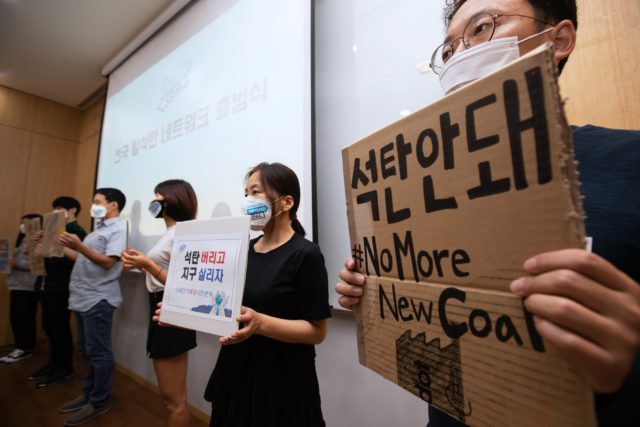

 지자체, 해양경찰, 중앙정부와 항만구역까지 책임을 미룰수 있는 군산의 불법 실뱀장어 폐선[/caption]


시민들의 의견
댓글 달기