주요 콘텐츠로 건너뛰기

[Solidarity Message] Japan, Stop Military Buildup! Preserve Peace Constitution!

지역

[Solidarity Message] Japan, Stop Military Buildup! Preserve Peace Constitution!

익명 (미확인) | 금, 2015/06/12- 21:08

solidarity message


Solidarity Message to <Anti-War Coalition In Solidarity to Protect Article 9>

People's Solidarity for Participatory Democracy(PSPD) has opposed the amendment of peace constitution and rearmament of Japan by Abe administration. We are very concerned about national security bills in a bid to be passed at the National Diet of Japan.


Japan must be prevented from exercising the right of collective self-defense. This will nullify the Japanese peace constitution, particularly article 9, which has served as an anchor of peace in East Asia.


This year is the 70th anniversary of the end of WWII. The memories of the atrocious Japanese colonial rule and aggression in the past in many of its neighboring countries cannot be simply erased.


Japan must stop military buildup and preserve its peace constitution.

We will continue to stand in solidarity with those who are concerned about and marching for peace across Asia-pacific.


Peace & Solidarity


Peace and Disarmament Center, PSPD


call for support


시민들의 의견

댓글 달기

Plain text

  • 웹 페이지 주소 및 이메일 주소는 자동으로 링크로 전환됩니다.
  • 줄과 단락은 자동으로 분리됩니다.
  • 사용할 수 있는 HTML 태그: <a href hreflang> <em> <strong> <cite> <blockquote cite> <code> <ul type> <ol start type> <li> <dl> <dt> <dd>
이미지
무제한 수의 파일을 이 필드에 업로드할 수 있습니다.
50 MB 한계입니다.
허용된 유형: png gif jpg jpeg.
Enter the YouTube URL. Valid URL formats include: http://www.youtube.com/watch?v=1SqBdS0XkV4 and http://youtu.be/1SqBdS0XkV4.
CAPTCHA
스펨 사용자 차단 질문

22842681698_f1ca94abab_c.jpg

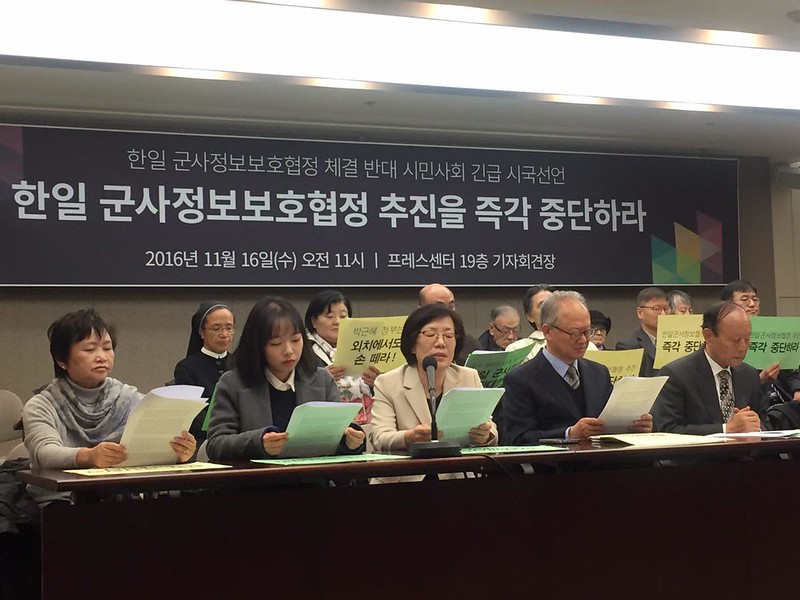
South Korean Civil Society’s Declaration against the General Security of Military Information Agreement (GSOMIA) between the Government of the Republic of Korea and the Government of Japan 

Immediately cease the GSOMIA negotiation


(16 November 2016, Seoul) We, 225 public figures and 113 civil society organisations, call upon Park Geun-hye administration to stop the signing of dogmatic, undemocratic and unpeaceful General Security of Military Information Agreement (GSOMIA) between the Government of the Republic of Korea and the Government of Japan. Both governments held the first meeting in Tokyo on 1st of November, the second meeting in Seoul on 9th of November, the third meeting in Tokyo on 14th of November and tentatively initialed the GSOMIA. The Park administration has already requested the legislative office for examination in an aim to ratify the GSOMIA within this month. We strongly condemn the government’s undemocratic decision and warn the Government to immediately stop negotiation on the GSOMIA.


We strongly protest against the way how negotiation process has been carried out in an unfair and non-transparent manner. As we all recall, this Agreement was secretly carried out to the point of initialing by Lee Myung-bak administration in 2012 and was ceased due to the strong opposition from the people. People were outraged by the fact that the government pushed ahead with the agreement without consensus from the general public with the power vested and the national assembly as the representative body of the government.  


This undemocratic behavior is repeated and getting even worse. The Ministry of National Defense, which is mainly responsible for the GSOMIA has vowed until recently that forming general public consensus is crucial and that the “signing the GSOMIA can only be proceeded with conditions established.” Regardless, the Park Geun-hye administration has disregarded such conditions and without any attempt to reach a general public’ s consensus, it has decided to continue signing the GSOMIA like a military operation. 
 
While South Korean people are angered and shocked by the recent Presidential scandal, the GSOMIA is being enforced. As proved by a million protesting on 12th of November, majority of people are calling for the President’s immediate resignation. As the Park administration has failed to carry out the constitutional responsibility bestowed by the people, it is not qualified to proceed the GSOMNIA. Paradoxically speaking, this GSOMIA negotiation clearly proves that the President must not be involved both in domestic and international affairs. 
 

We are extremely concerned about the negative impact of the GSOMIA. The government has granted indulgence through abruptly settling on the Agreement on ‘comfort women’ to Abe Shinzo administration in Japan, which has been right wing-led and distorted its history of aggression. Signing the GSOMIA will rather encourage Japan’s remilitarization and exercise of collective self-defense. As the most affected victims of Japanese imperialism, we will not accept the government to blindly take such actions.  


The GSOMIA will instigate the possible new cold war in Northeast Asia. Republic of Korea is the closest neighboring country to North Korea, an explicit enemy of the US-Japan alliance, and China and Russia, strategic competitor countries of US. The reason for the US-Japan alliance to include South Korea in their military strategy largely lies in geopolitical factor. The Korean Peninsula will be a strategic advantage as battle front and troop as the last resort. The South Korea-US-Japan Military Information Sharing Pact signed in 2014 and Terminal High Altitude Area Defense (THAAD) deployment decision made in this July are in the same context. Such South Korea’s trilateral alliance may raise increasing concern in strengthening the trilateral alliance between North Korea, China and Russia. The result will be a new cold war in Northeast Asia and exacerbation of arms race as well as permanent loss of peace on the Korean Peninsula. As the victim of cold war, we will not allow the re-emergence of a new cold war. 


Some may assert that military cooperation with Japan is necessary in a pragmatic approach against the acceleration of North Korea’s missile and nuclear weapon threats. Nevertheless, the GSOMIA for trilateral missile defense system establishment will not assure South Korea’s safety. According to a report published by the US Congress Research Service (CRS) in June, 2013, it is assured that “South Korea might not benefit as much, because it is so close to North Korea that incoming missiles would likely fly on a lower trajectory and could arrive in a matter of minutes.” Considering our reality that we are still under ceasefire, this is a valid criticism. 


Military approach like the GSOMIA will clearly not stop North Korea’s nuclear development. This is just expansive reproduction of a failed policy. This will only lead to self-harm result in the Korean Peninsula. This will erupt cold war in Northeast Asia in reality and waste valuable resources that should be utilized for welfare and proliferation of humanity not for military competition.


The cooperation between South Korea-Japan and South Korea-US-Japan should not head in such direction. The objective of cooperation should be focused on peace and the means should be through diplomatic channels. Six-party talks should be resumed as it has been discontinued for about past eight years and relations between North and South Korea, North Korea and the US as well as North Korea and Japan should be resolved.


However, the Park administration has clearly proved that it has no will or capability to do so. It is gradually being disclosed that a shadowy advisor who is at the center of the corruption scandal has exerted extensive influence on domestic and international affairs but the government is still attempting to sign the GSOMIA. '


We will never accept such a historical regression. We can no longer trust the government that has lost ability to realize the seriousness of the issue and the President Park Geun-hye has no credibility, qualification or capability as a leader of this country. 


수, 2016/11/16- 14:48
166
0

This letter, signed by civil society organizations around the world including PSPD, was released on March 25, 2016, in time for the Security Summit to be held in Washington DC on March 31-April 1.


To: Mr. Shinzo Abe
    Prime Minister of Japan


March 25, 2016


Subject: Call to help strengthen worldwide nuclear security by stopping plutonium separation


We, the undersigned, call on Prime Minister Shinzo Abe and the Government of Japan to make a strong contribution to the Nuclear Security Summit by announcing the indefinite postponement of the operation of the Rokkasho spent nuclear fuel reprocessing plant.


At the third Nuclear Security Summit held in The Hague, the Netherlands, in 2014 Prime Minister Shinzo Abe and President Barak Obama announced their agreement to:
“remove and dispose of all highly-enriched uranium (HEU) and separated plutonium from the Fast Critical Assembly (FCA) at the Japan Atomic Energy Agency (JAEA) in Japan.”
They declared that:
“this effort involves the elimination of hundreds of kilograms of nuclear material, furthering our mutual goal of minimizing stocks of HEU and separated plutonium worldwide, which will help prevent unauthorized actors, criminals, or terrorists from acquiring such materials.”


331 kilograms of plutonium from FCA are to be brought to the U.S. Department of Energy’s Savanna River Site in South Carolina. According to the Japan Atomic Energy Agency (JAEA), which operates the FCA, most of the plutonium (236 kg) is originally from the United Kingdom with 93 kg from the U.S. and the rest (2 kg) from France.


While asking the people of South Carolina to accept this material to protect the world from the possibility of theft from the JAEA’s lightly guarded Tokai-mura site, Japan is planning to begin to operate in 2018 its equally insecure Rokkasho Reprocessing plant, which is designed to separate annually up to 8,000 kilograms of plutonium from Japan’s spent nuclear fuel. The plant is currently the only reprocessing plant in a non-nuclear weapon state.


According to the US National Nuclear Security Administration’s (NNSA’s) Global Threat Reduction Initiative “Removal Program Overview” (December 3, 2014) the 331 kg of plutonium at FCA satisfies the program’s requirements for material to be sent to the United States for disposition, that:
“it must also pose a threat to national security, be susceptible to use in an improvised nuclear device, present a high risk of terrorist threat and have no other reasonable pathway to assure security from theft or diversion.”


While NNSA has been working hard to reduce this danger, it says threats still remain and calls for attention to the world-wide civilian separated plutonium problem emphasizing that:
“Global civilian plutonium inventories have risen sharply over the last 20 years” and that “Further international engagement is needed to stop plutonium accumulation and start drawing down inventories.”


After the 61st Pugwash Conference on Science and World Affairs, “Nagasaki’s Voice: Remember Your Humanity” (1-5 November 2015, Nagasaki, Japan) the Pugwash Council, sharing the same concern, declared:  
“Reprocessing to separate plutonium should end in all countries, including all nuclear weapon countries, whether for energy or weapon purposes…In view of the international security consequences of fuel cycle decisions, countries need to mutually agree to restrictions on their national sovereignty in making nuclear fuel cycle decisions.”


As of the end of 2014 Japan had 47,800 kilograms of separated plutonium: 10,800 kg in Japan, 20,700 kg in UK, and 16,300 kg in France. According to the International Panel on Fissile Material (IPFM) the amount of civilian separated plutonium worldwide as of the end of 2014 is about 270,000 kg. Three nuclear weapons states, France, the U.K., and Russia, and Japan account for most of this separated plutonium. The United States is faced with a difficulty trying to dispose of about 50,000 kg of surplus weapons plutonium. Further accumulation of nuclear-weapon-usable material is a concern for the international society and for Japan’s neighbors, who wonder why Japan is separating such huge quantities of directly weapon-useable material. Separated plutonium is a security risk. If other countries followed Japan’s example, it would increase proliferation risks. In fact, South Korea has been demanding that the United States acknowledge that the ROK has the same right as Japan to separate plutonium.


When Prime Minister Abe and President Obama announced the plan to transfer 331kg of plutonium to the U.S., they went on to:
“encourage others to consider what they can do to further HEU and plutonium minimization.”
At that time, in March 2014, operations at the Rokkasho reprocessing plant were to begin just around the time of the coming Nuclear Security Summit. This would have been a very ironic timing. The date subsequently was postponed to 2018, due to the inability of the plant’s operator to satisfy the new safety rules set by the Nuclear Regulation Authority created after the Fukushima accident. Some might be secretly hoping that this might effectively lower the profile of Japan’s plutonium separation program at a time when Japan’s Government hopes that the U.S. will agree to automatically extend, in 2018, their Agreement of Cooperation on the Peaceful Uses of Atomic Energy, which includes the U.S. acceptance of Japan’s right to separate plutonium from spent fuel irradiated in U.S. designed nuclear power plants.


We call on Japan to announce, at the Nuclear Security Summit to be held in Washington DC. March 31-April 1 2016, an indefinite postponement of its plan to start the Rokkasho reprocessing plant in order to further the mutual goal of Japan and the U.S. to minimize global stocks of separated plutonium. That would be a great contribution to the worldwide effort to strengthen nuclear security.


>>> To read this letter in Korean

화, 2016/04/05- 16:34
137
0

‘comfort women’ victims by the japanese army

This is an English version of “Sorrowful Homecoming” a documentary produced by “Team Witness” and uploaded twice on the website of the Korea Center for Investigative Journalism (Newstapa) on Mar. 2016.

This documentary include testimony as North Korean ‘comfort women’ victim who was raped by japanese military and ‘comfort station’ where the building countless innocent girls were raped by the japanese military during the japanese colonial Rule.

Mr.Dakashi Ito who is japanese journalist shooted twice in 1999, 2015 when he visited North Korea.

Part 1

Korean Version

수, 2016/03/30- 17:12
227
0

‘comfort women’ victims by the japanese army

This is an English version of “Sorrowful Homecoming” a documentary produced by “Team Witness” and uploaded twice on the website of the Korea Center for Investigative Journalism (Newstapa) on Mar. 2016.

This documentary include testimony as North Korean ‘comfort women’ victim who was raped by japanese military during the japanese colonial Rule.

Mr.Dakashi Ito who is japanese journalist shooted twice in 1999, 2015 when he visited North Korea.

Part 2

Korean Version

수, 2016/03/30- 17:23
210
0

This is an English version of “My Wish,” a documentary produced by “Witness” and uploaded on the website of the Korea Center for Investigative Journalism (Newstapa) on Jan. 26, 2016.

Haksoon Kim, who appears in the documentary, was a “comfort women” survivor and made the first testimony as a South Korean comfort woman victim in 1991.

This documentary is a recount of her interview made in July, 1997, five months before her death.


Subtitle by Sewol Ferry Worldwide supporters Translation Team

Korean Version(LINK)

화, 2016/03/08- 18:51
254
0

11 January 2016


United Nations Secretary General Ban Ki-moon
UN Headquarters
405 East 42nd Street
New York, NY 10017
USA    


Cc : Zainab Hawa Bangura, UN Special Representative on Sexual Violence in Conflict
Zeid Ra’ad Al Hussein, UN High Commissioner for Human Rights
Rashida Manjoo, UN Special Rapporteur on Violence against Women
Pablo de Greiff, UN Special Rapporteur on the Promotion of Truth, Justice, Reparation, and Guarantees of Non-recurrence
H.E. Choi Kyong-lim, President of the UN Human Rights Council
Members of the UN Committee against Torture
Members of the UN Human Rights Committee 
    

Re: Clarification on the UN Secretary-General’s Position on the Recent Republic of Korea-Japan Agreement on Wartime “Comfort Women”


People's Solidarity for Participatory Democracy (PSPD) is a non-governmental organization based in Seoul, the Republic of Korea (ROK) with United Nations(UN) ECOSOC consultative status. We are writing to you today to seek clarification of the Secretary-General's position on the recent ROK-Japan agreement on wartime “comfort women”. We express our concern on your recent congratulatory remarks on the agreement, because we view that the agreement was not made in a way to implement the values and principles put forth by the UN, which has emphasized a victim-centered approach.


In the official statement regarding the recent agreement between the ROK and Japan on issues related to “comfort women” from the ROK which was released on 28 December 2015, you welcomed “that the Governments of Japan and the Republic of Korea have reached an agreement,” and hoped “that the agreement will contribute to improving the bilateral relationship between the two countries.” Following your statement, the ROK President’s Office (Blue House) released a briefing on 1 January 2016, saying that you congratulated President Park Geun-hye, via telephone, on reaching the agreement with Japan, and stated that “history will laud President Park’s courageous decision based on her vision.”   


Yet, the latest agreement between the ROK and Japan hardly reflects the wishes of the victims themselves, nor did the process involve any participation by the victims. Lee Yong-soo, one of the few surviving victims of Japan’s wartime sexual slavery policy, harshly criticized the agreement, saying “The agreement does not reflect the views of former ’comfort women’. I will ignore it completely.”  Ms. Lee condemned the deal as amounting to “a second death of the victims.” The latest agreement indeed does not incorporate any of the demands which include official apologies, legal reparations, and guarantees of non-recurrence. The victims have consistently put forward these demands since making their past agony public for the first time in 1991. According to the recent agreement, the Japanese government did promise to provide JPY 1 billion (around 8.3 million USD) for a new special fund to be set up for a foundation for the surviving “comfort women”. However, Mr. Fumio Kishida, Japanese Minister of Foreign Affairs, made it clear that the money was not legal reparation , and still refuses to recognize Japan’s legal responsibility for wartime sexual slavery. However, the governments of both countries have concluded that the latest agreement will be the “final and irreversible” resolution to the “comfort women” issues, thus inviting mounting criticism from inside and outside the ROK.


We would like to remind you that the latest agreement on “comfort women” does not even satisfy the UN recommendations regarding Japan’s wartime sexual slavery and related issues which were made in the past. Different human rights mechanisms of the UN have condemned the acts of wartime sexual slavery committed by Japan as “crimes against humanity,” and recommended that the Japanese government acknowledge its legal responsibility, make formal reparations to the victims, and prosecute the parties responsible for such crimes. During its review on Japan in July 2014, the UN Human Rights Committee noted that most “comfort women” were recruited by, transported to, and managed at Japanese military bases or agencies working on behalf of the Japanese military through force and coercion, and expressed concerns at the Japanese government’s continued denial that these women were “ever mobilized or migrated by force” (CCPR/C/JPY/CO/6, para 11). In August 2014, the UN Committee on the Elimination of Racial Discrimination expressed its concerns that the Japanese government had not recognized nor apologized to “comfort women”, and urged the Japanese government to immediately conclude investigations and bring to justice those responsible for human rights violations (CERD/C/JPN/CO/7-9, para 18).


We would also like to point out that the UN and the international community at large uphold a consistent set of victim-centered principles and standards with respect to the rights of victims of human rights violations.


In February 2005, the UN Commission on Human Rights (now the UN Human Rights Council) adopted “Principles for the protection and promotion of human rights through action to combat impunity” (E/CN.4/2005/102/Add.1), followed by “Basic Principles and Guidelines on the Right to a Remedy and Reparation for Victims of Gross Violations of International Human Rights Law and Serious Violations of International Humanitarian Law” (A/60/509/Add.1) adopted by the UN General Assembly in December 2005. These two documents endorse the “victim-centered perspective” in international human rights law, and emphasize the victims’ right to justice, right to reparation, and right to know. These documents also stress as essential principles the need to give victims restitution, compensation, rehabilitation, reparation, and redress.


Since its establishment in 2002, the International Criminal Court has also stressed the need for victim participation in all phases of investigation and judicial procedures. “The Chicago Principles on Post-Conflict Justice 2001-2008”, which provide basic guidelines on the handling of atrocities perpetrated under authoritarian rule and amid armed conflicts, also emphasize: “Policies that seek justice for past violations should be victim-centered and should address victims’ rights to remedies and reparations.”


We note with serious concern that your remarks on "welcoming" the recent agreement between the ROK and Japan, and lauding it as a “courageous decision” by the South Korean President are not in line with the human rights principles and positions the UN and the international community have accumulated so far. 


We would therefore like to request your response to the following questions to further clarify your position. 


1. Do you think that the recent agreement between South Korea and Japan satisfy the UN-emphasized principles of the rights of the victims of human rights violations and properly address war crime legacies and past recommendations made by the UN human rights mechanisms to Japan?


2. According to the briefing issued by the Presidential Blue House of the ROK, you phoned the President of the ROK to discuss the recent agreement. Have you done the same with the Prime Minister of Japan? If so, what exactly was discussed or remarked in the latter conversation? If no such conversation took place with the Prime Minister of Japan, why have you had such a conversation with the President of the ROK and not with the Prime Minister of Japan?


3. The UN Secretary-General is obligated to make efforts to promote human rights in all Member States. Therefore, some argue that the UN Secretary-General should help invalidate the recent agreement between the ROK and Japan that seems to condone war crimes. What do you think of this argument?


4. Is the Secretary-General inclined to urge both the government of the Republic of Korea and Japanese governments to resolve the “comfort women” issues through official apologies, legal reparations, and guarantees of non-recurrence from the Japanese state through processes that are actually based upon victim participation?


We thank you for your reply in advance and look forward to hearing back from you at the earliest possible time. If you have any questions or would like clarification, please do not hesitate to contact us at [email protected] or +82 (0)2 723 4250. 

Yours sincerely,


Ms. Hyunback Jung
Co-Representative
People's Solidarity for Participatory Democracy 


월, 2016/01/11- 10:24
225
0