주요 콘텐츠로 건너뛰기

Korea Peace Appeal International Partners Meeting

지역

Korea Peace Appeal International Partners Meeting

admin | 목, 2023/03/23- 06:56
Korea Peace Appeal International Partners Meeting

Korea Peace Appeal Campaign International Partners Meeting

? 70 years of the Korean War Armistice,
Let’s Build Peace Together!

Korea Peace Appeal has scheduled a Zoom meeting for international partners.

Military tension on the Korean peninsula is elevating amid the never-ending ceasefire. The risk of an accidental armed conflict is very high. The prospect of peace on the Korean Peninsula and Northeast Asia is not so bright. There is a desperate need for voices calling for peace.

Marking the 70th anniversary of the Korean War Armistice this year, the Korea Peace Appeal Campaign has launched a new project <Korea Peace Action for the 70 years of the Korean War Armistice>. We plan to continue the Korea Peace Appeal signature campaign but more intensively, and organize various peace actions all over the world.

We aim to share awareness of the current situation and introduce our plan for 2023 and discuss ideas and opinions on building peace on the Korean Peninsula through the meeting.

Please join us in building peace together!


☮ Program

  • Presentation : Current Crisis on the Korean Peninsula
    – Jae-Jung Suh (Professor for Politics and International Relations at International Christian University)
  • Presentation : 2023 Plan and Introduction for International Participation
    – Korea Peace Appeal Campaign
  • Discussion

We have set two individual sessions considering the time difference. The two sessions will cover the same content! Please register for a session that suits your schedule by clicking on the link beside each session.

✅ 1st Session  Register
30 March 2023 (Thu) 5pm (PDT) / 8pm (EDT)
31 March (Fri) 9am (KST)

✅ 2nd Session  Register
31 March 2023 (Fri) 10am (CEST) / 5pm (KST)


Korea Peace Appeal 2

? Signature Campaign to End the Korean War
Sign the Korea Peace Appeal Now ?
endthekoreanwar.net

The post Korea Peace Appeal International Partners Meeting appeared first on 참여연대.

시민들의 의견

댓글 달기

Plain text

  • 웹 페이지 주소 및 이메일 주소는 자동으로 링크로 전환됩니다.
  • 줄과 단락은 자동으로 분리됩니다.
  • 사용할 수 있는 HTML 태그: <a href hreflang> <em> <strong> <cite> <blockquote cite> <code> <ul type> <ol start type> <li> <dl> <dt> <dd>
이미지
무제한 수의 파일을 이 필드에 업로드할 수 있습니다.
50 MB 한계입니다.
허용된 유형: png gif jpg jpeg.
Enter the YouTube URL. Valid URL formats include: http://www.youtube.com/watch?v=1SqBdS0XkV4 and http://youtu.be/1SqBdS0XkV4.
CAPTCHA
스펨 사용자 차단 질문

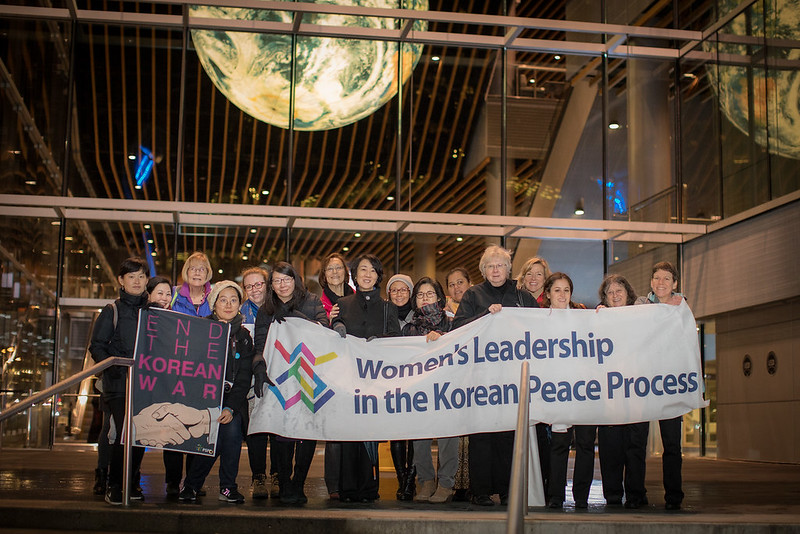
STATEMENT OF THE VANCOUVER WOMEN’S FORUM

ON PEACE AND SECURITY ON THE KOREAN PENINSULA

>>> Statement [Download]


As sixteen delegates representing peace movements from all over the world, we have traveled from Asia, Pacific, Europe, and North America to convene the Vancouver Women’s Forum on Peace and Security on the Korean Peninsula, an event held in solidarity with Canada’s Feminist Foreign Policy to promote a peaceful resolution to the crisis on the Korean Peninsula. Sanctions and isolation have failed to curb North Korea’s nuclear weapons program and instead severely harm the North Korean civilian population. A Korean Peninsula free of nuclear weapons will only be achieved through genuine engagement, constructive dialogue, and mutual cooperation. We issue the following recommendations to the Foreign Ministers participating in the January 16 Summit on Security and Stability in the Korean Peninsula: 


Immediately engage all relevant parties in dialogue, without preconditions, to work toward achieving a nuclear-free Korean peninsula;


Abandon support for the strategy of maximum pressure, lift sanctions which have deleterious effects on the North Korean people, work toward the normalization of diplomatic relations, remove barriers to citizen-to-citizen engagement, and strengthen humanitarian cooperation;


Extend the spirit of the Olympic truce and affirm the resumption for inter-Korean dialogue by supporting:

i) negotiations for the continued suspension of joint US-ROK military exercises in the south, and the continued suspension of nuclear and missiles tests in the north,

ii) a pledge not to conduct a first strike, nuclear or conventional, and 

iii) a process to replace the Armistice Agreement with a Korea Peace Agreement;


Adhere to all the Security Council recommendations on Women, Peace, and Security. In particular, we urge you to implement United Nations Security Council Resolution 1325, which acknowledges that the meaningful participation of women in all stages of conflict resolution and peacebuilding strengthens peace and security for all. 


These recommendations are based on our long experience engaging with North Koreans through citizen diplomacy and humanitarian initiatives, and from our collective expertise on militarism, nuclear disarmament, economic sanctions, and the human cost of the unresolved Korean War. The Summit is a sobering reminder that the gathered nations have a historic and moral responsibility to formally end the Korean War. A pledge not to conduct a first strike can de-escalate tensions by significantly reducing the apprehension of an attack and the risk of miscalculation that could result in an intentional or an inadvertent nuclear launch. Resolving the Korean War can be the single most effective action to halt the intense militarization of Northeast Asia, which gravely threatens the peace and security of 1.5 billion people in the region. The peaceful resolution of the Korean nuclear crisis is the key step toward the total global elimination of nuclear weapons.


January 15, 2018

Vancouver Women's Forum on Peace and Security on the Korean Peninsula

Christine Ahn, Women Cross DMZ

Kozue Akibayashi, WILPF

Lisa Natividad Guahan. Coalition for Peace and Justice

Ewa Eriksson, Fortier Women Cross DMZ

Yehjung Yi, Korean Sharing Movement

Mihyeon Lee, People’s Solidarity for Participatory Democracy

Liz Bernstein, Nobel Women’s Initiative

Moon-sook Lee, National Council of Churches in Korea

Susan Bazilli, Women Peace Security Network

Nan Kim, Alliance of Scholars Concerned about Korea

Ellen Judd, Canadian Voice of Women for Peace

Ann Wright, Women Cross the DMZ & Veterans for Peace

Patti Talbot, United Church of Canada

Mary-Wynne Ashford, International Physicians for the Prevention of Nuclear War

Erica Fein, Win Without War

Lyn Adamson, Canadian Voice of Women for Peace 


Jan 16th CC (644 of 654)-X2

<사진 = 밴쿠버여성포럼>

월, 2018/01/15- 13:52
93
0

Pyeongchang Olympics and the Great Shift in Korea


LEE Seung-hwan South-North Korea Exchanges and Cooperation Support Association


Korean Peninsula, Spring 2018


The series of events that began with the participation of North Korean athletes in the Pyeongchang Olympics and the accompanying visit by the North Korean delegation headed by Kim Yeo-jeong, followed by the visit to North Korea by the South Korean delegation, completely transformed how the Korean Peninsula entered spring this year, by putting an end, at least for the time being, to the nuclear and missile experiments and military drills that had raised the tension between the two Koreas every spring. With the volatility characterizing the state of affairs on the Korean Peninsula so quickly dissolved and the groundwork for the historical summits between the leaders of the two Koreas as well as between the North Korean leader and the U.S. president completed, the Pyeongchang Olympics will likely be remembered as a watershed moment in the Korean struggle for peace.


The background to the “nearly miraculous situation in East Asia,” as described by the Japanese government, can be found in the so-called March 5 Accord between Kim Jong-un and the South Korean delegation to Pyongyang. North Korea took the world by surprise by completely reversing its position and embracing the accord encompassing the organization of the third inter-Korean summit, the resumption of the North Korea-U.S. dialogue on the denuclearization of North Korea and the restoration of relations between the two countries, and the possible cessation, by North Korea, of its nuclear and missile experiments, contingent upon the successful continuation of dialogue with the United States. Through the accord, Pyongyang eagerly expressed its willingness to cease the nuclear and missile provocations that have fueled the escalating military tension on the Korean Peninsula and even to contribute to détente by tolerating without any changes to intensity ROK-U.S. joint military exercises slated for April.


Background of the March 5 Accord


Experts offer a number of different explanations as to the factors motivating the dramatic shift of attitude on the part of North Korea as displayed in the March 5 Accord.


The most widely accepted theory is that the international community’s prolonged sanctions against North Korea forced the country into accepting the terms of the accord. Notwithstanding the attendant controversies, these sanctions have been working. UN Security Council Resolution 2270 of March 2016 broadened the scope of the sanction to include comprehensive measures beyond responses to the country’s weapons of mass destruction (WMD) development, and significantly strengthened the intensity of sanctions exercised by China, a country that holds the key to the success of sanctions against North Korea. However, detractors of this theory argue that it is still too early to determine the true effects of these international sanctions, and that sanctions alone could not have changed Pyongyang’s policies so dramatically, given the nature of the Kim regime. These critics alternatively point to the innate change in Pyongyang’s strategy as the more direct source of the about-face displayed in the March 5 Accord. As the Kim Jong-un regime aspires to transform North Korea into a “strategic country” (with normal relations and a capability to shape the order it faces), it has had to address the reality that the extensive development of nuclear programs has failed to significantly improve the North Korean economy. In other words, it has had to embrace the opportunities for increased aid, the removal of sanctions, the signing of a peace agreement, and restoring relations with the United States even if embracing such opportunities would require the denuclearization of North Korea.


Even more important than the effects of sanctions and the change in the Kim regime’s strategy are the efforts being made by the Moon Jae-in government. By delaying the joint ROK-US military exercises last December, the Moon government succeeded in inducing Pyongyang’s decision to send North Korean athletes to the Pyeongchang Olympics and to accept the March 5 Accord. By responding, belatedly, to Pyongyang’s offer made in January 2014 that it would cease nuclear and missile experiments should Seoul cease the joint military exercises with the US military, the Moon government enabled Pyongyang to turn its stance around on the state of inter-Korean relations. Without the Moon government’s efforts at persuading Washington and postponing the joint military exercises, neither the sanctions nor the North Korean strategy would have led to this “nearly miraculous situations in East Asia.”


Why Sanctions Are Not the Cure-All Solutions to Problems Involving North Korea


Both Washington and the general American public view the recent development on the Korean Peninsula with a wary eye, regarding the shift in Pyongyang’s attitude as motivated by the strategic goal of increasing economic gains by putting the option of denuclearization on the negotiation table. President Trump denied that the decision to hold a summit with the North Korean leader was impromptu, but has expressed both doubts and hopes in his tweets: “May be false hope, but the U.S. is ready to go hard in either direction” and “Great progress being made, but sanctions will remain until an agreement is reached.”


Accordingly, the Trump administration’s new line of diplomacy with North Korea features hardliners like Mike Pompeo and John Bolton, a testament to Washington’s resolve to challenge North Korea even further with military options should its talks with Pyongyang fail.


The Liberal Korea Party and conservatives critical of the Moon government in South Korea, on the other hand, have blatantly characterized the change in Pyongyang’s attitude as “a mere security show put on by a hard-pressed North Korea,” expressing distrust and discontent even in the face of Washington’s new willingness to give talks a try. These detractors keep demanding sanctions as the only solutions to all problems involving North Korea, claiming that only stronger and continued sanctions would induce positive change in Kim Jong-un and lower the risk of an armed conflict.


Blind trust in sanctions, especially in the absence of a strategy for engagement and dialogue, can have fatal results, however. The current level of sanctions is already so high that it threatens the daily livelihood of North Koreans. Additional sanctions could backfire by tempting North Korea into accelerating its nuclear development program with a view to breaking through the uncomfortable status quo with violent actions. Unlike other countries, South Korea, too, stands to lose much from continued sanctions against North Korea. The May 24 Sanction Measures, the restriction on tourism to Mt. Kumgang, and the shutdown of the Kaesong Industrial Park all intended to hurt the North Korean economy, but also ended up damaging South Korean businesses just as much. Unconditional sanctions against North Korea, in other words, presents a self-destructive strategy from the South Korean perspective that increases the risks of war. Unconditional sanctions should not form South Korea’s strategy on long-term relations with the North.


Trilemma of Peace on the Korean Peninsula


The three main goals the South Korean government seeks to achieve with the Great Shift on the Korean Peninsula are denuclearization, the establishment of a peace regime, and the continuation of the Korea-US alliance. Two of these three goals may be achieved without much conflict, but all three cannot be achieved at the same time. Until now, all the parties involved have been pursuing different goals—South Korea, the establishment of a peace regime on the peninsula; the United States, the denuclearization of North Korea; and North Korea, its own rise as a “strategic country.” The three countries are now compelled to find effective measures to overcome this trilemma in order to achieve their objectives.


The Pyeongchang Olympics and the March 5 Accord created a new opening in this search for possible solutions to this trilemma. Pyongyang has so far sought to become a strategic country by amassing a nuclear arsenal. Through the March 5 Accord, however, it has offered to sit down for a summit with the US president and showed a willingness to make political and economic gains by giving up (allegedly) “completed” nuclear programs. Note Kim Jong-un’s remark to the South Korean delegation that North Korea “would like to be taken seriously as a partner of dialogue.”


Recall the five conditions of denuclearization Pyongyang demanded in an official statement released on July 6, 2016. The five conditions included in this July 6 Proposition were: (1) the disclosure of U.S. nuclear weapons brought into South Korea; (2) the abolition of all nuclear weapons and their bases in South Korea; (3) the prohibition on the introduction of nuclear strike assets into the Korean Peninsula; (4) the confirmation of the prohibition on the use of nuclear weapons against North Korea; and (5) the declaration, by Washington, of the withdrawal of US troops from South Korea with their ability to launch nuclear weapons. The proposition repeats much of the conditions listed in the Joint Statement on the Denuclearization of the Korean Peninsula of 1992, with the withdrawal of US troops additionally demanded. Washington has stated that it has either already satisfied or is willing to entertain the four earlier conditions. The only remaining problem between Washington and Pyongyang is therefore the latter’s latest demand that the former withdraw its troops from South Korea. 


Pyongyang, however, was careful to hedge its last demand, limiting the scope of troops to be withdrawn to those with the ability to launch nuclear weapons, and also demanding not the immediate withdrawal per se, but the declaration to that effect. Pyongyang, in fact, has expressed much willingness to tolerate the American military presence in South Korea at every major opportunity for negotiation. At the South-North Korean Summit of 2000, Kim Jong-il famously remarked that the US troops in South Korea should remain not as a force hostile to North Korea, but as the keepers of peace on the Korean Peninsula.


A Bold Proposition for the Inter-Korean and DPRK-US Summits


There are, in other words, a number of measures that all three parties may adopt toward solving the trilemma involving the denuclearization of North Korea, the continuation of the ROK-US alliance, and the establishment of a peace regime on the Korean Peninsula. These include guaranteeing the security of North Korea by implementing the Joint Statement on the Denuclearization of the Korean Peninsula, guaranteeing North Korea’s entry into the international community and its prospects for future prosperity by lifting sanctions, and guaranteeing the United States’ continued influence on East Asia by agreeing to keep US troops in South Korea without nuclear capabilities. The denuclearization of the Korean Peninsula without the withdrawal of US troops is perhaps the best possible scenario to which both Koreas and the United States could agree. The realization of that scenario would amount to the establishment of a joint security regime involving all three countries on a denuclearized Korean Peninsula. The rise of such a regime, in turn, would imply the accumulation of sincere and mutual trust among the three countries.


The establishment of a military alliance between North Korea and the United States, as demanded by some hardliners, would represent a more advanced form of such joint security regime. Hardliners like Hong Seok-hyeon thus demand that the Trump administration ought to work on enhancing the pro-US stance of Pyongyang by explicitly saying “No” to toppling the Kim regime, working towards the collapse of the Kim regime, accelerating the Korean unification, and moving US troops north of the 38th Parallel.


Once the three countries begin to develop mutual trust in one another by exercising new and bold ideas unbounded by the conventional mold of hostile relations, they will be able to maintain the impetus for denuclearization notwithstanding differences in detail. The peacebuilding process based upon such mutual trust would differ significantly from the step-by-step denuclearization and peacebuilding processes envisioned by the September 19 Joint Statement of 2005. In order to capitalize upon the current “miracle-like” opportunity created by the Pyeongchang Olympics and the Great Shift, bold actions akin to cutting the Gordian Knot are required.


Multilayered Approaches to North Korea and Expanding Civilian Exchange


The current state of affairs on the Korean Peninsula differs markedly from similar opportunities for peace that arose in the past, as the current situation requires bold actions and a firm commitment to peace. The solution required by the current situation would involve solving the major obstacles to peace on the Korean Peninsula early in the negotiation process. This, in turn, requires mutual trust and friendship among the two Koreas and the United States, which is crucial to maintain the drive for peace until the final end of the negotiation process, i.e., the permanent denuclearization of North Korea.


Another interesting characteristic of the current situation is that the peacebuilding process is guided in a top-down fashion with the strong commitment of the leaders involved. Given the complexity of the Korean Question and the history of distrust among the countries involved, a top-down approach involving a series of summits is crucial for solving the problems early on and establishing sufficient trust in a short span of time. At present, civilian exchange among the three countries involved would be restrained until local elections are held in South Korea in June, even all the while preparations are being made for the summits and high-level official talks.


Nevertheless, peacebuilding between South and North Koreas should be a multilayered process, and civilians have as important a role to play in the unification process as governments. Efforts should therefore be made in various areas in order to expand the opportunities for civilian exchange between the two Koreas shortly after the summits are held.


Both the South and North Korean governments, in particular, ought to address the issue of promoting exchange at multiple levels as part of the summit. Although the upcoming South-North Korean summit will mainly focus on denuclearization, peacebuilding, the evolution of inter-Korean relations, and economic cooperation with the United States, the leaders of both Koreas should not neglect the importance of restoring the ecosystem for rich civilian exchange at multiple levels. The two Korean leaders could provide a significant boost for continued and stronger civilian exchange if they embrace a written resolution to guarantee and support civilian exchange at various levels irrespective of political and military tension. By embracing such a resolution, the two Korean leaders could effectively declare their commitment to diversifying inter-Korean relations over and beyond government control.


This essay is the first essay written for the 2018 Peace Report Project of the Civil Peace Forum,

under the sponsorship of Friedrich-Ebert-Stiftung Korea Office.


[2018 Peace Report] See/Download

 
화, 2018/04/10- 09:47
78
0

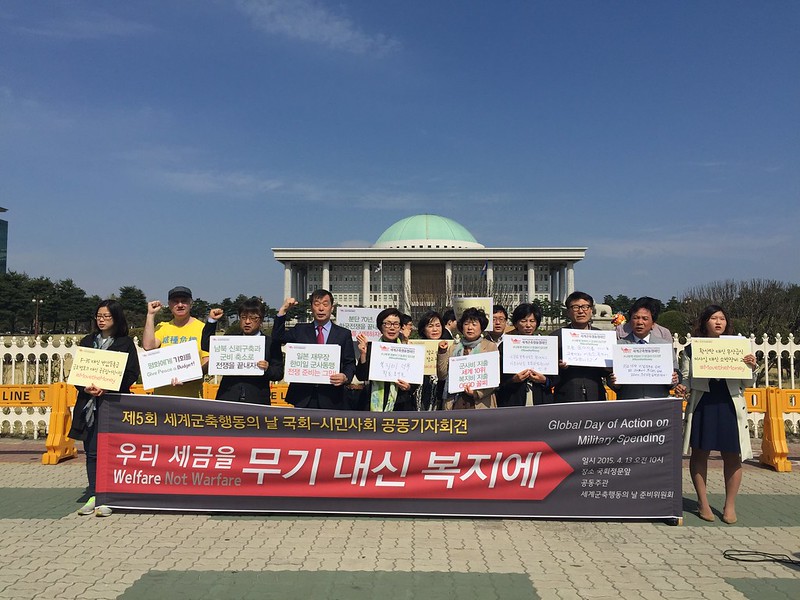
20150413_세계군축행동의날


Joint Statement of the National Assembly and the Civil Society for the 5th Global Day of Action on Military Spending

Our Taxes on Social Welfare instead of on Weaponry


Today on the Global Day of Action on Military Spending, we stand here to be with about 320 organizations from about 70 nations around the world. We should reflect on our reality that peace and safety of citizens worldwide are far from being established even when an astronomical amount of money is spent on military. We demand that our taxes be spent on restoring social justice and building a sustainable and peaceful world. This year, marking the one-year anniversary of the Sewol-ferry tragedy, voices desiring a safe nation have grown louder than ever, and the criticism of the ineffective investment in defense industry in the name of 'national security' is also growing stronger. It is time to change the priorities of the national policy and shift the focus from materialistic national security and military buildup to safety of people and peaceful cooperation.


According to 'Trends in World Military Expenditure, 2014' published by Stockholm International Peace Research Institute (SIPRI), the worldwide military spending last year amounted to 1.8 trillion dollars (about 1,968 trillion won), a little less than the last year's. Korea entered the top 10 for the first time last year and ranked 10th this year. 


Korea's military spending in 2015 amounts to 37.456 trillion won, increased by about 4.9% or 1.7504 trillion won from last year. This is excessive, taking up 14.5% of the government budget. 


While a large sum of military spending is being spent, our society is becoming more extremely socially polarized. Uneasiness from everyday life caused by issues in education, child care, health care, and housing encroaches on our lives, but welfare budget to expand social safety net is not nearly enough. The total amount of university student loan is now over 10 trillion won. The university tuition could be subsidized and cut by half if we decide not to use 7 trillion won of budget on purchasing 40 fighter aircrafts, F-35's, which are the most ineffective and unreasonable among the military weapons to be purchased from the U.S. by the Korean army. 1,400 public daycare centers, which President Park Geun-hye promised to provide during her presidential campaign but failed to fulfill, could be built with 880 billion won of budget set aside for 4 unmanned aerial reconnaissance drones called 'Global Hawk'. Also the budget deficit of 65.5 billion won in 34 local medical centers could be covered for the next 90 years if we do not spend 6 trillion won on operating and maintaining Global Hawk's. Students in South Gyeongsang Province, who had to put up with such remark "a school is not the place you come to eat", could have school lunches for free for the next 30 years if 3.3415 trillion won of budget is not spent on the cluster bomb units and the multiple launch rocket systems, both of which indiscriminate murder weapons banned by international law. All the firefighting equipment which is old to such an extent as to threaten the lives of firefighters could be replaced if we do not spend 1.5233 trillion won on purchasing interceptor missiles such as PAC-3. In retrospect, what we lack is not the budget. Where we allocate finances is important. We should face the threat to our lives, and reprioritize the budget.


How about the Sewol-ferry tragedy? We had to witness 304 people being buried at sea because the country, which spends about 35 trillion won every year to protect citizens from outside threat and ranks 10th in military spending, did not have basic rescue equipment. The Blue House National Security Office denied being the so-called "control tower" for the Sewol-ferry disaster. If so, for whom is the national security if the disaster which could have resulted in deaths of 470 citizens is not a matter of national security? Moreover, the Tongyeong naval rescue ship which proved to be utterly useless at the time of Sewol-ferry disaster showed rampant corruption in the nation's defense industry. If we were to talk about society after the Sewol-ferry tragedy, we should start by dealing with this glaring contradiction.


Someone might raise a question about decreasing the military expenditure when there is a serious threat from North Korea. South Korea spends an amount, almost equal to North Korea's GDP, on military. This amount does not even include the military spending by the United States Forces Korea. North Korea is obsessed with weapons of mass destruction such as nuclear weapons because it knows its military spending is no match for South Korea's. Thus it is not a matter of amount of military expenditure, but a matter of trust.


In the East Asian region, there is a fierce competition on military spending among countries such as the United States, China, Russia and Japan. Some claim that South Korea should increase the military spending in order not to fall behind these nations. However, South Korea, as a middle power country responsible for initiating a peaceful unification on the Korean peninsula, should avoid confrontation based on South Korea-the U.S.-Japan military alliance but should demonstrate leadership for peace, cooperation, coexistence and common security. The recent controversy over the U.S. deploying a Terminal High-Altitude Area Defense (THAAD) missile defenses in South Korea directly shows 'Asian paradox', the disconnect between deep economic interdependence and a serious conflict in military diplomacy. 


There are 20 nations worldwide whose military expenditures take up over 4% of their GDP's in 2014. This number is greater than that in the early 1990's right after the Cold War. If the world had spent even 5% of its military spending on combatting poverty, we could have realized the United Nations Millennium Development Goals (MDGs) that promised to halve global poverty rates by the year 2015. However as the world went through two great wars in Iraq and Afghanistan, the promise could not be kept. Korean government also promised to provide 0.25% of its GNI as Official Development Assistance (ODA) by the year 2015 to eradicate poverty but it allocated vastly insufficient amount and ended up breaking its promise to the international society. The new Sustainable Development Goals (SDGs) which is to be proposed in September, 2015 cannot be achieved without fundamental changes and reflection on military expenditure in each country.


The 5th Global Day of Action on Military Spending should not be the anniversary full of empty promises but should be a milestone to change. Thus, to the government and citizens of Korea which ranks 10th in military spending in the world and ranks last in welfare spending among 28 OECD countries, we suggest the following:


1. We demand that the military spending be reduced to alleviate social bipolarization, to expand social safety net, and to build safe society without disasters. Increasing military spending means taking away other opportunities under a limited government budget. Finances obtained by decreasing military expenditure should be used to remove any urgent threats that citizens face in their daily life.


1. This year, the 70th anniversary of the division of Korea, we demand that the efforts be put to end the Korean war and create a peace regime. The Korean government should reflect on the large amount of direct and indirect expenses spent to keep the unstable armistice regime during the past years. The nuclear threat in the Korean peninsula, which is the main reason behind the increase in the military spending, is also the result of this armistice regime and arms race. We should devise measures to recover mutual trust and start conversations instead of purchasing offensive weapons and increasing military expenditure every year. The first step towards achieving this is to lift the May 24th measures which stands between the inter-Korean relations. 


1. We express our deep concerns over the situation where the preparation for war comes before peace and where military alliance comes before cooperation in the Asia-Pacific region. We demand that Korea put efforts to change relations based on various disputes and military conflicts into cooperative ones. Appealing to the military means or strengthening military alliances to antagonize a specific country cannot resolve the conflicts. We should protect the Japanese pacific constitution, a bastion of peace in East Asia, and should not allow the right of collective self-defense. We should not allow the deployment of the U.S. missile defense system in South Korea and break away from the South Korea-U.S.-Japan military ties.


1. In order to establish peace we need participation of citizens and solidarity of people across borders. A mature sense of citizenship is more effective than any weapons to protect the community. Understanding each other and cooperation across borders are  faster ways to solve conflicts than using fighter aircrafts and missiles. We should not stand by and watch the government make decisions on whether a nation exaggerates an outside threat it claims to exist, and on whether our taxes should be used for purchasing military weapons or for building a sustainable society. Decisions on and execution processes of national security matters, including conclusion of various security treaties, development of military cooperation, execution of military exercises, and purchase of expensive and offensive weapons, must be transparent and controlled democratically, considering their enormous effects on society. Priorities in foreign policies and national security policies should be determined by citizens as it is done in other fields. 


Disarmament is not a story of a distant future but an imminent and real issue. We demand that the government, the national assembly and all the citizens show wisdom to establish peace together. 


April 13, 2015
Participants of the 5th Global Day of Action on Military Spending


For more information


The GDAMS website http://demilitarize.org

The GDAMS Korea website http://gdams.or.kr
The GDAMS Preparatory Committee of Seoul
People’s Solidarity for Participatory Democracy +82-2-723-4250, [email protected]

월, 2015/04/13- 20:50
78
0
<div class="xe_content"><h1>GPPAC Northeast Asia Response to</h1> <h1>DPRK-US Hanoi Summit Outcome</h1> <p> </p> <p style="text-align:right;">4 March 2019</p> <p> </p> <p>The second DPRK-US Summit came to an end in the Vietnamese Capital of Hanoi on February 28. It is regretful that this summit did not produce any concrete agreement, and many were disappointed that it did not result in a long-awaited declaration of the end of the Korean War. Yet, GPPAC believes that the Hanoi Summit should not be prematurely judged as a failure. Rather, we must recognise that the path towards realising a peaceful, nuclear-free Korean Peninsula will require a great deal more work, on all levels of society.</p> <p> </p> <p>It is extremely significant that both the DPRK and the United States have clearly expressed their willingness to continue dialogue and negotiations. The Hanoi Summit was one step as part of a long-term process. It is vital that the international community focuses not only on the lack of an agreement, but rather on the next steps required to further develop constructive dialogue. We encourage not only the DPRK and the US, but also other regional actors including China, Japan, Russia and the Republic of Korea, to play an active role in supporting this process, ensuring that talks will continue. These efforts should also include discussion on a concrete roadmap and timeframe, recognising the increased role of both nuclear umbrella and non-nuclear-weapon states, and include sincere consideration of possible multilateral frameworks.</p> <p> </p> <p>Importantly, this broad support for the Korea peace process must also include the involvement of civil society. As a global network of peacebuilding organisations, GPPAC pledges to work together with its members in both Koreas as well as around the world to promote dialogue and cooperation for the Korean Peninsula. Concretely, we will continue this through the regular convening of the Ulaanbaatar Process, with participation of regional civil society and experts. This is vital not only for the Korean Peninsula, but also as steps towards the establishment of regional mechanisms for sustainable peace and denuclearisation in the broader Northeast Asian region.</p> <p> </p> <p>>> Download</p> <p> </p> <p> </p></div>
월, 2019/03/04- 00:19
13
0

Calls for Truth and Justice Persist!

On February 4th, just one day before the 100th day anniversary of the Itaewon tragedy that occurred on October 29th, family members of the victims and citizens set up a memorial altar at Seoul Plaza. However, even after 100 days have passed, the truth about that day has yet to be properly investigated. The police’s special investigation unit and the national assembly’s investigation have ended with little success, as they only questioned on-site personnel and did not investigate the fundamental causes of the tragedy. On January 13th, Park Hee-young, the mayor of Yongsan-gu, and Kim Kwang-ho, the chief of the Seoul Metropolitan Police Agency, were arrested and charged on charges of negligent homicide in the performance of official duties. However, the special investigation team decided not to press charges against Yoon Hee-Geun, the chief of police who did not deploy riot police to prevent the tragedy, Lee Sang-min, the minister of interior and safety, who is in charge of commanding and overseeing the police, and Oh Se-hoon, the mayor of Seoul, who should have taken responsibility for the disaster that happened in the very heart of Seoul. The investigation said that they do not have “concrete” responsibility for the disaster and therefore their acts cannot constitute a crime. Without having one proper face questioning, the investigation ended.

A parliamentary probe into the Itaewon Tragedy was also found to be inadequate. While the state, local government, and police were found responsible at a comprehensive level, many important facts could not be properly checked due to perjury or refusal to submit relevant evidence by attending institutions. In particular, the family members demand to know the exact time and place of the death of victims as they are either unknown and listed merely as ‘on the streets of Itaewon,’ and to have a thorough investigation in which the families can participate. The families also accuse the government of unfair treatment by trying to prevent them from coming together. The families demand to know what actually triggered this man-made disaster given that many of the police officers on that night were said to be undercover to investigate drug offenses rather than crowd-controlling. There is so much truth yet to be revealed. We demand the launch of an independent body to lead the investigation of the Itaewon tragedy. We ask you to stand with us in the pursuit of finding the truth of the Itaewon tragedy.

Researchers Honored at the ‘Twinkle Twinkle Distinguished Theis Award’ Ceremony for Shining Light on the Cold World.

20230130_반짝반짝논문상 시상식, 수상작 발표회3

On January 30th, the Participatory Society Research Institute hosted the presentation ceremony for the winners of the ‘Twinkle Twinkle Distinguished Thesis Award’ at the Areum-Dri hall in the PSPD. We offer our deep appreciation and encouragement to the researchers who expose the reality of our society and pursue practice-oriented research. These researchers include: Goo Ji-hye, who revealed in her research how labeling “teenage labor” as “deviant” on the pretext of protecting teenagers would lead to the denial of citizenship and labor rights for young women; Ahn Hwa-young, who shed light on how the urban poor, who were sacrificed in the brutal process of industrialization, gained their voice through the urban novels of the 1980s; Lee Hee-young, Jung Da-wool, and Jung Seong-jo, who tracked how the biopolitics in the K-covid19 strategy operated to exclude sexual minorities; and Shin Hyun-a, who studied Okpo Nobo, the newsletter of Dae-woo Shipbuilding Labor Union, and put together the process of how the workers tried to create and retain their own language in the contest with the capitalists after the ’87 Grand Struggle.

Two Years After Myanmar Coup, We Will Achieve The Spring Revolution With Myanmar People

20230201_미얀마쿠데타2년

On February 1st, it marked the two-year anniversary of the military coup in Myanmar. As of the end of January, the death toll of civilians in Myanmar had reached at least 2,901 people due to the military’s increasing violence against the people. Despite the military’s violent actions such as shooting, bombing, arson, and arrests, the people of Myanmar have not stopped fighting for democracy. In support of the pro-democracy movement, the Korean Civil Society in Support of Democracy in Myanmar, along with the Myanmar communities in Korea, held press conferences, rallies, and marches to condemn the Myanmar military and honor those who sacrificed their lives in the fight for democracy. It was a time for Korean civil society organizations to come together and raise their voices in support of the ongoing struggle for democracy in Myanmar.

NIS Urged to Relinquish Control of Espionage Investigations: A Core Reform for Democracy and Rule of Law

Concerns have been raised as the NIS raided the headquarters of labor unions over suspicions of anti-state activity, bringing back memories of the Lee Myung-bak and Park Geun-hye administrations, which sought to create a police state by strengthening the authority of the NIS. As a result, the PSPD has joined the Democratic Oversight Networks of the NIS, a coalition of civil society organizations and congresspeople, to hold an emergency discussion. During the gathering, it was pointed out that attempts to reverse the core reform of the NIS – the transfer of authority to conduct anti-espionage investigations – are threatening both democracy and the rule of law, and must therefore be stopped.

South Korean Court Rules in Favor of Protesters’ Right to Pass in Front of Yoon’s Office

The PSPD has filed a lawsuit to revoke the ban on demonstrations near the presidential office imposed by the Yongsan Police Station. A Seoul Administrative Court ruled against the police, stating that the presidential office was not considered part of the presidential residence defined in Article 11, Paragraph 3 of the Assembly And Demonstration Act. This was the basis on which the police had issued dispositions banning gatherings. The court’s ruling is absolutely correct as it confirms that the police’s arbitrary interpretation was unlawful. Demonstrations that express the opinions of civilians about the president should take place where they can be seen and heard by the president.

“No” to E-Commerce Monopolies: Action Needed.

20230216_플랫폼독점규제법발의

Recently, unfair practices by online platform operators such as Coupang, Kakao, and Naver Corp have been revealed one after another. The EU and the USA will soon put the Digital Market Act into force, which designates large online platforms as important gatekeepers and regulates anti-competitive behavior by companies. The “National Network for Fairness in Online Platforms,” of which the PSPD is a part, has proposed the “Online Platform Monopoly Regulation Act,” which is Korea’s version of the Digital Markets Act. They are working together with Rep. Lee Dong-ju of the Democratic Party to introduce this act.

Translated by a PSPD Volunteer

The post This Month at PSPD, March 2023 appeared first on 참여연대.

화, 2023/03/21- 16:37
5
0