주요 콘텐츠로 건너뛰기

☮️ Suspend the ROK-US Combined Military Exercises
지역

☮️ Suspend the ROK-US Combined Military Exercises

admin | 화, 2023/03/07- 18:53
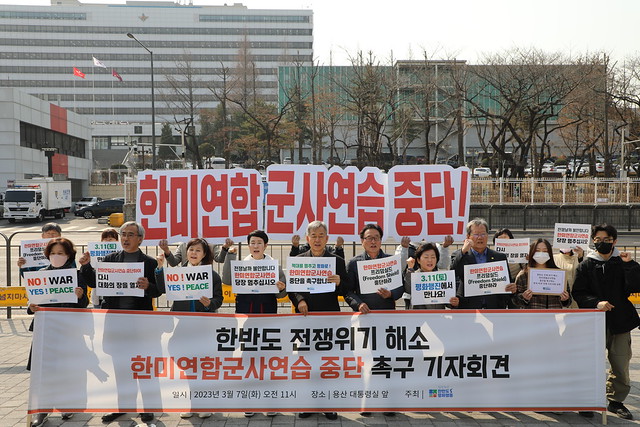
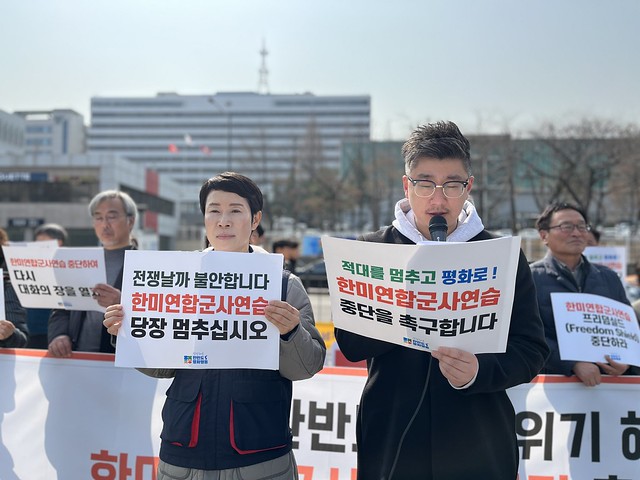
20230307_한미연합군사연습 중단 촉구 기자회견
photo by <Korea Peace Appeal Campaign>

The governments of the United States and South Korea will conduct a large-scale ROK-US Combined Military Exercise, Freedom Shield (FS), beginning March 13. According to the media, during this period, the ROK-US Combined Forces Command will practice scenarios such as beheading the North Korean leadership, ousting commanders, and stabilization operations in North Korea, and will also intensively conduct a large-scale field exercise named Warrior Shield (WS). US Strategic assets including strategic bombers are expected to be part of the exercise, and the ROK-US-Japan Ballistic Missile Defence drill has also been announced for later this month.

In response, on 7 March 2023, the held a press conference in front of the Yongsan Presidential Office and issued a joint statement. Military tensions on the Korean Peninsula are very high and are heading towards power-to-power confrontation without any measures to prevent a conflict. It is imperative that the ROK-US Combined Military Exercises are immediately suspended before they lead to a larger crisis. Suspending the ROK-US Combined Military Exercises could be a decisive step in reopening the door to dialogue and diplomacy between the two Koreas and the US and DPRK.
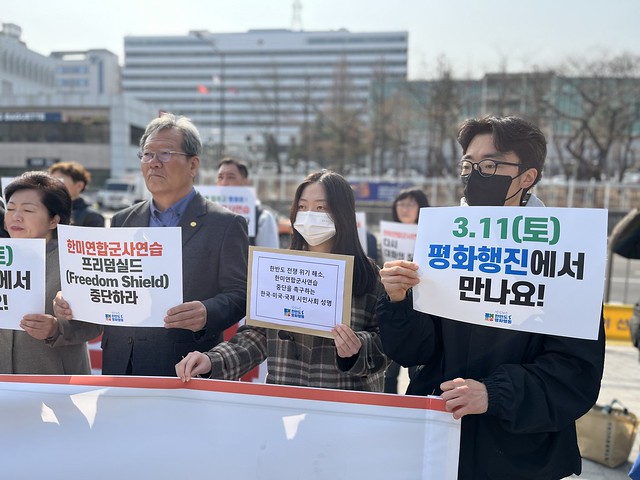
20230307_한미연합군사연습 중단 촉구 기자회견

The joint statement was proposed by the <Korea Peace Appeal Campaign>, <Korea Peace Now Grassroots Network>, <Peace Treaty Now> and was endorsed by 745 South Korean organizations and 99 US and international civil society organizations. The statement was also delivered to the Office of the South Korean President and the US Embassy in Seoul.


ROK·US·International Civil Society Statement

Call to Resolve the Threat of War on the Korean Peninsula
and Suspend ROK-US Combined Military Exercises 

As people who act for peace in South Korea, the US, and worldwide, we are deeply concerned about the elevating military tension on the Korean Peninsula. We must suspend all military actions, including ROK-US Combined Military Exercises.

Despite the opening toward peace through the Inter-Korean and DPRK-US Summits in 2018, the once-discontinued ROK-US Combined Military Exercises resumed in just a year, and the relationship between the two Koreas and the DPRK-US has progressively deteriorated. Last year, North Korea withdrew its four-year commitment to suspend nuclear tests and ICBM test launches because of the US hostile policy and military threats.

The situation is getting worse after the inauguration of the Yoon Suk-yeol government. Both the US and South Korea announced plans to expand the scale of ROK-US Combined Military Exercises and enhance the Extended Deterrence Strategy, and for the first time in 5 years, military exercises with aircraft carriers and strategic bombers have resumed on the Korean Peninsula. North Korea has also declared corresponding military operations and started military exercises. Although it was in the open sea, North and South Korea exchanged missile launches close to their rivals’ sea border, causing tensions to ratchet up even further. At that time, a failed missile launch from South Korea crashed in Gangneung, leaving the residents in the dark for hours, terrified. Moreover, North and South Korea have crossed the Military Demarcation Line by deploying unmanned aerial vehicles. At the 70th anniversary of the Korean War Armistice, the reality is that the armistice itself is at stake.

ROK and US authorities are claiming that the ROK-US Combined Military Exercises are annual defense drills, but the truth is different. It appears that the drills are based on operation plans that reportedly include pre-emptive strikes and decapitation measures against North Korea, large-scale deployment of US troops and strategic assets assuming an all-out war, etc. Over the last several decades, air force bombers like B-1B, B-2, and B-52 which are nuclear-capable, nuclear-powered aircraft carriers, nuclear-powered submarines, large-scale deployments of US-ROK troops, etc. were mobilized. Due to their size and character, the ROK-US Combined Military Exercises have intensified the military and political tension on the Korean Peninsula.

The ROK and US governments have given notice that they would carry out the most extensive field exercises in March by mobilizing the largest number of troops and strategic assets ever, and have already started several ROK-US Combined Military Exercises since January. ROK-US-Japan Military Cooperation has also developed to the level of a military alliance. North Korea is also taking military action, including missile drills, warning that “We will respond at all times and take strong overwhelming actions”.

The situation is rapidly moving toward great power confrontation with no countermeasures to prevent conflict. Large-scale military action mobilized with real weapons only increases the risk of accidental clashes. We know well how a show of force has led to war in the case of several countries. It is only a matter of time before an unprecedented military crisis or war transpires.

War exercises that heighten the threat of war on the Korean Peninsula must stop. We must acknowledge that isolation, military pressure, and sanctions have not accomplished peace and denuclearization in Korea but only brought about resistance from North Korea, and we must lay down our hostility.

Today, the entire world, including the Korean Peninsula, is facing complex crises such as climate, infectious disease, food, and economic crises. We cannot solve these crises unless we cooperate and stop blocization and military confrontations. In particular, the reality is that there is no information or controls on the carbon emitted during large-scale military training and war preparations, such as deploying strategic bombers. Military drills threaten the Earth and human beings, and they must stop.

We must end the Korean war that has afflicted all members of the Korean Peninsula for over 70 years, and redirect the cost of destructive weapons to solving inequality and the climate crisis. It is time to end hostility and confrontation and strive for a peaceful and sustainable world through reconciliation and cooperation.

The suspension of the ROK-US combined military exercises will play a decisive role in re-establishing the forum for dialogue and diplomacy between the two Koreas and between the DPRK and the US. We call on the ROK and US governments to choose wisely.

7 March 2023

Korea Peace Appeal Organizations in South Korea (745)

US Civil Society Organizations (48)
Action One Korea
American Peace Information Center
Answer Coalition
Atlanta Civic Action 
Channing and Popai Liem Education Foundation
China-US Solidarity Network
Coalition of Koreans in America (CKA)
CODEPINK
Education Center for Tomorrow 
Environmentalists Against War
Friends Peace Teams-Asia West Pacific 
GA Peace Forum 
Gandhi Alliance for Peace
Global Network Against Weapons & Nuclear Power in Space
HOA–Hawaiʻi Okinawa Alliance
Korea Peace Now Grassroots Network
Korea Peace Now!
Korea Policy Institute
Korean American National Coordinating Council, Inc.
Korean American Public Action Committee (KAPAC)
Korean Americans for the Progressive Party of Korea (KAPP)
KPNGN PNW
Maine Natural Guard
Massachusetts Peace Action
Military Poisons
MinKwon Center for Community Action
New England Korea Peace Campaign
NH Peace Action
Nodutdol for Korean Community Development
Parallax Perspectives
Peace Action
Peace Action of San Mateo County
Peaceworkers
Phil Berrigan Memorial Chapter Veterans For Peace
Presbyterian Peace Network for Korea
Proposition One Campaign for a Nuclear-Free Future
RootsAction
Seattle Evergreen Coalition
Show Up! America
The Least of These Church Justice & Peace Committee
Utah Campaign to Abolish Nuclear Weapons (UCAN)
Veterans For Peace, Spokane Chapter #35
Veterans For Peace’s Korea Peace Campaign
Washington Butterfly for Hope
Women Against War
Women Cross DMZ 
Women for Genuine Security
Women’s International League for Peace and Freedom (WILPF) US

International Civil Society Organizations (51)
6.15공동선언실천 해외측위원회
6.16공동선언실천 일본지역위원회
재일한국민주여성회
재일한국민주통일일연합 도쿄본부
재일한국민주통일일연합 중앙본부
한민족유럽연대
1923 Korea-Japan Citizens’ Solidarity
Blue Banner, Mongolia
Canadian Union of Public Employees (CUPE), Canada
Center for Peace Education, Philippines
Centre for Peace and Conflict Studies (CPCS), Cambodia
Commission 4 of the ILPS, Canada
Coop Anti-War Cafe Berlin, Germany
Freante Antiimperialista Internacionalista, Spain
German East Asia Mission (DOAM), Germany
Ingenieurkonsulent für Kulturtechnik und Wasserwirtschaft, Europe
International Peace Bureau (IPB), Germany
International Women’s Network against Militarism
Northeast Asia Regional Peacebuilding Institute (NARPI)
Peace Boat, Japan
Peace Depot Inc. Japan
Peace for East Asia (PEASIA), Canada
Peace Treaty Now (PTN)
Peace Women Across The Globe (PWAG), Switzerland
Peace Women Partners, Philippines
Prutehi Litekyan Save Ritidian, Guam
Queen’s Collegiate, Canada
Stop the War Coalition Philippines
The Hwamok Fellowship
The United Church of Canada
Unity of Women for Freedom – Philippines
Women Against Nuclear Power, Finland
Women for Peace, Finland
Women’s International League for Peace and Freedom (WILPF)
Women’s International League for Peace and Freedom (WILPF) Kyoto
World Beyond War
福岡県日朝協会
原水爆禁止日本国民会議
日本朝鮮学術教育交流協会
日朝友好連帯群馬県民会議
日朝友好連帯埼玉県民会議
日朝友好連帯千葉県の会
日朝友好神奈川県民会議
朝鮮女性と連帯する日本婦人連絡会
朝鮮学校「無償化」排除に反対する連絡会
朝鮮の自主的平和統一支持する京都委員会
朝鮮の自主的平和統一を支持する日本委員会
朝鮮の自主的平和統一を支持する長野県民会議
平和憲法を守る荒川の会
戦争への道を許さない北・板橋・豊島の女たちの会
フォーラム平和・人権・環境

▶ For the Korean version see here


Korea Peace Appeal 2

? Signature Campaign to End the Korean War
Sign the Korea Peace Appeal Now ?
endthekoreanwar.net

The post ☮️ Suspend the ROK-US Combined Military Exercises appeared first on 참여연대.
시민들의 의견

댓글 달기

Plain text

  • 웹 페이지 주소 및 이메일 주소는 자동으로 링크로 전환됩니다.
  • 줄과 단락은 자동으로 분리됩니다.
  • 사용할 수 있는 HTML 태그: <a href hreflang> <em> <strong> <cite> <blockquote cite> <code> <ul type> <ol start type> <li> <dl> <dt> <dd>
이미지
무제한 수의 파일을 이 필드에 업로드할 수 있습니다.
50 MB 한계입니다.
허용된 유형: png gif jpg jpeg.
Enter the YouTube URL. Valid URL formats include: http://www.youtube.com/watch?v=1SqBdS0XkV4 and http://youtu.be/1SqBdS0XkV4.
CAPTCHA
스펨 사용자 차단 질문

Police Seizes and Searches PSPD and Change 2016 Office

We Condemn Repression of Legitimate Voter Actions!


(16 June 2016, Seoul) On 16 June 2016, the South Korean police seized and searched the office of the People’s Solidarity for Participatory Democracy (PSPD), which has been used as the office of the Citizens’ Network for General Elections of 2016 (Change 2016), and the homes of involved activists, on the alleged charges that Change 2016 has violated the Public Official Election Act of South Korea. Change 2016 strongly condemns the police’s seizure and search.


Although the Public Official Election Act in its present form severely inhibits voters’ freedom of expression, Change 2016 has been organizing its campaign within the boundaries of the law in compliance with the opinion of the National Election Commission. Nevertheless, alleging that Change 2016 has been “meticulously and intently” violating the Public Official Election Act, the South Korean police set out disproportionate investigation and raid. Such police action obviously constitutes repression of voters’ legitimate exercise of their freedom of expression. 

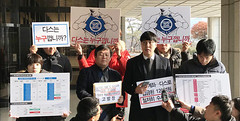
The police claim that Change 2016 has conducted “a public opinion poll in the guise of an innocuous survey,” and held press conferences in front of the offices of “the 10 Worst Candidates” who were chosen by voters are acts of crime that go against the Public Official Election Act. 


Legal and polling experts, however, have confirmed that the survey that Change 2016 conducted was indeed not a public opinion poll. Moreover, Change 2016 has never displayed the names and photographs of the candidates in front of their campaign offices. Although the present Public Official Election Act curtails voters’ freedom of expression, Change 2016 has made sure to operate within the boundaries of the law. The latest attack on Change 2016 in the form of sudden police search and seizure is rather arbitrary, and demonstrates the political motive of threatening and repressing the works of the South Korean civil society.


We, at Change 2016, hereby demand that the South Korean police immediately stop its arbitrary investigation of Change 2016. Why should the government abuse its power in this way to silence voters, when it should do more to guarantee and respect voters’ rights to freedom of expression? All civil society organizations affiliated with Change 2016 will work together to fight this abuse of legal enforcement.

목, 2016/06/16- 18:13
117
0

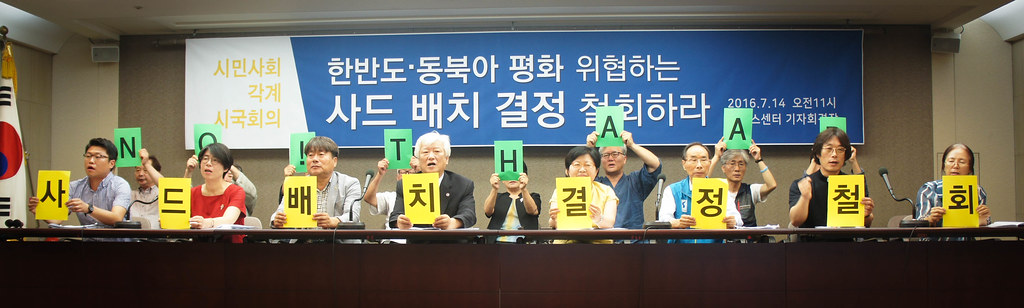
사드 배치 결정 철회 촉구 시국회의


The decision to place THAAD in South Korea, which threatens peace in the Korean Peninsula and Northeast Asia and violates the residents’ right to live peacefully, must be rescinded. 


The entire country is being shaken, and the already-dangerous political situation in the Korean Peninsula and Northeast Asia is becoming even more unpredictable because on July 8, 2016, South Korea and the U.S. announced that they are deploying THAAD to South Korea. Up until South Korea and the U.S. officials announced Seongju, North Gyeongsang Province as the location for THAAD deployment, this process had been entirely ambiguous and one-sided. Even though a plethora of concerns regarding the use, the efficiency, the military/diplomatic prices, and the side effects of THAAD were raised, the South Korean government, behind the curtains, decided to follow the request of the U.S. Now, in Seongju, the anger and the resistance of its residents, who have suddenly been notified of the deployment of THAAD, are growing rapidly. 
 
THAAD is not a weapons system for the residents of the Korean peninsula or for their defense. 

THAAD is essentially a part of the U.S. Missile Defense System (MD). It will be the U.S. military and government that will be running THAAD. MD is an aggressive weapons system, based on the “absolutely stubborn” idea, which aims to incapacitate the missile attacks of the countries against the U.S. and enable the U.S. to launch missiles whenever they want to. The South Korean government is insisting that the deployment of THAAD is to defend the Korean Peninsula from North Korean nuclear weapons and missiles. However, recently, the government has admitted that THAAD cannot defend Seoul and its metropolitan area. The South Korean government is still advertising as if THAAD can at least defend the area within its 200km radius, but this is not true. 200km is nothing but a number to describe the range of the intercept missile attached to THAAD. But, the detectable range of the radar on THAAD theoretically reaches at most a few thousand kilometers. This is why there has been criticism that the main purpose of the frontline deployment of THAAD is to detect medium- to long-range missiles flying over the Korean Peninsula and nearby skies according to the U.S. military strategy. Therefore, there is no such thing as an “adequate” location to place THAAD in this country. The decision of South Korea and the U.S. to place THAAD in Seongju must be rescinded. 


THAAD deployment is militarily and diplomatically self-destructive measure, which will threaten the safety of South Korean citizens and become a severe obstruction in peace and prosperity of the Korean Peninsula and Northeast Asia.

South Korean THAAD is closely related to the missile defense system that was introduced to Japan. Deployment of THAAD to South Korea signifies that South Korea will be sucked into the U.S.-Japan MD, which targets not only North Korea but also China, as a subsidiary partner, and that the Korea-U.S.-Japan military cooperation system will become official. No matter how much South Korean government claims that this is essential to the South Korean sovereignty, the international society and neighboring countries will not accept it. The “strategic companion” relationship with China has become a meaningless term, and the basis of economic cooperation and the friendly relationship between the citizens of both countries can be at risk. China and Russia have already announced that they will be “taking correspondent measures.” It is obvious that this will also negatively affect the international cooperation to solve the nuclear problem in the Korean Peninsula. This is why THAAD can never be a tool to protect the safety of South Korean citizens and peace in the Korean Peninsula. The decision to place THAAD, the “real danger,” which brings threats and conflicts instead of peace, in South Korea must be rescinded.   


We also protest against the undemocratic and non-transparent decision process. 

Before facilitating THAAD deployment, exhibitions, discussions, and evaluations of its use, effects, and military/diplomatic significance should have been carried out. The information about the negotiation process must have been transparently released. However, the South Korean government skipped all these procedures and simply controlled all information. There was not enough discussion even within the related organizations. They treated this important matter, which puts the future of peace in the Korean Peninsula at stake, as if they are carrying out a military strategy. The South Korean national assembly, which represents all of South Korean citizens, never received any substantial reports. The character, the content, and the discussion process of “South Korea-U.S. joint working group for the discussion of THAAD deployment” were not shared with the National Assembly. Even after the decision to deploy THAAD in South Korea, the South Korean government is insisting that this does not require the agreement of the National Assembly. In the case of Seongju, which was decided as the location for THAAD deployment, the residents and the military officials received the unexpected news without any explanation. They were not notified of the negative effects on the environment surrounding the THAAD base and health of the residents. The undemocratic and non-transparent decision of the South Korean government to place THAAD must be rescinded immediately.  


THAAD deployment must receive the consent of the representative body, which in this case, is the National Assembly.

THAAD deployment is directly related to the lives and the safety of South Korean citizens and is a critical matter, which will influence the friendly cooperative relationship with neighboring countries. It may also cost an astronomical amount of money. Therefore, this matter cannot be solely decided by the administrative body; it needs the agreement of the National Assembly. More than anything, the dangerous practice of the South Korean government, which ignores the discussion process and treats this issue like a secret military strategy to avoid the regulation of the National Assembly, cannot be left uncontrolled. If the National Assembly represents all of South Korean citizens, they must stop the one-sided push of THAAD deployment and exercise their right to consent. If the government never asks for the agreement of the National Assembly, the National Assembly must restrain the government’s abuse of its authorities through every measure, such as an investigation in relation to government, an adaptation of the resolution to oppose, and a demand for jurisdiction dispute.  


We are going to start a pan-national peace action to rescind the decision to place THAAD in South Korea. 

We are going to start a pan-national peace action that gathers people from various backgrounds and publicizes the problems of this decision to rescind the decision to place THAAD in South Korea and to stop South Korea from being sucked into the U.S.-Japan missile defense system. We are going to form solidarity to prevent Seongju, North Gyeongsang Province from becoming another victim of state violence, like Pyeongtaek Deachuri or Jeju Gangjeong village. In addition, we are going to fight with all of South Korean citizens, so that THAAD will not be placed in Seongju or any other parts of South Korea. To accomplish this, we are going to actively try to convince and pressure local governments, the National Assembly, and related government organizations and will convey our message to governments and civil societies of neighboring countries, including the U.S. and japan. We will surely punish any abuse of power that undemocratically pushes for the placement of THAAD. Moreover, we are going to form solidarity to facilitate the reconciliation and the cooperation of North and South Korea and to form a peaceful system. The Korean Peninsula should no longer become an explosive warehouse, which is swayed and used by the arms race of the neighboring powers, but should transform as the stepping stone of Northeast Asian peace and cooperation. We are going to actively spread civil resistance and actions for the withdrawal of the decision to place THAAD and for peace in the Korean Peninsula and Northeast Asia. 


July 14, 2016


번역 : 목지수 (참여연대 평화군축센터 자원활동가)

목, 2016/07/14- 23:23
106
0

People Power 2017, this month of PSPD


Through presidential election achieved by candle protest, ‘Moon Jae-in government’ has started its sailing. Many citizens are watching the news with joy because the new government is accomplishing its roles very well. Thus, PSPD receives questions what activities PSPD plans to carry out. They concern that PSPD’s role of social reform may shrink getting far from citizens.


PSPD will encourage the new government to execute social reforms candle citizen have hoped for. Needless to say, PSPD will demand the government to fill inadequacy and have productive debate. Whether election vows are kept or postponed after taking the power will be monitored and assessed. Arguments with opponents who hinder reforms that PSPD and candle citizens hope for will not be avoided. It will convince and criticize lawmakers who block legislation of reform bills. These are all what PSPD has been doing even during Kim Dae-jung and Noh Moo-hyun government and it will keep carrying out its duties sincerely and consistently. 
  

Suggested seven tasks for eradication of deep-rooted evils and practices, and straightening up democracy 

월간 참여사회 2017년 6월(통권 246호)
PSPD welcomes swift reform measures of president Moon Jae-in and new government. To take representative examples, Moon has ordered suspension of adopting state-authorized history textbook, to acknowledge two temporary contract teachers for line of duty death who died saving students when Sewol ferry sank and to investigate what Park Geun-hye administration and prosecutors have done in respect to a document ‘Jeong Yoon-heoi, actual power behind the throne’. He also has given directions to resolve job security issue of non-regular workers of Incheon International Airport, to close old coal power plants temporarily and to investigate problems associated with policy making process of four major river projects. PSPD supports these measures and at the same time, suggests seven tasks in order to eradicate deep-rooted practices and straighten up democracy.


△ Justice minister should be from non-prosecutor background △ Immediate commence of investigation on political maneuvering, violation and evasion of laws committed by Park Geun-hye and her administration △ It is required to investigate political intervention and fabricating public opinions conducted by National Intelligent Service during Lee Myung-bak and Park Geun-hye term △ THAAD deployment process must be stopped and reconsidered  △ Follow-up measures of agreement between Park Geun-hye and Abe government on ‘comfort women’ must be suspended and re-negotiation is required △ Investigate whole process of four major river and foreign resource development project forced by Lee Myung-bak government . 


They are not easy to complete at once but expected to carry out one by one while administrative leadership and reform engine are strong during first 100 days after inauguration.


Proposed 14 social and economic reform measures 
PSPD has proposed 14 social and economic assignments on 18 May which can be decided and executed by executive order of president as follow. △ Improve labor cost ceiling system, standard labor cost system and public organization management assessment in order to expand jobs in public sector △ Increase application for the insured’s share ceiling system of National Health Insurance Service for the purpose of lessening personal medical expense △ Abolish ‘Surplus childcare guideline’ which increases workload of childcare teachers △ Repeal core retrogressive revision of labor law <Fair human resource guideline> and <Guideline for Interpretation and management of employment regulations> (2016.01.22.) △ Withdraw notification of ‘Not a union’ for Korea Teachers and Education Workers Union △ Dispose administrative interpretation (68207-2855, 2000.9.19.) of the Labor Ministry that working on holidays are not included in overtime △ Exclude public officers who have involved in scandals such as Lone Star from appointment to economic ministry and public organizations △ Completely investigate allegations on connection among Fair Trade Commission, Korea Exchange and Samsung during Park Geun-hye government △ Pay allowance to young people who are unemployed or preparing for employment △ Establish a task force to secure housing rental for working class △ Reduce credit card commissions for small and self-employed business and prepare measure to protect store lessee △ Ease eligibility of national scholarship for tertiary education, raise the budget and set zero interest policy for student loans △ Drop down communication fee △ Instant shut down of screen horseracing in residential area of Yongsan in Seoul and Wolpyeong-dong in Daejeon, and stop expansion in Gyeonggi Kimpo.


Request to disclose criteria to screen candidates for high ranking public positions
There are favorable comments on designation of candidates for high ranking public positions made right after inauguration of Moon. It is great news in comparison with early term of Park Geun-hye government when designated candidates received huge criticism including prime minister because not only they failed to meet qualification but also had moral problems. 


However, it is necessary to formally establish systematic environment to set criteria for screening candidates and prove verification process regardless of who becomes a president. All and each government of Noh Moo-hyun, Lee Myung-bak and Park Geun-hye is known to have criteria but details have never been disclosed. Therefore, PSPD sent a letter of opinion to the president Moon Jae-in on 23 May requesting to thoroughly prepare screening criteria and share process and results with the people and National Assembly.


Recommended Kim Seon-su for a Supreme Court Justice
Lee Sang-hoon, a Supreme Court Justice has retired last February completing 6 year-term but appointment of his successor has been delayed because of the impeachment and the presidential election. Another justice Park Byung-dae is scheduled to step down in June that two Supreme Court justices are needed. During Noh Moo-hyun government, PSPD carried out a movement to recommend desirable Supreme Court and Constitutional Court Justice. Unfortunately, it stopped for Lee Myung-bak and Park Geun-hye administration since neither Chief Supreme Court Justice who has the right to request recommendation nor the president who is entitled to appoint seem to pay attention and accept PSPD’s recommendation.


On 22 May, PSPD recommended Kim Seon-su for Supreme Court Justice. He is a lawyer who has worked for rights of labor for a long time. Korea Bar Association also recommended Kim Seon-su to one of chief justice candidates on 15 May. We expect to hear that a lawyer who has actively advocated rights of socially disadvantaged people become a Supreme Court justice. Furthermore, we hope another new chief justice to be appointed in September satisfies expectation of citizens. 


Press conference held to present how voters became victims during presidential election period

월간 참여사회 2017년 6월(통권 246호)
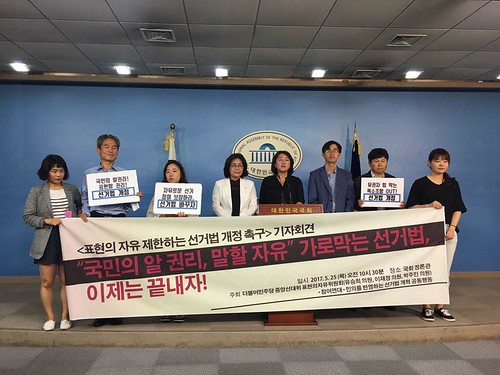
PSPD activists have been investigated and put on trial for the charge of holding a press conference with a picket in which a name of candidate is written while carrying out voter campaign for the 20th General election last April. It happens because harsh election law obstructs voter’s right of freedom to expression. National Assembly was urged to revise the National Election Law before the presidential election but it did not realized. Comes as no surprise, unjust law has made victims. On 25 May, PSPD held a press conference ‘Let’s put it an end, election law that blocks the freedom of people to speak’ in cooperation with lawmakers of the Minju party; Yoo seung-hee and Lee Jae-jeong, and presented victim cases occurred during the 19th Presidential Election period. 


People were cracked down for the reason of including names and photos of candidates on poster ‘Peace leave, THAAD come?’, in parody leaflets comparing and reviewing candidate’s human rights policy on juveniles and flyers of experimental vote of the youth. In addition, the National Election Commission gave an excessive interpretation that writing a word of candle on banner even violated the law so that PSPD hang the same kind of banner in front of secretariat office to protest. To increase awareness of problems with the election law, story funding project <Why did they broke the law> was carried out from end of February to 15 May and a journalist Park Sang-gyu wrote seven articles. Many people have red and concurred with why election law has to change making contribution of 15,820,000 KRW in total. This fund will be used for campaign of revising the election law together with Park sang-gyu.   


목, 2017/06/15- 14:34
88
0

People Power 2018

This Month of PSPD


The New Year has come. Best wishes for a happy new year and I hope you all share happiness with neighbors. There have been lots of changes in our society in 2017 and we have sincerely dreamt for those changes. By and with the power of the people, PSPD has been trying to make people’s dream come true. It will work harder to make more changes and try to be with more citizens in 2018. Let me introduce what PSPD has done in December 2017 as follow.


Wrap up 2017, Plan for 2018

In 2017, PSPD has taken down Park Geun-hye administration with and by the power of the people. Prosecutors Office Act has been reformed that expedient dispatching prosecutors to the office of the President is prohibited. The Ministry of Justice is cutting out connections with prosecutors step by step. Anti-corruption Act has been changed to protect teachers who report corruptions in private schools. Entrance fee to tertiary educational institutes is abolished and Yongsan horse racing screen gambling is closed. Children’s allowance is established and corporate tax is increased for top companies in terms of sales. Patriot education of the Ministry of Defense is stopped which only focused on confrontation of South and North Korea and hostility to each other. The government has withdrawn the claim for damage from Gangjeong residents who protested against Jeju Naval Base construction.


The above are all what PSPD has demanded and worked for a long time, and there are still more to mention. These achievements are partly because a new government is inclined to progressive but aren’t possible without consistent efforts of PSPD. Wrapping up 2017 and planning for 2018 have started since mid-December last year. The first discussion of General Meeting Preparation Committee was held on 11 December. Colleting opinions and hearings for members will be held in January 2018 and I hope you all participate in the process.


Public hearing held at Constitutional Court to review constitutionality of ‘Packet monitoring’

패킷

PSPD opposes to indiscriminate information collecting executed by National Intelligent Service and investigation authorities. In the line with this, PSPD has requested to review constitutionality of NIS’s packet monitoring to the Constitutional Court in March 2016 in cooperation with Jinbo Network Center and Catholic Human Rights Council. Packet Monitoring, a new term to most citizens is watching internet line itself. In other word, it allows to see and hear all activities done using the internet by a target subject. The bigger problem is anyone who shares the internet with a target subject regardless of wired or wireless are at risk to exposure.


After 22 months passed since the request for constitutionality, public hearing was held on 14 December at the Constitutional Court. PSPD, Minbyun and Jinbo Network have explained to judges why packet monitoring is a violation of constitution. NIS’ packet monitoring must stop because all digital private life in the internet can be watched.


One-person demonstration relayed to change the Election Law

선거법

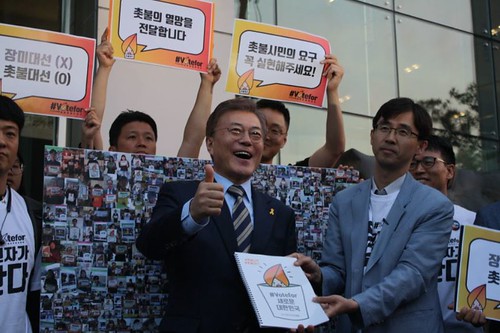
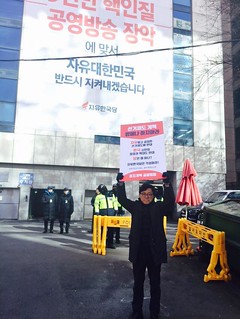
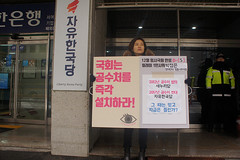
During 2017, PSPD has been a core organization of <Joint Action for Political reform> which works together to reflect people’s opinions in reforming the Election Act. It has asserted seat allocation according to votes gained by party (Mixed-member proportional representation system), change of restrictions concerning the right to vote such as lowering down voting age and abolition of Article 90 and 93 of the Election Act which regulate voter’s right to expression. However, it has been blocked by sluggish politicians and conflicts of interests. Hence, PSPD and civil organizations carried out one-person demonstration relay in front of the National Assembly and Liberty Party Korea during December. In addition, PSPD requested constitutional decision on 13 December 2017 in respect to limiting voting franchise to 19 years old of age or above of the Public Official Election Act.


Urged to pass reform legislation and denounced Liberty Party Korea 

자유한국당

Liberty Party has refused to review the bill of establishing an investigation bureau for high-ranking public officers since 21 November. It is one of measures to reform prosecutors and to clean up corruptions related to power and authority. PSPD has suggested adoption of a special investigation bureau in 1996 for the first time but it had faced organizational resistance of the Ministry of Justice and prosecutors all the time. However, it is an election promise of Moon administration and resistance of prosecutors are much weaker now. Nevertheless, it has failed to pass the National Assembly because of opposition of Liberty Party.

Therefore, PSPD has executed intense actions urging Liberty Party to participate in the bill review and to pass it to establish an investigation bureau for high ranking public officers.  


2017 Public Whistle Blowers’ Night and Righteous Citizen Award

의인상

<2017 Public whistle Blowers’ Night and Righteous Citizen Award> was held at the Seoul Press Center on 1 December. PSPD has held Public Whistle Blowers Night since 2010 in order to remind importance of whistle blowing for public interests and express gratitude to their courageous actions. Furthermore, PSPD also has made Righteous Citizen Award to remember their courage and sacrifice.

The awardees of 2017 are Jeong Hyun-sik and his family (spouse Lee Jeong-sook and son Eui-gyeom) who reported corruptions and connections of Choi Sun-sil, Cheongwadae and K Sports Foundation to the Hankyeroh, Kim Gwang-ho who exposed engine defects and failure of executing recall of Hyundai Motors, Shin In-sool who reported illegal distribution of maritime bunker C oil, Kim Eun-sook who exposed wrong expenditure of subsidies by Jeju branch of Korea Legal Aid Center for Family Relations and Lee Myung-yoon who revealed Gwangju nursing home’s concealment of beating dementia patients.


Reported DAS slush fund to identify real owner

56쪽-사진교체

PSPD and Minbyun have filed a bill of indictment to the prosecutor office on 7 December in regard to slush fund of DAS which is suspected to be owned by a former president Lee Myung-bak. Allegations are embezzlement and tax evasion of Lee Sang-eun, a CEO of DAS and real owner whose name is unknown. Jeong Ho-young, a former BBK special prosecutor is also reported for the charge of neglecting his duty by conniving illegal acts.

Recently, following allegations have been raised by several media. △ In early, 2008, 12 billion won was found from 43 accounts owned by 17 people and it has been deposited to DAS accounts by transferring to other names or depositing again after closing accounts △ Despite Jung Ho-young, a special prosecutor has confirmed borrowed name accounts, he covered it up under the condition of depositing them to DAS accounts △ Accounting treated it as internal transfer from DAS corporation in overseas


12 billion won taken care by accounts under 17 names is likely to be a slush fund of Lee Myung-bak who is consistently suspected as a real owner of DAS. If that is true, Lee must be punished for embezzlement in aggravated punishment of specific economic crimes or tax evasion in aggravated punishment of specific crimes. Most of all, if Jung Ho-young found the facts but connived it, he also committed a serious crime.


This case was allocated to Seoul Central Prosecutors Office in the first place. However, Yoon Seok-yeol was just one of superintendent public prosecutors dispatched to Jung’s BBK Special Prosecutor Team in 2008 and investigation on slush fund including finding a real owner of DAS did not make progress because of various reasons. Fortunately, an investigation team is formed at Eastern office of prosecutors and has started working on 26 December. Besides reporting to the prosecutors, PSPD has reported DAS and real owner to National Tax Service for evading corporate and income tax and requested Financial Service Commission to investigate allegation on borrowed name accounts which seem to be actually owned by DAS and take following action to correct it. 


월, 2018/01/22- 18:06
85
0

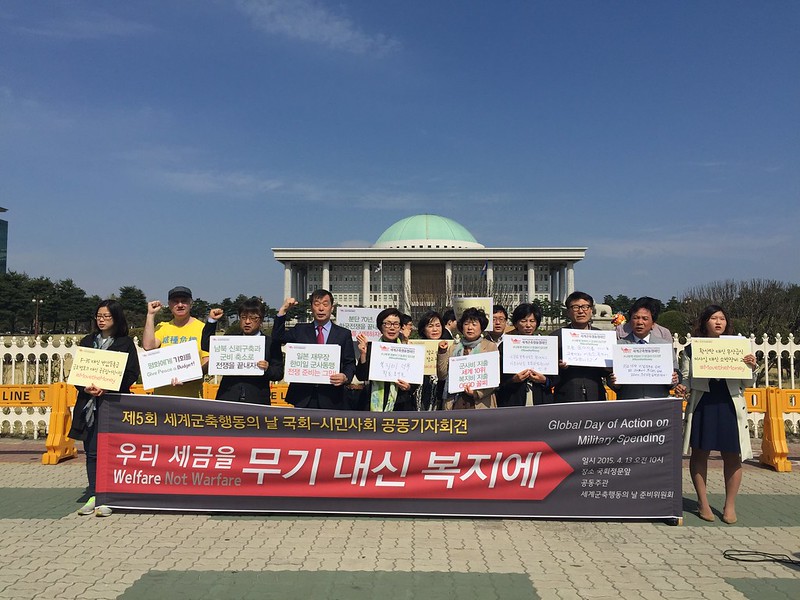
20150413_세계군축행동의날


Joint Statement of the National Assembly and the Civil Society for the 5th Global Day of Action on Military Spending

Our Taxes on Social Welfare instead of on Weaponry


Today on the Global Day of Action on Military Spending, we stand here to be with about 320 organizations from about 70 nations around the world. We should reflect on our reality that peace and safety of citizens worldwide are far from being established even when an astronomical amount of money is spent on military. We demand that our taxes be spent on restoring social justice and building a sustainable and peaceful world. This year, marking the one-year anniversary of the Sewol-ferry tragedy, voices desiring a safe nation have grown louder than ever, and the criticism of the ineffective investment in defense industry in the name of 'national security' is also growing stronger. It is time to change the priorities of the national policy and shift the focus from materialistic national security and military buildup to safety of people and peaceful cooperation.


According to 'Trends in World Military Expenditure, 2014' published by Stockholm International Peace Research Institute (SIPRI), the worldwide military spending last year amounted to 1.8 trillion dollars (about 1,968 trillion won), a little less than the last year's. Korea entered the top 10 for the first time last year and ranked 10th this year. 


Korea's military spending in 2015 amounts to 37.456 trillion won, increased by about 4.9% or 1.7504 trillion won from last year. This is excessive, taking up 14.5% of the government budget. 


While a large sum of military spending is being spent, our society is becoming more extremely socially polarized. Uneasiness from everyday life caused by issues in education, child care, health care, and housing encroaches on our lives, but welfare budget to expand social safety net is not nearly enough. The total amount of university student loan is now over 10 trillion won. The university tuition could be subsidized and cut by half if we decide not to use 7 trillion won of budget on purchasing 40 fighter aircrafts, F-35's, which are the most ineffective and unreasonable among the military weapons to be purchased from the U.S. by the Korean army. 1,400 public daycare centers, which President Park Geun-hye promised to provide during her presidential campaign but failed to fulfill, could be built with 880 billion won of budget set aside for 4 unmanned aerial reconnaissance drones called 'Global Hawk'. Also the budget deficit of 65.5 billion won in 34 local medical centers could be covered for the next 90 years if we do not spend 6 trillion won on operating and maintaining Global Hawk's. Students in South Gyeongsang Province, who had to put up with such remark "a school is not the place you come to eat", could have school lunches for free for the next 30 years if 3.3415 trillion won of budget is not spent on the cluster bomb units and the multiple launch rocket systems, both of which indiscriminate murder weapons banned by international law. All the firefighting equipment which is old to such an extent as to threaten the lives of firefighters could be replaced if we do not spend 1.5233 trillion won on purchasing interceptor missiles such as PAC-3. In retrospect, what we lack is not the budget. Where we allocate finances is important. We should face the threat to our lives, and reprioritize the budget.


How about the Sewol-ferry tragedy? We had to witness 304 people being buried at sea because the country, which spends about 35 trillion won every year to protect citizens from outside threat and ranks 10th in military spending, did not have basic rescue equipment. The Blue House National Security Office denied being the so-called "control tower" for the Sewol-ferry disaster. If so, for whom is the national security if the disaster which could have resulted in deaths of 470 citizens is not a matter of national security? Moreover, the Tongyeong naval rescue ship which proved to be utterly useless at the time of Sewol-ferry disaster showed rampant corruption in the nation's defense industry. If we were to talk about society after the Sewol-ferry tragedy, we should start by dealing with this glaring contradiction.


Someone might raise a question about decreasing the military expenditure when there is a serious threat from North Korea. South Korea spends an amount, almost equal to North Korea's GDP, on military. This amount does not even include the military spending by the United States Forces Korea. North Korea is obsessed with weapons of mass destruction such as nuclear weapons because it knows its military spending is no match for South Korea's. Thus it is not a matter of amount of military expenditure, but a matter of trust.


In the East Asian region, there is a fierce competition on military spending among countries such as the United States, China, Russia and Japan. Some claim that South Korea should increase the military spending in order not to fall behind these nations. However, South Korea, as a middle power country responsible for initiating a peaceful unification on the Korean peninsula, should avoid confrontation based on South Korea-the U.S.-Japan military alliance but should demonstrate leadership for peace, cooperation, coexistence and common security. The recent controversy over the U.S. deploying a Terminal High-Altitude Area Defense (THAAD) missile defenses in South Korea directly shows 'Asian paradox', the disconnect between deep economic interdependence and a serious conflict in military diplomacy. 


There are 20 nations worldwide whose military expenditures take up over 4% of their GDP's in 2014. This number is greater than that in the early 1990's right after the Cold War. If the world had spent even 5% of its military spending on combatting poverty, we could have realized the United Nations Millennium Development Goals (MDGs) that promised to halve global poverty rates by the year 2015. However as the world went through two great wars in Iraq and Afghanistan, the promise could not be kept. Korean government also promised to provide 0.25% of its GNI as Official Development Assistance (ODA) by the year 2015 to eradicate poverty but it allocated vastly insufficient amount and ended up breaking its promise to the international society. The new Sustainable Development Goals (SDGs) which is to be proposed in September, 2015 cannot be achieved without fundamental changes and reflection on military expenditure in each country.


The 5th Global Day of Action on Military Spending should not be the anniversary full of empty promises but should be a milestone to change. Thus, to the government and citizens of Korea which ranks 10th in military spending in the world and ranks last in welfare spending among 28 OECD countries, we suggest the following:


1. We demand that the military spending be reduced to alleviate social bipolarization, to expand social safety net, and to build safe society without disasters. Increasing military spending means taking away other opportunities under a limited government budget. Finances obtained by decreasing military expenditure should be used to remove any urgent threats that citizens face in their daily life.


1. This year, the 70th anniversary of the division of Korea, we demand that the efforts be put to end the Korean war and create a peace regime. The Korean government should reflect on the large amount of direct and indirect expenses spent to keep the unstable armistice regime during the past years. The nuclear threat in the Korean peninsula, which is the main reason behind the increase in the military spending, is also the result of this armistice regime and arms race. We should devise measures to recover mutual trust and start conversations instead of purchasing offensive weapons and increasing military expenditure every year. The first step towards achieving this is to lift the May 24th measures which stands between the inter-Korean relations. 


1. We express our deep concerns over the situation where the preparation for war comes before peace and where military alliance comes before cooperation in the Asia-Pacific region. We demand that Korea put efforts to change relations based on various disputes and military conflicts into cooperative ones. Appealing to the military means or strengthening military alliances to antagonize a specific country cannot resolve the conflicts. We should protect the Japanese pacific constitution, a bastion of peace in East Asia, and should not allow the right of collective self-defense. We should not allow the deployment of the U.S. missile defense system in South Korea and break away from the South Korea-U.S.-Japan military ties.


1. In order to establish peace we need participation of citizens and solidarity of people across borders. A mature sense of citizenship is more effective than any weapons to protect the community. Understanding each other and cooperation across borders are  faster ways to solve conflicts than using fighter aircrafts and missiles. We should not stand by and watch the government make decisions on whether a nation exaggerates an outside threat it claims to exist, and on whether our taxes should be used for purchasing military weapons or for building a sustainable society. Decisions on and execution processes of national security matters, including conclusion of various security treaties, development of military cooperation, execution of military exercises, and purchase of expensive and offensive weapons, must be transparent and controlled democratically, considering their enormous effects on society. Priorities in foreign policies and national security policies should be determined by citizens as it is done in other fields. 


Disarmament is not a story of a distant future but an imminent and real issue. We demand that the government, the national assembly and all the citizens show wisdom to establish peace together. 


April 13, 2015
Participants of the 5th Global Day of Action on Military Spending


For more information


The GDAMS website http://demilitarize.org

The GDAMS Korea website http://gdams.or.kr
The GDAMS Preparatory Committee of Seoul
People’s Solidarity for Participatory Democracy +82-2-723-4250, [email protected]

월, 2015/04/13- 20:50
78
0