주요 콘텐츠로 건너뛰기

Building and Sustaining Peace at the Regional Level

지역

Building and Sustaining Peace at the Regional Level

admin | 월, 2023/01/30- 15:02

On December 8 2022, in partnership with the Permanent Mission of Mongolia to the United Nations, the Global Partnership for the Prevention of Armed Conflict (GPPAC) organised a roundtable discussion titled Building and Sustaining Peace at the Regional Level: The Network Approach to Regional Coordination in Northeast Asia during an advocacy visit of Ulaanbaatar Process participants to New York City.

This discussion was an informal dialogue to share the learning from the Ulaanbaatar Process with global peacebuilding policy experts within the United Nations, Member States and regional organisations. The conversation outlined critical avenues to support regional peacebuilding coordination in policy and shared practical experiences for practical action. The discussion also outlined persistent challenges of regional peacebuilding coordination, and discussed recommendations to develop solutions to strengthen peacebuilding work in Northeast Asia.

During the roundtable, remarks were shared by Ulziibayar Vangansuren, Permanent Mission of Mongolia to the United Nations; Ambassador Enkhsaikhan Jargalsaikhan, Chair of NGO Blue Banner and former Mongolian Permanent Representative to the UN; Sonja Bachmann, Teamleader Northeast Asia and Pacific, UN Department of Peacebuilding Political Affairs (DPPA); Kajita Natsuha, learning designer and facilitator; Kim Jeongsoo, Standing Representative, Women Making Peace and Hwang Sooyoung, Manager, Centers for Peace and Disarmament and for International Solidarity, People’s Solidarity for Participatory Democracy (PSPD).

Based on the experiences from Northeast Asia, the following key elements build an effective regional peacebuilding architecture:

  • Multi-stakeholder coordination is required and must be based on complementarity among partners.
  • The network approach to peacebuilding must be at the core of regional coordination.
  • Inclusivity is key for effective regional peacebuilding networks.

The following recommendations have thus been identified for the strengthening of the regional peacebuilding mechanisms:  

  • The UN should take a more active convening role to bring together regional actors, the UN, national governments, and civil society, among others, to coordinate actions better and ensure a stronger impact of peacebuilding activities.  Where regional peacebuilding networks play an essential role in building the foundation for regional dialogue, the UN should provide technical and political accompaniment to ensure the commitment to action. 

  • Improved funding mechanisms are needed to support the civil society organizations’ network approach. A network approach creates empowering and equitable spaces for exchanging expertise for more impactful and informed action, sharing resources and access points at various levels, and enabling and supporting communities committed to peace. Donors should reflect on how to improve funding mechanisms to support better civil society organizations engaged in regional peacebuilding networks, allowing them, through effective funding, to fill the gaps in the regional peacebuilding infrastructure. It is crucial to ensure that all regions are fairly represented in the international discussion on peacebuilding and are given international attention, as this also impacts funding availability. 

  • The inclusion of women and youth is key in regional peacebuilding networks and should be supported. Although women are strongly affected by conflicts, they are often excluded from negotiations and peace processes, especially in highly patriarchal contexts. The inclusion of local women within peacebuilding initiatives is essential to ensure that their unique perspectives can have a real impact at the decision-making level. Likewise, the meaningful participation of young people in dialogue on equal terms is essential to achieve and sustain peace. Young people in all their diversities should be considered as drivers for change, and their contributions should be held as relevant and valuable. Donors should prioritise supporting regional peacebuilding dialogues that ensure the meaningful participation of women and youth at all stages of the process.  The UN and its Member States should use their influence and international platforms to  ensure that the unique perspectives of local women and youth peacebuilders are heard and taken into account in the decision-making processes.

This is an article for Global Partnership for the prevention of Armed Conflict (GPPAC) Northeast Asia News, Jan 2023

Summary Document [See/Download]

The post Building and Sustaining Peace at the Regional Level appeared first on 참여연대.

시민들의 의견

댓글 달기

Plain text

  • 웹 페이지 주소 및 이메일 주소는 자동으로 링크로 전환됩니다.
  • 줄과 단락은 자동으로 분리됩니다.
  • 사용할 수 있는 HTML 태그: <a href hreflang> <em> <strong> <cite> <blockquote cite> <code> <ul type> <ol start type> <li> <dl> <dt> <dd>
이미지
무제한 수의 파일을 이 필드에 업로드할 수 있습니다.
50 MB 한계입니다.
허용된 유형: png gif jpg jpeg.
Enter the YouTube URL. Valid URL formats include: http://www.youtube.com/watch?v=1SqBdS0XkV4 and http://youtu.be/1SqBdS0XkV4.
CAPTCHA
스펨 사용자 차단 질문

We sincerely pray for the safe return of the missing.

We pray for all those who died in the magnitude 7.8 earthquake and the series of following earthquakes that occurred in southeastern Turkey on 6 February. In addition, we express our deep condolences to all those who lost their loved ones and their livelihoods due to this earthquake.

The number of deaths currently identified has already exceeded 10,000. The scale of damage is expected to increase even more if Northwestern Syria, which has been suffering from a long-lasting war, is included. Search and rescue operations are difficult due to aftershocks, and many people are still trapped in the rubble of buildings in the freezing cold. We sincerely pray for the safe return of the missing and a speedy recovery in the affected areas.

09 Feb 2023

People’s Solidarity for Participatory Democracy (PSPD)

Korean Version >>

The post Rest in peace to all those who lost their lives in the Turkey-Syria earthquake. appeared first on 참여연대.

목, 2023/02/09- 11:28
2
0
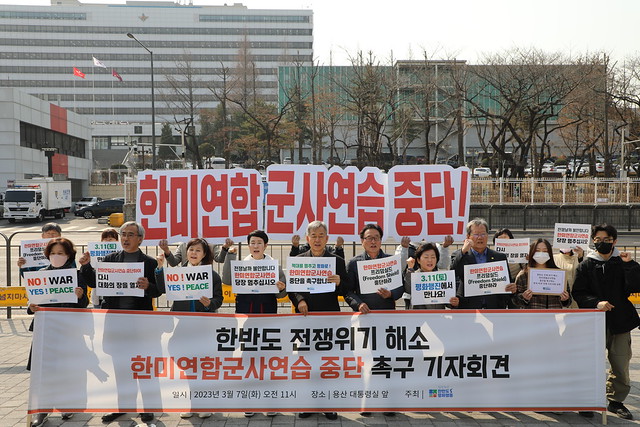
20230307_한미연합군사연습 중단 촉구 기자회견
photo by <Korea Peace Appeal Campaign>

The governments of the United States and South Korea will conduct a large-scale ROK-US Combined Military Exercise, Freedom Shield (FS), beginning March 13. According to the media, during this period, the ROK-US Combined Forces Command will practice scenarios such as beheading the North Korean leadership, ousting commanders, and stabilization operations in North Korea, and will also intensively conduct a large-scale field exercise named Warrior Shield (WS). US Strategic assets including strategic bombers are expected to be part of the exercise, and the ROK-US-Japan Ballistic Missile Defence drill has also been announced for later this month.

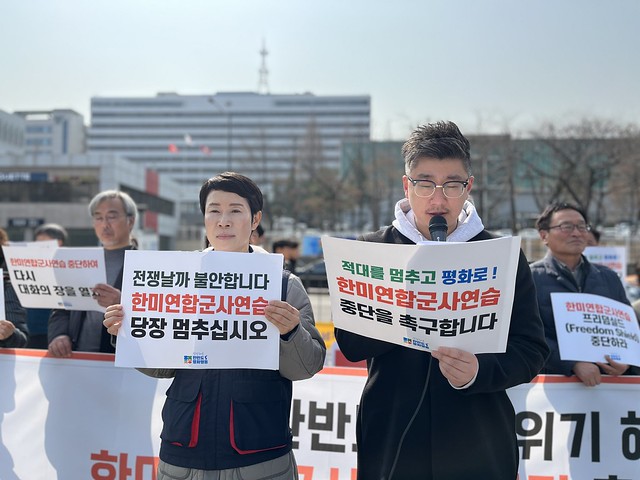
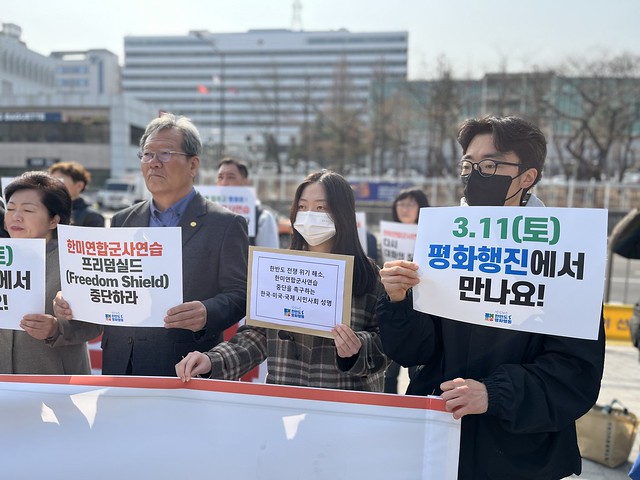
In response, on 7 March 2023, the held a press conference in front of the Yongsan Presidential Office and issued a joint statement. Military tensions on the Korean Peninsula are very high and are heading towards power-to-power confrontation without any measures to prevent a conflict. It is imperative that the ROK-US Combined Military Exercises are immediately suspended before they lead to a larger crisis. Suspending the ROK-US Combined Military Exercises could be a decisive step in reopening the door to dialogue and diplomacy between the two Koreas and the US and DPRK.

20230307_한미연합군사연습 중단 촉구 기자회견

The joint statement was proposed by the <Korea Peace Appeal Campaign>, <Korea Peace Now Grassroots Network>, <Peace Treaty Now> and was endorsed by 745 South Korean organizations and 99 US and international civil society organizations. The statement was also delivered to the Office of the South Korean President and the US Embassy in Seoul.


ROK·US·International Civil Society Statement

Call to Resolve the Threat of War on the Korean Peninsula
and Suspend ROK-US Combined Military Exercises 

As people who act for peace in South Korea, the US, and worldwide, we are deeply concerned about the elevating military tension on the Korean Peninsula. We must suspend all military actions, including ROK-US Combined Military Exercises.

Despite the opening toward peace through the Inter-Korean and DPRK-US Summits in 2018, the once-discontinued ROK-US Combined Military Exercises resumed in just a year, and the relationship between the two Koreas and the DPRK-US has progressively deteriorated. Last year, North Korea withdrew its four-year commitment to suspend nuclear tests and ICBM test launches because of the US hostile policy and military threats.

The situation is getting worse after the inauguration of the Yoon Suk-yeol government. Both the US and South Korea announced plans to expand the scale of ROK-US Combined Military Exercises and enhance the Extended Deterrence Strategy, and for the first time in 5 years, military exercises with aircraft carriers and strategic bombers have resumed on the Korean Peninsula. North Korea has also declared corresponding military operations and started military exercises. Although it was in the open sea, North and South Korea exchanged missile launches close to their rivals’ sea border, causing tensions to ratchet up even further. At that time, a failed missile launch from South Korea crashed in Gangneung, leaving the residents in the dark for hours, terrified. Moreover, North and South Korea have crossed the Military Demarcation Line by deploying unmanned aerial vehicles. At the 70th anniversary of the Korean War Armistice, the reality is that the armistice itself is at stake.

ROK and US authorities are claiming that the ROK-US Combined Military Exercises are annual defense drills, but the truth is different. It appears that the drills are based on operation plans that reportedly include pre-emptive strikes and decapitation measures against North Korea, large-scale deployment of US troops and strategic assets assuming an all-out war, etc. Over the last several decades, air force bombers like B-1B, B-2, and B-52 which are nuclear-capable, nuclear-powered aircraft carriers, nuclear-powered submarines, large-scale deployments of US-ROK troops, etc. were mobilized. Due to their size and character, the ROK-US Combined Military Exercises have intensified the military and political tension on the Korean Peninsula.

The ROK and US governments have given notice that they would carry out the most extensive field exercises in March by mobilizing the largest number of troops and strategic assets ever, and have already started several ROK-US Combined Military Exercises since January. ROK-US-Japan Military Cooperation has also developed to the level of a military alliance. North Korea is also taking military action, including missile drills, warning that “We will respond at all times and take strong overwhelming actions”.

The situation is rapidly moving toward great power confrontation with no countermeasures to prevent conflict. Large-scale military action mobilized with real weapons only increases the risk of accidental clashes. We know well how a show of force has led to war in the case of several countries. It is only a matter of time before an unprecedented military crisis or war transpires.

War exercises that heighten the threat of war on the Korean Peninsula must stop. We must acknowledge that isolation, military pressure, and sanctions have not accomplished peace and denuclearization in Korea but only brought about resistance from North Korea, and we must lay down our hostility.

Today, the entire world, including the Korean Peninsula, is facing complex crises such as climate, infectious disease, food, and economic crises. We cannot solve these crises unless we cooperate and stop blocization and military confrontations. In particular, the reality is that there is no information or controls on the carbon emitted during large-scale military training and war preparations, such as deploying strategic bombers. Military drills threaten the Earth and human beings, and they must stop.

We must end the Korean war that has afflicted all members of the Korean Peninsula for over 70 years, and redirect the cost of destructive weapons to solving inequality and the climate crisis. It is time to end hostility and confrontation and strive for a peaceful and sustainable world through reconciliation and cooperation.

The suspension of the ROK-US combined military exercises will play a decisive role in re-establishing the forum for dialogue and diplomacy between the two Koreas and between the DPRK and the US. We call on the ROK and US governments to choose wisely.

7 March 2023

Korea Peace Appeal Organizations in South Korea (745)

US Civil Society Organizations (48)
Action One Korea
American Peace Information Center
Answer Coalition
Atlanta Civic Action 
Channing and Popai Liem Education Foundation
China-US Solidarity Network
Coalition of Koreans in America (CKA)
CODEPINK
Education Center for Tomorrow 
Environmentalists Against War
Friends Peace Teams-Asia West Pacific 
GA Peace Forum 
Gandhi Alliance for Peace
Global Network Against Weapons & Nuclear Power in Space
HOA–Hawaiʻi Okinawa Alliance
Korea Peace Now Grassroots Network
Korea Peace Now!
Korea Policy Institute
Korean American National Coordinating Council, Inc.
Korean American Public Action Committee (KAPAC)
Korean Americans for the Progressive Party of Korea (KAPP)
KPNGN PNW
Maine Natural Guard
Massachusetts Peace Action
Military Poisons
MinKwon Center for Community Action
New England Korea Peace Campaign
NH Peace Action
Nodutdol for Korean Community Development
Parallax Perspectives
Peace Action
Peace Action of San Mateo County
Peaceworkers
Phil Berrigan Memorial Chapter Veterans For Peace
Presbyterian Peace Network for Korea
Proposition One Campaign for a Nuclear-Free Future
RootsAction
Seattle Evergreen Coalition
Show Up! America
The Least of These Church Justice & Peace Committee
Utah Campaign to Abolish Nuclear Weapons (UCAN)
Veterans For Peace, Spokane Chapter #35
Veterans For Peace’s Korea Peace Campaign
Washington Butterfly for Hope
Women Against War
Women Cross DMZ 
Women for Genuine Security
Women’s International League for Peace and Freedom (WILPF) US

International Civil Society Organizations (51)
6.15공동선언실천 해외측위원회
6.16공동선언실천 일본지역위원회
재일한국민주여성회
재일한국민주통일일연합 도쿄본부
재일한국민주통일일연합 중앙본부
한민족유럽연대
1923 Korea-Japan Citizens’ Solidarity
Blue Banner, Mongolia
Canadian Union of Public Employees (CUPE), Canada
Center for Peace Education, Philippines
Centre for Peace and Conflict Studies (CPCS), Cambodia
Commission 4 of the ILPS, Canada
Coop Anti-War Cafe Berlin, Germany
Freante Antiimperialista Internacionalista, Spain
German East Asia Mission (DOAM), Germany
Ingenieurkonsulent für Kulturtechnik und Wasserwirtschaft, Europe
International Peace Bureau (IPB), Germany
International Women’s Network against Militarism
Northeast Asia Regional Peacebuilding Institute (NARPI)
Peace Boat, Japan
Peace Depot Inc. Japan
Peace for East Asia (PEASIA), Canada
Peace Treaty Now (PTN)
Peace Women Across The Globe (PWAG), Switzerland
Peace Women Partners, Philippines
Prutehi Litekyan Save Ritidian, Guam
Queen’s Collegiate, Canada
Stop the War Coalition Philippines
The Hwamok Fellowship
The United Church of Canada
Unity of Women for Freedom – Philippines
Women Against Nuclear Power, Finland
Women for Peace, Finland
Women’s International League for Peace and Freedom (WILPF)
Women’s International League for Peace and Freedom (WILPF) Kyoto
World Beyond War
福岡県日朝協会
原水爆禁止日本国民会議
日本朝鮮学術教育交流協会
日朝友好連帯群馬県民会議
日朝友好連帯埼玉県民会議
日朝友好連帯千葉県の会
日朝友好神奈川県民会議
朝鮮女性と連帯する日本婦人連絡会
朝鮮学校「無償化」排除に反対する連絡会
朝鮮の自主的平和統一支持する京都委員会
朝鮮の自主的平和統一を支持する日本委員会
朝鮮の自主的平和統一を支持する長野県民会議
平和憲法を守る荒川の会
戦争への道を許さない北・板橋・豊島の女たちの会
フォーラム平和・人権・環境

▶ For the Korean version see here


Korea Peace Appeal 2

? Signature Campaign to End the Korean War
Sign the Korea Peace Appeal Now ?
endthekoreanwar.net

The post ☮️ Suspend the ROK-US Combined Military Exercises appeared first on 참여연대.

화, 2023/03/07- 18:53
2
0

GPPAC calls for an inclusive, people-centered peacebuilding response to the COVID-19 pandemic


6 April 2020


As peacebuilders from around the world, united as the Global Partnership for the Prevention of Armed Conflict (GPPAC), we stand in solidarity with all those affected by the novel coronavirus (COVID-19).


The pandemic is causing physical and psychological suffering, as people and communities experience illness, loss and economic hardship, as well as isolation, fear, and despair. It is not just a challenge to human health, but to human dignity, and the values that we hold dearest as peacebuilders. 


At a time like this, strengthening peacebuilding, human security and global cooperation as well as creating innovative, responsive, inclusive and multilateral conflict prevention strategies is more essential than ever.


We call upon governments, civil society, businesses, communities and individuals to put inclusive peace and human rights at the centre of all responses to the outbreak.


We call for:


  • A global ceasefire, to prevent a multiplication of suffering as the pandemic and armed violence intersect.

  • A unified response, without discrimination, racism, xenophobia and political division; and with protection of vulnerable and marginalised groups, including those now at greater risk of domestic, sexual and gender-based violence.

  • Protection of civic space and human rights, this health crisis must not be used as an excuse to erode them.

  • International solidarity, including economic solidarity, in response to this crisis.  

  • A transformative vision of a post-COVID-19 world, which centres people, prevention, peace, cooperation and human security.


A global ceasefire

We add our voices to the call of UN Secretary-General António Guterres for a global ceasefire. We are dedicated to preventing and ending violent conflict, as its staggering human cost is always unacceptable, and will be further exacerbated by the virus. Its impact will be greatest on societies where healthcare systems have collapsed or are already overburdened by war; on those who are fleeing or living in refugee camps, where physical distancing is near impossible, and access to clean water, good sanitation and healthcare is limited.


As peacebuilders, we are here to help support dialogue and mediation, and to seek a peaceful way forward together. We call for a permanent lockdown on war!


Unity over division

Governments, political, religious and community leaders, media and civil society: Do not allow this pandemic to be used as an excuse for xenophobia, racism, discrimination, stigmatisation, toxic nationalism, or perpetuation of international political divisions. 


No-one is to blame. There is an urgent need for us to come together and work across divides to limit the spread and impact of the virus.


We call on governments to respond to the crisis in a non-discriminatory way, ensuring that support reaches all parts of society, in rural areas and cities, and includes marginalised and vulnerable groups. This includes the protection of those at increased risk of domestic, sexual and gender-based violence; and the protection of health workers. Equally important is the need to ensure that communication surrounding the disease and measures to address it is accurate, equal and accessible, taking into account language, literacy and disabilities, as well as access to communications media.


We encourage regional inter-governmental organisations to convene virtual dialogues and to invite civil society leaders, including women peacebuilders, young people, traditional indigenous leaders and faith community leaders to provide recommendations on response and recovery. Now, more than ever, we need a multi-stakeholder approach.


Protect human rights and civic space

We support temporary measures to slow or halt the spread of COVID-19. However, we call on governments in the strongest possible terms to respect human rights and to not abuse this moment to restrict civil rights and civic space or further militarize communities.


  • Do not violate people’s rights to privacy.

  • Address the spread of hate speech and false health information, but do not broadly restrict freedom of expression and speech and access to information.

  • Do not limit freedom of peaceful assembly any longer than is strictly necessary to halt this virus.

  • Do not use a state of emergency to bypass democratically elected bodies in policy making and legislation unrelated to the disease.

  • If events where civil society ordinarily has a voice are cancelled or taken online, ensure that civil society voices can still be heard.


Any measures taken should be necessary, proportional, and time bound. Emergency powers must have clear limitations and oversight and grievance mechanisms in place.


The UN and regional organizations must work to ensure that the response to the pandemic is progressive, peace-oriented and inclusive rather than authoritarian and exclusive.


As civil society, we are here to help limit the spread of the disease and its consequences: We can help convey accurate information, prevent panic, support community cohesion and assist in humanitarian response. We can contribute to a recovery strategy. We can help assess the human rights and conflict impact of measures taken. Do not silence us.


Solidarity at every level - but don’t divert funding

We stand in solidarity with all those affected around the world. We have seen and applaud beautiful examples of solidarity in communities, in countries and between nations. We call on governments, especially those of wealthy countries, to extend that solidarity across the world.


This pandemic impacts us all. However, in poorer countries the effects will be more intense, multiplied by weaker healthcare systems, malnutrition, lack of access to water, sanitation and information as well as a lack of opportunity for many to stay home without going hungry. The poor will also be hit in wealthy nations, for many of the same reasons.


We call on governments and wealthy nations in particular to address these inequalities on principle, but also because this virus is not restricted or confined by borders or gates: We need a global pandemic “Marshall Plan” to protect people, economies, and our collective future. A unified, coordinated strategy and pooling of resources is needed for just and inclusive recovery. The Sustainable Development Goals (SDGs) provide an integrated framework to help rebuild, and particularly to address the needs of marginalised and vulnerable populations more quickly and comprehensively.


At the same time, we call on donors and donor countries not to divert funds from other issues: it remains as important as ever to build peace, address gender inequality, protect human rights, mitigate the climate crisis, fight hunger, and much more. Instead, lets create new aid packages to halt this pandemic, protect the vulnerable from its economic effects, and bolster healthcare systems around the world. 


Local peacebuilders are first responders. Their work is critical and should be supported. We also call on donors to be flexible in allowing grantees to adjust their programmes to respond to this crisis, and to extend grants as a result of many planned activities having to be postponed.


A moment of opportunity

We have a shared responsibility to shape the world we want to live in once this pandemic has passed. As a community of peacebuilders we have bigger dreams than a return to the pre-pandemic status quo. As humanity, we have a chance:


To end wars and build peace.


To contribute to achieving all the Sustainable Development Goals.


To (re)build the public good and public institutions.


To recommit to international cooperation for the benefit of humankind, and advance reform of the international institutional architecture, including the UN system.


To realise a true shift to prevention – in healthcare, in conflict, in creating healthy environments and more – and the transformative approach societies deserve.


To refocus on what is most important to us.


To protect and expand human rights and civic space.


To show that human instinct leans towards kindness and caring, not hatred and violence.


To support people and the planet over money and markets.


To recognise our critical workers - those in healthcare, teaching, cleaning, food production and more - with better wages and conditions.


To build our collective infrastructures for peace and resilience to this and future challenges.


To be able to look back one day and say: 2020 was the year we chose to change the whole world for the good.


https://gppac.net/news/gppac-calls-inclusive-people-centered-peacebuildi... target="_blank" rel="nofollow">GPPAC website>>


수, 2020/04/08- 18:23
1
0

Journey for Peace in 2022

Shining moments of the Korea Peace Appeal Campaign in 2022

“There is no way to peace. Peace is the way.”

Now, the moments that we’ve worked to make peace here.
We gathered the main activities of the Korea Peace Appeal Campaign in 2022.
Thank you for being with us this year.

2023 marks the 70th anniversary of the Korean War Armistice.
It’s time to cheer up to ease military tension and open the road to peace.

The world doesn’t get better on its own.
If we don’t say peace,
Peace is not coming.

Let’s make hope of peace together!


Korea Peace Appeal 2

? Signature Campaign to End the Korean War
Sign the Korean Peace Appeal Now ?
endthekoreanwar.net

The post Journey for Peace in 2022 : Korea Peace Appeal Campaign appeared first on 참여연대.

금, 2023/01/06- 18:48
1
0

Korean War Q&A

Didn’t the Korean War end in 1953? The answer is NO.


Why should we end the Korean War?
Korea Peace Appeal Campaign prepared a Q&A.

? What is the impact of the unresolved Korean War?
? How have the two Koreas been improving their relations?
? Why should the US and the DPRK improve their relations?
? Should the issue of North Korea’s nuclear program be resolved first to achieve peace on the peninsula?
? How does the Korea Peace interact with North Korea’s humanitarian and human rights situation?
? Join the Korea Peace Appeal Campaign!

? Click Here to see the Q&A


Korea Peace Appeal 2

? Signature Campaign to End the Korean War
Sign the Korea Peace Appeal Now ?
endthekoreanwar.net

The post Korean War Q&A appeared first on 참여연대.

수, 2023/01/18- 14:03
1
0