주요 콘텐츠로 건너뛰기

[공지] RLA 40주년 기념 컨퍼런스: 국제시민사회의 코로나 19 위기대응 방안 온라인 강연 씨리즈

지역

[공지] RLA 40주년 기념 컨퍼런스: 국제시민사회의 코로나 19 위기대응 방안 온라인 강연 씨리즈

admin | 목, 2020/05/07- 01:23


RLA 40주년 기념 컨퍼런스

국제시민사회의 코로나 19 위기대응 방안 온라인 강연 씨리즈 4~5월 안내

Right Livelihood Awards (RLA) 재단은 40 주년 기념사업의 일환으로 아래와 같이 온라인 글로벌 컨퍼런스를 개최할 예정입니다. RLA 재단은 미국 UC Santa Cruz의 Right Livelihood College의 주관으로 RLA 역대 수상자(OB)들과 신규 수상자(YB)들과 함께 “코로나19 등 우리사회에 가장 시급한 현안”들을 공유하고 향후 위기대응 방안을 논의하고자 합니다.


※ 시청방법: Zoom 또는 YouTube 채널 접속:

☞ https://rightlivelihood.ucsc.edu/events/webinars.html (라이브 시청 공지)

☞ https://www.youtube.com/channel/UCoANHFe83hG20ZukmjTvEtw (YouTube 라이브 채널 바로가기)

☞ https://www.youtube.com/RightLivelihoodFoundation (지난 강연 다시보기)


경실련은 지난 2003년 국내에서는 유일하게 RLA 대안노벨상을 수상하였습니다. 경실련은 RLA의 OB단체로서 이번 RLA 40주년 기념 컨퍼런스에 함께 연대하고 있습니다. 여러분들의 많은 관심과 시청 부탁드립니다.


<5월 연사 일정>

5월 6일 (아시아 지역, 오후 8시 ~ 9시 15분): 코로나 시대의 물의 정의와 극복과제

– 연사자 1. 마우드 발로 (RLA 2005년 수상자)

– 연사자 2. 로버트 빌로트 (RLA 2017년 수상자)


5월 13일 (아시아, 오후 8시 ~ 9시 15분): 민주주의의 위기와 기회

– 연사자 1. 프랜시스 모어-라페 (RLA 1987년 수상자)

– 연사자 2. 베스나 테실릭 (RLA 1998년 수상자)

– 연사자 3. 자밀라 라큅 (앨버트 아인슈타인 연구소, RLA 2012년 수상단체)


5월 27일 (아시아, 오후 8시 ~ 9시 15분): 위기속 불평등과 취약점

– 연사자 1. 글로렌 다스 (Tenaganita, RLA 2005년 수상단체)

– 연사자 2. 만프레드 노박 (Global Campus for Human Rights)


지난 4월 강연 영상 등 관련 행사 정보는 아래 내용 또는 링크를 직접 참조하시길 바랍니다.


Inspiring Change in Times of Crisis –  Conversations that Matter Series

Our common global challenges are becoming increasingly acute and tangible all over the globe; for example the climate crisis, authoritarian governance, the continuous threat of violent conflict, including the use of nuclear weapons, and growing inequality between rich and poor.  We are now facing a new global crisis, as the spread of COVID-19 is affecting everyone around the world. As part of the Right Livelihood Foundation 40th Anniversary, three global conferences were planned for the spring of 2020. Two of them are currently postponed, due to the pandemic. The Foundation has therefore adapted with new ideas and will instead launch an online series, inviting Laureates under different themes. These conversations will be spread in the Foundation’s network and Right Livelihood College network.


May 6: Water Justice in the Age of Coronavirus and Beyond

Water contaminated by toxic chemical wastes; hundreds of millions without access to minimum necessary quantities of potable water.  These were grave, immense issues long before the coronavirus pandemic.  Now the pandemic, raging globally, poses new questions for us:  Do these pre-existing conditions, the polluted waters, the lack of access, make the pandemic worse?  Conversely, will the pandemic affect society’s future ability or willingness to improve access and quality?  These are the kinds of questions we will be exploring in this webinar with two Right Livelihood laureates, Maude Barlow and Robert Bilott.

Speakers:

Wednesday, May 6th, 8:00-9:15 AM Pacific (5:00-6:15 PM CET)
Click here for timezone conversion. Click here to add to your calendar.

Water contaminated by toxic chemical wastes; hundreds of millions without access to minimum necessary quantities of potable water. These were grave, immense issues long before the coronavirus pandemic. Now the pandemic, raging globally, poses new questions for us: Do these pre-existing conditions, the polluted waters, the lack of access, make the pandemic worse? Conversely, will the pandemic affect society’s future ability or willingness to improve access and quality? These are the kinds of questions we will be exploring in this webinar with two Right Livelihood laureates, Maude Barlow, and Robert Bilott.

Right Livelihood Laureates

Maude Barlow was given the Right Livelihood Award in 2005 “...for her exemplary and longstanding worldwide work for trade justice and the recognition of the fundamental human right to water.” Maude is the National Chairperson of the Council of Canadians and chairs Food & Water Watch’s board. She is also an executive member of the San Francisco-based International Forum on Globalization and a Councillor with the Hamburg-based World Future Council. Maude is the recipient of 14 honorary doctorates. She is the recipient of many awards, in addition to the Right Livelihood Award, including the Citation of Lifetime Achievement at the 2008 Canadian Environment Awards, and the 2009 Earth Day Canada Outstanding Environmental Achievement Award. In 2008/2009, she served as Senior Advisor on Water to the 63rd President of the United Nations General Assembly. She is also the best-selling author or co-author of 19 books, including Blue Future: Protecting Water for People and the Planet Forever, Blue Covenant: The Global Water Crisis and The Coming Battle for the Right to Water, and most recently Whose Water is it Anyway? Taking Water Protection into Public Hands.

Robert Bilott was given the Right Livelihood Award in 2017 “…for exposing a decades-long history of chemical pollution, winning long-sought justice for the victims, and setting a precedent for effective regulation of hazardous substances.” Rob is a partner at the law firm of Taft Settinius & Hollister LLP in Cincinnati, Ohio. For more than 29 years, Rob has handled a wide variety of highly complex environmental matters and related toxic tort litigation for a diverse array of clients, including the nation’s first cases involving PFAS drinking water contamination. To date, Rob has secured benefits in excess of $1 Billion for clients impacted by PFAS contamination, including through key leadership positions in the nation’s first class action, personal injury, medical monitoring, and multi-district litigations and trials. In a legal battle lasting 19 years, he represented 70,000 citizens whose drinking water had been contaminated with Perfluorooctanic acid (PFOA) by the chemical giant DuPont. Expanding upon the concept of class-action litigation, he set up a 7-year toxicological study of the 70,000 victims, which contributed significantly to the scientific understanding of the global health risks associated with the entire class of Per- and Polyfluoroalkyl Substances (PFAS). This class of substances, which do not break down in the environment or the human body, are ubiquitous in our societies today. At a time when environmental regulation is under serious threat of being watered down in the United States and elsewhere, Bilott successfully won compensation for his clients and continues to call for better regulation of toxic substances. Rob is the author of the book, “Exposure: Poisoned Water, Corporate Greed, and One Lawyer’s Twenty-Year Battle against DuPont,” and his story is the inspiration for the new motion picture, “Dark Waters”, starring Mark Ruffalo as Rob. His story is also featured in the documentary available on Netflix, “The Devil We Know.”  Rob is a frequent lecturer and speaker on environmental issues internationally, including presentations to the EU and UK parliaments and UN organizations.

Moderator

Andrew Szasz received his BA from Harvard College (1969), his MA from the University of Chicago (1971), and his Ph.D., in Sociology, from the University of Wisconsin, Madison (1982). He has taught at the University of California, Santa Cruz since 1986, first as Professor of Sociology, later as Professor of Environmental Studies. Szasz taught courses on Social Theory, Environmental Sociology, Environmental Justice, the American Environmental Movement, and the Sociology of Climate Change. He has written books and articles on environmental regulation, grassroots toxics movements, green consuming, environmental justice, and, most recently, on the sociology of climate change. His books include EcoPopulism:  Toxic Waste and the Movement for Environmental Justice and Shopping Our Way to Safety:  How We Changed from Protecting the Environment to Protecting Ourselves. Most recently, Szasz co-edited How the World’s Religions are Responding to Climate Change: Social Scientific Investigations.


May 13: Threats & Opportunities to Democracy

As the Coronavirus spreads around the world, it is having far-reaching effects not only on public health, but also on our capacities for democratic politics. States have responded to the pandemic in various ways as they try to quickly implement new rules and restrictions for their populations to fight COVID-19. Many of these measures have not followed regular democratic protocols for decision-making, and some raise serious concerns about threats to democracy posed by increasing authoritarianism, lack of transparency, repression of media and opposition groups and parties, and other concerns. At the same time, crises can also be moments of political opportunity. As countries grapple with the Coronavirus, there is a spotlight on issues of unemployment, labour conditions, access to health care, and social interdependence, and this may provide openings and momentum for new democratic movements and agendas. What are the threats to democracy we should be grappling with and trying to prevent? What opportunities and potentials do we see for future democratic societies that we could be building now?

Speakers:


Wednesday, May 13, 2020 – 8:00-9:00 AM Pacific
Threats & Opportunities for Democracy

With Frances Moore-Lappé (USA), Jamila Raqib (USA), Vesna Teršelič (Croatia) & Elizabeth Beaumont (USA, Moderator)

As the Coronavirus spreads around the world, it is having far-reaching effects not only on public health, but also on our capacities for democratic politics. States have responded to the pandemic in various ways as they try to quickly implement new rules and restrictions for their populations to fight COVID-19. Many of these measures have not followed regular democratic protocols for decision-making, and some raise serious concerns about threats to democracy posed by increasing authoritarianism, lack of transparency, repression of media and opposition groups and parties, and other concerns. At the same time, crises can also be moments of political opportunity.  As countries grapple with the Coronavirus, there is a spotlight on issues of unemployment, labor conditions, access to health care, and social interdependence, and this may provide openings and momentum for new democratic movements and agendas.   What are the threats to democracy we should be grappling with and trying to prevent?  What opportunities and potentials do we see for future democratic societies that we could be building now?


May 27: Inequality and Vulnerability in Crisis

Around the world, states and organisations are struggling to control the outbreak of COVID-19. The directives from WHO declares that we should constantly wash our hands, keep good hygiene, and stay inside to protect others. But how does this affect the part of the population without access to basic hygiene articles, running water or a home to take refuge in when quarantine rules are applied. Like most crises, COVID-19 takes extraordinarily high demands on those already exposed in society. How can we turn this crisis into an opportunity to strengthen human rights and more just societies?

Speakers:


Past conversations in the series:

April 17, Building Solidarity Economics in the Age of Coronavirus and Beyond

Join us for a timely panel discussion on how Nnimmo and Vandana’s alternative economic frameworks are informing and informed by this moment of the coronavirus crisis. We will consider how these frameworks can inform all of us about positive paths forward, and how we might turn this moment of great tragedy and challenge into a future of opportunities.

Speakers:


April 29: Women in Global Health – COVID spotlight on major challenges

Healthcare structures around the world are now being tested, and differences in approaches are becoming increasingly visible. As in the majority of crises, women are disproportionately affected. Reports of domestic violence towards women have increased, while women are also over-represented in care work and family-related care, making it harder to maintain social distancing. How can we take advantage of and learn from this pandemic to change the global health system, so that it becomes more inclusive, accessible, and just for all?

Speakers:


위 행사 관련정보: https://www.rightlivelihoodaward.org/40th-anniversary-conferences/ 또는 https://rightlivelihood.ucsc.edu/events/webinars.html 에 접속하시면 직접 확인하실 수 있습니다.


문의: 국제팀 (02-766-5623)

시민들의 의견

댓글 달기

Plain text

  • 웹 페이지 주소 및 이메일 주소는 자동으로 링크로 전환됩니다.
  • 줄과 단락은 자동으로 분리됩니다.
  • 사용할 수 있는 HTML 태그: <a href hreflang> <em> <strong> <cite> <blockquote cite> <code> <ul type> <ol start type> <li> <dl> <dt> <dd>
이미지
무제한 수의 파일을 이 필드에 업로드할 수 있습니다.
50 MB 한계입니다.
허용된 유형: png gif jpg jpeg.
Enter the YouTube URL. Valid URL formats include: http://www.youtube.com/watch?v=1SqBdS0XkV4 and http://youtu.be/1SqBdS0XkV4.
CAPTCHA
스펨 사용자 차단 질문

2015 광주환경운동연합 체육대회


가을의 시원한 바람과 햇빛을 받으며,  광주환경운동연합 회원과 가족이 함께 어울리며 뛸 수 있는

광주환경운동연합  회원체욱대회에 회원 여러분을 초대합니다.


○ 일 시: 10월 19일(토) 12시~17시

○ 장 소: KT&G 연초 제조창 운동장

○ 프로그램:

12:00~13:00 접수 및 식사

13:00~13:30 기념식

13:30~17:00 즐거운 환경연합 공동체 놀이 및 경품추첨

* 경품제공 등 후원 및 자원봉사 해주실 분은 사무실에 연락주세요^^

○ 참여 및 경품지원 : 광주환경운동연합 062-514-2470

○ 오시는 길 : 광주광역시 북구 양산동하서로300

□ 버스 : 첨단 30, 금남 57, 용전 84, 첨단 193, 첨단 95

           [정류장: KT&G 연초 제조창정문,KT&G 연초 제조창 후문]

홍보 사본

금, 2015/09/18- 13:18
237
0
월, 2015/09/21- 10:18
32
0

월성1호기 수명연장은 무효다!  

월성1호기 수명연장무효 소송인단 기자회견

월성1호기 수명연장 무효소송 첫 번째 재판
10월 2일(금) 오후 3시 10분 서울 행정법원 B208호 법정

재판에 대한 우리의 뜨거운 관심이
재판부가 정치적으로 휘둘릴 가능성을 줄이며,
소송에 영향을 줄 수 있다고 합니다.
‘이렇게나 많은 시민들이 월성1호기 수명연장을 반대하고 있다!’
시민들의 뜻을 보여줄 수 있도록 재판 당일 많은 참여를 부탁드립니다.

진행 순서 [2015. 10. 2. 금]
● 기자회견 : 오후 14시 30분 서울행정법원 앞
● 재판 참관 : 오후 15시 10분 서울행정법원 B208호 법정
● 소송브리핑

30년 설계수명이 끝난 노후원전 월성1호기
월성1호기의 설비결함에 대하여, 노후원전의 위험성에 대하여 논란이 끊이질 않음에도 지난 2월 27일 규제기관인 원자력안전위원회는 새벽 한시 두 명의 위원이 퇴장한 가운데 월성1호기에 대한 수명연장안을 날치기로 통과시켰습니다.

원전이 위치한 양남면의 주민들은 원전이 내뿜는 방사능 물질인 삼중수소로 큰 고통을 겪고 있습니다. 그럼에도 한수원은 월성1호기의 폐쇄를 요구하는 주민들의 목소리를 무시한 채, 주민수용성에 대한 합의 없이 현재 월성1호기를 재가동 하고 있습니다.

노후원전은 사고위험성이 높고, 사고가 발생할 경우에는 주민뿐만 아니라 전국민이 방사능 오염으로 고통을 겪게 될 것입니다.

정말로 국민 안전을 생각한다면, 무조건적으로 안전하다 이야기할 것이 아니라 국민이 신뢰할 수 있도록 더 엄격한 관리기준을 적용하고, 실행해야할 것입니다.

그러나 한수원은 다양한 전문가들이 지적한 안전성 관련 문제를 무시하며, 규제기관이라는 원자력안전위원회는 이익단체 한수원의 입장을 대변하고 있습니다. 이로 인해 월성1호기는 하루가 불안한 위기의 가동에 들어갔습니다.

졸속으로 처리된 월성1호기의 수명연장에 반대하며, 80여개 시민사회단체가 결합한 핵없는사회를위한공동행동은 2167명의 원고, 33명의 대리인단과 함께 ‘월성1호기 수명연장무효 국민소송’을 진행합니다.

첫 번째 재판이 10월 2일 오후 3시 10분, 양재역 서울행정법원B208호 법정에서 열립니다. 원고로 참여하지 않았어도, 신분증이 없어도, 누구든지 재판 참관이 가능합니다.

재판참관은 ‘가장 효과 좋은 집회’라는 말이 있을 정도로 중요합니다.
많은 사람들이 관심을 가지고 있음을 재판부에 보여주는 것이, 재판부가 정치적으로 휘둘리지 않고 올바른 판단을 하는 데에 영향을 줄 수 있다고 합니다. 한 분, 한 분이 소중합니다. 바쁘시더라도 귀한 발걸음 해주시어, 하나 된 시민의 힘을 보일 수 있으면 좋겠습니다.

월, 2015/09/21- 14:11
678
0

감사편지

20150918-thanks-web  

■2015 환경운동연합 후원의밤 영상 (2014~2015 활동영상 & 우리들의 회화나무 故김태영님 추모영상 )

월, 2015/09/21- 16:56
724
0

[논평] 지하철에 가득한 방사성 라돈, 시민건강 위협한다


-서울 지하철1∼4호선의 21.5%, 5∼8호선의 16.8% 역이 라돈 실내공기 기준치(148Bq/㎥) 초과

-1급 발암물질, 폐암유발. 기준치 초과해도 아무런 법적 제재 없어

-엉성한 관리기준, 노동자와 시민 건강 우려


올 해 국감 첫날인 9월 10일 장하나 의원(새정치민주연합, 환경노동위원회 소속)이 보도한 자료에 따르면, 서울메트로, 서울도시철도공사에서 제출 받은 자료를 분석한 결과 서울지하철 1~8호선 역사, 터널, 배수펌프장의 라돈 농도가 기준치의 최대 20배를 초과하는 양이 검출되었다.

장하나 의원실이 제출받은 자료에 따르면 서울메트로(2013년)와 서울도시철도공사(2014년)에서 역사, 터널, 배수펌프장 라돈 농도를 측정한 결과, 1∼4호선 144개 중 31개 역, 5∼8호선 154개 중 26개 역이 기준치를 초과했고, 길음역 배수펌프장에서는 기준치(148Bq/㎥)의 20배를 초과하는 어마어마한 양(3,029Bq/㎥)이 검출되었다.

라돈은 지각에서 85%가 방출되는 자연방사성 기체이지만, 높은 농도의 라돈 가스에 지속적으로 노출이 될 경우 폐암, 위암 등을 일으키는 것으로 알려져 있다. 위해성이 높은 1급 발암물질로서, 세계보건기구(WHO)는 라돈을 폐암 발병 주요 원인물질로 규정하고 있을 정도다.

이 라돈은 특히 환기가 잘 안 되는 지하철 역사나 주택가의 저층부, 터널, 배수펌프장 등지에서 농도가 높게 나타난다. 고농도의 라돈 가스가 방출되는 이들 지점에 대한 엄격한 관리는 단연 필수적이다.

그럼에도 불구하고, 국내에는 라돈 농도에 대해 엄격한 규제관리기준이 존재하지 않는다. 현행 「다중이용시설 등의 실내공기질관리법」에 라돈의 기준치는 148Bq/㎥로 규정되어 있지만, 이는 유지기준이 아닌 권고기준에 불과한 실정이다. 이 때문에 라돈이 기준치를 초과하더라도 아무런 제재가 이루어지지 않는다. 장하나 의원실은 ‘심지어 「산업안전보건법」상 라돈과 같은 자연방사능물질에 대한 보건조치의무는 명시되어 있지만, 고용노동부는 이에 관한 세부지침을 마련한 바 없어 사실상 제도적 공백이 상당하다.’고 밝히고 있다. 이러한 사실관계에 따르면 지속적으로 라돈가스에 노출되는 지하철, 배수펌프장 등 환기가 잘 안 되는 저층 지대에서 근무하는 노동자들은 라돈 가스로 인한 위험성이 클 수밖에 없다.

실제로, 지난 2008년 이후 라돈으로 인한 산업재해가 인정된 18건의 사례 중 11명이 서울지하철에서 근무한 것으로 알려졌다. 지난 4월에는 근로복지공단 직업성 폐질환연구소에서 2011년 폐암으로 사망한 전 지하철 노동자 김모씨가 근무처의 라돈 때문에 폐암에 걸렸다고 단정한 사례도 있었다.

고농도의 라돈가스 문제는 지하철, 배수처리장 등지에서 근무하는 노동자들뿐만 아니라, 매일같이 지하철을 이용하는 천만 서울시민들의 건강과 생명에도 심각한 우려가 되는 일이다.

그럼에도 불구하고 꾸준히 지적되는 기준치 이상 심각한 양의 라돈 가스 방출 실례(實例)는 상황을 개선하기 위한 법 개정 노력 등 실효성 있는 관리기준 대책이 없다는 것을 반증한다. 국민의 건강에 심각한 우려가 되는 현 상황에 대해 고용노동부와 환경부는 서로 책임을 떠넘기기만 하며 상황을 방관하고 있는 실정이다.

정부는 국민의 안전을 보호할 의무가 있음을 상기하여, 라돈 등 실내 유해물질에 대해 실효성 있는 관리규제 대책을 지금이라도 확실하게 세워야 할 것이다. 또한 서울시에서도 이 문제에 대해 심각성을 인지하고, 적극적으로 나서 자체기준을 마련하는 등 라돈 가스에 대한 대책 마련을 강구해야할 것이다.


2015. 09. 14.

시민방사능감시센터 

*문의 : 이연희 활동가 (010-5399-0315)


화, 2015/09/22- 10:32
599
0

 안녕하세요 녹색교통입니다.

대학생 장학사업 2차 모집이 아래와 같이 진행됩니다.

※ 1차 모집에 접수 된 학생들은, 2차모집 일정에 맞쳐 발표 및 인터뷰가 진행 될 예정입니다.

   ( 일정이 미뤄져서, 1차 모집에 접수된 학생들에게는 가산점이 부여할 예정입니다. 많은 양해 부탁드리겠습니다)

※ 인터뷰에 참석하는 지역 학생들에겐 교통비(시외,고속, 열차비용)가 지급됩니다


신청서 양식 ▼ 

2015 대학장학금_신청서 장학금활용계획서.hwp


저작자 표시 비영리 동일 조건 변경 허락
화, 2015/09/22- 13:23
459
0

(인천) 저어새 생태예술 작은학교 교육생 모집 - 초등학생 대상 - 이론, 탐조, 체험 프로그램 .. - 10월 8일까지 선착순 모집

교육비 무료 

화, 2015/09/22- 17:26
522
0


지속 가능한 미래를 보장하기 위해 핵무기를 폐기하라

경실련 등 RLA 수상단체 및 수상자 공동 핵무기 철폐  UN 탄원서 제출


지속 가능한 미래를 보장하기 위해 세계 미래 협의회 (World Future Council, WFC) 회원들과 대안 노벨상 (바른생활상: Right Livelihood Awards, RLA) 수상자들은 핵무기 폐기를 촉구했습니다. 1월 19일 발표 된 공동성명에서 58명의 WFC 회원들과 RLA 수상자들은 지속 가능한 미래를 보장하기 위해 정부가 핵 위험 감소 및 군축에 대한 조치를 취할 것을 촉구하였습니다.

해당 성명은, 1월 20일 조셉 바이든 미국 대통령의 취임식과 1월 22일 핵무기 금지 조약의 발효를 위한 UN 최초 성명인 제 1호 결의안의 75 주년에 맞춰 발표됐습니다. 지난 1946년 1월 24일에 채택 된 UN 총회 결의안 제1호에서 “핵무기 및 기타 대량 살상 무기 제거”라는 전 지구적인 목표를 설정한 바 있습니다.

“183개 당사국들이 참여한 ‘생물 및 독소 무기 협약 (1972)’에서 생물학무기를 폐지했으며, 193개 당사국들이 참여한 ‘화학 무기 협약 (1993)’에서 화학무기를 폐지하였습니다. 이제, 우리는 3등급 대량 살상 무기인 핵무기를 폐지 할 때입니다.”—Paul Walker (미국) 군축운동연합 부의장 / RLA 2013년 수상자

“9개의 핵무장 국가들이 보유한 14,000개의 핵무기는 인류와 미래 세대에 실존적 위협이됩니다. 핵무기는 전염병을 해결하거나, 기후변화를 안정시키고 지속가능발전 목표를 달성하는 데  필요한 재정과 인적 자원을 소비하는 데 쓸모가 없으며, 무력 사용이나 위협 없이 평화적 방법으로 UN 회원국들의 분쟁을 해결할 것을 명시하는 UN헌장에 위배되는 것입니다.”—Maria Fernanda Espinosa, WFC 회원 / 제73차 UN총회 의장

“비핵 국가는 핵무기금지조약 협상을 통해 중요한 조치를 취해 왔습니다. 우리 뉴질랜드에서는 영토, 항공, 해상에서 핵무기의 이동을 전면 금지시켜 왔고, 핵무기 산업에 대한 공공투자를 중단시켜 왔으며, 그리고 국가적 차원에서 군축 기조 수립하는 등 핵무기금지조약을 비준하기 위해 우리 뉴질랜드는 효과적인 조치들을 이행해왔습니다.”—Alyn Ware (뉴질랜드) WTF 평화군축운동 국장 / RLA 2009년 수상자

“우리 세대는 이전 세대의 지도력을 바탕으로, 지구를 위협하는 핵무기를 모두 제거 할 의무가 있습니다. 이 의무는, 관습적으로 국제법상 핵무기의 위협이나 사용을 금지하고 완전한 철폐가 요구되기 때문에, 모든 국가에 적용됩니다. 이는, 1996년 국제사법재판소와 2018년 UN 인권위원회에 의해 공표된 것입니다.”—Neshan Gunasekera, WTF 회원 / 핵무기 반대를 위한 국제 변호사 협회 이사

“트럼프는 떠났고, 이제 민주당 하원과 상원 의원들은 우리로 하여금 핵전쟁의 위험을 줄이는 데 있어서, 트럼프 전 대통령은 말할 것도 없고, 오바마 행정부를 초월하여, 조 바이든 대통령에게 압력을 가할 것을 요구합니다. 미국과 다른 핵무장 국가들은, 즉각 핵전쟁을 억제하기 위해 선제타격을 금지하거나 발사경보 체계를 구축하겠다고 약속하는 한편, 지상의 ICBM을 모두 제거하고 핵 비축량을 “최후의 심판일” 때의 능력보다 훨씬 아래로 줄이기위한 조치를 취하고 시작해야합니다. 가능한 한 빠른시일 내 이를 달성하기 위해 전 세계적인 금지 조치와 핵무기의 완전히 철폐하기 협상이 긴요합니다.”—Daniel Ellsberg, 전 미국방부 핵전쟁 기획 고문 (펜타곤 보고서 부분 공개한 공로로 RLA 수상)

“핵무기의 위협은 인류 위에 얇은 실로 매달린 다모클레스의 칼(언제 닥칠지 모를 위험)과 같습니다. 언제든지 실이 끊어지면, 인류 전체가 위험에 빠질 수 있습니다. 우리가 기후 위기, 전례없는 생물 다양성 손실, 코로나19 대유행 속에서 배운 것이 있다면, 핵무기를 포함한 군국주의는 현재와 미래에 주요한 인간안보 문제를 해결하는 데 전혀 쓸모가 없다는 것입니다.”—Kehkashan Basu, 초록희망재단 (Green Hope Foundation) 설립자 / WTF 회원, 국제 아동평화상 2016년 수상자

해당 성명서는 아래와 같이 1월 25일에 예정된 UN 결의안 제 1호 75 주년 기념식을 위한 행사(http://www.abolition2000.org/event/the-united-nations-and-nuclear-disarmament-commemoration-of-the-75th-anniversary-of-un-resolution-1-1/)와 함께 UN 회원국들에 발표 될 예정입니다.


Joint statement by World Future Council members and Right Livelihood Laureates on the occasions of the Entry-into-Force of the Treaty on the Prohibition of Nuclear Weapons and the 75th anniversary of UN Resolution 1 (1)


We, Right Livelihood Laureates and members of the World Future Council, express deep concern about the existential threat to humanity and the planet from the 14,000 nuclear weapons possessed by nine nuclear-armed States, many of them poised for use at a moment’s notice by decision of unstable leaders or through use by accident, miscalculation or crisis escalation.


The production, deployment, testing, use and threat to use nuclear weapons violate the Right to Life and other international law, threaten current and future generations, provoke international conflicts and consume resources required to address the COVID-19 pandemic and climate change, and to achieve the Sustainable Development Goals.

The very first resolution of the United Nations General Assembly, UN Res 1 (1) which was adopted by consensus on January 24, 1946, established the UN goal of the elimination of nuclear weapons and other weapons of mass destruction. It is time to fulfil that goal.

On January 22, 2021, the Treaty on the Prohibition of Nuclear Weapons (TPNW) will enter into force making it illegal for States Parties to develop, test, produce, manufacture, acquire, possess, deploy, use or threaten to use nuclear weapons or to assist or encourage such acts. The treaty is an important measure by the 51 non-nuclear countries who have ratified, and others who may subsequently join, to advance the abolition of nuclear weapons through national nuclear prohibition measures and international promotion.

We encourage all ratifying states to adopt comprehensive implementing measures, to include the prohibition of the threat, use, production, testing, transit and financing of nuclear weapons within their territorial jurisdiction. In particular, the prohibition of nuclear weapons transit and financing, including public investments in the nuclear weapons industry, would impact considerably on the nuclear arms race and on the policies and practices of the nuclear-armed states.

In addition, we encourage the ratifying states to establish ministerial positions, public advisory committees and disarmament education funds to facilitate public education and effective policy to further advance the objective of a nuclear-weapon-free world, as has already been done, for example, in New Zealand.

The nuclear armed and allied states have said that they will not join the Treaty. As such, they will not be bound by it. However, they cannot escape their individual and collective obligations to achieve nuclear disarmament. They agreed to this in UNGA Resolution 1 (1). Most of them also agreed to this in joining the Non-Proliferation Treaty, Article VI of which requires them to achieve nuclear disarmament. In addition, they are bound by customary international law prohibiting the threat or use of nuclear weapons as affirmed by the International Court of Justice in 1996 and the UN Human Rights Committee in 2018.

The Entry-into-Force of the TPNW on January 22, and the 75th anniversary of UNGA Resolution 1 (1) on January 24, 2021, provide opportune occasions for non-nuclear governments and civil society to remind the nuclear armed and allied states of the illegality of the threat or use of nuclear weapons and of their nuclear disarmament obligations, and call on them to implement these immediately.

The nuclear armed and allied states claim that they require nuclear deterrence for their security. However, they have a legal obligation under the UN Charter (Article 2) to achieve security without reliance on the threat or use of force in their international relations. In addition, the UN and many regional bodies and treaty organisations, provide mechanisms for achieving security and resolving conflicts through common security approaches including diplomacy, negotiation, mediation, arbitration and adjudication – instead of through militarism and war.

And, if we have learned anything from the climate crisis, unprecedented biodiversity loss and the COVID-19 pandemic, it is that militarism and weapons, including nuclear weapons, are useless in addressing the key human security issues of today and tomorrow.

The 1972 Biological and Toxin Weapons Convention (BTWC), with 183 States Parties, has abolished biological weapons, and the 1993 Chemical Weapons Convention (CWC), with 193 States Parties, has abolished chemical weapons.  It is now time to abolish the third class of weapons of mass destruction, nuclear weapons.

Measures the nuclear-armed and allied states should take include;

  1. Affirm that nuclear war cannot be won and must never be fought, stand down their nuclear forces and affirm policies never to initiate a nuclear war;
  2. Replace nuclear deterrence with security frameworks based on human security and common security, including acceptance of the compulsory jurisdiction of the International Court of Justice for international disputes not resolved by other means;
  3. Collectively join the TPNW, or alternatively start negotiations in a series of Summits or in a UN negotiating forum on the elimination of nuclear weapons under strict and effective international verification and enforcement;
  4. Cut nuclear weapons budgets, end investments in the nuclear weapons industry, and redirect these investments and budgets to support the United Nations, COVID-19 management and recovery, drastic reductions in carbon emissions to protect the climate, achievement of the Sustainable Development Goals, and public education for disarmament and the peaceful resolution of conflict; and
  5. Commit to achieving the complete, global elimination of nuclear weapons no later than 2045, the 100th anniversary of the United Nations.

In this way, humanity can abolish nuclear weapons and help assure a sustainable future.


Endorsed by:

  1. Ales Bialiatski, Belarus, Right Livelihood Laureate 2020
  2. Alexander Likhotal, Russia, Member, World Future Council
  3. Alexandra Wandel, Germany, Chair Management Board, World Future Council
  4. Alice Tepper Marlin, United States of America, Right Livelihood Laureate 1990
  5. Alyn Ware, New Zealand, Right Livelihood Laureate 2009
  6. Anda Filip, Romania, Member, World Future Council
  7. Anders Wijkman, Sweden, Member, World Future Council
  8. András Biró, Hungary, Right Livelihood Laureate 1995
  9. Andrea Reimer, Canada, Member, World Future Council
  10. Angelina Davydova, Russia, Member, World Future Council
  11. Angie Zelter for Trident Ploughshares, United Kingdom, Right Livelihood Laureate 2001
  12. Anwar Fazal, Malaysia, Right Livelihood Laureate 1982
  13. Ashok Khosla, India, Member, World Future Council
  14. Cherie Nursalim, Indonesia, Member, World Future Council
  15. Chico Whitaker, Brazil, Right Livelihood Laureate 2006
  16. Citizens’ Coalition for Economic Justice (CCEJ), South Korea, Right Livelihood Laureate 2003
  17. Fernando Rendón, for  Festival Internacional de Poesia de Medellin, Colombia, Right Livelihood Laureate 2006
  18. Dan Ellsberg, United States of America, Right Livelihood Laureate 2006
  19. Dipal Barua, for Grameen Shakti, Bangladesh, Right Livelihood Laureate 2007, Member, World Future Council
  20. Frances Moore Lappé, United States, Right Livelihood Laureate 1987, Member, World Future Council
  21. Gino Strada, Italy, Right Livelihood Laureate 2015
  22. Hafsat Abiola, Nigeria, Member, World Future Council
  23. Hans Herren, Switzerland, Right Livelihood Laureate 2013, Member, World Future Council
  24. Hanumappa R. Sudarshan,India, Right Livelihood Laureate 1994
  25. Helen Mack, Guatemala. Right Livelihood Laureate 1992
  26. Helmy Abouleish, Egypt, Right Livelihood Laureate 2003, Member, World Future Council
  27. Herbie Girardet, UK, Honorary Member, World Future Council
  28. Hunter Lovins, USA, Right Livelihood Laureate 1983
  29. Ida Kuklina for Committee of Soldiers’ Mothers of Russia, Russia, Right Livelihood Laureate 1996
  30. Jacqueline Moudeina, Chad, Right Livelihood Laureate 2011
  31. Jakob von Uexküll, Founder of the Right Livelihood Award and the World Future Council
  32. Jan L McAlpine, USA, Member, World Future Council
  33. Jean Ann Bellini for Comissão Pastoral da Terra, Brazil, Right Livelihood Laureate 1991
  34. Juan E. Garcés, Spain, RLA 1999
  35. Julia Marton-Lefèvre, Hungary, Member, World Future Council
  36. Kehkashan Basu, Canada, Member, World Future Council
  37. Khadija Ismayilova, Azerbaijan, Right Livelihood Laureate 2017
  38. Mageswari Sangaralingam for SAM Sarawak, Malyasia, Right Livelihood Laureate 1988
  39. Maria Fernanda Espinosa, Ecuador, Member, World Future Council
  40. Marie-Claire Cordonier Segger, Canada, UK, Switzerland, Member, World Future Council
  41. Martín von Hildebrand for COAMA, Colombia, Right Livelihood Laureate 1999
  42. Maude Barlow, Canada, Right Livelihood Laureate 2005, Member, World Future Council
  43. Neshan Gunasekera, Sri Lanka, Member, World Future Council
  44. Nnimmo Bassey, Nigeria, Right Livelihood Laureate 2010
  45. Ole von Uexküll, Executive Director, Right Livelihood Foundation
  46. Paul Walker, United States of America, Right Livelihood Laureate 2013
  47. Raul Montenegro, Argentina, Right Livelihood Laureate 2004
  48. P K Ravindran for Kerala Sastra Sahitya Parishat (KSSP), India, Right Livelihood Laureate 1996
  49. Sam Perlo-Freeman, for the Campaign Against the Arms Trade, Right Livelihood Laureate 2012
  50. Shrikrishna Upadhyay, Nepal, Right Livelihood Laureate 2010
  51. Sima Samar, Afghanistan, Right Livelihood Laureate 2012
  52. Sulak Sivaraksa, Thailand, Right Livelihood Laureate 1995
  53. Tony Colman, UK, Member, World Future Council
  54. Tony Rinaudo, Australia, Right Livelihood Laureate 2018
  55. Theo van Boven, the Netherlands, Right Livelihood Laureate 1985
  56. Walden Bello, the Philippines, Right Livelihood Laureate 2003
  57. Wes Jackson,  United States of America, Right Livelihood Laureate 2000
  58. Yetnebersh Nigussie, Ethiopia, Right Livelihood Laureate 2017


*원문: https://www.rightlivelihoodaward.org/media/petition-abolish-nuclear-weapons-to-assure-a-sustainable-future/

경실련은 지난 2003년 국내에서는 유일하게 대안 노벨상을 수상하였고 수상자들과 함께 전세계 핵군축캠페인을 전개해 왔습니다. 회원님들의 많은 관심과 성원 부탁드립니다.

문의: 국제팀 02-766-5623

금, 2021/01/22- 09:00
3
0

아시아 여성과 월경, 그리고 나. 어떤 연결이 있을까? 마을에서 함께 모여 월경 이야기 해볼래요?

아시아 여성과 월경, 그리고 우리라는 주제로 나는달 작은 포럼이 열립니다. 도란도란 모여 월경에 대한 이야기 꽃을 피우고 네팔여성과 함께 하는 나는달 캠페인도 참여해요!

언제? 2015년 10월 1일 (목) 오전 11:00~1:00

어디서? 초록상상 (중랑구 면목동)

문의 여성환경연대 02-722-7944


수, 2015/09/23- 20:30
737
0

초록강좌_츠지신이치-최종

포스터를 클릭하면 신청란으로 넘어갑니다.초록강좌_츠지신이치-최종  
목, 2015/09/24- 09:47
51
0

suwon

suwon


수원환경운동연합은 지속가능한 사회를 지향합니다. 생명·평화·공존을 가치를 실현하기 위해 기후변화대응, 탈핵·에너지전환, 환경정책, 환경교육, 자연생태 보존 활동과 지역사회 연대활동을 펼치고 있습니다. 생명에 대한 애정과 시민사회운동에 대한 열정을 가진 분을 기다립니다.

1) 근무조건 - 근무지 : 수원환경운동연합 / 경기 수원시 장안구 영화동 308-1 동성영화타운상가 331호 - 고용형태 : 정규직 - 급여 : 급여내규에 따라 지급(4대보험적용) - 근무조건 : 주5일이나 활동의 내용과 성격상 주말 근무가 있음.(조절가능) # 3개월 수습기간 적용

2) 채용분야와 담당업무 - 회원담당 활동가(사무간사) - 주요 업무 : 회계, 회원사업, 소식지, 지역현안 활동지원(회계업무 조정)

3) 전형방법 및 일자 - 지원서 마감 : 2015년 10월 11일 - 서류전형 합격자와 면접일은 개별통보

4) 제출서류 - 이력서 및 자기소개서 1부 - 이메일 접수 : suwon@kfem.or.kr(이메일로 접수해주세요) - 문의 :  수원 환경운동연합 031-223-7938  / 윤은상 사무국장 010-2663-0896,
목, 2015/09/24- 11:24
289
0

정치발전소 부설 《사회정책연구센터》 소개

정치발전소 부설 《사회정책연구센터》는 ▲사회정책연구 ▲정책모니터링 ▲연구모임 운영 등 정치발전소 강좌 이후 좀 더 깊이 있는 모임과 정책연구를 전문적으로 담당하는 기관입니다.

<사회정책연구센터>는 교육과 연구 사이, 이론과 실천 사이, 현실과 이상 사이에서 회원들의 참여를 바탕으로 정책연구 활동과 다양한 연구모임을 진행하고자 합니다.
정치에서 정책이 어떻게 다루어지는지 구체적으로 살펴보고, 정치의 동력이 되는 정책을 만들어 가는데 힘을 쏟겠습니다.
또한 참여하는 사람은 즐겁고, 사회에는 유익한 활동을 해나갈 것입니다.박선민
적극적인 참여와 관심으로 함께 해주시길 부탁드립니다. 감사합니다.

2015년 7월
사회정책연구센터장
박선민 드림


▢ 후원금
◦ 사회정책연구센터는 후원금을 기반으로 운영됩니다. 재정적 동반자가 되어주십시오. (후원 계좌 : 농협 036-12-101163 박선민)
◦ 정치발전소 회원으로 가입하고, 회비를 사회정책연구센터로 지정 기탁해주시면 보다 안정적 운영이 가능할 것입니다.

▢ 사업
◦ 사회정책 연구/ 다양한 연구모임 운영
◦ 월례사회정책포럼
◦ 입법정책 심화 과정 운영
◦ 사회정책 현안 특강 및 간담회
◦ 미래세대 정치교육
◦ 출판·저널·자료집 등 제작 및 발간

목, 2015/09/24- 14:45
235
0

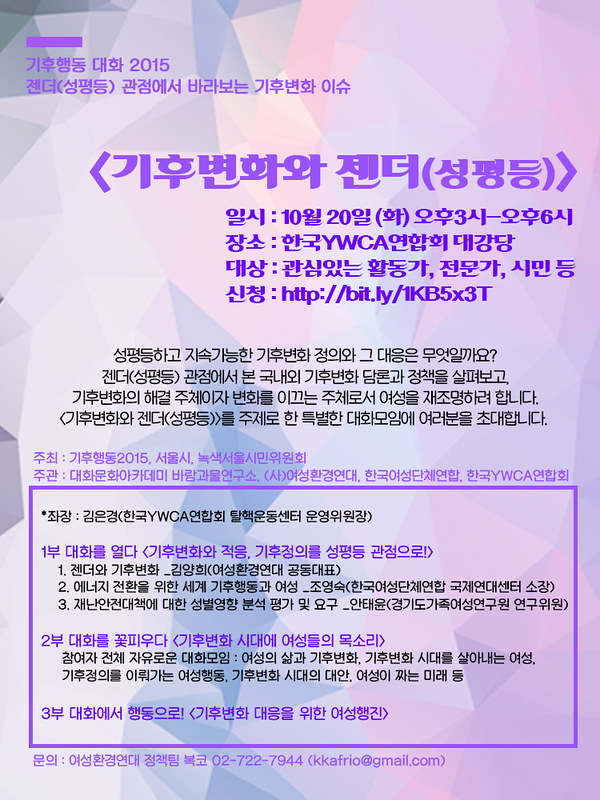
기후변화젠더포럼-웹자보

기후행동 대화 2015
젠더(성평등) 관점에서 바라보는 기후변화 이슈

<기후변화와 젠더(성평등)>

-일시 : 10월 20일 (화) 오후3시-6시
-장소 : 한국YWCA연합회 대강당
-대상 : 관심있는 활동가, 전문가, 시민 등
-신청 : http://bit.ly/1KB5x3T

성평등하고 지속가능한 기후변화 정의와 그 대응은 무엇일까요? 젠더(성평등) 관점에서 본 국내외 기후변화 담론과 정책을 살펴보고, 기후변화의 해결 주체이자 변화를 이끄는 주체로서 여성을 재조명하려 합니다. <기후변화와 젠더(성평등)>를 주제로 한 특별한 대화모임에 여러분을 초대합니다.

좌장 : 김은경 (한국YWCA연합회 탈핵운동센터 운영위원장)

1부 대화를 열다 <기후변화와 적응, 기후정의를 성평등 관점으로!>
1. 젠더와 기후변화 _김양희(여성환경연대 공동대표)
2. 에너지 전환을 위한 세계 기후행동과 여성 _조영숙(한국여성단체연합 국제연대센터 소장)
3. 재난안전대책에 대한 성별영향 분석 평가 및 요구 _안태윤(경기도가족여성연구원 연구위원)

2부 대화를 꽃피우다 <기후변화 시대에 여성들의 목소리>
참여자 전체 자유로운 대화모임 : 여성의 삶과 기후변화, 기후변화 시대를 살아내는 여성, 기후정의를 이뤄가는 여성행동, 기후변화 시대의 대안, 여성이 짜는 미래 등

3부 대화에서 행동으로! <기후변화 대응을 위한 여성행진>

주최 : 기후행동2015, 서울시, 녹색서울시민위원회
주관 : 대화문화아카데미 바람과물연구소, (사)여성환경연대, 한국여성단체연합, 한국YWCA연합회
문의 : 여성환경연대 정책팀 복코 (02-722-7944)


목, 2015/09/24- 15:50
325
0