주요 콘텐츠로 건너뛰기

[시평 489] '용산'이라는 미래

지역

[시평 489] '용산'이라는 미래

익명 (미확인) | 월, 2019/01/28- 10:44

'용산'이라는 미래

비뚤어진 욕망을 주조한 세계가 만든 비극


김윤영 빈곤사회연대 사무국장


"용산참사 현장을 왜 남일당이라고 불러요?"


얼마 전 한 동생이 물었다. 그 건물 일 층에 남일당이라는 금은방이 있었거든. 그래서 남일당이야. 질문자는 한참 동안 대답을 믿지 않았다. 고작 그런 이유로 10년 동안 남일당이었다는 것은 조금 허망하다는 투였다. 원래 동네의 골목이란 그런 이름으로 불리기 일쑤다. 약국이 없는 사거리가 약국사거리거나 구청이 이전한 자리를 여전히 구청이라고 부르는 식이다. 골목이나 사람들이 사라진 동네는 예외다. 기억도 함께 사라지기 때문이다.


허허벌판이 되었다가 거대한 건물이 올라가고 있는 한강로5가 동, 용산4구역에서 핏줄처럼 흐르던 골목의 흔적은 더이상 느낄 수 없다. 2009년 1월 20일, 망루가 불타던 그날로부터 10년이 흘렀다.


10년 동안 외쳐온 '진상규명 책임자 처벌'


용산참사는 이주대책을 요구하던 용산4구역 철거민들의 망루 농성에 경찰특공대가 투입되고, 이 과정에서 철거민 다섯 명과 경찰 한 명이 사망한 사건이다. 용산참사 이후 화재의 원인과 사망, 진압과정에 대한 수사와 재판이 진행되었으나 경찰은 수사기록 3천 쪽을 제출하지 않았고, 증거들은 사라지거나 훼손되었다. 철거민의 화염병이 화재를 일으켰다는 증거는 발견되지 않았지만, 철거민들에 의해 난 불로 인해 경찰이 사망한 것으로 재판은 결론지어졌고, 철거민 5명의 죽음에 대한 진상은 다루지조차 못한 채 망루 안에 있던 철거민들은 중형을 선고받았다.


지난 10년간 진상규명을 위한 노력은 다양한 사실을 밝혀냈다. 망루 안에 위험물질이 있다는 사실을 지휘부가 인지하고 있었음에도 작전을 수행하는 부대원에게 알리지 않았다는 것, 당시 경찰 서울청장이었던 김석기는 무전기를 꺼놓았다며 책임을 회피했지만, 사실이 아니었다는 것 등 경찰의 작전이 매우 성급하고 무리하게 진행되었다는 점이다.


그러나 이러한 잘못에 대해서는 아직 아무도 처벌받지 않았다. 오사카 총영사와 한국공항공사 사장을 거쳐 현재 새누리당 국회의원으로 승승장구한 김석기는 무리한 진압에 대한 책임을 회피하기 위해 사이버수사대 요원 900명을 동원해 경찰 진압의 정당성을 홍보하는 댓글 공작을 지시했다는 사실이 확인되었지만, 공소시효가 만료했다. 용산4구역의 개발 인허가는 이후 적법한 절차를 거치지 못했다는 것이 확인되어 승인 취소되었지만 이로 인해 주거와 생계를 빼앗긴 이들은 아무도 책임지지 않았다.


용산참사 10주기를 맞아 유가족과 피해생존 철거민들은 진상규명과 책임자 처벌을 요구했다. 아직 아무도 처벌받지 않았기 때문이다.


삶과 존엄을 파괴하는 강제철거


정확한 사실을 확인하는 것은 중요한 일이지만 몇 가지 사실을 바르게 나열한다고 해서 진실이 드러나진 않는다. 용산참사의 진실은 우리가 본 불타는 망루에 담겨있다.


2009년 당시, 이명박 전 대통령은 전 국토를 공사장으로 만들어야 한다고 주문했다. 당시 새로운 금융기법이었던 프로젝트파이낸싱은 천문학적인 대출에 높은 이자를 지불하는 것이었으므로 빠른 개발만이 높은 이익을 보장했다. 빠른 개발은 철거민들의 빠른 퇴거를 요구하고, 이를 위해 동원되는 것은 강도 높은 폭력이다. 아직 살고 있는 주민들을 해코지하거나 장사하는 가게에 오물을 투척하거나, 빈집의 유리창과 문을 떼어내고 험악한 분위기를 조성하는 일들은 모두 한국 사회 만연한 '철거'의 과정이다.


용산4구역 철대위 위원장이었던 이충연은 망루에 오른 것은 '용역깡패들의 폭력을 피해 간 것'이라고 얘기한다. 더는 가족들이 당하는 고통과 모욕을 두고 볼 수 없었고, 조합은 단 한 차례의 협의 조차 하려하지 않았다. 용산구청을 비롯해 조율에 나서거나 돕는 사람은 없었기에 그들은 망루로 향했다. 망루를 오른 사람들은 남일당, 그 골목을 채우고 있던 사람들이었다.


지난 12월 3일에는 한강에서 마포 아현동 철거민 박준경 님의 시신이 발견되었다. 그는 10년째 살던 집에서 7월과 9월, 두 차례 강제철거를 당해 쫓겨났고, 임시로 머무르던 주변 공가에서마저 11월 30일 퇴거당한 뒤 '내일이 오는 것이 두렵다'는 유서를 남기고 목숨을 끊었다.


용산참사 이후 서울시의 경우 동절기 강제철거가 금지되었지만 12월 1일부터 동절기에 해당한다. 그 전에 퇴거를 완료하기 위해 철거지역은 전쟁터가 되고, 박준경님의 마지막 철거 역시 11월 30일이었다. 용산참사 이후 재개발지역 상가세입자의 문제가 수면위로 드러났지만 재건축 세입자에게는 이조차 해당하지 않기에 우장창창, 궁중족발 등 비극이 반복되고 있다.


십 년 동안 아무것도 변하지 않은 것은 아니다. 용산참사 이후 개발지역 세입자의 문제는 사회적으로 드러났고, 경찰 진상조사위원회과 검찰의 과거사위원회를 만들어냈다. 비록 외압으로 인한 조사 부진과 한계를 갖고 있으나 유가족과 피해생존자, 이들과 연대하는 사람들이 없었다면 가능하지 않았을 것이다. 우리는 다시 '용산참사 진상규명'의 초입에 섰다.


용산참사 진상규명과 책임자 처벌은 가깝게는 사망과 화재원인에 대한 규명과 진압 책임자의 처벌이지만 근본적으로는 어떠한 도시를 만들 것인지에 대한 질문이다. 열심히 돈 벌어 건물주에게 바쳐야 하는 세입자들이 언젠가 건물주가 되길 희망하는 이곳에서 우리는 새로운 사회를 꿈꾸어야 한다. 비뚤어진 욕망을 주조한 세계에 대한 몇 겹의 이해와 이를 개조하기 위한 노력이 동반되지 않는다면 용산은 언제나 우리의 미래가 될 것이다.


참여사회연구소는 2011년 10월 13일부터 '시민정치시평'이란 제목으로 <프레시안> 에 칼럼을 연재하고 있습니다. 참여사회연구소는 1996년 "시민사회 현장이 우리의 연구실입니다"라는 기치를 내걸고 출범한 참여연대 부설 연구소입니다. 지난 19년 동안 참여민주사회의 비전과 모델, 전략을 진지하게 모색해 온 참여사회연구소는 한국 사회의 현안과 쟁점을 다룬 칼럼을 통해 보다 많은 시민들과 만나고자 합니다. 참여사회연구소의 시민정치는 우리가 속한 공동체에 주체적으로 참여하고, 책임지는 정치를 말합니다. 시민정치가 이루어지는 곳은 우리 삶의 결이 담긴 모든 곳이며, 공동체의 운명에 관한 진지한 숙의와 실천이 이루어지는 모든 곳입니다. '시민정치시평'은 그 모든 곳에서 울려 퍼지는 혹은 솟아 움트는 목소리를 담아 소통하고 공론을 하는 마당이 될 것입니다. 많은 독자들의 성원을 기대합니다. 같은 내용이 프레시안에도 게시됩니다. 목록 바로가기(클릭)


* 본 내용은 참여연대나 참여사회연구소의 공식 입장이 아닙니다.

시민들의 의견

댓글 달기

Plain text

  • 웹 페이지 주소 및 이메일 주소는 자동으로 링크로 전환됩니다.
  • 줄과 단락은 자동으로 분리됩니다.
  • 사용할 수 있는 HTML 태그: <a href hreflang> <em> <strong> <cite> <blockquote cite> <code> <ul type> <ol start type> <li> <dl> <dt> <dd>
이미지
무제한 수의 파일을 이 필드에 업로드할 수 있습니다.
50 MB 한계입니다.
허용된 유형: png gif jpg jpeg.
Enter the YouTube URL. Valid URL formats include: http://www.youtube.com/watch?v=1SqBdS0XkV4 and http://youtu.be/1SqBdS0XkV4.
CAPTCHA
스펨 사용자 차단 질문

Civil Peace Forum 2018-2 Peace Report

Ushering in an Era of Great Transformation on the Korean Peninsula through Citizen Participation


Lee Hyeuk-hee / Chairperson of Operation Committee, One Korea Action


Different Era Requires Different Thinking


At this very moment, the Korean Peninsula is entering a new era of great transformation. After the North Korea-United States summit following the inter-Korean summit in 2018, this great transformation is now the current of the times that no one can swim against. I refer to this development of events as a great transformation because this is an extraordinary time that is now unfolding: something none of us has ever experienced.


This great transformation can be specifically defined as “the end of the Cold War”, “deconstruction of a divided Korea”, and “the emergence of a new order on the Korean Peninsula” filling in the political vacuum left after the Cold War system has ceased or been aborted. The biggest shock and concern would be to witness the paradigm shift of “peace through national security” to “security through cooperation”. We have never experienced living in a world in which not guns but a collective security system and armies without a main enemy maintain peace. To adapt to this new situation will take quite some time. Deconstruction of a divided Korea will be even more shocking. If this division actually refers to a “hostility” derived from “regional division” and “different lifestyles” (See Lee Jong-suk, 1998), North Korea will gradually go through a transition into market socialism following its policy of accelerating marketization and focusing on economic development. This means expiration of the “different lifestyles”, and the hostility which arose from the hate for being different from one another will also very likely disappear. The only thing left then is the regional division. If Korea can maintain its de facto unification even though regional division is still in place, the national division, which has grown on its own and persisted for a long time only on the Korean Peninsula, can be deconstructed.


More importantly, however, is the matter of “recreation”. Paik Nak-chung pointed out that in terms of a reunification theory applicable to the Korean Peninsula, people must take the initiative and be creative in deconstructing the existing division. The key to this argument that reunification must be part of a recreation process is that an entirely new Korean Peninsula has to be created by overcoming the contradictions which exist in both South and North Korean society through comprehensive inner reflection, not by unifying the two societies without rectifying their own inconsistencies.


In May 27, 2018, at a press conference reporting on the second round of the Inter-Korea Summit, President Moon Jae-in remarked, “This is only a start. However, it is not anything that has been witnessed in the past. It will be a whole new beginning.” I assume that his emphasis is along the same line as what I’ve mentioned above. It is also worth noting Chairman Kim Jong Un’s words during the 2018 North Korea–United States summit: “It was not easy to get here. The past worked as fetters on our limbs, and the old prejudices and practices worked as obstacles on our way forward. But we overcame all of them, and we are here today,” adding that “the world will see major changes.” Chairman Kim’s remarks were originally made with the intent of ending North Korea’s hostile relationship with the United States, but they can be viewed as an indicator of the upcoming major changes within his country. As such, a tremendous opportunity for a great transformation of the Korean Peninsula through citizen participation has presented itself, at a time when the leaders of the two Koreas are willing to create a new Korea and are pushing forward with great effort.


What we must focus on now is determining how we can help this great transformation to happen with citizen participation and not political decisions made by our leaders. More precisely, the question is “How can we become creative in the process of recreation as a people, and go beyond the boundaries of grand decisions and visions put forward by the governments of South and North Korea?”


The Candlelight Revolution: A Starting Point for Great Transformation


To understand the trends within this great transformation and respond to them, we need to look at the fundamental factors that facilitated it. While there are many opinions and views on this issue, the undeniable fact is that Korea’s “Candlelight Revolution” was at its core. The previous administrations, run by Lee Myung-bak and Park Geun-hye, pursued a strong confrontational policy towards North Korea which led to military crisis, instead of managing inter-Korean relations. This is a distinctive feature of the system of a divided in Korea in which South Korean leaders attempt to strengthen their political hold through a confrontational footing towards North Korea to gain and unite their supporters, supported by advisors who intend to prompt an economic collapse of the North and reunify through absorption. When peaceful everyday life was no longer possible in the two Koreas due to this fierce confrontation, Paik Nak-chung anticipated that a “citizen participation movement does not merely mean participation by citizens, but the inevitability of an ultimate change in the status quo, which is a call to change the anti-peace regime”. Indeed, this occurred in the Candlelight Revolution. As he reviewed these revolutionary processes, Paik remarked that “the Candlelight Revolution, which overthrew a regime that was against progress in inter-Korean relations was the best example of citizen participation I have ever witnessed.” Only afterwards, it became clear that “citizen participation” meant “voluntary participation of citizens” attempting to resolve a situation that disrupted everyday life, overthrowing a regime that fundamentally supported the system of peninsular division.


The current approval rating for President Moon shows that support for his administration comes from its success in bringing about peace on the Korean Peninsula by improving inter-Korean relations rather than removing deep-rooted irregularities or improving the economy. Civil society has played an especially important role in shaping favorable conditions for rapidly improving relations in 2018, at least according to the words of Chairman Kim Jong Un. During his opening remarks at the April 27 inter-Korean summit, Kim used the phrase “lost 11 years” and expressed hope that these lost years would not be repeated. Paradoxically, his remarks can be interpreted as North Korea being willing to dialogue with South Korea to improve inter-Korean relations, as the new regime in the South was put in place due to the success of the Candlelight Revolution.


The Starting Point for Great Transformation is to Institutionalize South-North Relations


Looking back at the June 15th (2000) North–South Joint Declaration, the administration headed by Kim Dae-jung adopted an “engagement policy” after abandoning one of confrontation towards North Korea, pushed by the previous administration of Kim Young-sam. This new approach was to rebuild trust between the two Koreas by promoting social and cultural exchanges and vitalizing economic cooperation mainly in the non-governmental sector rather than through direct government intervention. Engagement policy was shaped and influenced by the negative legacy effects of the worsening inter-Korean relations left behind by the Kim Young-sam administration. However, all the connections made between South and North Korea gradually disintegrated with the Lee Myung-bak administration and the closure of the Kaesong Industrial Complex (KIC) in February 2016 by the Park Geun-hye administration. This brought the efforts by the Kim Dae-jung and Roh Moo-hyun administrations to improve inter-Korean relations back to square one. Certainly, it is difficult to understand how inter-Korean relations, which had seen 1 million South Koreans allowed to visit Mount Kumgang and 10,000 more every year to visit Pyongyang, had totally collapsed due to policy under the Lee Myung-bak and Park Geun-hye administrations. This collapse shows the limits of functionalist approaches that focus on exchange and cooperation in a non-political arena, rather than those of engagement policy.


As for the Kim Dae-jung administration before him, the Moon Jae-in government was handed the legacy of negative inter-Korean relations. An anti-North Korean mentality was widespread among Korean citizens and theories of reunification through absorption or even of the uselessness of reunification were dominant in the related discourse. However, the Moon administration broke away from the past when the opportunity came and adopted a totally different approach. Its top-down approach is to rapidly normalize relations between South and

North and build trust through negotiation and dialogue between high-ranking government officials and then expand downward into exchanges in the non-governmental sector and economic cooperation.


This approach has many advantages. First, it promotes stability and sustainability of inter-Korean relations. It is unrealistic to expect Mount Kumgang tourism or the KIC to resume operations without first constructing mutual trust in a political and military sense, as the two Koreas were once at the brink of war. There will be no South Koreans, whether private citizens or business people, who would return to tourism or business with North Korea in the face of such instability. Second, the inter-Korean summit revealed that President Moon is focusing more on peace while Chairman Kim on reunification. Such a difference seems like déjà vu of the situation after the June 15th North–South Joint Declaration in which the South focused on implementing Article 4 of the Declaration, which promoted economic cooperation and social and cultural exchange, while the North focused on Article 1, which emphasized the reunification to be achieved by the two Koreas.


Unfortunately, there failed to be any further progress on implementing Article 2 of the June 15th North–South Joint Declaration, implementation plans for reunification, which was virtually the Declaration’s final aim, and here we are now. During the fourth inter-Korean

summit held in May 26, 2018, the two leaders sought to persuade the world that the two Koreas will not repeat the mistakes of the past. Or, they at least succeeded in convincing the world that they would institutionalize inter-Korean relations - in other words, a confederation of South and North would be achieved. This development was no less than a message that the two Koreas are acting at least towards the same purposes and goals. It is also clear that military tensions and adventurism between the South and the North will not be restrained without such institutionalization: a whole new approach.


The Citizen Participation Movement in a Special Era


In this era of great transformation, the members of the citizen participation movement have to find consensus on the details of reunification theory and then take the initiative to promote it widely, to ensure that people from all walks of life are the focus during this transformation.


When the limitations of the functionalist approach appeared, the argument that it was simply“pouring money into North Korea” gained prominence. This argument was an emotional, rather than scientific or rational, line of thinking as well as some kind of distorted “frame”, and defined humanitarian assistance and non-governmental exchanges as “forces against reunification,” assuming that any assistance to the North would help sustain the regime there.


However, this is simply based on the strategy of demonizing North Korea and promoting its collapse. But it held great sway among the population and some even became supporters of “reunification through absorption”.


To point out the flaws in this argument, we have to clarify the term “reunification”. In terms of overcoming the system of division, reunification is defined as “the process by which the vast majority of the people on the Korean Peninsula live under a better system than the current one”. According to this definition, it is “a gradual process that takes place over a long period of time” as opposed to what happened in Germany or Vietnam, where reunification occurred once, suddenly, after a preparation process. If reunification is viewed as a process and not a dramatic moment, it will be recognized as having a progressive form which is the sum total of different processes at several stages towards reunification, and not a finished form. In this case, reunification will be defined as a process in which the people seek the type of state that best suits their interests, and not instantly becoming a single-race nation.


Based on this, reunification will be further defined as a state in which the two Koreas help each other, visit one another, and coexist in peace - in other words, a state of being virtually reunified, not simply known as a single nation state. We define reunification as a “confederation” of the South and North, an institutionalized form of inter-Korean relations. Such a confederation will be reunification, and the need for reunification will now become more than just a reunion of one nation divided by foreign countries. The understanding of the word will be extended into a process in which the two Koreas, in recent history developing along two different routes, create a unified community in the interest of economic and security needs. A confederation means the South and North exist as two sovereign states for a certain period of time.


According to the principles upheld by the Basic Agreement of 1991, inter-Korean relations are distinct in that they exist inside one nationality and aim for reunification. While they are not relations between two different countries, it is also clear at the same time that a certain form of institutionalization comparable to international relations is needed for a certain period during which the two Koreas build a community and learn to coexist in peace. As the South and North have already accepted the idea of a confederation of two Koreas as the provisional form for reunification stated in Article 2 of the June 15th North–South Joint Declaration, they have to expand their scope of thinking through deep reflection.

However, a confederation of two Koreas is certainly different from the establishment of “a peace state”, an idea advocated by some in the peace movement that aims for peaceful coexistence. Under confederation, the Korean War will be declared over, which will mark the end of the Armistice regime, and a “peace agreement” discussed to regulate the state of peace on the Korean Peninsula as denuclearization proceeds. The agents responsible for observing such a peace agreement should be none other than the two Koreas. Although a series of events, including declaring the end of war and signing of a peace agreement will not be possible without guarantees from the US and China, the major foreign participants in the Korean War, the central responsibility for maintaining the regime of peace on the Peninsula will lie with the North and South themselves. The North-South Confederation will be a very inter-Korean organization to uphold the peace agreement proposed in the National Community Unification Formula, and agreed in the June 15th Joint Declaration. This confederation should not posit a permanent state of peaceful coexistence as its end goal; it needs to be situated as a tool of a peace regime aimed at reunification. The peace state and the North-South Confederation have fundamentally different purposes: the former the maintenance of peace, the latter reunification. Of course, the two Koreas are not the only actors in the peace regime on the Peninsula. It goes without saying that a system of cooperation and security must be built that encompasses not just Northeast Asia but the entire continent. But even this is only meaningful to the extent that the two Koreas participate as responsible parties and garner international support for reunification, and should not serve as grounds to perpetuate the state of partition.


The North-South Confederation will serve to accelerate the integration of the two communities with the goal of establishing a regime of peace aimed at reunification. The natural sequence of integration under such a Confederation would be to start with the establishment of an economic community, moving on to a socio-cultural community, and then culminating in a political community. The Korean people have witnessed the Panmunjeom Declaration and the fourth inter-Korean summit meeting. If the fifth summit meeting, scheduled for the Fall of 2018, also materializes, this would enable a new discourse that conceptualizes reunification as “de facto reunification in the form of a North-South Confederation” to firmly take root as part of the discourse on reunification. Once reunification undergoes such a concept transformation among the population, it should be possible to open a new era with a major transition through the participation of the people, free from the shackles of the old idea of reunification through absorption. For the moment, there is also dire need for a national campaign to explain the meaning and content of the Panmunjeom Declaration and the Singapore Declaration. Informing the people of the content of these declarations alone can go a long way toward spreading the new conversation on reunification and accomplishing civic participation in an era of major transition. There is an urgent need to organize speaking events nationwide at the city, district, and town level to inform people of the coming of this era, with the aim of securing the participation of at least 10% of the population.


Next, the campaign to build civic participation must work toward involving the people who took part in the Candlelight Revolution in inter-Korean exchanges and realizing solidarity with the North Korean people.

The late Reverend “Late Spring” Moon Ik-hwan was the first to advocate solidarity between the people of the two Koreas after partition of the Peninsula. The 1994 initiative known as the “70 Million Compatriots in Preparation for Reunification” embodied this idea. Solidarity between the people of North and South Korea will not be an impossible dream once a North-South Confederation is institutionalized and de facto reunification becomes reality. Achieving solidarity between the people of the two Koreas, in particular, is a challenge that the South Korean civic movement must tackle. Rather than blaming past governments for “the lost 11 years”, the civic movement must come to terms with the failure of inter-Korean exchanges and peace movements to attract mass participation. In particular, the direction and aim of inter-Korean exchanges were not informed by the concept of civic participation. Exchange programs,although numerous and frequent, have mainly involved organizations and prominent figures,failing to draw general participation and taking root in people’s everyday lives. Now that the Candlelight Revolution has given rise to a new opportunity, the participants in that Revolution must take part in the new era of peace, prosperity, and reunification on the Korean Peninsula.


However, those who got out for the Candlelight Revolution are for the most part people who had not been born or become interested in such things before the “lost” 11 years. Should we try to explain past inter-Korean exchanges, they will not understand, and neither would they be won over to that same framework of inter-Korean exchanges. It is apparent that we need a new way of relating to them, a way which befits a new era. For civic participation to become a grassroots movement, such a new way of relating to people in North Korea is sorely needed.


People living in the North are not the same as before, either. The new generation since the“March of Ordeal” are known to have a completely different outlook than those before them. Snacks and other food products recently manufactured there apparently have the phone

numbers of manufacturers printed on them, sometimes even bar codes and QR codes. This suggests North Korean people are on the cusp of exercising their “consumer rights”, often deemed the most basic of all human rights. News reports even have it that the most popular

food manufacturer in North Korea, Gold Cup Athlete General Food Factory, boasts that average people test all its products prior to launch. These are signs that confirm, while not the immediate arrival, at least the potential for the Fourth Sector, or civil society, to emerge in North Korea.


What will the citizen participation movement for reunification do, if things change so dramatically, if, for example, railways and roads are connected and Mount Kumgang tourism resumes in earnest through an inter-Korean summit? The answer is that it must focus on

building solidarity between the people of the two Koreas. The idea of creating a new relationship has to be reexamined in earnest if a desire exists to keep up with the changes in both South and North Korea.


The present donation campaign for the people of North Korea is the most telling example of efforts to overcome the system dividing Korea - in other words, a reunification movement pursued in everyday life. The campaign was lauded as the most significant self-help movement of the Korean people since the Dangun era. Every organization took part as it unfolded at every municipal level (cities, districts, and towns) as the first donation campaign for the North.


Finding success in forming new relations will depend on whether the existing exchanges in different fields expand and create a new movement of popular exchange with a wide range of participants. Such efforts will only bring about real change as opportunities arise out of the Candlelight Revolution. Certainly, what is important here is that these efforts should not be one-sided. The new movement of exchange has to take the distinctive features of North Korean society and the position of its regime into consideration and establish a scope that is within what North Korean society can accept. In this regard, the “Inter-Korean Joint Liaison Office”to be established in Kaesong is the most crucial route. Civil society must assume the responsibility for preparing to establish solidarity between the people of the two Koreas in everyday life through this Office. To this end, a network for inter-Korean exchange and cooperation is needed. Such an intermediate support organization would include a variety of Candlelight Revolution participants and “regular” citizens hoping to form new relations and grassroots organizations. The network would first need to introduce to the public assistance projects for North Korea. Second, it would coordinate and rearrange overlapping projects.


Third, it would offer educational programs on peace and reunification to alleviate possible culture shock that can arise from contact with North Korean society. Fourth, it will need to come up with strategic projects to build solidarity between the two cultures.

A special era calls for a special method of movement-building. The only mission civil society needs to accomplish is to exacerbate the current trends ending the Cold War system - something made possible by the Candlelight Revolution and its citizen participants - and to finally end the system dividing our peninsula.


* This essay is the second essay written for the 2018 Peace Report Project of the Civil Peace Forum, under the sponsorship of Friedrich-Ebert-Stiftung Korea Office.


Report [See/Download

Korean Version >> 

토, 2018/07/28- 12:45
156
0

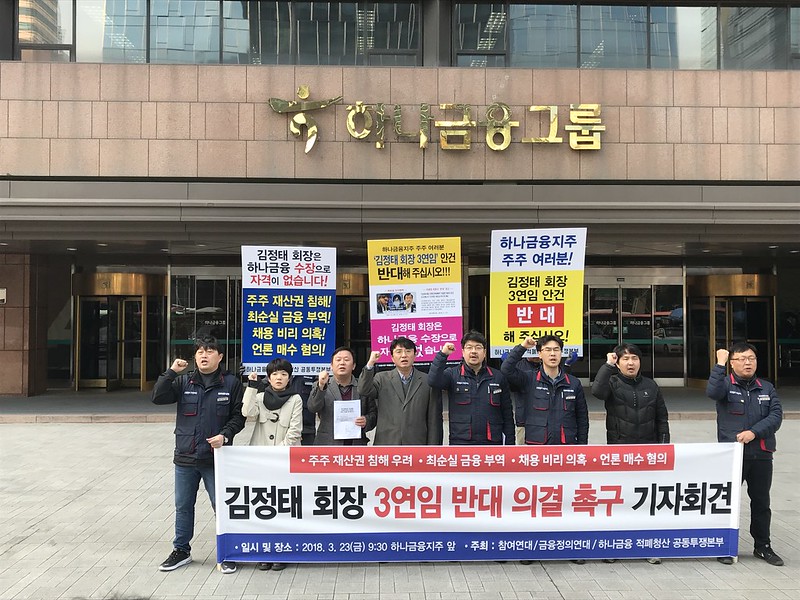
하나금융지주 주주총회 김정태 회장 3연임에 반대 의결을 촉구합니다!

하나금융지주 주주총회 ‘김정태 회장 3연임 반대 의결’ 촉구 기자회견

일시 장소 : 3.23.(금) 09:30, 하나금융지주 앞(중구 을지로 66) 


EF20180323_기자회견_하나금융지주 김정태 회장 3연임 반대_01


1. 취지와 목적

  • 23일 하나금융지주 주주총회에서 김정태 회장 3연임 여부가 결정됩니다. 현재 김정태 회장 3연임 안건에 대해 찬반 의견이 엇갈리고 있습니다. 국내 영향력 있는 의결권 자문사인 서스틴베스트와 좋은기업지배구조연구소는 김정태 회장 3연임 안건에 대해 '반대' 권고를 냈습니다. 언론 보도에 따르면, 한국기업지배구조원도 ‘반대’ 의견을 표명한 것으로 알려졌습니다. 반면 해외 의결권 자문사인 ISS는 '찬성' 의견을 제시하였습니다. 국내 의결권 자문사들은 김정태 회장의 구체적인 행태들을 근거로 미래의 주주이익 침해 가능성과 CEO리스크를 우려해 반대 권고를 하였지만, ISS는 현재 진행되고 있는 금융감독당국과의 갈등 상황은 반영하지 않고, 과거 실적만 고려했을 뿐 미래의 위험성은 간과한 채 찬성 의견을 제시하였습니다. 
  • 김정태 회장은 박근혜 정부의 압력에 굴복하여 최순실 금고지기를 위한 ‘위인설관(爲人設官)’ 특혜승진을 허용하면서도, 자신의 3연임을 위해 최근 채용비리와 관련하여 금융당국과 극한 갈등을 유발하면서 진흙탕 싸움을 펼치고 있습니다. 김정태 회장은 자신의 사익을 위해 하나금융지주를 극단의 위기로 몰아가고 있는 것입니다. 이것이 바로 CEO리스크의 전형을 보여주는 것입니다. 뿐만 아니라 김정태 회장은 스스로도 은행법 위반과 김영란법 위반 등의 혐의로 이미 검찰에 고발당한 상황이어서, 사안의 진전에 따라서는 CEO로서의 역할을 끝까지 완수하지 못할 가능성도 있습니다. 
  • 이런 상황에서 만약 주주총회에서 김정태 회장 3연임이 통과된다면 하나금융은 더욱 깊은 수렁으로 빠져들 것입니다. 김정태 회장은 금융감독원 조사와 검찰 수사에 대응하느라 제대로 경영에 전념할 수도 없을 뿐만 아니라, 각종 비리 의혹이 범죄 사실로 확정되어 물러나게 된다면 갑작스런 경영 공백을 피할 수 없게 될 것입니다.  차라리 이번 주주총회에서 ‘김정태 회장 3연임’을 막고, 새로운 회장후보추천위원회를 구성하여 ‘모피아 낙하산’을 제외하고 공정성, 투명성, 객관성을 갖춘 국민들의 눈높이에 걸맞은 새 회장을 선출하는 것이 하나금융을 빠르게 안정시키고 미래의 주주 이익 가치를 지키는 방안이 될 것입니다. 
  • 금융정의연대와 참여연대 경제금융센터, 하나금융지주 적폐청산 공동투쟁본부는 하나금융지주 전체 주주들의 이익이 침해 받지 않고 대한민국 금융산업의 안정과 공공성을 위해서라도 김정태 회장 3연임 안건에 대해 반드시 반대 의결을 해 주기를 촉구하기 위해 기자회견을 개최했습니다.  

2. 개요

  •  
  • 일시 : 2018년 3월 23일(금) 오전 9시 30분
  • 장소 : 하나금융지주 명동 본점 앞(서울 중구 을지로 66)
  • 주최 : 금융정의연대/참여연대 경제금융센터/하나금융지주 적폐청산 공동투쟁본부


▣ 붙임1 : 기자회견문


기자회견문

하나금융지주 주주총회에서 김정태 회장의 3연임 선임 안건은
주주 가치를 위해 부결되어야 한다


현재 김정태 회장은 국정농단 사태의 주범인 최순실의 금고지기로 알려진 이상화 전 독일법인장의 승진에 부당하게 개입하고, 자신에게 비판적인 언론의 매수를 시도했다는 등 중대한 위법 혐의를 받고 있고, 이에 대해 수사가 진행 중이다. 따라서 김정태 회장은 하나금융지주 대표이사로서 자격이 없다. 그 동안 드러난 수많은 의혹만으로도 당장 사퇴해야 한다. 그는 개인의 사욕을 위해 하나금융을 암울하게 만들고 있으며, 대한민국 금융 질서를 문란케 하는 뉴스거리로 전락하고 말았다. 


국내 의결권 자문사들은 김정태 회장이 독립적이고 객관적이라 할 수 없는 회장후보추천위원회를 통해 선출되었고, 김정태 회장의 사회적 신뢰가 저하되어 기업 및 주주가치에 중대한 훼손을 입힌 것으로 판단하여 ‘반대’를 권고했다.


김정태 회장은 자신의 이익을 위해 부당한 영향력을 행사하여 하나금융지주에 손해를 끼쳤다. 이로 인해 회사의 평판에는 상당한 악영향을 끼쳤다. 상법상 이사의 충실의무 해태는 물론, 반복된 은행법 위반, 김영란법까지 위반한 의혹으로 검찰에 고발된 김정태 회장에게 또다시 하나금융지주의 경영을 맡길 수는 없다. 


김 은정, [23.03.18 15:08]

김정태 회장은 수많은 개인 비리와 채용비리 의혹, 금융감독원장이 하나은행 채용청탁 의혹으로 낙마하는 초유의 사태에도 자신의 3연임을 위해 금융당국과 극한 갈등을 유발하면서, 오로지 자신의 사익을 위해 하나금융지주를 극단의 위기로 몰아가고 있는 진흙탕 싸움을 펼치고 있다. 이로 인한 하나금융의 평판은 이루 말할 수 없는 훼손을 입고 있다.


하나금융지주 적폐청산 공동투쟁본부와 참여연대 경제금융센터, 금융정의연대는 이러한 작금의 사태들이 이번 주주총회에서 김정태 회장의 3연임을 막아야 하는 절체절명의 이유라고 생각하며, 이번 투쟁의 성공이 문재인 정부 금융개혁의 시작이 될 것임을 확신한다. 


우리단체는 국민을 위한 금융, 공공성이 확립된 금융개혁의 시작을 위해 김정태 회장의 조속한 사법처리를 촉구한다. 


또한, 하나금융지주 주주들에게 고(告)한다. 전체 주주들의 이익이 침해 받지 않고 대한민국 금융산업의 안정과 공공성을 위해 반드시 김정태 회장 3연임 안건에 대해 반대 의결을 해 주기를 촉구한다. 


2018년 3월 23일

금융정의연대/참여연대/하나금융지주 적폐청산 공동투쟁본부


보도자료 원문보기/다운로드


금, 2018/03/23- 15:11
156
0

우리는 학대받고 탄압받는 로힝야 곁에 있겠습니다 

미얀마 정부는 국제사회의 진상규명 노력에 협력하고, 책임자 처벌하라

로힝야 난민들의 안전하고 존엄한 귀환 및 시민권 보장하라


일시 및 장소 : 2018년 8월 24일(금) 오전11시, 주한 미얀마대사관 앞


20180824_로힝야 학살 1주기 미얀마 정부 규탄 기자회견

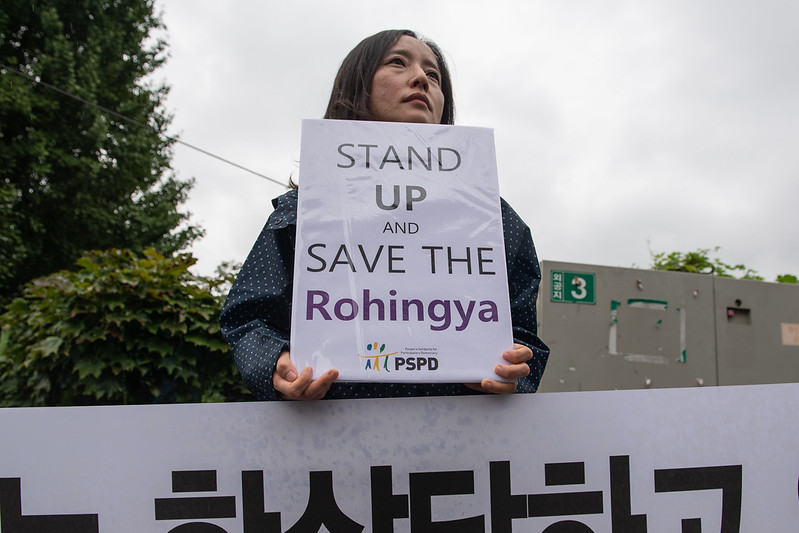
2018.08.24 로힝야 학살 1주기 미얀마 정부 규탄 기자회견 (사진 = 조진섭)


20180824_로힝야 학살 1주기 미얀마 정부 규탄 기자회견

2018.08.24 로힝야 학살 1주기 미얀마 정부 규탄 기자회견 (사진 = 조진섭)


20180824_로힝야 학살 1주기 미얀마 정부 규탄 기자회견

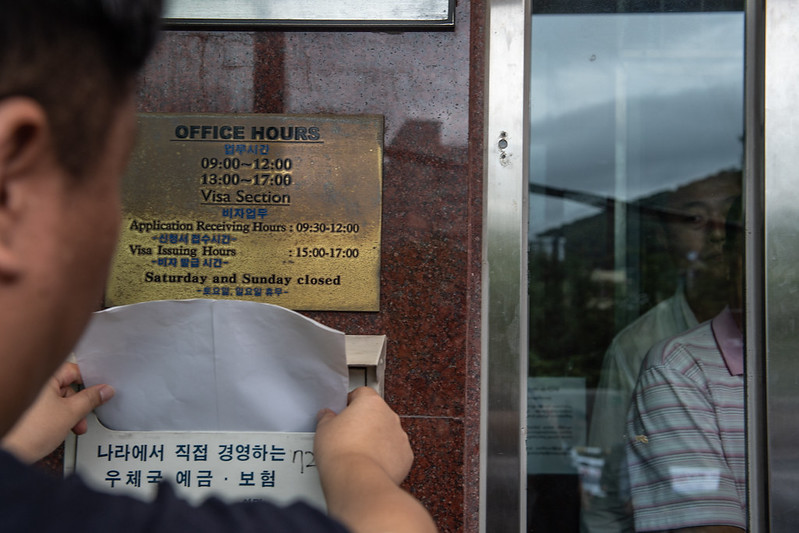
2018.08.24 기자회견 참가자들은 한국 시민사회의 우려와 요구를 담은 성명서를

미얀마 대사관에 전달했다 (사진 = 조진섭)


오늘(24일) 오전 11시, 32개 한국의 인권시민사회단체는 로힝야 학살 1주기를 맞아 주한 미얀마대사관 앞에서 로힝야를 탄압하고 있는 미얀마 정부를 규탄하고, 한국 시민사회의 우려와 요구를 담은 성명서를 주한 미얀마대사관에 전달하였습니다.


지난해 8월 25일, 약 25,000명의 로힝야 민간인들이 미얀마 군부에 의한 무차별적인 집단살해, 강간, 방화 등으로 희생되었습니다. 또한 80만 명에 육박하는 로힝야 난민들은 여전히 집으로 돌아가지 못한 채 인접국인 방글라데시 난민촌에서 생활하고 있습니다. UN을 비롯한 국제사회는 이를 반인도적 범죄, 전형적인 인종청소(제노사이드)라고 규정하고 있지만 미얀마 정부는 여전히 그 책임을 부인하고 있습니다.  


한국의 시민사회단체는 성명서를 통해 미얀마 정부에 독립적이고 철저한 조사를 통해 진실을 규명하고 책임자를 처벌할 것을 촉구하였습니다. 또한 지난 40여년간 무국적자로 온갖 차별과 박해를 받아온 로힝야 난민들의 자발적이고 안전하며 존엄한 귀환과 시민권 보장을 요구하였습니다. 또한 한국 정부를 포함한 국제사회가 로힝야 난민에 대한 인도적 지원을 확대하고, 로힝야 문제의 지속가능한 해결을 위한 노력에 적극 협력할 것을 주문하였습니다.


한편, 로힝야 학살 1주기를 맞아 이를 추모하고 기억하는 행사 “Rohingya Genocide Remembrance Day”가 독일, 캐나다, 아일랜드 등 전세계 각국에서 진행될 예정입니다. 한국에서도 8월 24일(금) 오후 6시, 서울시NPO지원센터 품다홀에서 로힝야 학살 1주기 추모행사 “집으로 돌아가는 길”이 개최됩니다.


▣ 붙임1. 로힝야 학살 1주기 한국시민사회 공동성명서(국‧영문)

▣ 기자회견 사진 보기(출처 : 조진섭 작가) >>  

 
로힝야 학살 1주기 한국시민사회 공동성명서(국문)
 

우리는 학살당하고 외면당하는 로힝야 곁에   있겠습니다

미얀마 정부는 로힝야 학살 인정하고 난민 귀환 보장하라!

 
로힝야와 연대하는 한국 시민사회는 작년 미얀마 정부에 의해 학살당한 희생자들을 추모하고, 스스로를 ‘로힝야’라고 부를 권리마저 부인된, 세계에서 가장 박해받고 있는 이들과 연대하기 위해 오늘 미얀마 대사관 앞에 모였다.
 
1년 전 오늘, 미얀마 정부는 미얀마 소수 민족인 로힝야 사람들에 대한 대규모 군사작전을 벌였다. 그로 인해 약 25,000명의 로힝야 민간인들이 집단살해, 집단강간, 구타, 자의적 체포와 구금, 거주지 방화, 재산 약탈을 당했으며 약 80만 명의 난민이 발생했다. 그럼에도 불구하고 미얀마 정부는 여전히 이러한 사실 자체를 부인하고 책임을 회피하고 있다. 
 
우리는 미얀마 정부가 오랫동안 로힝야 사람들에 대한 집단적인 폭력과 추방 그리고 법·제도적 차별을 광범위하고 체계적으로 지속해온 사실을 다시 환기한다. 로힝야는 법이 토착 민족으로 인정하는 기준인 1823년보다 훨씬 이전부터 아라칸 지역에 살아온 미얀마의 사회구성원이다. 그럼에도 불구하고, 1982년부터 시민권을 사실상 박탈당하고 무국적자로 내몰렸다. 이동의 자유는 물론 종교의 자유도 제약되어 왔고, 자녀 출산도 2명으로 제한되어 왔다.
 
미얀마 군부가 조직적으로 저지른 작년의 학살은 전 세계를 경악하게 했다. 로힝야 학살이 노벨 평화상 수상자인 아웅산 수치 정권에서 발생했다는 점은 한국 시민사회에도 커다란 충격이었다. 유엔을 비롯한 국제사회는 이를 반인도적 범죄 또는 전형적인 인종청소라고 규정했다. 이양희 유엔 미얀마인권특별보고관은 집단학살(제노사이드)의 특징들이 있다고 발표했다. 국제형사재판소가 개입을 검토할 정도였다.
 
학살 생존자의 증언과 드러난 증거들은 이 끔찍한 비극의 책임이 미얀마 정부에 있음을 증명하고 있다. 그러나 미얀마 정부는 여전히 그 책임을 부인하고 있다. 아무리 미얀마 정부가 학살이 로힝야 무장세력 때문이라고 주장하더라도, 수많은 학살 생존자들의 증언을 지울 수는 없다. 또한 이양희 유엔 미얀마인권특별보고관의 활동을 포함한 국제사회의 독립적이고 신뢰할 수 있는 조사를 미얀마 정부가 받아들이지 않는 한, 우리는 그들의 어떤 주장도 신뢰할 수 없다.
 
로힝야 사람들은 고향으로 돌아갈 권리가 있다. 한국 시민사회는 이들의 자발적이고 안전하며 존엄성이 보장된 귀환을 보장할 것을 미얀마 정부에 촉구한다. 어떤 정부도 이러한 권리를 부정하거나, 그 권리를 포기할 것을 강요해서는 안 된다. 로힝야의 국적도, 유엔 안전보장이사회의 합의 여부와도 상관없이, 국제인권규범은 이들의 기본권을 보장하고 있으며 이는 향후 귀환 과정에서도 온전히 적용되어야 한다.
 
더불어 우리는 지금 한국 사회에 표출되고 있는 난민과 무슬림에 대한 혐오에 우려를 표한다. 로힝야 학살 소식에 달렸던 끔찍한 혐오 댓글들은 이제 예멘 난민들과 무슬림 이주민들에게로 대상만 바뀌었을 뿐이다. 인간의 당연한 권리를 부정하는 혐오를 방치하고 용인한다면 결국 그 피해는 우리 모두에게 돌아올 것이 자명하다. 우리는 종교, 인종, 피부색, 국적, 성별, 성 정체성, 정치적 견해 등을 이유로 한 차별과 혐오를 단호히 반대하며 인권의 기본적 원칙에 기반하여 대처할 것이다.
 
한국 시민사회는 미얀마 정부의 로힝야 학살과 이에 대한 부정을 결코 좌시하지 않을 것이며 학살에 대한 진상규명, 책임자 처벌, 피해자 구제, 재발 방지를 위한 노력을 국제사회와 함께 해나갈 것을 약속한다. 우리는 로힝야 사람들의 고통에 지속적으로 연대할 것이다. 이는 한국 사회에서도 자라나고 있는 인종주의적 폭력과 혐오에 맞서 싸우는 방법이기 때문이다.
 
이에 한국 시민사회는 다음과 같이 요구한다.
 
 
하나, 미얀마 정부는 독립적이고 철저한 조사를 통해 진실을 규명하고 책임자를 처벌하라! 이를 위해 미얀마 정부는 국제사회의 진상규명 노력에 협력하고, 학살 발생지역에 대한 국제언론과 인권단체들의 제약 없는 출입을 허용하라.
 
하나, 미얀마 정부는 로힝야를 토착 민족으로 인정하고 시민권을 부여하라!
 
하나, 미얀마 정부는 로힝야 난민들의 자발적이고 안전하며 존엄한 귀환을 보장하고, 송환 논의에 로힝야의 적극적 참여를 보장하라!
 
하나, 미얀마 정부는 로힝야 피해자에 대한 구제 방안을 마련하고 재발 방지를 약속하라!
 
하나, 유엔 안전보장이사회는 로힝야 학살을 국제형사재판소에 회부하라!
 
하나, 한국 정부를 포함한 국제사회는 로힝야 난민에 대한 인도적 지원을 확대하고, 로힝야 문제의 지속가능한 해결을 위한 노력에 적극 협력하라!
 
 
2018년 8월 24일
거창평화인권예술제위원회, 공익법센터 어필, 공익인권법재단 공감, 광주인권지기 활짝, 구속노동자후원회, 국제민주연대, 난민인권센터, 다산인권센터, 대한불교조계종 사회노동위원회, 민변 국제연대위원회, 사회변혁노동자당, 생명평화아시아, 성적소수문화인권연대 연분홍치마, 신대승네트워크, 실천불교전국승가회, 아시아인권평화디딤돌 아디(ADI), 에이팟코리아(A-PAD Korea), 이주민센터 친구, 인권운동공간 활, 인권운동사랑방, 인천인권영화제, 작은형제회, 전국장애인차별철폐연대, 전북평화와인권연대, 제주다크투어, 제주평화인권연구소 왓, 진실의 힘, 참여연대, 천주교인권위원회, 팔레스타인평화연대, 한국게이인권운동단체 친구사이, 해외주민운동연대(KOCO)  <총 32개 단체>
 
▣ 로힝야 학살 1주기 한국시민사회 공동성명서(영문)
 
Joint Statement of Korean Civil Society for the First Rohingya Genocide Remembrance Day
 

We Stand for Rohingya who have been Slaughtered and Ignored.

The Myanmar Government Shall Concede the Genocide of Rohingya and Guarantee the Safe Return of the Refugees.

 
The Korean Civil Society, united in our solidarity with Rohingya, gathered today
in front of the Myanmar embassy to honor victims killed by Myanmar government last
year and to band together with the most persecuted people who have been denied the
right to call ‘Rohingya’ themselves.
 
A year ago from today, the Myanmar government launched a major military
campaign against Rohingya, the ethnic minority in Myanmar. As a result, about 25,000
civilians were killed, beaten, arbitrarily arrested, detained, and they suffered from
residential arson and property looting. About 800,000 were being made refugees.
Nevertheless, the Government still denies the fact and shuns responsibility.
 
We call attention on the fact that the Myanmar government has for a long time
maintained a broad and systematic way of collective violence, deportation and legal and
institutional discrimination against the Rohingya people. Rohingya is a member of
Myanmar society that has lived in the Arakan region since long before 1823 which is the
legal standard to be recognized as indigenous people of the nation. However, since 1982,
Rohingya people have been virtually deprived of their civil rights and driven to be stateless
people. The freedom of movement as well as the freedom of religion have been
limited and their childbirth has been restricted to two children.
 
Last year's organized genocide by the Myanmar military shocked the world. The
genocide of Rohingya had also a huge impact on the Korean civil society as the genocide
took place under the government of Aung San Suu Kyi who is the winner of the Nobel
Peace Prize. The international community, including the U.N., defined it as an
anti-humanitarian crime or typical ethnic cleansing. Lee Yang-hee, a U.N. special
investigator on human rights in Myanmar, announced that the number of characteristics of
genocide were found in the matter. Moreover, the International Criminal Court also
considered an intervention on this incident.
 
The evidence and testimonies from the survivors of the genocide attests to the
responsibility of the government for this terrible tragedy. However, the Myanmar
government is still denying its responsibility. No matter how much the government claims
that the genocide was caused by the Rohingya armed forces, it cannot erase the testimony
of countless survivors of the genocide. We also cannot trust any of their claims unless the
Myanmar government accepts an independent and reliable international investigation,
including the activities of Lee Yang-hee, the U.N. special investigator on human rights.
 
The Rohingya people have the right to return home. The Korean civil society
urges the Myanmar government to guarantee their voluntary, safe and dignified return. No
government should deny or force to relinquish these rights from them. Regardless of
Rohingya's nationality or whether the U.N. Security Council agreed or not, the
international human rights regulations guarantee their basic rights, which should be fully
applied in the course of their return.
 
We also would like to express concerns about the hatred of refugees and Muslims
now being exposed to Korean society. The terrible hateful comments on the media
coverage regarding the genocide of Rohingya have only changed its targets to Yemen
refugees and Muslim immigrants. It is evident that the damage will come back to all of us
if we neglect and tolerate the hatred that denies human rights. We will resolutely oppose
to discrimination and hatred on the grounds of religion, race, skin color, nationality,
gender, gender identity, and political views and we will deal with this problem based on
the basic principles of human rights.
 
The Korean civil society will never tolerate the genocide of the Myanmar
government and its irregularities and we will promise to work with the international
community to find the truth, to fight impunity, to rescue victims and to prevent recurrence.
We will continue to associate with the sufferings of the people of Rohingya. This will be
the way to fight against racism and hatred growing in Korean society.
 
In response, the Korean civil society demands the followings:
 
The Myanmar government should seek justice and the truth through the
independent and thorough investigations and hold the perpetrators accountable for their
actions. In order to do this, the Myanmar government should cooperate with the
international community to find out the truth and the Myanmar government should
permit unrestricted access by international media and human rights groups to the site of
the genocide.
 
The Myanmar government should acknowledge Rohingya as indigenous people
and give them the citizenship.
 
The Myanmar government should ensure voluntary, safe and dignified return of
all the refugees, and ensure active participation in the repatriation discussion.
The Myanmar government should come up with a rescue plan for victims of
Rohingya and promise to prevent recurrence.
 
The U.N. Security Council should submit the case of the genocide to the
International Criminal Court.
 
The international community, including the Korean government, should expand
humanitarian aid to the refugees in Rohingya and cooperate actively in efforts to
resolve the issue in a sustainable manner.
August 24th, 2018
A-PAD Korea
Advocates for Public Interest Law (APIL)
Asian Dignity Initiative
Catholic Human Rights Committee
Committee to Support Imprisoned Workers
Dasan Human Rights Center
eco-peace-asia
Geochang Peace and Human Rights Art Festival Commission
GongGam Human Rights Law Foundation
Gwang-Ju Human Rights Center 'Hwal JJak'
Human Rights Movement Space 'Hwal'
Incheon Human Rights Film Festival
Incorporated Organization Silcheon Bulgyo
Jeju Dark Tours
Jeju peace human rights institute WHAT
Korean Gay Men's Human Rights Group 'Chignusai'
Korean House for International Solidarity
Korean Solidarity for Overseas Community Organization (KOCO)
Migrants center FRIENDS
MINBYUN-Lawyers for a Democratic Society International Solidarity Committee
NANCEN, Refugee Rights Center
New Bodhisattva Network
Order of Friars Minor
Palestine Peace & Solidarity in South Korea
People's Solidarity for Participatory Democracy
PINKS : SOLIDARITY FOR SEXUAL MINORITY CULTURES & HUMAN RIGHTS
Sarangbang Group for Human Rights
Social and Labor Committee of Jogye order of Korean Buddhism
Socialist Revolutionary Workers Party
Solidarity Against Disability Discrimination
Solidarity for Peace & Human Rights
Truth Foundation
(Total 32 Korean Organizations)
금, 2018/08/24- 13:28
156
0

시민대책위, “파리바게뜨 본사는 노사대화 결과 실현 위한 구체적 대안 제시하라”


노동자, 가맹점주 등 다양한 당사자에 대한 최종 책임은 파리바게뜨 본사에 있어

문제해결 위한 사회적 대화 계속되어야 하고 양대노총의 공조와 연대 지속되어야

협력업체 소속 관리자 등의 제빵노동자에 대한 지속적 강압행위 즉각 중단되어야

파리바게뜨 불법파견 관련 노사간담회에 대한 시민대책위 기자회견

일시/장소: 2018.1.08.(월) 오후 1시, 서울 양재동 SPC 본사 앞(양재역 5번 출구)


파리바게뜨 불법파견 문제 해결과 청년노동자 노동권 보장을 위한 시민사회대책위원회(이하 “시민대책위”)는 2018.1.08.(월) 오후 1시, SPC 본사(양재역 5번 출구)에서 3차에 걸쳐 진행된 노사간담회에 대한 입장을 밝히는 기자회견을 진행했다. 기자회견에서 시민대책위는 ▲파리바게뜨 본사의 불법파견 문제해결의 책임을 다시 한번 강조하고 ▲노사간담회의 결과와 파리바게뜨 본사가 제안한 내용이 실질적으로 실현되기 위한 방안을 제시했다. 


20180108_기자회견_파리바게뜨 불법파견 시민대책위_노사간담회 관련


시민대책위는 노사간담회를 통해 논의 중인 파리바게뜨 노사의 대화결과를 존중한다는 입장을 밝혔다. 노사대화의 구체적인 내용에 대해서는 ▲직접고용 원칙 후퇴, 기존 해피파트너즈의 존속은 미흡한 대안임을 지적하면서도 ▲협력업체를 합작회사에서 제외한 자회사 방안이 논의되는 등 파리바게뜨 본사의 사용자 책임을 담보할 방안이 논의되고 있어 대화의 방향이 큰 틀에서 긍정적이라고 평가했다. 또한, 논의내용 중 시민대책위가 지속적으로 요구해 온 파리바게뜨 본사의 사용자 책임 등이 일정하게 반영된 상황은 민주노총과 한국노총, 두 비정규직 노동조합의 연대의 결과임을 강조했다.


기자회견에서 시민대책위는 파리바게뜨 불법파견의 본질은 사용자가 노동자를 고용하지만 그 책임은 부담하지 않는 위법한 고용구조임을 재차 강조했다. 이어 노사간담회에서 제시된 파리바게뜨 본사의 제안이 사용자가 법에 따라 이행해야 하는 직접고용을 회피하기 위한 미봉책으로 머물지 않고 제빵노동자의 노동권보장 등 실질적인 대안으로 연결되기 위한 방안으로 ▲제빵노동자와 가맹점주 등 가맹사업의 중요한 이해관계자에 대한 파리바게뜨 본사의 책임을 더욱 분명히 하기 위한 세부내용이 논의되어야 하고 ▲제빵노동자에 대한 강압행위를 지속하고 있는 일부 협력업체 관리자에 대한 문제가 해소되어야 한다는 점 등을 제시했다. 특히, 노사 간의 대화가 진행 중인 현재에도 지속되고 있는 제빵노동자에 대한 강압행위는 당장 중단되어야 한다고 강조했다.


파리바게뜨 본사의 명확한 책임과 그 역할에 대해 시민대책위는 “기존 해피파트너즈는 ‘협력업체 배제’라는 진전된 파리바게뜨 본사의 제안이 원천적으로 실현될 수 없는 구조”라고 지적하며 파리바게뜨 본사의 보다 명확한 책임과 역할을 촉구했다.


 - 시민대책위는 기존 해피파트너즈의 경우, ▲파리바게뜨 본사와 협력업체, 가맹점주가 1/3씩 출자한 자본금 9천만 원 규모의 합작회사이며 ▲불법파견업체였던 협력업체의 사장이 현재 이사로 등재되어 있고 ▲협력사의 관리자가  해피파트너즈 소속으로 등록되어 있음을 지적했다. 


 - 직접고용이 아닌 차선책이 대안으로 선택되더라도 파리바게뜨 본사가 사용자로서 그 책임을 부담하는 고용구조의 필요성을 강조하며 제빵노동자의 노동권 보장, 처우개선 문제의 해결을 위해 파리바게뜨 본사와 자회사가 제빵노동자의 사용자로서 파리바게뜨 제빵노동자에 대한 공동책임이 있음을 강조하고, 관련하여 ‘노사공동협의 구조’가 마련되어야 한다고 주장했다. 


 - 이와 함께 파리바게뜨의 또 다른 중요한 이해당사자인 ‘가맹점주를 포함한 의사결정구조’를 통해 이후 가맹사업 운영에 있어 노동자와 가맹점주의 목소리가 반영될 수 있도록 해야 한다는 점 또한 강조했다.  파리바게뜨 본사의 책임과 관련하여 시민대책위는 제빵노동자에 대한 사실상의 부당노동행위를 포함한 강압행위의 중단을 요구하며 기존 해피파트너즈에 대한 파리바게뜨 본사의 입장을 요구했다.


 - 사태해결을 위한 노사간담회가 진행되는 와중에도 제빵노동자에 대한 파리바게뜨 본사와 해피파트너즈의 강압행위는 끊이지 않았다. 그중 협력업체와 해피파트너즈 소속 관리자 일부의 잘못된 행태에 대한 해소가 필요하다고 시민대책위는 밝혔다. 


 - 협력업체와 해피파트너즈를 통한 제빵노동자에 대한 강압행위가 지속되고 있어 제빵노동자가 피해당사자로서 존재하는 상황에서 제빵노동자와 협력업체 소속 관리자가 함께 일할 수 없음을 강조하고 이에 대한 파리바게뜨 본사의 입장을 촉구했다.


시민대책위는 가장 중요한 것은 제빵노동자의 노동권 보장과 파리바게뜨 본사의 사용자 책임임을 다시 한번 강조했다. 두 노동조합과 파리바게뜨 본사는 ‘파리바게뜨 불법파견 문제해결’의 사회적 의미를 무겁게 받아들여 논의내용에 대해 심사숙고해야 할 것이라고 주장했다. 관련하여 제빵노동자가 소속된 두 비정규직 노동조합의 연대와 공조가 무엇보다 중요하다고 설명했다. 시민대책위는 두 비정규직 노동조합에 더욱 굳건한 공조를 요구했다. 


기자회견 일정과 개요


  • 일시/장소: 2018.1.08.(월) 오후 1시, 서울 양재동 SPC 본사 앞(양재역 5번 출구) 
  • 제목: <파리바게뜨 불법파견 관련 노사간담회에 대한 시민대책위 기자회견>
  • 주최: 파리바게뜨 불법파견 문제 해결과 청년노동자 노동권 보장을 위한 시민사회대책위원회
  • 참가자: 김명환(전국민주노동조합총연맹 위원장), 신환섭(전국화학섬유식품산업노동조합 위원장), 안진걸(참여연대 공동사무처장), 이가현(알바노조 위원장), 이남신(한국비정규노동센터 상임활동가), 최유경(전국화학섬유식품산업노동조합 파리바게뜨 지회 조합원), 노동자의벗 등


기자회견문


진전된 노사대화, 여전히 미흡한 본사 책임

대화결과가 실현될 수 있는 본사 역할 명확히 제시되어야


파리바게뜨 불법파견 문제가 드러난 지, 6개월의 시간이 흘렀다. 그리고 지금 사태 해결을 위한 중요한 분기점을 맞았다. 파리바게뜨 불법파견 문제의 해결을 위한 사회적 대화는 계속되어야 하고 그 결과는 파리바게뜨 제빵노동자를 위한 최선의 대안이어야 한다. 이를 위해 제빵노동자의 두 비정규직 노동조합의 공조와 연대는 지속되어야 한다. 


‘파리바게뜨 불법파견 문제 해결과 청년노동자 노동권 보장을 위한 시민사회단체대책위원회’(이하 “시민대책위”)는 직접고용이라는 원칙을 제시해 온 입장에서 자회사를 통한 고용이라는 파리바게뜨 본사의 제안에 아쉬움을 표하지 않을 수 없다. 그럼에도 불구하고, 시민대책위가 지속적으로 주장해온 파리바게뜨 본사의 책임성 강화, 협력업체 배제 등의 요구가 노사간담회의 논의내용에 일정하게 반영된 상황은 진전된 성과라고 평가한다.


다만, 직접고용이라는 원칙에도 불구하고 현실의 조건으로 인해 차선책을 고려해야 하는 상황에서도 불법파견 해소의 본질인 ‘노동자를 고용하는 실질사용자의 책임’을 명확히 해야 함을 강조하고자 한다. 


시민대책위가 강조하는 파리바게뜨 본사의 책임이란, 파리바게뜨 본사와, 파리바게뜨 본사가 제안한 자회사가 파리바게뜨 제빵노동자에 대한 공동책임이 있음을 분명히 하고 노사공동협의구조를 마련하며 가맹사업의 또 다른 파트너인 가맹점주를 포함한 의사결정구조를 담보함을 의미한다. ‘파리바게뜨 불법파견’의 핵심은 파리바게뜨 본사가 사용자의 책임을 회피하기 위해 현행법을 위반하여 노동자를 고용하고 사용했다는 사실에 있다. 따라서, ‘불법파견’이라는 문제의 해결 역시, 그 본질은 실질사용자인 파리바게뜨 본사의 책임을 명확히 함에 있다. 


이와 함께, 협력업체에 대한 파리바게뜨 본사의 분명한 입장을 요구한다. 파리바게뜨 본사와 해피파트너즈의 제빵노동자에 대한 강압행위는 지금도 끊이지 않고 있다. 특히 협력업체와 해피파트너즈 소속 관리자 일부의 잘못된 행태는 사태의 조속한 해결을 위해 반드시 시정해야 한다.


시민대책위는 이어질 노사간담회는 불법파견의 해소라는 문제의 본질에 부합하는 방향으로 진행되어야 함을 강조한다. 이익 있는 곳에 책임이 있다. 노동자를 고용하고 사용한 자가 마땅히 자신의 노동자에 대해 그 책임을 부담해야 한다는 원칙이 다시 확인되고 이를 바탕으로 파리바게뜨 제빵노동자를 위한 실질적인 대안이 도출되기를 기대한다.


대화의 본질은 불법파견으로 고통받아온 파리바게뜨 제빵노동자의 노동인권과 권익을 보장해야 함에 있다. 시민대책위는 지금까지의 파리바게뜨 노사 간의 대화 결과를 존중하며, 양대노총 노동조합의 공조를 바탕으로 파리바게뜨 제빵노동자를 위한 최선의 결론이 도출되기를 기대한다. 

월, 2018/01/08- 17:01
156
0

대한민국, 사형집행중단 20년 / 15회 세계사형폐지의 날 기념식 공동성명

사형집행 중단 20년, 대한민국은 이제 완전한 사형폐지국이 된다. 

완전한 사형폐지국이 되어야 한다


오는 2017년 12월 30일이면 대한민국에서 마지막 사형이 집행 된 지 꼭 20년 된다. 국제사회에서는 이미 지난 2007년 대한민국을 ‘실질적 사형폐지국’으로 분류했지만 사형집행 재개의 위협이 없었던 것이 아니다. 그때마다 생명과 평화를 가장 중요한 가치로 여기는 일부 정치인들과 종교 인권 시민 단체들의 노력으로 사형집행을 막을 수 있었다. 이제 사형집행 중단 20년을 계기로 국회 입법을 통해 사형제를 완전히 폐지하고 우리 사회의 인권 수준을 크게 향상 시킬 때이다. 


사형제 폐지가 국제사회의 거스를 수 없는 흐름이라는 것을 모르는 사람은 아마 없을 것이다. 2016년 말을 기준으로 법률상 모든 범죄에 대한 사형을 폐지한 국가는 104개국이며 우리나라처럼 사실상 사형폐지국은 37개국으로 법률적 또는 사실상 사형폐지국은 전 세계 198개국 3분의 2가 훨씬 넘는 141개국에 이른다. 아메리카 대륙에서 유일하게 사형을 집행하고 있는 국가인 미국 역시 사형을 폐지 한 주(州)가 계속 증가하여 현재 19개주에 이르고 있다. 


지난 2009년 대한민국 정부는 <유럽평의회 범죄인 인도협약>에 가입하면서 국내에 송환되는 범죄인에 대하여 사형이 선고되더라도 집행을 하지 않겠다는 협정을 맺었고 국회는 이를 비준하였다. 이 협정에 따라 유럽에서 송환된 범죄인에 대해서는 사형을 집행할 수 없게 됨으로써 더 이상 사형제를 유지 할 명분도 사라졌다. 


수많은 유엔 회원국들이 우리나라를 향해 사형제 폐지를 권고하였고 우리 정부 역시 매년 십 수년 동안 사형이 집행되지 않았다는 사실을 매우 중요한 인권옹호 현황으로 유엔에 보고 해 왔기 때문에 정부가 주도하여 사형제를 폐지한다고 해도 이는 매우 자연스러운 일이다. 그러므로 사형집행 중단 20년을 계기로 정부가 사형집행 유예선언, 즉 모라토리움을 선언한다면 국제사회의 박수와 함께 아시아 지역 인권운동 진영의 동경을 받을 것이다. 


대한민국은 15대 국회를 시작으로 지난 19대 국회까지 매 국회마다 사형제도폐지특별법이 발의 되었다. 특히 17대 국회와 19대 국회에서는 재적 국회의원 수 과반을 훨씬 넘는 국회의원들이 공동발의를 했음에도 단 한 차례도 법제사법위원회의 문턱을 넘지 못했다는 사실은 매우 안타깝다. 그럼에도 불구하고 사형집행 중단 20년을 맞아 20대 국회에서도 여야의원들이 마음을 모아 사형제도폐지특별법 발의를 준비 중이라는 소식은 반가운 일이다. 여야의 많은 국회의원들이 공동발의에 동참 해 줄 것을 희망한다.  


대한민국은 이제 ‘실질적 사형폐지국’을 넘어 ‘완전한 사형폐지국’이 되어야 한다. 범죄에 대한 처벌은 사형처럼 강력한 복수의 방법으로 행해져서는 안 된다. 참혹한 범죄에 참혹한 형벌로 응징하는 폭력의 악순환 고리를 이제는 끊어내야 한다. 범죄 발생의 근본적 원인을 해소하고 사회 구조적인 모순을 풀어나가며 범죄 발생을 줄여 진정한 사회적 안전망 구축에 더 많은 노력을 기울이는 것이 필요하다.


또한 범죄 피해자들과 그 가족들의 아픔과 고통을 덜어주기 위한 범사회적 노력을 시작해야한다. 이들이 우리 사회의 당연한 구성원으로 경제적, 심리적 소외감 없이 공동체의 일원으로 살아 갈 수 있도록 국가와 모든 사회 구성원들이 대책 마련을 위해 머리를 맞대야 한다. 사형제의 완전한 폐지는 안전한 사회를 만들기 위해 국가와 사회가 앞으로 더 크고 무거운 책임을 지겠다는 약속이기 때문이다. 


사형제 폐지를 위한 종교, 인권, 시민 단체들은 사형집행 중단 20년과 열다섯 번째 세계사형폐지의 날을 맞이하여 간곡하고 단호한 권고를 국회에 전달한다. 모든 법률에서 사형을 폐지하고 대한민국이 완전한 사형폐지국이 되어 아시아와 전 세계의 인권 운동을 이끌 인권선진국이 될 수 있도록 결단이 필요하다. 어떠한 순간에도 국민의 생명을 함부로 여기지 않는 대한민국의 모습을 기대하며, 이제는 대한민국 국회와 정부가 사형제도 폐지라는 전 세계적 부름에 답해야 할 때라는 것을 다시 한 번 강조한다.  


2017년 10월 10일


대한민국 사형집행 중단 20년, 15회 세계사형폐지의 날을 기념하며 


사형제 폐지 종교 · 인권 · 시민 단체 연석회의


국제앰네스티한국지부, 민주사회를위한변호사모임, 민주주의법학연구회, 사형제폐지불교운동본부, 서울대학교공익인권법센터, 원불교사회개벽교무단, 원불교인권위원회, 인권운동더하기, 참여연대, 천주교인권위원회, 한국기독교교회협의회인권센터, 한국기독교사형폐지운동연합회, 한국불교종단협의회불교인권위원회, 한국천주교주교회의정의평화위원회사형제도폐지소위원회, 한국사형폐지운동협의회 등 15개 단체

화, 2017/10/10- 16:04
156
0