주요 콘텐츠로 건너뛰기

[Joint Statement] Now Is the Time for Dialogue on Denuclearization and Not Military Action That Will Escalate the Crisis on the Korean Peninsula

지역

[Joint Statement] Now Is the Time for Dialogue on Denuclearization and Not Military Action That Will Escalate the Crisis on the Korean Peninsula

익명 (미확인) | 화, 2017/05/16- 11:17

Joint Statement of 102 Peace Activists

Now Is the Time for Dialogue on Denuclearization and Not Military Action That Will Escalate the Crisis on the Korean Peninsula


We, undersigned peace-loving people around the world, are deeply concerned about the current escalating tension in Northeast Asia and urge governments to have peaceful dialogues among each other rather than taking military actions.


The state of affairs on the Korean Peninsula is more volatile than ever, now that President Park has been impeached and new government is to be constituted through an early presidential election in South Korea. The Trump administration, in the meantime, is fueling the escalating tension even further with messages that it will not rule out a preemptive strike on North Korea, and that it will redeploy strategic nuclear warheads to South Korea if necessary. The situation is further destabilized by the Trump administration’s decision to send an aircraft carrier to waters near the Korean Peninsula. The latest military stance and strategy of Washington, however, completely overlooks the desire of Koreans for peace. The Kim Jong-un government in Pyongyang meanwhile has warned of another upcoming nuclear test it intends to conduct, poised as it is to show off its growing nuclear capabilities. An existing crisis is already escalating in Northeast Asia over the Terminal High Altitude Area Defense (THAAD) system that the South Korean and U.S. governments have decided to deploy in South Korea. All these acts of military bravado, taking hostage the lives and peace of Koreans, must cease now. It is time for policymakers to be responsible and return to dialogue and negotiations and stop fueling the growing tensions.


Therefore, we exhort the US administration and political leaders of North and South Korea. 


Withdraw the decision to deploy the THAAD system, part of the U.S.-South Korea-Japan Missile Defense system, in South Korea.
The South Korean and U.S. governments have decided heavy-handedly, without the consent of the Korean legislatures and despite strong public objections, to deploy the THAAD system to Seongju, South Korea. The two governments claim that such a decision is necessary to protect South Koreans against possible nuclear strikes by North Korea, but the claim is backed by little realistic evidence. South Korea is too close to North Korea for THAAD to be effective. The North only needs low-altitude missiles, to hit and destroy the South in a matter of a few minutes, and these missiles could not be intercepted by THAAD. Moreover, the THAAD system has never been proven effective in actual battle. The deployment of THAAD by the U.S. Army in South Korea represents the South Korea-U.S.-Japan alliance against China and effectively symbolizes South Korea siding with the Americans over the Chinese. The presence of such an openly hostile missile defense system gravely disrupts the prospects for peace in Northeast Asia. Beijing and Moscow have already warned that they would take “corresponding measures” in response to the deployment, with the Chinese government and businesses now engaged in unofficial but retaliatory economic sanctions against South Korea. The growing instability and arms race in Northeast Asia will only undermine international efforts for a peaceful resolution of the nuclear crisis on the Korean peninsula.


What we need now is to resume dialogue towards denuclearization of the Korean Peninsula and a genuine end to the Korean War.

Pyongyang must desist from further testing of its missiles and nuclear capabilities. We cannot support the development of weapons that directly contradict international efforts for nuclear disarmament and that hold the lives and safety of innocent people hostage. It is critical to resume dialogue and negotiations to root out the nuclear threats to the entire region and to achieve the much-needed transition from the Armistice’s ceasefire to a peace regime on the Korean Peninsula. In doing so, we ought to admit the failure of the past sanction- and neglect-centered policies that insisted, unrealistically, that the government in Pyongyang either renounce its nuclear program prior to negotiations or collapse. With the end of nuclear diplomacy, the Kim government did nothing but augment its nuclear and missile capabilities, complicating the situation still further. We realize that countless military drills and the acquisition of cutting-edge weapon systems no longer guarantee peace and security. The perpetual political tension and military hostility can end only through dialogue and negotiation. Honest talks hold the only wise solution to the current predicament.


The Korean Peninsula can no longer afford to exist as a powder keg waiting to be ignited by the chronic military tensions and the constant arms race. This is among the first and foremost place where international efforts to tackle the nuclear problem and overcome the old Cold War legacy should begin. We need to start making serious efforts for peace, not only for the two Koreas, but also for Northeast Asia and the world at large. We urge the Trump administration, the Kim government, and the newly elected President of South Korea to listen to the desire of people worldwide for peace and resist the temptation to ratchet up military tensions on the Korean Peninsula for political gain.


May 16th, 2017


Akiko Yoshizawa(The Association for military base free peaceful Okinawa in Japan, Co-chair), Akira Asada(Sinsyu University, Professor Emeritus), Alfred L. Marder(US Peace Council, President), Alice Slater(Nuclear Age Peace Foundation, New York Representative), Ann Wright(Veterans for Peace, Colonel), Arnie Saiki(Moana Nui Alliance, Coordinator), Ayumi Temlock(Member of New Jersey Peace Action), Bruce K. Gagnon(Global Network Against Weapons & Nuclear Power in Space, Coordinator), Bruce Kent(Pax Christi UK, Vice President), Changsoon Chang(Musician), Chiaki Lee(The citizens of Matsue in Japan), Christine Ahn(Women Cross DMZ, International Coordinator), Colin Archer(International Peace Bureau, Retired Secretary-General), Corazon Valdez Fabros(International Peace Bureau, Co-Vice President), Daisuke Yamaguchi(Peace Depot Japan, Researcher), David McReynolds(War Resisters International, Former Chair), David Otieno(The Global Campaign on Military Spending Africa, Convener), David Swanson(World Beyond War, Director), David Webb(Campaign for Nuclear Disarmament, Chair), Dieter Deiseroth(IALANA Germany, Member of the Academic Council), Ellen-Rae Cachola(Women's Voices Women Speak, Organizer), Harumi Ishino(Osaka International University, Professor Emeritus), Hiroki Tanaka(Blue Legion), Hiroko Suzuki(Montreal Save Article 9), Hiromichi Umebayashi(Peace Depot Inc, Special Advisor), Hitomi Taniguch(Anti-War Committee of Yawata), Ichiro Yuasa(Peace-Depot, Vice-President), IWAKAWA Yasuhisa(Interpreter/translator), Iwase Hiroko, J. Enkhsaikhan(Blue Banner, Chairman), Jacqueline Cabasso(Western States Legal Foundation, Executive Director), Janis Alton(Canadian Voice of Women for Peace, Co-Chair), Jim Albertini(Malu ‘Aina Center for Non-violent Education & Action), Julia Matsui Estrella(Pacific Asian Center for Theologies and Strategies(PACTS)), Juliane Drechsel-Grau(IALANA Germany, Board Member), Jun Tisaka(Japan Peace Committee, Secretary General), Kataoka Akira(Peace Committee of Kyoto, Chair of the board), Kawasaki Akira(Peace Boat, Executive Committee Member), Kazuhiro Furuoya, Kazuyuki Yamada(The Wind from Yonaguni Island), Kenji Ago(Seinan Gakuin University / Japanese and Korean Citizens’ Peace Solidarity against Nukes, Professor Emeritus), Kevin Zeese(Popular Resistance, Co-Director), Kip Goodwin(Kauai Alliance for Peace and Social Justice, Communications Director), Kitamura Megumi(Hiroshima religious peace council affiliation), Kiyoko Takahashi(Article9 Association group in Hadano/Peace Depot), Koji Sugihara(Network Against Japan Arms Trade, representative), Koohan Paik(International Forum on Globalization, Asia-Pacific Program Director), Kouitirou Toyosima, Kristine Karch(International Network No to War - No to NATO, Co-Chair), Kuni Nagatomo(Japanese Constitution Article9), Kyle Kajihiro(Hawai'i Peace and Justice, Board member), Leah Bolger(World Beyond War, Chair Coordinating Committee), Lucas Wirl(International Association of Lawyers against Nuclear Arms(IALANA) Germany, Executive Director), Lynette Cruz(Hui Aloha Aina o Ka Lei Maile Alii, President), Maki Sasaki, Makoto Yanagida(No-Nukes Plaza Tanpopo-sya, Co-Representative), Margaret Flowers(Popular Resistance, Co-Director), Masako Watanabe, Masami Ono(Retired Teachers), Meri Joyce(Global Partnership for the Prevention of Armed Conflict, (GPPAC), Northeast Asia Regional Liaison Officer), Michael Pulham(Christian Campaign for Nuclear Disarmament), Michie Ichihara(Gallery of Life, President), Mitsumasa Ohta(Wind of Citizens toward Uniting for Peace), Monique Salhab(Veterans For Peace, Secretary, National Board of Directors), Muto, Ichiyo(People’s Plan Study Group), Nagase Riei(Board Member, Board Member), Nami Morita(KAFTI, Director), Naomi Klein(Author), Noam Chomsky(MIT, Retired Instituted Professor), Nomura Osami, Noriko Kuju(Peace-Life-Ignatio-A9), Otto Jaeckel(IALANA Germany, Chair), Patricia Pulham(Christian Campaign for Nuclear Disarmament), Pete Shimazaki Doktor(Hawai`i Okinawa Alliance, Co-Founder), Peter Becker(International Association of Lawyers Against Nuclear Arms (IALANA), Co-President), Phyllis Creighton(Hiroshima/Nagasaki Day Coalition, Board member), Reiner Braun(International Peace Bureau, Co-President), Ronald Fujiyoshi(Ohana Ho`opakele, Treasurer), Sachiko Mikami, Sato Daisuke(No Nukes Asia Forum Japan, General Secretary), Shigehiro Terajima (Labornet-TV), Shigeru Nakamura(Article9 Association group in Hadano), Shimazu Rumi(The One Thousand Against War Committee), Shin Chiba(International Christian University, Professor), Shizue Tomoda, Suda Minoru(Ritsumeikan University, Professor Emeritus), Sukla Sen(EKTA (Committee for Communal Amity), Activist), Sumi Hasegawa(McGill University, Retired Faculty), Taikei Kokubu(Shinshuu Ōtani-ha Ansenji Priesthood, Shinshuu Ōtani-ha), Takeda Takao(NIPPONZANMYOHOJI), Tarak Kauff(Veterans for Peace, Board of Directors), Taro Abe(Nagoya Gakuin University, Professor), Tutihashi Ryoko, Wataru Mikami, Will Griffin(The Peace Report), Wolfgang Alban(IALANA Germany, Board Member), Yasunari Fujimoto(Forum for Peace, Human Rights and Environment (Peace Forum), Co-President), Yasuo Takagi, Yayoi Tsuchida(Japan Council against A and H Bombs (Gensuikyo), Assistant General Secretary), Yoshinobu Toyoda, Yoshioka Tatsuya(Global Partnership for the Prevention of Armed Conflict, Northeast Asia Regional Representative), Yoshiyuki Ishino(Anti-War Committee of Yawata Kyoto)

시민들의 의견

댓글 달기

Plain text

  • 웹 페이지 주소 및 이메일 주소는 자동으로 링크로 전환됩니다.
  • 줄과 단락은 자동으로 분리됩니다.
  • 사용할 수 있는 HTML 태그: <a href hreflang> <em> <strong> <cite> <blockquote cite> <code> <ul type> <ol start type> <li> <dl> <dt> <dd>
이미지
무제한 수의 파일을 이 필드에 업로드할 수 있습니다.
50 MB 한계입니다.
허용된 유형: png gif jpg jpeg.
Enter the YouTube URL. Valid URL formats include: http://www.youtube.com/watch?v=1SqBdS0XkV4 and http://youtu.be/1SqBdS0XkV4.
CAPTCHA
스펨 사용자 차단 질문

사드 배치 중단 요구 논평


사드 배치 기정사실화로 자충수 두는 한국 정부

동아시아 정치·군사 갈등 고조시키는 사드 배치 중단해야


제15차 싱가포르 아시아안보회의(샹그릴라 대화)에서 한민구 국방부 장관은 사드(THAAD)가 북한의 핵미사일 방어용이라면서 “사드 배치에 분명한 의지가 있다”고 사드 배치 강행 의사를 밝혔다. 중국과 러시아는 즉각 강력한 반대의 뜻을 표시했다. 대북제재와 남중국해를 둘러싼 미중 간의 갈등이 고조되고 있는 가운데 사드 한국 배치가 미국의 대중국 압박카드가 되고 있는 모양새다. 이처럼 동아시아의 정치·군사적 갈등이 증폭되는 상황에서, 그 어느 때보다 한반도 평화를 중심에 둔 현명하고 균형 있는 정부의 대처가 요구된다. 그럼에도 정부는 한반도 사드 배치를 기정사실화하여 중국 등의 반발을 사고, 중국의 협력이 필수적인 북핵 문제 해결을 더욱 요원하게 만들고 있다. 군사외교무대에서 자충수를 두면서 미중 갈등의 한복판으로 걸어 들어가고 있는 것이다.


아시아안보회의를 앞두고 정부는 “곧 사드 한반도 배치와 관련한 발표가 있을 것”이라든지 “대구에 사드 시스템을 배치하기로 한국과 미국이 합의”했다는 등의 사드 배치가 임박했다는 잇따른 외신 보도를 일체 부인한 바 있다. 심지어 한미 국방장관 회담을 앞두고 애슈턴 카터 미 국방장관이 한미 간 사드 배치 논의를 할 예정이라고 밝힌 것에 대해서도 공식 의제가 아니라며 선을 그었다. 그러나 이후 한민구 국방부 장관은 하루 만에 입장을 바꿔 사드 한국 배치 의사를 강력하게 표명했다. 사드가 중국에 대한 미국의 다용도 압박카드가 되고 있는 상황에서 한국이 나서 중국과 직접 충돌하는 형국이다. 


이번 한일 국방장관 회담에서 있었던 한일군사정보보호협정(GSOMIA) 체결에 대한 논의도 우려스럽기는 마찬가지다. 한민구 국방부 장관은 협정 체결에 대해 “여건 조성이 중요하므로 한일 양국이 노력해야 한다”는 입장을 밝혔다. 한일군사정보보호협정은 한국군이 확보한 정보 자산을 일본과 공유함으로써 미국 주도의 한미일 미사일방어체계(MD) 구축을 가능하게 하고 나아가 일본의 집단적 자위권 행사를 뒷받침하는 필수불가결한 요소다. 이는 명백하게 한미일 군사협력으로 대중국 포위망 구축에 동참하겠다는 의사다. 


북핵 협상과 대북 제재에서 중국의 핵심적인 역할을 요구하면서도 정작 중국의 협력을 어렵게 하고, 강경한 반발을 초래하고 있는 사드 배치를 밀어붙이는 한국 정부는 과연 무엇을 위해, 그리고 누구를 위해 사드 배치를 강행하는지 답해야 할 것이다. 한국 방어와 무관한 사드를 배치하고 한미일 군사협력을 강화하여 중국을 적대시하는 것은 한반도 핵 위기를 해결하는데 아무런 도움이 되지 않는다. 동북아의 갈등과 군비경쟁만 가속화될 것이다. 그런 측면에서 안보 분야의 다자간 대화와 포괄적 안보 등을 제안한 한민구 국방부 장관의 이번 연설은 참으로 공허하기 짝이 없다.


이번 회의는 사드가 군사적 효용에도 문제가 있지만 외교적 마찰을 초래할 수도 있다는 사실을 여실히 보여주었다. 미중이 갈등하는 사안에 휘둘리다 목적을 상실한 채 표류하는 외교는 더 이상 반복되어서는 안 된다. 한반도 주민의 안전과 역내 평화에 미칠 영향을 고려한다면, 사드 배치는 마땅히 철회되어야 한다.
 

화, 2016/06/07- 14:26
80
0

보도협조요청


정경두 국방부 장관 ‘사드 정식 배치’ 발언 규탄 기자회견

사드 문제 해결 의지 있다더니

부지 공사 후엔 정식 배치 발언까지

정경두 국방부 장관 ‘사드 정식 배치’ 발언 규탄한다!


2018년 10월 31일(수) 오후 12시, 국방부 정문 앞 / 오후 2시, 성주 소성리 마을회관


언론 보도에 따르면 지난 10월 26일 국회 법제사법위원회의 군사법원 국정감사에서 정경두 국방부 장관은 사드 배치 진행 상황에 대한 이완영 자유한국당 의원의 질문에 “지금은 임시 배치되어 있고, 일반 환경영향평가가 끝나면 정식 배치하는 절차로 진행하고 있다”고 답변했습니다. 


문재인 대통령은 작년 9월 8일, 사드 임시 배치 직후 “사드 체계의 최종 배치 여부는 여러 번 약속드린 바와 같이 보다 엄격한 일반 환경영향평가 후 결정될 것입니다”라고 발표했습니다. 그러나 정경두 장관의 답변은 사드 ‘정식 배치’를 기정사실로 전제한 것으로서, 사드 최종 배치 여부는 일반 환경영향평가 이후에 결정한다는 문재인 정부의 입장과는 맞지 않는 것입니다. 


정부는 지난 4월 '사드 완전 배치를 위한 부지 공사’라는 주민들의 우려에도 불구하고 사드 부지 공사를 강행했고, 국방부는 ‘미국 측이 희망한다면 사드 체계 유지에 필요한 비용에 방위비 분담금을 사용할 수 있을 것’이라 밝히기도 했습니다. 작년 9월 사드 발사대 추가 배치 이후 문재인 정부의 모든 행보는 사드 정식 배치를 향해 있었고, 국방부 장관이 국정감사장에서 정식 배치를 기정사실화한 것입니다. 더 이상 정부를 믿을 수 없습니다.


이에 10월 31일(수) 서울 국방부 정문 앞과 성주 소성리에서 동시에 정경두 국방부 장관의 ‘사드 정식 배치’ 발언 규탄 기자회견을 진행할 예정입니다. 국방부 앞 기자회견 후에는 국방부 장관에게 발언의 의미와 사드 배치 향후 계획을 묻는 질의서를 전달할 예정입니다. 소성리 기자회견 후에는 제100회 소성리 수요집회를 개최합니다. 기자회견은 소성리사드철회 성주주민대책위원회, 사드배치반대 김천시민대책위원회, 원불교 성주성지수호비상대책위원회, 사드배치반대 대구경북대책위원회,사드배치저지 부울경대책위원회(가), 사드한국배치저지전국행동이 공동 주최합니다. 


많은 관심과 취재 부탁드립니다.


보도협조 [원문보기/다운로드]


수, 2018/10/31- 02:22
80
0

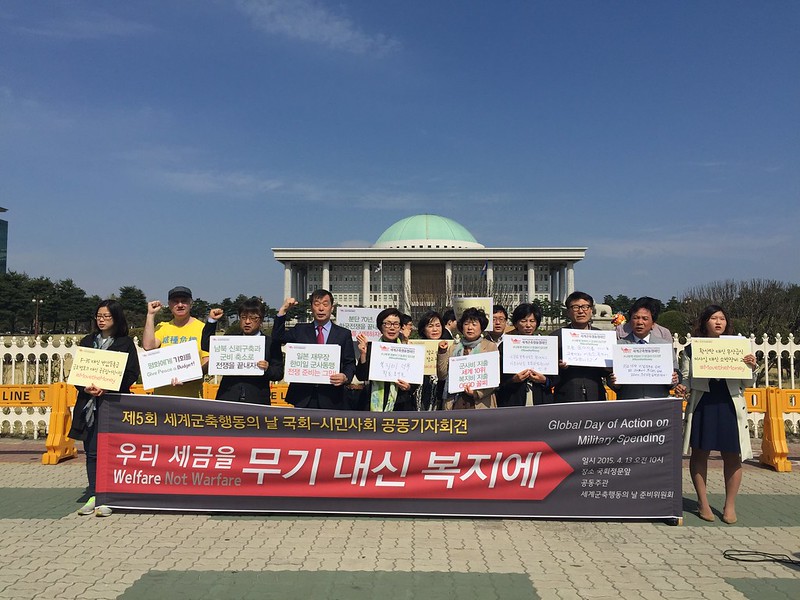
20150413_세계군축행동의날


Joint Statement of the National Assembly and the Civil Society for the 5th Global Day of Action on Military Spending

Our Taxes on Social Welfare instead of on Weaponry


Today on the Global Day of Action on Military Spending, we stand here to be with about 320 organizations from about 70 nations around the world. We should reflect on our reality that peace and safety of citizens worldwide are far from being established even when an astronomical amount of money is spent on military. We demand that our taxes be spent on restoring social justice and building a sustainable and peaceful world. This year, marking the one-year anniversary of the Sewol-ferry tragedy, voices desiring a safe nation have grown louder than ever, and the criticism of the ineffective investment in defense industry in the name of 'national security' is also growing stronger. It is time to change the priorities of the national policy and shift the focus from materialistic national security and military buildup to safety of people and peaceful cooperation.


According to 'Trends in World Military Expenditure, 2014' published by Stockholm International Peace Research Institute (SIPRI), the worldwide military spending last year amounted to 1.8 trillion dollars (about 1,968 trillion won), a little less than the last year's. Korea entered the top 10 for the first time last year and ranked 10th this year. 


Korea's military spending in 2015 amounts to 37.456 trillion won, increased by about 4.9% or 1.7504 trillion won from last year. This is excessive, taking up 14.5% of the government budget. 


While a large sum of military spending is being spent, our society is becoming more extremely socially polarized. Uneasiness from everyday life caused by issues in education, child care, health care, and housing encroaches on our lives, but welfare budget to expand social safety net is not nearly enough. The total amount of university student loan is now over 10 trillion won. The university tuition could be subsidized and cut by half if we decide not to use 7 trillion won of budget on purchasing 40 fighter aircrafts, F-35's, which are the most ineffective and unreasonable among the military weapons to be purchased from the U.S. by the Korean army. 1,400 public daycare centers, which President Park Geun-hye promised to provide during her presidential campaign but failed to fulfill, could be built with 880 billion won of budget set aside for 4 unmanned aerial reconnaissance drones called 'Global Hawk'. Also the budget deficit of 65.5 billion won in 34 local medical centers could be covered for the next 90 years if we do not spend 6 trillion won on operating and maintaining Global Hawk's. Students in South Gyeongsang Province, who had to put up with such remark "a school is not the place you come to eat", could have school lunches for free for the next 30 years if 3.3415 trillion won of budget is not spent on the cluster bomb units and the multiple launch rocket systems, both of which indiscriminate murder weapons banned by international law. All the firefighting equipment which is old to such an extent as to threaten the lives of firefighters could be replaced if we do not spend 1.5233 trillion won on purchasing interceptor missiles such as PAC-3. In retrospect, what we lack is not the budget. Where we allocate finances is important. We should face the threat to our lives, and reprioritize the budget.


How about the Sewol-ferry tragedy? We had to witness 304 people being buried at sea because the country, which spends about 35 trillion won every year to protect citizens from outside threat and ranks 10th in military spending, did not have basic rescue equipment. The Blue House National Security Office denied being the so-called "control tower" for the Sewol-ferry disaster. If so, for whom is the national security if the disaster which could have resulted in deaths of 470 citizens is not a matter of national security? Moreover, the Tongyeong naval rescue ship which proved to be utterly useless at the time of Sewol-ferry disaster showed rampant corruption in the nation's defense industry. If we were to talk about society after the Sewol-ferry tragedy, we should start by dealing with this glaring contradiction.


Someone might raise a question about decreasing the military expenditure when there is a serious threat from North Korea. South Korea spends an amount, almost equal to North Korea's GDP, on military. This amount does not even include the military spending by the United States Forces Korea. North Korea is obsessed with weapons of mass destruction such as nuclear weapons because it knows its military spending is no match for South Korea's. Thus it is not a matter of amount of military expenditure, but a matter of trust.


In the East Asian region, there is a fierce competition on military spending among countries such as the United States, China, Russia and Japan. Some claim that South Korea should increase the military spending in order not to fall behind these nations. However, South Korea, as a middle power country responsible for initiating a peaceful unification on the Korean peninsula, should avoid confrontation based on South Korea-the U.S.-Japan military alliance but should demonstrate leadership for peace, cooperation, coexistence and common security. The recent controversy over the U.S. deploying a Terminal High-Altitude Area Defense (THAAD) missile defenses in South Korea directly shows 'Asian paradox', the disconnect between deep economic interdependence and a serious conflict in military diplomacy. 


There are 20 nations worldwide whose military expenditures take up over 4% of their GDP's in 2014. This number is greater than that in the early 1990's right after the Cold War. If the world had spent even 5% of its military spending on combatting poverty, we could have realized the United Nations Millennium Development Goals (MDGs) that promised to halve global poverty rates by the year 2015. However as the world went through two great wars in Iraq and Afghanistan, the promise could not be kept. Korean government also promised to provide 0.25% of its GNI as Official Development Assistance (ODA) by the year 2015 to eradicate poverty but it allocated vastly insufficient amount and ended up breaking its promise to the international society. The new Sustainable Development Goals (SDGs) which is to be proposed in September, 2015 cannot be achieved without fundamental changes and reflection on military expenditure in each country.


The 5th Global Day of Action on Military Spending should not be the anniversary full of empty promises but should be a milestone to change. Thus, to the government and citizens of Korea which ranks 10th in military spending in the world and ranks last in welfare spending among 28 OECD countries, we suggest the following:


1. We demand that the military spending be reduced to alleviate social bipolarization, to expand social safety net, and to build safe society without disasters. Increasing military spending means taking away other opportunities under a limited government budget. Finances obtained by decreasing military expenditure should be used to remove any urgent threats that citizens face in their daily life.


1. This year, the 70th anniversary of the division of Korea, we demand that the efforts be put to end the Korean war and create a peace regime. The Korean government should reflect on the large amount of direct and indirect expenses spent to keep the unstable armistice regime during the past years. The nuclear threat in the Korean peninsula, which is the main reason behind the increase in the military spending, is also the result of this armistice regime and arms race. We should devise measures to recover mutual trust and start conversations instead of purchasing offensive weapons and increasing military expenditure every year. The first step towards achieving this is to lift the May 24th measures which stands between the inter-Korean relations. 


1. We express our deep concerns over the situation where the preparation for war comes before peace and where military alliance comes before cooperation in the Asia-Pacific region. We demand that Korea put efforts to change relations based on various disputes and military conflicts into cooperative ones. Appealing to the military means or strengthening military alliances to antagonize a specific country cannot resolve the conflicts. We should protect the Japanese pacific constitution, a bastion of peace in East Asia, and should not allow the right of collective self-defense. We should not allow the deployment of the U.S. missile defense system in South Korea and break away from the South Korea-U.S.-Japan military ties.


1. In order to establish peace we need participation of citizens and solidarity of people across borders. A mature sense of citizenship is more effective than any weapons to protect the community. Understanding each other and cooperation across borders are  faster ways to solve conflicts than using fighter aircrafts and missiles. We should not stand by and watch the government make decisions on whether a nation exaggerates an outside threat it claims to exist, and on whether our taxes should be used for purchasing military weapons or for building a sustainable society. Decisions on and execution processes of national security matters, including conclusion of various security treaties, development of military cooperation, execution of military exercises, and purchase of expensive and offensive weapons, must be transparent and controlled democratically, considering their enormous effects on society. Priorities in foreign policies and national security policies should be determined by citizens as it is done in other fields. 


Disarmament is not a story of a distant future but an imminent and real issue. We demand that the government, the national assembly and all the citizens show wisdom to establish peace together. 


April 13, 2015
Participants of the 5th Global Day of Action on Military Spending


For more information


The GDAMS website http://demilitarize.org

The GDAMS Korea website http://gdams.or.kr
The GDAMS Preparatory Committee of Seoul
People’s Solidarity for Participatory Democracy +82-2-723-4250, [email protected]

월, 2015/04/13- 20:50
78
0

Pyeongchang Olympics and the Great Shift in Korea


LEE Seung-hwan South-North Korea Exchanges and Cooperation Support Association


Korean Peninsula, Spring 2018


The series of events that began with the participation of North Korean athletes in the Pyeongchang Olympics and the accompanying visit by the North Korean delegation headed by Kim Yeo-jeong, followed by the visit to North Korea by the South Korean delegation, completely transformed how the Korean Peninsula entered spring this year, by putting an end, at least for the time being, to the nuclear and missile experiments and military drills that had raised the tension between the two Koreas every spring. With the volatility characterizing the state of affairs on the Korean Peninsula so quickly dissolved and the groundwork for the historical summits between the leaders of the two Koreas as well as between the North Korean leader and the U.S. president completed, the Pyeongchang Olympics will likely be remembered as a watershed moment in the Korean struggle for peace.


The background to the “nearly miraculous situation in East Asia,” as described by the Japanese government, can be found in the so-called March 5 Accord between Kim Jong-un and the South Korean delegation to Pyongyang. North Korea took the world by surprise by completely reversing its position and embracing the accord encompassing the organization of the third inter-Korean summit, the resumption of the North Korea-U.S. dialogue on the denuclearization of North Korea and the restoration of relations between the two countries, and the possible cessation, by North Korea, of its nuclear and missile experiments, contingent upon the successful continuation of dialogue with the United States. Through the accord, Pyongyang eagerly expressed its willingness to cease the nuclear and missile provocations that have fueled the escalating military tension on the Korean Peninsula and even to contribute to détente by tolerating without any changes to intensity ROK-U.S. joint military exercises slated for April.


Background of the March 5 Accord


Experts offer a number of different explanations as to the factors motivating the dramatic shift of attitude on the part of North Korea as displayed in the March 5 Accord.


The most widely accepted theory is that the international community’s prolonged sanctions against North Korea forced the country into accepting the terms of the accord. Notwithstanding the attendant controversies, these sanctions have been working. UN Security Council Resolution 2270 of March 2016 broadened the scope of the sanction to include comprehensive measures beyond responses to the country’s weapons of mass destruction (WMD) development, and significantly strengthened the intensity of sanctions exercised by China, a country that holds the key to the success of sanctions against North Korea. However, detractors of this theory argue that it is still too early to determine the true effects of these international sanctions, and that sanctions alone could not have changed Pyongyang’s policies so dramatically, given the nature of the Kim regime. These critics alternatively point to the innate change in Pyongyang’s strategy as the more direct source of the about-face displayed in the March 5 Accord. As the Kim Jong-un regime aspires to transform North Korea into a “strategic country” (with normal relations and a capability to shape the order it faces), it has had to address the reality that the extensive development of nuclear programs has failed to significantly improve the North Korean economy. In other words, it has had to embrace the opportunities for increased aid, the removal of sanctions, the signing of a peace agreement, and restoring relations with the United States even if embracing such opportunities would require the denuclearization of North Korea.


Even more important than the effects of sanctions and the change in the Kim regime’s strategy are the efforts being made by the Moon Jae-in government. By delaying the joint ROK-US military exercises last December, the Moon government succeeded in inducing Pyongyang’s decision to send North Korean athletes to the Pyeongchang Olympics and to accept the March 5 Accord. By responding, belatedly, to Pyongyang’s offer made in January 2014 that it would cease nuclear and missile experiments should Seoul cease the joint military exercises with the US military, the Moon government enabled Pyongyang to turn its stance around on the state of inter-Korean relations. Without the Moon government’s efforts at persuading Washington and postponing the joint military exercises, neither the sanctions nor the North Korean strategy would have led to this “nearly miraculous situations in East Asia.”


Why Sanctions Are Not the Cure-All Solutions to Problems Involving North Korea


Both Washington and the general American public view the recent development on the Korean Peninsula with a wary eye, regarding the shift in Pyongyang’s attitude as motivated by the strategic goal of increasing economic gains by putting the option of denuclearization on the negotiation table. President Trump denied that the decision to hold a summit with the North Korean leader was impromptu, but has expressed both doubts and hopes in his tweets: “May be false hope, but the U.S. is ready to go hard in either direction” and “Great progress being made, but sanctions will remain until an agreement is reached.”


Accordingly, the Trump administration’s new line of diplomacy with North Korea features hardliners like Mike Pompeo and John Bolton, a testament to Washington’s resolve to challenge North Korea even further with military options should its talks with Pyongyang fail.


The Liberal Korea Party and conservatives critical of the Moon government in South Korea, on the other hand, have blatantly characterized the change in Pyongyang’s attitude as “a mere security show put on by a hard-pressed North Korea,” expressing distrust and discontent even in the face of Washington’s new willingness to give talks a try. These detractors keep demanding sanctions as the only solutions to all problems involving North Korea, claiming that only stronger and continued sanctions would induce positive change in Kim Jong-un and lower the risk of an armed conflict.


Blind trust in sanctions, especially in the absence of a strategy for engagement and dialogue, can have fatal results, however. The current level of sanctions is already so high that it threatens the daily livelihood of North Koreans. Additional sanctions could backfire by tempting North Korea into accelerating its nuclear development program with a view to breaking through the uncomfortable status quo with violent actions. Unlike other countries, South Korea, too, stands to lose much from continued sanctions against North Korea. The May 24 Sanction Measures, the restriction on tourism to Mt. Kumgang, and the shutdown of the Kaesong Industrial Park all intended to hurt the North Korean economy, but also ended up damaging South Korean businesses just as much. Unconditional sanctions against North Korea, in other words, presents a self-destructive strategy from the South Korean perspective that increases the risks of war. Unconditional sanctions should not form South Korea’s strategy on long-term relations with the North.


Trilemma of Peace on the Korean Peninsula


The three main goals the South Korean government seeks to achieve with the Great Shift on the Korean Peninsula are denuclearization, the establishment of a peace regime, and the continuation of the Korea-US alliance. Two of these three goals may be achieved without much conflict, but all three cannot be achieved at the same time. Until now, all the parties involved have been pursuing different goals—South Korea, the establishment of a peace regime on the peninsula; the United States, the denuclearization of North Korea; and North Korea, its own rise as a “strategic country.” The three countries are now compelled to find effective measures to overcome this trilemma in order to achieve their objectives.


The Pyeongchang Olympics and the March 5 Accord created a new opening in this search for possible solutions to this trilemma. Pyongyang has so far sought to become a strategic country by amassing a nuclear arsenal. Through the March 5 Accord, however, it has offered to sit down for a summit with the US president and showed a willingness to make political and economic gains by giving up (allegedly) “completed” nuclear programs. Note Kim Jong-un’s remark to the South Korean delegation that North Korea “would like to be taken seriously as a partner of dialogue.”


Recall the five conditions of denuclearization Pyongyang demanded in an official statement released on July 6, 2016. The five conditions included in this July 6 Proposition were: (1) the disclosure of U.S. nuclear weapons brought into South Korea; (2) the abolition of all nuclear weapons and their bases in South Korea; (3) the prohibition on the introduction of nuclear strike assets into the Korean Peninsula; (4) the confirmation of the prohibition on the use of nuclear weapons against North Korea; and (5) the declaration, by Washington, of the withdrawal of US troops from South Korea with their ability to launch nuclear weapons. The proposition repeats much of the conditions listed in the Joint Statement on the Denuclearization of the Korean Peninsula of 1992, with the withdrawal of US troops additionally demanded. Washington has stated that it has either already satisfied or is willing to entertain the four earlier conditions. The only remaining problem between Washington and Pyongyang is therefore the latter’s latest demand that the former withdraw its troops from South Korea. 


Pyongyang, however, was careful to hedge its last demand, limiting the scope of troops to be withdrawn to those with the ability to launch nuclear weapons, and also demanding not the immediate withdrawal per se, but the declaration to that effect. Pyongyang, in fact, has expressed much willingness to tolerate the American military presence in South Korea at every major opportunity for negotiation. At the South-North Korean Summit of 2000, Kim Jong-il famously remarked that the US troops in South Korea should remain not as a force hostile to North Korea, but as the keepers of peace on the Korean Peninsula.


A Bold Proposition for the Inter-Korean and DPRK-US Summits


There are, in other words, a number of measures that all three parties may adopt toward solving the trilemma involving the denuclearization of North Korea, the continuation of the ROK-US alliance, and the establishment of a peace regime on the Korean Peninsula. These include guaranteeing the security of North Korea by implementing the Joint Statement on the Denuclearization of the Korean Peninsula, guaranteeing North Korea’s entry into the international community and its prospects for future prosperity by lifting sanctions, and guaranteeing the United States’ continued influence on East Asia by agreeing to keep US troops in South Korea without nuclear capabilities. The denuclearization of the Korean Peninsula without the withdrawal of US troops is perhaps the best possible scenario to which both Koreas and the United States could agree. The realization of that scenario would amount to the establishment of a joint security regime involving all three countries on a denuclearized Korean Peninsula. The rise of such a regime, in turn, would imply the accumulation of sincere and mutual trust among the three countries.


The establishment of a military alliance between North Korea and the United States, as demanded by some hardliners, would represent a more advanced form of such joint security regime. Hardliners like Hong Seok-hyeon thus demand that the Trump administration ought to work on enhancing the pro-US stance of Pyongyang by explicitly saying “No” to toppling the Kim regime, working towards the collapse of the Kim regime, accelerating the Korean unification, and moving US troops north of the 38th Parallel.


Once the three countries begin to develop mutual trust in one another by exercising new and bold ideas unbounded by the conventional mold of hostile relations, they will be able to maintain the impetus for denuclearization notwithstanding differences in detail. The peacebuilding process based upon such mutual trust would differ significantly from the step-by-step denuclearization and peacebuilding processes envisioned by the September 19 Joint Statement of 2005. In order to capitalize upon the current “miracle-like” opportunity created by the Pyeongchang Olympics and the Great Shift, bold actions akin to cutting the Gordian Knot are required.


Multilayered Approaches to North Korea and Expanding Civilian Exchange


The current state of affairs on the Korean Peninsula differs markedly from similar opportunities for peace that arose in the past, as the current situation requires bold actions and a firm commitment to peace. The solution required by the current situation would involve solving the major obstacles to peace on the Korean Peninsula early in the negotiation process. This, in turn, requires mutual trust and friendship among the two Koreas and the United States, which is crucial to maintain the drive for peace until the final end of the negotiation process, i.e., the permanent denuclearization of North Korea.


Another interesting characteristic of the current situation is that the peacebuilding process is guided in a top-down fashion with the strong commitment of the leaders involved. Given the complexity of the Korean Question and the history of distrust among the countries involved, a top-down approach involving a series of summits is crucial for solving the problems early on and establishing sufficient trust in a short span of time. At present, civilian exchange among the three countries involved would be restrained until local elections are held in South Korea in June, even all the while preparations are being made for the summits and high-level official talks.


Nevertheless, peacebuilding between South and North Koreas should be a multilayered process, and civilians have as important a role to play in the unification process as governments. Efforts should therefore be made in various areas in order to expand the opportunities for civilian exchange between the two Koreas shortly after the summits are held.


Both the South and North Korean governments, in particular, ought to address the issue of promoting exchange at multiple levels as part of the summit. Although the upcoming South-North Korean summit will mainly focus on denuclearization, peacebuilding, the evolution of inter-Korean relations, and economic cooperation with the United States, the leaders of both Koreas should not neglect the importance of restoring the ecosystem for rich civilian exchange at multiple levels. The two Korean leaders could provide a significant boost for continued and stronger civilian exchange if they embrace a written resolution to guarantee and support civilian exchange at various levels irrespective of political and military tension. By embracing such a resolution, the two Korean leaders could effectively declare their commitment to diversifying inter-Korean relations over and beyond government control.


This essay is the first essay written for the 2018 Peace Report Project of the Civil Peace Forum,

under the sponsorship of Friedrich-Ebert-Stiftung Korea Office.


[2018 Peace Report] See/Download

 
화, 2018/04/10- 09:47
78
0

긴급 평화버스 웹자보


긴급행동 소성리를 지키자

4/25(화) - 4/28(금) 서울에서 매일 평화버스가 출발합니다


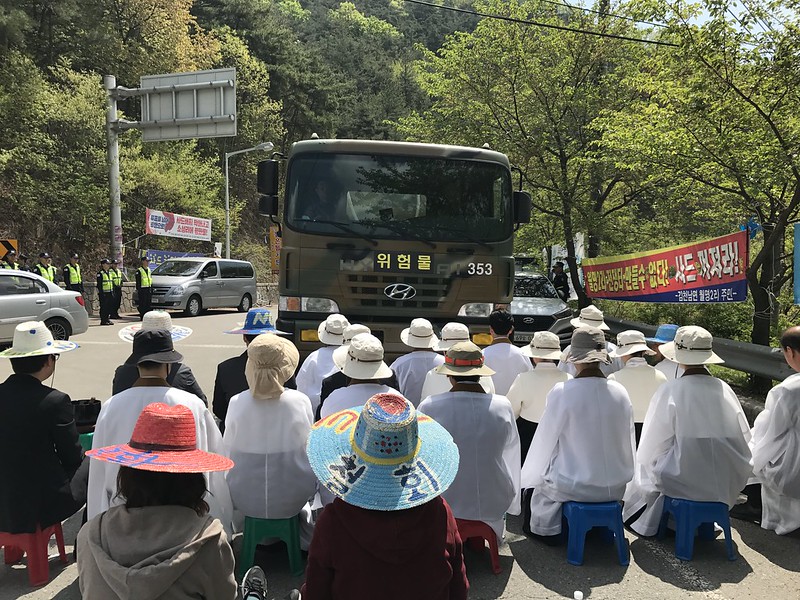
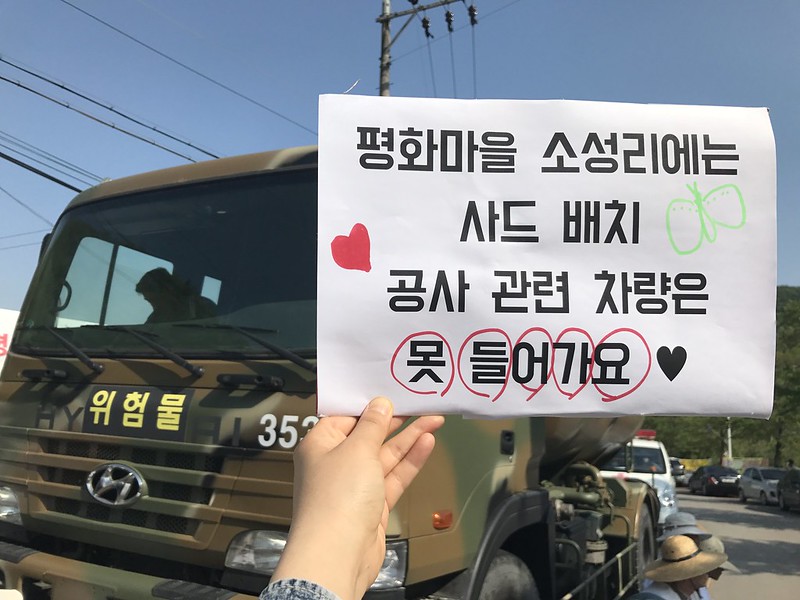
지금 사드 배치 예정지 성주 소성리에서는 주민과 종교인, 지킴이들이 관련 장비를 온몸으로 막으며 힘겨운 싸움을 이어가고 있습니다. 함께 있는 것만으로 큰 힘이 될 거예요. 평화버스를 타고 소성리로 와주세요! 


탑승 안내


  • 출발일 : 4/25(화) - 4/28(금)
  • 서울 출발 : 아침 7시, 대한문 앞(시청역 2번 출구)
  • 소성리 출발 : 저녁 6시, 보건소 삼거리
  • 참가비 : 자율 기부 (식비 미포함)
  • 신청 : 이름, 탑승일, 참가자 수를 문자로 보내주세요 (010-6351-2174)


원불교 성주성지수호비상대책위원회, 사드한국배치저지전국행동


20170422_소성리 사드배치 관련차량 저지


20170423_사드배치차량 재반입저지


사드 철회! 평화마을 소성리 후원 안내 ♥

사드 배치 강행에 맞서 소성리를 지키는 활동을 더 잘 하기 위해, 더 많은 평화지킴이들이 소성리에서 함께할 수 있도록 하기 위해 투쟁기금을 모금하고 있어요. 많은 관심과 후원 부탁드립니다.


  • 후원계좌 : 농협 351-0941-2439-43 (사드배치반대김천시민대책위) / 농협 351-0943-1151-63 (사드배치철회성주투쟁위)
  • 후원물품 보내실 곳 : 경북 성주군 초전면 소성길 173 소성리 마을회관 (쌀, 김치, 컵라면, 각종 부식, 휴지 등 생필품 환영)
  • 후원 문의 : 054-933-5520 (소성리 종합 상황실)
  • 소성리 상황실 텔레그램 공지 채널 >> 클릭
월, 2017/04/24- 12:52
77
0