주요 콘텐츠로 건너뛰기

[Joint Statement] Now Is the Time for Dialogue on Denuclearization and Not Military Action That Will Escalate the Crisis on the Korean Peninsula

지역

[Joint Statement] Now Is the Time for Dialogue on Denuclearization and Not Military Action That Will Escalate the Crisis on the Korean Peninsula

익명 (미확인) | 화, 2017/05/16- 11:17

Joint Statement of 102 Peace Activists

Now Is the Time for Dialogue on Denuclearization and Not Military Action That Will Escalate the Crisis on the Korean Peninsula


We, undersigned peace-loving people around the world, are deeply concerned about the current escalating tension in Northeast Asia and urge governments to have peaceful dialogues among each other rather than taking military actions.


The state of affairs on the Korean Peninsula is more volatile than ever, now that President Park has been impeached and new government is to be constituted through an early presidential election in South Korea. The Trump administration, in the meantime, is fueling the escalating tension even further with messages that it will not rule out a preemptive strike on North Korea, and that it will redeploy strategic nuclear warheads to South Korea if necessary. The situation is further destabilized by the Trump administration’s decision to send an aircraft carrier to waters near the Korean Peninsula. The latest military stance and strategy of Washington, however, completely overlooks the desire of Koreans for peace. The Kim Jong-un government in Pyongyang meanwhile has warned of another upcoming nuclear test it intends to conduct, poised as it is to show off its growing nuclear capabilities. An existing crisis is already escalating in Northeast Asia over the Terminal High Altitude Area Defense (THAAD) system that the South Korean and U.S. governments have decided to deploy in South Korea. All these acts of military bravado, taking hostage the lives and peace of Koreans, must cease now. It is time for policymakers to be responsible and return to dialogue and negotiations and stop fueling the growing tensions.


Therefore, we exhort the US administration and political leaders of North and South Korea. 


Withdraw the decision to deploy the THAAD system, part of the U.S.-South Korea-Japan Missile Defense system, in South Korea.
The South Korean and U.S. governments have decided heavy-handedly, without the consent of the Korean legislatures and despite strong public objections, to deploy the THAAD system to Seongju, South Korea. The two governments claim that such a decision is necessary to protect South Koreans against possible nuclear strikes by North Korea, but the claim is backed by little realistic evidence. South Korea is too close to North Korea for THAAD to be effective. The North only needs low-altitude missiles, to hit and destroy the South in a matter of a few minutes, and these missiles could not be intercepted by THAAD. Moreover, the THAAD system has never been proven effective in actual battle. The deployment of THAAD by the U.S. Army in South Korea represents the South Korea-U.S.-Japan alliance against China and effectively symbolizes South Korea siding with the Americans over the Chinese. The presence of such an openly hostile missile defense system gravely disrupts the prospects for peace in Northeast Asia. Beijing and Moscow have already warned that they would take “corresponding measures” in response to the deployment, with the Chinese government and businesses now engaged in unofficial but retaliatory economic sanctions against South Korea. The growing instability and arms race in Northeast Asia will only undermine international efforts for a peaceful resolution of the nuclear crisis on the Korean peninsula.


What we need now is to resume dialogue towards denuclearization of the Korean Peninsula and a genuine end to the Korean War.

Pyongyang must desist from further testing of its missiles and nuclear capabilities. We cannot support the development of weapons that directly contradict international efforts for nuclear disarmament and that hold the lives and safety of innocent people hostage. It is critical to resume dialogue and negotiations to root out the nuclear threats to the entire region and to achieve the much-needed transition from the Armistice’s ceasefire to a peace regime on the Korean Peninsula. In doing so, we ought to admit the failure of the past sanction- and neglect-centered policies that insisted, unrealistically, that the government in Pyongyang either renounce its nuclear program prior to negotiations or collapse. With the end of nuclear diplomacy, the Kim government did nothing but augment its nuclear and missile capabilities, complicating the situation still further. We realize that countless military drills and the acquisition of cutting-edge weapon systems no longer guarantee peace and security. The perpetual political tension and military hostility can end only through dialogue and negotiation. Honest talks hold the only wise solution to the current predicament.


The Korean Peninsula can no longer afford to exist as a powder keg waiting to be ignited by the chronic military tensions and the constant arms race. This is among the first and foremost place where international efforts to tackle the nuclear problem and overcome the old Cold War legacy should begin. We need to start making serious efforts for peace, not only for the two Koreas, but also for Northeast Asia and the world at large. We urge the Trump administration, the Kim government, and the newly elected President of South Korea to listen to the desire of people worldwide for peace and resist the temptation to ratchet up military tensions on the Korean Peninsula for political gain.


May 16th, 2017


Akiko Yoshizawa(The Association for military base free peaceful Okinawa in Japan, Co-chair), Akira Asada(Sinsyu University, Professor Emeritus), Alfred L. Marder(US Peace Council, President), Alice Slater(Nuclear Age Peace Foundation, New York Representative), Ann Wright(Veterans for Peace, Colonel), Arnie Saiki(Moana Nui Alliance, Coordinator), Ayumi Temlock(Member of New Jersey Peace Action), Bruce K. Gagnon(Global Network Against Weapons & Nuclear Power in Space, Coordinator), Bruce Kent(Pax Christi UK, Vice President), Changsoon Chang(Musician), Chiaki Lee(The citizens of Matsue in Japan), Christine Ahn(Women Cross DMZ, International Coordinator), Colin Archer(International Peace Bureau, Retired Secretary-General), Corazon Valdez Fabros(International Peace Bureau, Co-Vice President), Daisuke Yamaguchi(Peace Depot Japan, Researcher), David McReynolds(War Resisters International, Former Chair), David Otieno(The Global Campaign on Military Spending Africa, Convener), David Swanson(World Beyond War, Director), David Webb(Campaign for Nuclear Disarmament, Chair), Dieter Deiseroth(IALANA Germany, Member of the Academic Council), Ellen-Rae Cachola(Women's Voices Women Speak, Organizer), Harumi Ishino(Osaka International University, Professor Emeritus), Hiroki Tanaka(Blue Legion), Hiroko Suzuki(Montreal Save Article 9), Hiromichi Umebayashi(Peace Depot Inc, Special Advisor), Hitomi Taniguch(Anti-War Committee of Yawata), Ichiro Yuasa(Peace-Depot, Vice-President), IWAKAWA Yasuhisa(Interpreter/translator), Iwase Hiroko, J. Enkhsaikhan(Blue Banner, Chairman), Jacqueline Cabasso(Western States Legal Foundation, Executive Director), Janis Alton(Canadian Voice of Women for Peace, Co-Chair), Jim Albertini(Malu ‘Aina Center for Non-violent Education & Action), Julia Matsui Estrella(Pacific Asian Center for Theologies and Strategies(PACTS)), Juliane Drechsel-Grau(IALANA Germany, Board Member), Jun Tisaka(Japan Peace Committee, Secretary General), Kataoka Akira(Peace Committee of Kyoto, Chair of the board), Kawasaki Akira(Peace Boat, Executive Committee Member), Kazuhiro Furuoya, Kazuyuki Yamada(The Wind from Yonaguni Island), Kenji Ago(Seinan Gakuin University / Japanese and Korean Citizens’ Peace Solidarity against Nukes, Professor Emeritus), Kevin Zeese(Popular Resistance, Co-Director), Kip Goodwin(Kauai Alliance for Peace and Social Justice, Communications Director), Kitamura Megumi(Hiroshima religious peace council affiliation), Kiyoko Takahashi(Article9 Association group in Hadano/Peace Depot), Koji Sugihara(Network Against Japan Arms Trade, representative), Koohan Paik(International Forum on Globalization, Asia-Pacific Program Director), Kouitirou Toyosima, Kristine Karch(International Network No to War - No to NATO, Co-Chair), Kuni Nagatomo(Japanese Constitution Article9), Kyle Kajihiro(Hawai'i Peace and Justice, Board member), Leah Bolger(World Beyond War, Chair Coordinating Committee), Lucas Wirl(International Association of Lawyers against Nuclear Arms(IALANA) Germany, Executive Director), Lynette Cruz(Hui Aloha Aina o Ka Lei Maile Alii, President), Maki Sasaki, Makoto Yanagida(No-Nukes Plaza Tanpopo-sya, Co-Representative), Margaret Flowers(Popular Resistance, Co-Director), Masako Watanabe, Masami Ono(Retired Teachers), Meri Joyce(Global Partnership for the Prevention of Armed Conflict, (GPPAC), Northeast Asia Regional Liaison Officer), Michael Pulham(Christian Campaign for Nuclear Disarmament), Michie Ichihara(Gallery of Life, President), Mitsumasa Ohta(Wind of Citizens toward Uniting for Peace), Monique Salhab(Veterans For Peace, Secretary, National Board of Directors), Muto, Ichiyo(People’s Plan Study Group), Nagase Riei(Board Member, Board Member), Nami Morita(KAFTI, Director), Naomi Klein(Author), Noam Chomsky(MIT, Retired Instituted Professor), Nomura Osami, Noriko Kuju(Peace-Life-Ignatio-A9), Otto Jaeckel(IALANA Germany, Chair), Patricia Pulham(Christian Campaign for Nuclear Disarmament), Pete Shimazaki Doktor(Hawai`i Okinawa Alliance, Co-Founder), Peter Becker(International Association of Lawyers Against Nuclear Arms (IALANA), Co-President), Phyllis Creighton(Hiroshima/Nagasaki Day Coalition, Board member), Reiner Braun(International Peace Bureau, Co-President), Ronald Fujiyoshi(Ohana Ho`opakele, Treasurer), Sachiko Mikami, Sato Daisuke(No Nukes Asia Forum Japan, General Secretary), Shigehiro Terajima (Labornet-TV), Shigeru Nakamura(Article9 Association group in Hadano), Shimazu Rumi(The One Thousand Against War Committee), Shin Chiba(International Christian University, Professor), Shizue Tomoda, Suda Minoru(Ritsumeikan University, Professor Emeritus), Sukla Sen(EKTA (Committee for Communal Amity), Activist), Sumi Hasegawa(McGill University, Retired Faculty), Taikei Kokubu(Shinshuu Ōtani-ha Ansenji Priesthood, Shinshuu Ōtani-ha), Takeda Takao(NIPPONZANMYOHOJI), Tarak Kauff(Veterans for Peace, Board of Directors), Taro Abe(Nagoya Gakuin University, Professor), Tutihashi Ryoko, Wataru Mikami, Will Griffin(The Peace Report), Wolfgang Alban(IALANA Germany, Board Member), Yasunari Fujimoto(Forum for Peace, Human Rights and Environment (Peace Forum), Co-President), Yasuo Takagi, Yayoi Tsuchida(Japan Council against A and H Bombs (Gensuikyo), Assistant General Secretary), Yoshinobu Toyoda, Yoshioka Tatsuya(Global Partnership for the Prevention of Armed Conflict, Northeast Asia Regional Representative), Yoshiyuki Ishino(Anti-War Committee of Yawata Kyoto)

시민들의 의견

댓글 달기

Plain text

  • 웹 페이지 주소 및 이메일 주소는 자동으로 링크로 전환됩니다.
  • 줄과 단락은 자동으로 분리됩니다.
  • 사용할 수 있는 HTML 태그: <a href hreflang> <em> <strong> <cite> <blockquote cite> <code> <ul type> <ol start type> <li> <dl> <dt> <dd>
이미지
무제한 수의 파일을 이 필드에 업로드할 수 있습니다.
50 MB 한계입니다.
허용된 유형: png gif jpg jpeg.
Enter the YouTube URL. Valid URL formats include: http://www.youtube.com/watch?v=1SqBdS0XkV4 and http://youtu.be/1SqBdS0XkV4.
CAPTCHA
스펨 사용자 차단 질문

Journey for Peace in 2022

Shining moments of the Korea Peace Appeal Campaign in 2022

“There is no way to peace. Peace is the way.”

Now, the moments that we’ve worked to make peace here.
We gathered the main activities of the Korea Peace Appeal Campaign in 2022.
Thank you for being with us this year.

2023 marks the 70th anniversary of the Korean War Armistice.
It’s time to cheer up to ease military tension and open the road to peace.

The world doesn’t get better on its own.
If we don’t say peace,
Peace is not coming.

Let’s make hope of peace together!


Korea Peace Appeal 2

? Signature Campaign to End the Korean War
Sign the Korean Peace Appeal Now ?
endthekoreanwar.net

The post Journey for Peace in 2022 : Korea Peace Appeal Campaign appeared first on 참여연대.

금, 2023/01/06- 18:48
1
0

20230110_정전70년 평화행동 제안 기자회견

On 10 Jan, the Korea Peace Appeal Campaign and the South Korean Committee on June 15th Joint Declaration had a press conference <Let’s work together to resolve war crsis and realize peace on the Korean Peninsula>.

Thourogh the press conference, they expressed concerns about the current crisis and strongly urged “to stop all military threats aggravating tensions on the Korean Peninsula, stop provocative actions and start crisis management together.”


Let’s Work Together to Resolve the War Crisis and Realize Peace on the Korean Peninsula

January 10th, 2023

The new year has begun full of anxiety over war. The military crisis on the Korean Peninsula gets worse without an exit. The peninsula has reached a dangerous situation where tensions have simmered as all communication channels between South and North have been cut off. And a realistic solution to prevent armed conflict and rebuild the condition for dialogue is nowhere in sight. President Yoon Suk-yeol is creating more anxiety by continuing remarks such as ‘prepared for entering the war,’ ‘superior war preparation,’ ‘review of the suspension of the September 19 military agreement’ and so on. The Ministry of Unification is also raising tensions by mentioning measures like installing loudspeakers or allowing leaflets to be sent which might lead to clashes in the border area.

We gathered here today with a desperate heart of ‘No more war on the Korean Peninsula under any circumstance.’ It is difficult to predict what catastrophe will happen if any unexpected armed conflict should occur in a strained atmosphere. Amid a vicious circle in the form of a chicken game on the Korean Peninsula and deepening confrontation between the ROK-the US-Japan and the DPRK-China-Russia, Northeast Asia is increasingly becoming a powder keg of the world.

All military threats aggravating tensions on the Korean Peninsula must be stopped. We strongly urge that the parties concerned stop provocative actions and start crisis management together. Hostile policies and force projection operations can never be a solution but only worsen the vicious circle. The current crisis is the result of the collapse of mutual trust as negotiations have failed after the agreements were not kept and hostile policies continued. The hard-won inter-Korean and DPRK-US agreements in 2018 must be implemented. What we need are realistic measures and preemptive actions to ease military tensions and shift to a dialogue phase. In particular, the suspension of large-scale ROK-US joint military exercises will play a key role in improving relationships and setting conditions for dialogues.

We can’t just stand idly by and let this crisis happen with anxiety. The more difficult it is to speak about peace, the louder our voice for peace should be. Moreover, this year 2023 is the 70th anniversary of the signing of the Korean War Armistice Agreement. However, even the 70-year-old unstable armistice cannot be guaranteed to remain the same in the future. It is a moment when the voices calling for no war and the realization of peace, as well as the efforts of civil society from all spheres, are more desperate than ever.

At this potential flashpoint a way out seems hard found, the South Korean Committee on June 15th Joint Declaration and the Korea Peace Appeal Campaign propose ‘2023 Korea Peace Action for the 70th Anniversary of the Armistice (tentative)’ and earnestly urge everyone who wants peace to join us.

To resolve the war crisis and realize peace on the Korean Peninsula this year, we are carrying forward

☮ an intensive signature campaign to oppose the war and realize peace on the Korean Peninsula
☮ demand to stop the ROK-US joint military exercises and ROK-US-Japan military cooperation
☮ simultaneous peace actions in 300 places around the world including 200 Korean cities and towns
☮ a massive peace rally and a march on 22 July, Saturday
☮ a large-scale peace action around 15 August

Through this, we would like to resolve the war crisis and create a new turning point for peace as we meet people from all over the nation to firmly organize the voice of peace and stand in solidarity with people across the globe who want peace on the Korean Peninsula and East Asia.

Starting with today’s press conference proposal, we will meet civil society organizations across the nation to bring together wisdom and hearts, and launch ‘2023 Korea Peace Action for the 70th Anniversary of the Armistice (tentative)’ on 14 February, Tuesday to get into our stride with actions. We request all sorts of religious and civil society organizations to participate in ‘2023 Korea Peace Action for the 70th Anniversary of the Armistice’ to discuss and seek actions that we can take together here and now, and to show the strong power of the peace-wanting people. Let’s overcome this unprecedented war crisis with remarkably wide and robust solidarity and joint action so that we can open the way for peace again.

? Korean Version


Korea Peace Appeal 2

? Signature Campaign to End the Korean War
Sign the Korea Peace Appeal Now ?
endthekoreanwar.net

The post Let’s resolve the war crisis in Korea appeared first on 참여연대.

월, 2023/01/16- 13:00
1
0

On December 8 2022, in partnership with the Permanent Mission of Mongolia to the United Nations, the Global Partnership for the Prevention of Armed Conflict (GPPAC) organised a roundtable discussion titled Building and Sustaining Peace at the Regional Level: The Network Approach to Regional Coordination in Northeast Asia during an advocacy visit of Ulaanbaatar Process participants to New York City.

This discussion was an informal dialogue to share the learning from the Ulaanbaatar Process with global peacebuilding policy experts within the United Nations, Member States and regional organisations. The conversation outlined critical avenues to support regional peacebuilding coordination in policy and shared practical experiences for practical action. The discussion also outlined persistent challenges of regional peacebuilding coordination, and discussed recommendations to develop solutions to strengthen peacebuilding work in Northeast Asia.

During the roundtable, remarks were shared by Ulziibayar Vangansuren, Permanent Mission of Mongolia to the United Nations; Ambassador Enkhsaikhan Jargalsaikhan, Chair of NGO Blue Banner and former Mongolian Permanent Representative to the UN; Sonja Bachmann, Teamleader Northeast Asia and Pacific, UN Department of Peacebuilding Political Affairs (DPPA); Kajita Natsuha, learning designer and facilitator; Kim Jeongsoo, Standing Representative, Women Making Peace and Hwang Sooyoung, Manager, Centers for Peace and Disarmament and for International Solidarity, People’s Solidarity for Participatory Democracy (PSPD).

Based on the experiences from Northeast Asia, the following key elements build an effective regional peacebuilding architecture:

  • Multi-stakeholder coordination is required and must be based on complementarity among partners.
  • The network approach to peacebuilding must be at the core of regional coordination.
  • Inclusivity is key for effective regional peacebuilding networks.

The following recommendations have thus been identified for the strengthening of the regional peacebuilding mechanisms:  

  • The UN should take a more active convening role to bring together regional actors, the UN, national governments, and civil society, among others, to coordinate actions better and ensure a stronger impact of peacebuilding activities.  Where regional peacebuilding networks play an essential role in building the foundation for regional dialogue, the UN should provide technical and political accompaniment to ensure the commitment to action. 

  • Improved funding mechanisms are needed to support the civil society organizations’ network approach. A network approach creates empowering and equitable spaces for exchanging expertise for more impactful and informed action, sharing resources and access points at various levels, and enabling and supporting communities committed to peace. Donors should reflect on how to improve funding mechanisms to support better civil society organizations engaged in regional peacebuilding networks, allowing them, through effective funding, to fill the gaps in the regional peacebuilding infrastructure. It is crucial to ensure that all regions are fairly represented in the international discussion on peacebuilding and are given international attention, as this also impacts funding availability. 

  • The inclusion of women and youth is key in regional peacebuilding networks and should be supported. Although women are strongly affected by conflicts, they are often excluded from negotiations and peace processes, especially in highly patriarchal contexts. The inclusion of local women within peacebuilding initiatives is essential to ensure that their unique perspectives can have a real impact at the decision-making level. Likewise, the meaningful participation of young people in dialogue on equal terms is essential to achieve and sustain peace. Young people in all their diversities should be considered as drivers for change, and their contributions should be held as relevant and valuable. Donors should prioritise supporting regional peacebuilding dialogues that ensure the meaningful participation of women and youth at all stages of the process.  The UN and its Member States should use their influence and international platforms to  ensure that the unique perspectives of local women and youth peacebuilders are heard and taken into account in the decision-making processes.

This is an article for Global Partnership for the prevention of Armed Conflict (GPPAC) Northeast Asia News, Jan 2023

Summary Document [See/Download]

The post Building and Sustaining Peace at the Regional Level appeared first on 참여연대.

월, 2023/01/30- 15:02
1
0
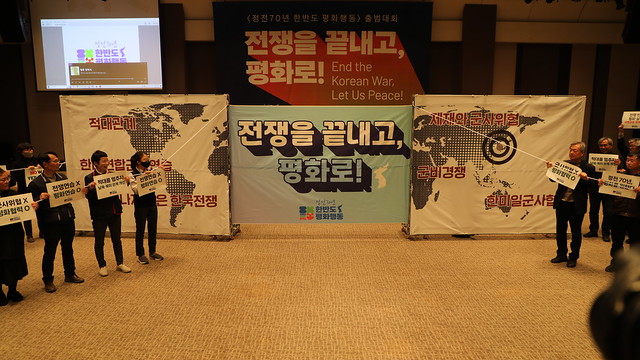
20230214_정전 70년 한반도 평화행동 출범대회
2023.02.14 Korea Peace Appeal Campaign

⭐ End The Korean War, Let Us Peace!

Tuesday, 14  February, 2023, Korea Press Foundation

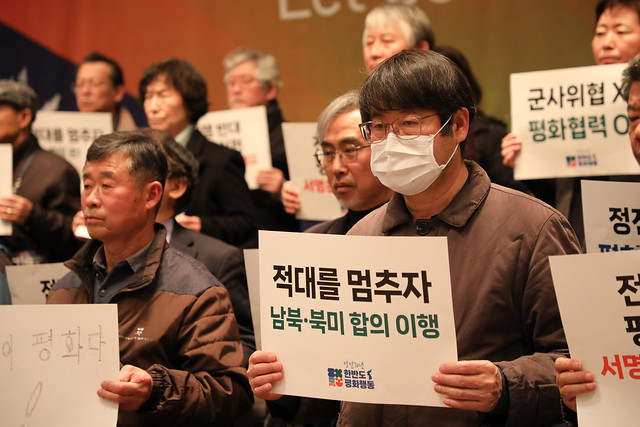
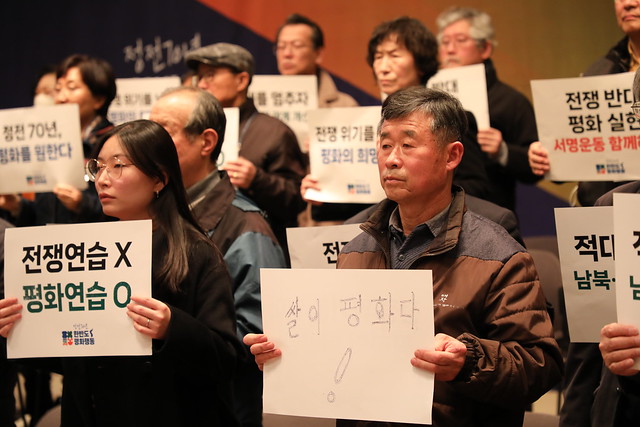
As 2023 marks the 70th anniversary of the Korean War Armistice, the <South Korean Committee on June 15th Joint Declaration> and the <Korea Peace Appeal Campaign> launched a new project <Korea Peace Action for the 70th Anniversary of the Armistice>. A press conference was held where many religious and civil society representatives, who have been endeavoring for peace in the Korean Peninsula, participated and gathered eager to rebuild hope of peace over the threat of war. 735 organizations nationwide are a part of the <Korea Peace Appeal Campaign>.

Our main goal is to resolve the threat of war and build peace. As a joint civil society, we plan to continue the signature campaign but more intensively, and organize other various peace actions. The <Korea Peace Appeal Campaign> will warn the danger of the present crisis, create domestic and foreign public opinions for the peace of the Korean Peninsula and Northeast Asia, and gather voices of opposition toward the recent rapid promotions of the military cooperation between South Korea, the US, and Japan. This year we will be manifesting the following actions:

☮ Korea Peace Appeal Signature Campaign
☮ Actions urging suspension of the ROK-US Combined Military Exercises and ROK-US-Japan Military Cooperation
☮ Korea peace actions in 300 cities worldwide comprising 100 overseas (June-July)
☮ Saturday, 22 July 2023, Massive Peace Rally and Parade
☮ Thursday, 27 July 2023, International Conference
☮ 15 August 2023 (TBD), Massive Peace Rally

20230214_정전 70년 한반도 평화행동 출범대회

Korea Peace Action for the 70th Anniversary of the Armistice Declaration

Let’s resolve the threat of war and build peace in the Korean Peninsula

70 long years have passed since the roar of gunfire coming from the three-year war in Korea stopped. The past 70 years were certainly not a peaceful period but a temporary ceasefire. Due to the fear and anxiety that the war could outbreak any time soon, the neverending hostility and military tension, and the internal and external challenges leveraging and goading these unstable conditions, everyone living on the Korean Peninsula had to cope with the immense pain and expense.

When the South and North Korean Leaders, and the North Korean and US leaders discussed a transfer to a new relationship at the Panmunjom Declaration of 27 April, the Pyongyang Joint Declaration of 19 September, the Singapore Joint Statement of 12 June, the Korean people saw a single thread of hope that the tension and danger of war, which had been crushing us, would disappear and a peacefully coexisting future unlock. Despite the North-South and North-US Agreement, dialogues were adjourned on account of the different views on corresponding measures, and as the power-to-power confrontations intensify, the present Korean Peninsula is falling into great despair. We are not even sure if the unstable ceasefire will be maintained. A sense of crisis that there is no guarantee an accidental collision could turn into a terrible disaster from a nuclear war is oppressing every life and existence on this land.

No methods of dialogue are left between the North-South and North-US. Moreover, the global environment is restraining us. Amidst the Russia-Ukraine war and the US-China conflict, the possibility of Korea being used as a proxy battlefield for international-level military tensions and new Cold War confrontations is greater than ever. However, there is no sound of a practical and active solution to ease tension, prevent armed conflict, or create dialogue conditions.

The government of Yoon Suk Yeol clarified ‘Peace through Strength’ and massively expanded the scale of military exercise, propagandizing that military force can beget surrender. However, this has only aggravated the danger of military clashes in Korea. By stating the practicality of extended deterrence against nuclear and missile threats of North Korea, the Yoon Suk Yeol government has been justifying that we jump on the United States’ strategy against China and South Korea to be subordinated to the ROK-US-Japan military cooperation system. However, the danger of a nuclear arms race and nuclear war around the Korean Peninsula is proliferating. The result of pressure through power is merely the repetition of North Korea’s advancement in nuclear power and mutual armed protests. The only thing the Yoon Suk Yeol government proved so far is that they have no practical method nor capability to manage the crisis and bring peace.

We still have time to prevent conflict and disintegration. We also have a chance for dialogue and negotiation. The reason things got worse is that even after agreeing to a new relationship, the government hesitated to take corresponding measures to build trust, such as suspending the ROK-US joint military exercises, not the insufficiency of armed protest. We must stop the outbursts of armed protests. We must open the door to peace through bolder and more flexible confidence-building measures and pre-emptive easing of tensions. We must act to build peace. The more difficult it is to talk about peace, the more we must gather willingness toward peace from all social standings and reverberate the voice of people who demand peace.

As we launch the <Korea Peace Action for the 70th Anniversary of the Armistice>, we call for the following. We call for stopping hostilities. We call for immediate and faithful action to improve relations as agreed by two Koreas and North Korea and the US. We call for an end to a 70-year-old unstable ceasefire and an agreement on the peace treaty. We call for a Korean Peninsula and a world without nuclear weapons and nuclear threats. We call for restoring trust and resolving conflicts through dialogue and cooperation, not sanctions and military threats. Particularly, we call for a halt in the large-scale ROK-US combined military exercise and opening the way for dialogue toward peace. We call for stopping military cooperation between South Korea, the US, and Japan, which will lead to a new Cold War confrontation, and instead creating an order of cooperation in which the Korean Peninsula and Asia coexist peacefully. Please, we do not call for a destructive arms race, but we call for the safety of people and cooperation to overcome the climate crisis.

We will act. We will take action in the 1 million signature campaign for the Korea Peace Appeal. We will continue the peace declaration and solidarity of people from all social standings in many parts of the world, including 200 cities in Korea and 100 cities in overseas, in the online and offline space. We will work hard to stop ROK-US joint military exercises and military cooperation between South Korea, the US, and Japan, which are escalating tensions and confrontations on the Korean Peninsula and Asia. Marking the 70th anniversary of the Korean War Armistice in July this year, we will focus our actions so that the nation calling for peace on the Korean Peninsula and the voices of peace forces from all around the world can resonate all over the Korean Peninsula and the whole world.

If we seek peace, we can open the way to peace.

We decide our future.

Join us in the <Korea Peace Appeal Campaign>.


14 February 2023

From all Korea Peace Appeal Campaign organizations (total of 735)


Korea Peace Appeal 2

? Signature Campaign to End the Korean War
Sign the Korea Peace Appeal Now ?
endthekoreanwar.net

The post ⭐️ Fresh Start of the Korea Peace Appeal Campaign appeared first on 참여연대.

금, 2023/03/03- 16:30
0
0