주요 콘텐츠로 건너뛰기

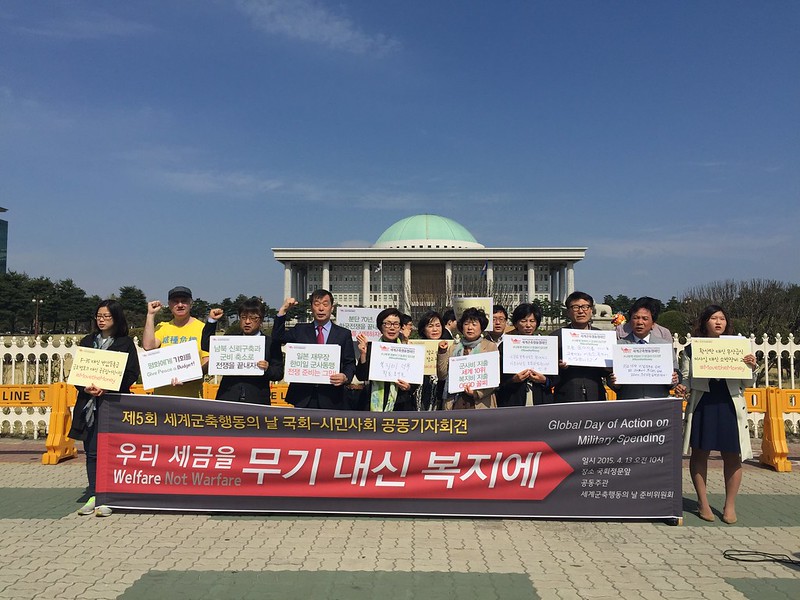
[GDAMS] [Statement] Our Taxes on Social Welfare instead of on Weaponry
지역

[GDAMS] [Statement] Our Taxes on Social Welfare instead of on Weaponry

익명 (미확인) | 월, 2015/04/13- 20:50

20150413_세계군축행동의날


Joint Statement of the National Assembly and the Civil Society for the 5th Global Day of Action on Military Spending

Our Taxes on Social Welfare instead of on Weaponry


Today on the Global Day of Action on Military Spending, we stand here to be with about 320 organizations from about 70 nations around the world. We should reflect on our reality that peace and safety of citizens worldwide are far from being established even when an astronomical amount of money is spent on military. We demand that our taxes be spent on restoring social justice and building a sustainable and peaceful world. This year, marking the one-year anniversary of the Sewol-ferry tragedy, voices desiring a safe nation have grown louder than ever, and the criticism of the ineffective investment in defense industry in the name of 'national security' is also growing stronger. It is time to change the priorities of the national policy and shift the focus from materialistic national security and military buildup to safety of people and peaceful cooperation.


According to 'Trends in World Military Expenditure, 2014' published by Stockholm International Peace Research Institute (SIPRI), the worldwide military spending last year amounted to 1.8 trillion dollars (about 1,968 trillion won), a little less than the last year's. Korea entered the top 10 for the first time last year and ranked 10th this year. 


Korea's military spending in 2015 amounts to 37.456 trillion won, increased by about 4.9% or 1.7504 trillion won from last year. This is excessive, taking up 14.5% of the government budget. 


While a large sum of military spending is being spent, our society is becoming more extremely socially polarized. Uneasiness from everyday life caused by issues in education, child care, health care, and housing encroaches on our lives, but welfare budget to expand social safety net is not nearly enough. The total amount of university student loan is now over 10 trillion won. The university tuition could be subsidized and cut by half if we decide not to use 7 trillion won of budget on purchasing 40 fighter aircrafts, F-35's, which are the most ineffective and unreasonable among the military weapons to be purchased from the U.S. by the Korean army. 1,400 public daycare centers, which President Park Geun-hye promised to provide during her presidential campaign but failed to fulfill, could be built with 880 billion won of budget set aside for 4 unmanned aerial reconnaissance drones called 'Global Hawk'. Also the budget deficit of 65.5 billion won in 34 local medical centers could be covered for the next 90 years if we do not spend 6 trillion won on operating and maintaining Global Hawk's. Students in South Gyeongsang Province, who had to put up with such remark "a school is not the place you come to eat", could have school lunches for free for the next 30 years if 3.3415 trillion won of budget is not spent on the cluster bomb units and the multiple launch rocket systems, both of which indiscriminate murder weapons banned by international law. All the firefighting equipment which is old to such an extent as to threaten the lives of firefighters could be replaced if we do not spend 1.5233 trillion won on purchasing interceptor missiles such as PAC-3. In retrospect, what we lack is not the budget. Where we allocate finances is important. We should face the threat to our lives, and reprioritize the budget.


How about the Sewol-ferry tragedy? We had to witness 304 people being buried at sea because the country, which spends about 35 trillion won every year to protect citizens from outside threat and ranks 10th in military spending, did not have basic rescue equipment. The Blue House National Security Office denied being the so-called "control tower" for the Sewol-ferry disaster. If so, for whom is the national security if the disaster which could have resulted in deaths of 470 citizens is not a matter of national security? Moreover, the Tongyeong naval rescue ship which proved to be utterly useless at the time of Sewol-ferry disaster showed rampant corruption in the nation's defense industry. If we were to talk about society after the Sewol-ferry tragedy, we should start by dealing with this glaring contradiction.


Someone might raise a question about decreasing the military expenditure when there is a serious threat from North Korea. South Korea spends an amount, almost equal to North Korea's GDP, on military. This amount does not even include the military spending by the United States Forces Korea. North Korea is obsessed with weapons of mass destruction such as nuclear weapons because it knows its military spending is no match for South Korea's. Thus it is not a matter of amount of military expenditure, but a matter of trust.


In the East Asian region, there is a fierce competition on military spending among countries such as the United States, China, Russia and Japan. Some claim that South Korea should increase the military spending in order not to fall behind these nations. However, South Korea, as a middle power country responsible for initiating a peaceful unification on the Korean peninsula, should avoid confrontation based on South Korea-the U.S.-Japan military alliance but should demonstrate leadership for peace, cooperation, coexistence and common security. The recent controversy over the U.S. deploying a Terminal High-Altitude Area Defense (THAAD) missile defenses in South Korea directly shows 'Asian paradox', the disconnect between deep economic interdependence and a serious conflict in military diplomacy. 


There are 20 nations worldwide whose military expenditures take up over 4% of their GDP's in 2014. This number is greater than that in the early 1990's right after the Cold War. If the world had spent even 5% of its military spending on combatting poverty, we could have realized the United Nations Millennium Development Goals (MDGs) that promised to halve global poverty rates by the year 2015. However as the world went through two great wars in Iraq and Afghanistan, the promise could not be kept. Korean government also promised to provide 0.25% of its GNI as Official Development Assistance (ODA) by the year 2015 to eradicate poverty but it allocated vastly insufficient amount and ended up breaking its promise to the international society. The new Sustainable Development Goals (SDGs) which is to be proposed in September, 2015 cannot be achieved without fundamental changes and reflection on military expenditure in each country.


The 5th Global Day of Action on Military Spending should not be the anniversary full of empty promises but should be a milestone to change. Thus, to the government and citizens of Korea which ranks 10th in military spending in the world and ranks last in welfare spending among 28 OECD countries, we suggest the following:


1. We demand that the military spending be reduced to alleviate social bipolarization, to expand social safety net, and to build safe society without disasters. Increasing military spending means taking away other opportunities under a limited government budget. Finances obtained by decreasing military expenditure should be used to remove any urgent threats that citizens face in their daily life.


1. This year, the 70th anniversary of the division of Korea, we demand that the efforts be put to end the Korean war and create a peace regime. The Korean government should reflect on the large amount of direct and indirect expenses spent to keep the unstable armistice regime during the past years. The nuclear threat in the Korean peninsula, which is the main reason behind the increase in the military spending, is also the result of this armistice regime and arms race. We should devise measures to recover mutual trust and start conversations instead of purchasing offensive weapons and increasing military expenditure every year. The first step towards achieving this is to lift the May 24th measures which stands between the inter-Korean relations. 


1. We express our deep concerns over the situation where the preparation for war comes before peace and where military alliance comes before cooperation in the Asia-Pacific region. We demand that Korea put efforts to change relations based on various disputes and military conflicts into cooperative ones. Appealing to the military means or strengthening military alliances to antagonize a specific country cannot resolve the conflicts. We should protect the Japanese pacific constitution, a bastion of peace in East Asia, and should not allow the right of collective self-defense. We should not allow the deployment of the U.S. missile defense system in South Korea and break away from the South Korea-U.S.-Japan military ties.


1. In order to establish peace we need participation of citizens and solidarity of people across borders. A mature sense of citizenship is more effective than any weapons to protect the community. Understanding each other and cooperation across borders are  faster ways to solve conflicts than using fighter aircrafts and missiles. We should not stand by and watch the government make decisions on whether a nation exaggerates an outside threat it claims to exist, and on whether our taxes should be used for purchasing military weapons or for building a sustainable society. Decisions on and execution processes of national security matters, including conclusion of various security treaties, development of military cooperation, execution of military exercises, and purchase of expensive and offensive weapons, must be transparent and controlled democratically, considering their enormous effects on society. Priorities in foreign policies and national security policies should be determined by citizens as it is done in other fields. 


Disarmament is not a story of a distant future but an imminent and real issue. We demand that the government, the national assembly and all the citizens show wisdom to establish peace together. 


April 13, 2015
Participants of the 5th Global Day of Action on Military Spending


For more information


The GDAMS website http://demilitarize.org

The GDAMS Korea website http://gdams.or.kr
The GDAMS Preparatory Committee of Seoul
People’s Solidarity for Participatory Democracy +82-2-723-4250, [email protected]

시민들의 의견

댓글 달기

Plain text

  • 웹 페이지 주소 및 이메일 주소는 자동으로 링크로 전환됩니다.
  • 줄과 단락은 자동으로 분리됩니다.
  • 사용할 수 있는 HTML 태그: <a href hreflang> <em> <strong> <cite> <blockquote cite> <code> <ul type> <ol start type> <li> <dl> <dt> <dd>
이미지
무제한 수의 파일을 이 필드에 업로드할 수 있습니다.
50 MB 한계입니다.
허용된 유형: png gif jpg jpeg.
Enter the YouTube URL. Valid URL formats include: http://www.youtube.com/watch?v=1SqBdS0XkV4 and http://youtu.be/1SqBdS0XkV4.
CAPTCHA
스펨 사용자 차단 질문

South Korea: Reopen Kaesong Industrial Complex Immediately


(Seoul, 11 February 2016) On 10 February 2016, the South Korean government announced the closure of Kaesong Industrial Complex, citing North Korea’s 4th nuclear test and launching of a long-range rocket as reasons. However, South Korean civil society organisations emphasise that closure of Kaesong Industrial Complex is an absolutely improper measure. We call on the South Korean government to immediately reopen Kaesong Industrial Complex. It is not a time to immediately end relations with North Korea. Instead, we must find wise solutions to escape this cold period. 


We note with concern that the closure of Kaesong Industrial Complex goes completely against the 2013 agreement between the two Koreas in which they each committed to continue operations at Kaesong Industrial Complex regardless of the political situation. This recent unilateral decision by the South Korean government is also a violation of the Economic Partnership Agreement between the two countries, which is a de facto international treaty. 


The South Korean government argues that approximately 120 billion KRW (around 120 million USD) in wages paid to workers at Kaesong Industrial Complex has been used in development of nuclear weapons and missiles. This accusation has no grounds because most wages paid to North Korean workers are in the form of social and cultural policy funds and gift cards. 


We deplore the South Korean government actions, which ignore the lives of the North Korean workers and difficulties faced by South Korean companies, around 120 of whom face bankruptcy as a result of the closure. While the South Korean government is discussing an alternative site for a factory and financial support, nothing can replace Kaesong Industrial Complex to companies. At the same time, the approximately 54,000 North Korean workers and their families are now at the edge of a precipice. They are not at all related to North Korea’s nuclear testing or long-range rocket launch. 


It is obvious that additional sanctions will not resolve North Korea’s nuclear ambitions, as the past 20 years of sanctions against it have not been successful. It is clear that establishing a peace system and denuclearisation is the only effective solution, not simply repeating already-failed policies of sanctions. The South Korean government must reopen Kaesong Industrial Complex immediately.  /END/


Endorsed by below 69 civil society organisations and networks: 
Busan Counseling Center Against Sexual Violence, Busan Women's Association United, Cheonan Women's Association, Chungbuk Civil Society Organizations Network in Korea, Chungnam Civil Society Organizations Network in Korea, Citizens Coalition for Democratic Media, Civil Peace Forum, Civil Society Organizations Network in Korea, Cultural Action, Daegu Citizens Union for Peaceful Reunification, Daegu Gyeongbuk Women's Association United, Daegu Women's Association, Daejeon Civil Society Organizations Network in Korea, Daejeon Women's Association for Democracy, Daejeon Women's Association United, Eco Horizon Institute, Eco Justice, Goyang Peace Nuri, Green Korea United, Green Transport Movement, Gwangju Jeonnam Women's Association United, Gyeonggi Civil Society Organizations Network in Korea, Gyeonggi Women's Association United, Gyeongnam Civil Society Organizations Network in Korea, Gyeongnam Women's Association, Gyeongnam Women's Association United, Housewives Association, Jeju Women's Association, Jeju Women's Human Rights Solidairty, Jeonbuk Civil Society Organizations Network in Korea, Jeonbuk Women's Association United, Jeonnam Civil Society Organizations Network in Korea, Korea Association of Christian Women for Women Minjung, Korea Sexual Violence Relief Center, Korea Single Parent United, Korea Women's Hot Line, Korea Women's Political Solidarity, Korea Women's Studies Institute, Korea YMCA, Korea Youth Corps, Korean Association of Women Theologians, Korean Catholic Women's Community for a New World, Korean Differently Abled Women United, Korean Federation for Environmental Movement, Korean Sharing Movement, Korean Women Workers Association, Korean Women's Association United, Korean Women's Environmental Network, National Solidarity for Solving Prostitution Issues, Network for Gender Sensitive Budget, Peace Ground, Peace Network, Peace3000, People's Solidarity for Participatory Democracy, Pohang Women's Association, Pusan Women Education Center, Research Institute of the Differently Abled Person's Rights in Korea, Reunification Tree, Saewoomtuh, Suwon Women's Association, The National Association of Parents for Cham Education, Tongilmaji, Transparency International Korea, Ulsan Women's Association, Women Education Center, Women Making Peace, Women Migrants Human Rights Center of Korea, WomenLink, Young Korean Academy
 

목, 2016/02/11- 19:55
168
0

2015 International Conference for Peace in East Asia


Program of 2015 International Conference for Peace in East Asia


2015 East Asia Peace Declaration


The year 2015 marks the 70th anniversary of the world’s liberation from the military aggression and colonialism of Nazi Germany and imperial Japan. The 2015 also marks the 70th year since the horrors of the atomic bomb inflicted devastation on humanity for the first time. 


Although East Asia endured continuous warfare and the Cold War tensions over the past seven decades, East Asia as a region went through a most dramatic transformation and achieved unprecedented development and prosperity in history. In spite of these accomplishments, however, potentials and possibilities of East Asia now face critical challenges—an ongoing war in the Cold War standoff, and reinforced arms race. In particular, unsolved North Korea’s nuclear problems not only destabilize the Korean armistice, but accelerate the regional nuclear and conventional arms race. Furthermore, despite the fact that Japan was the principal aggressor in East Asia throughout the early 20thcentury, its recent attempts to reemerge as a military power without making clear amends to the past, further destabilizing East Asia’s volatile peace. As Japan attempts to revise its Peace Constitution that has been the cornerstone for peace in the postwar East Asia, we cannot help but be concerned.


Increasingly fractious hegemonic competition in the East Asia–Pacific region today are also worsening wounds of the past. If we continue to resort to militarism and nationalism without a reliable regional peace mechanism that can resolve such sensitive regional issues in a nonviolent and mutually-beneficial manner, East Asia may degenerate from its mutual prosperity into a melee for hegemony. We must learn from our past—two World Wars stemmed from our inability to control such hegemonic rivalry.


Furthermore, the East Asia–Pacific region has directly suffered from massive casualties incurred by a series of nuclear catastrophes: atomic bombs dropped on Hiroshima and Nagasaki, nuclear tests conducted in places such as the Bikini Atoll, and the recent Fukushima nuclear disaster. As demonstrated by the 2011 Fukushima nuclear disaster caused by an earthquake along Japan’s east coast, nuclear catastrophes do not exclusively result from the weapons of foreign countries, but can be triggered by nuclear facilities any country in the region. Forging a world without nuclear weapons, that is, building a world free of nuclear threats, has become the earnest desire and sincere hope of all East Asians. As is clear from the seriousness of the Fukushima nuclear disaster, nuclear power is the energy of the past and therefore, each country should suggest a goal to create a nuclear phase-out society. 


East Asia has become a tangled intersection of superpowers and home to a fierce arms race, making it one of the world’s most volatile regions. It is also the region most vulnerable to potential human and ecological disasters inflicted by nuclear weapons and accidents. Europe has been the center of the global movement to create, maintain and consolidate peace in the post-World War II era, and it is now East Asia’s turn to do the same. In this vein, to forge a lasting peace in East Asia and contribute to peace for all humanity, we of this conference declare the following.


Article 9 of the Japanese Constitution is the Cornerstone for Peace in East Asia
Article 9 of the Japanese Constitution is the cornerstone for peace in East Asia and a failsafe that prevents us from repeating past mistakes. We believe the biggest contribution Japan can make to regional peace and prosperity is to adhere to its commitment to global peace as stated in its constitution and flourish as an exemplar for peaceful development. For a long time, a number of Japanese intellectuals strived to uphold the peace provision outlined in the Japanese Constitution. Civil society organizations across Japan and East Asia proposed and supported the movement to award the Nobel Peace Prize to the Japanese Peace Constitution. This movement also has received international attention and support. Along with those who represent Japan’s voice of conscience, we solemnly state Article 9 of the Japanese Constitution must be upheld as an expression of humanity’s noblest goal—world peace. Nuclear threats and ecological crisis threats future of human beings. Now, it is time to expand our international peace movement to reflect universal pacifism which is stipulated in the Japanese Peace Constitution to other countries' constitutions.


Peace in East Asia Cannot be achieved without Ending the Korean War
The existing armistice and division of the Korean Peninsula are the unfortunate outcome of the World War II and the Cold War. The armistice system of the Korean peninsula not only caused pains of the Koreans but also is a fundamental cause of unstable peace in the region. The divided Korean peninsula is the world’s most heavily militarized zone and the powder keg in East Asia where the world’s largest military exercises are conducted. North Korea’s recent nuclear developments have exacerbated vicious cycle of an arms race in and surrounding of the Korean peninsula. The Korean War needs to end for peace in the Korean peninsula and East Asia. The four key parties—the United States, China, North and South Korea—must immediately convene a peace talk to replace the current armistice treaty with a peace treaty. The recent normalization of the U.S.-Cuba relations can serve as a benchmark for the future normalization of the U.S.–North Korea relations.


Denuclearization of the Korean Peninsula and ‘Nuclear Safety’ will create a Nuclear-Free World 
North Korea’s development and sophistication of its nuclear weapons programs can no longer be ignored. The Six-Party Talks, which aim to denuclearize the Korean Peninsula and establish peace, must be resumed at the earliest possible time. To this end, the threshold for resuming dialogue and negotiation must be lowered. To weaken North Korea’s motives to develop its nuclear weapons and to minimize the threat of another Korean conflict, the United States, South Korea, and Japan, that enjoy asymmetric military advantages over North Korea, should take the initiative in relieving tensions in Korea. First and foremost, transforming the unstable armistice system into a peace system, normalizing the US-North Korea, Japan-North Korea relations, denuclearizing the Korean peninsula and negative security assurance on North Korea should be discussed with a bolder and more comprehensive approach. To expedite this process, the contribution of the United State is crucial in normalizing its relations with North Korea and signing the Peace Treaty to denuclearize North Korea and reduce arms in both countries. In response, both North and South Korea must abide by the promises made in the 1992 Joint Declaration on the Denuclearization of the Korean Peninsula. 


To be truly free from all nuclear threats, it is also imperative to respond and provide alternative measures for the threats posed by the “peaceful” use of nuclear energy. Establishing joint safety measures for nuclear power plants in Japan, China, and North and South Korea—in operation, under construction, and scheduled for construction—has become a pressing matter. Full cooperation among concerned countries is one of the most urgent tasks. 


The Roles of Women and Civil Societies should be emphasized for Peace and Cooperation 
We cannot blame governments only for all the threats to peace in East Asia. Political parties, legislatures, and civil societies too are responsible and should work together to influence public opinion and advise the governments to make laws and policies that promote peace. For a harmonious and sustainable future, we must strive to bolster and facilitate understanding and cooperation between people beyond our borders, and build solidarity for peace and justice, so that we do not repeat the unfortunate history of our past. In particular, as rightfully advised by the United Nations Security Council Resolution 1325, the importance of expanding the role and participation of women in redefining security and establishing a lasting peace should be emphasized.
 
Solidarity for peace towards a new East Asia has already begun to form. Until this solidarity becomes an ‘East Asian Peace Community of Nations’, let us never stop our march for peace. 


13 August 2015
Participants, 2015 International Conference for Peace in East Asia


수, 2015/08/19- 21:21
151
0