주요 콘텐츠로 건너뛰기

[Statement] The Vancouver Women's Forum on Peace and Security on the Korean Peninsula

지역

[Statement] The Vancouver Women's Forum on Peace and Security on the Korean Peninsula

익명 (미확인) | 월, 2018/01/15- 13:52

STATEMENT OF THE VANCOUVER WOMEN’S FORUM

ON PEACE AND SECURITY ON THE KOREAN PENINSULA

>>> Statement [Download]


As sixteen delegates representing peace movements from all over the world, we have traveled from Asia, Pacific, Europe, and North America to convene the Vancouver Women’s Forum on Peace and Security on the Korean Peninsula, an event held in solidarity with Canada’s Feminist Foreign Policy to promote a peaceful resolution to the crisis on the Korean Peninsula. Sanctions and isolation have failed to curb North Korea’s nuclear weapons program and instead severely harm the North Korean civilian population. A Korean Peninsula free of nuclear weapons will only be achieved through genuine engagement, constructive dialogue, and mutual cooperation. We issue the following recommendations to the Foreign Ministers participating in the January 16 Summit on Security and Stability in the Korean Peninsula: 


Immediately engage all relevant parties in dialogue, without preconditions, to work toward achieving a nuclear-free Korean peninsula;


Abandon support for the strategy of maximum pressure, lift sanctions which have deleterious effects on the North Korean people, work toward the normalization of diplomatic relations, remove barriers to citizen-to-citizen engagement, and strengthen humanitarian cooperation;


Extend the spirit of the Olympic truce and affirm the resumption for inter-Korean dialogue by supporting:

i) negotiations for the continued suspension of joint US-ROK military exercises in the south, and the continued suspension of nuclear and missiles tests in the north,

ii) a pledge not to conduct a first strike, nuclear or conventional, and 

iii) a process to replace the Armistice Agreement with a Korea Peace Agreement;


Adhere to all the Security Council recommendations on Women, Peace, and Security. In particular, we urge you to implement United Nations Security Council Resolution 1325, which acknowledges that the meaningful participation of women in all stages of conflict resolution and peacebuilding strengthens peace and security for all. 


These recommendations are based on our long experience engaging with North Koreans through citizen diplomacy and humanitarian initiatives, and from our collective expertise on militarism, nuclear disarmament, economic sanctions, and the human cost of the unresolved Korean War. The Summit is a sobering reminder that the gathered nations have a historic and moral responsibility to formally end the Korean War. A pledge not to conduct a first strike can de-escalate tensions by significantly reducing the apprehension of an attack and the risk of miscalculation that could result in an intentional or an inadvertent nuclear launch. Resolving the Korean War can be the single most effective action to halt the intense militarization of Northeast Asia, which gravely threatens the peace and security of 1.5 billion people in the region. The peaceful resolution of the Korean nuclear crisis is the key step toward the total global elimination of nuclear weapons.


January 15, 2018

Vancouver Women's Forum on Peace and Security on the Korean Peninsula

Christine Ahn, Women Cross DMZ

Kozue Akibayashi, WILPF

Lisa Natividad Guahan. Coalition for Peace and Justice

Ewa Eriksson, Fortier Women Cross DMZ

Yehjung Yi, Korean Sharing Movement

Mihyeon Lee, People’s Solidarity for Participatory Democracy

Liz Bernstein, Nobel Women’s Initiative

Moon-sook Lee, National Council of Churches in Korea

Susan Bazilli, Women Peace Security Network

Nan Kim, Alliance of Scholars Concerned about Korea

Ellen Judd, Canadian Voice of Women for Peace

Ann Wright, Women Cross the DMZ & Veterans for Peace

Patti Talbot, United Church of Canada

Mary-Wynne Ashford, International Physicians for the Prevention of Nuclear War

Erica Fein, Win Without War

Lyn Adamson, Canadian Voice of Women for Peace 
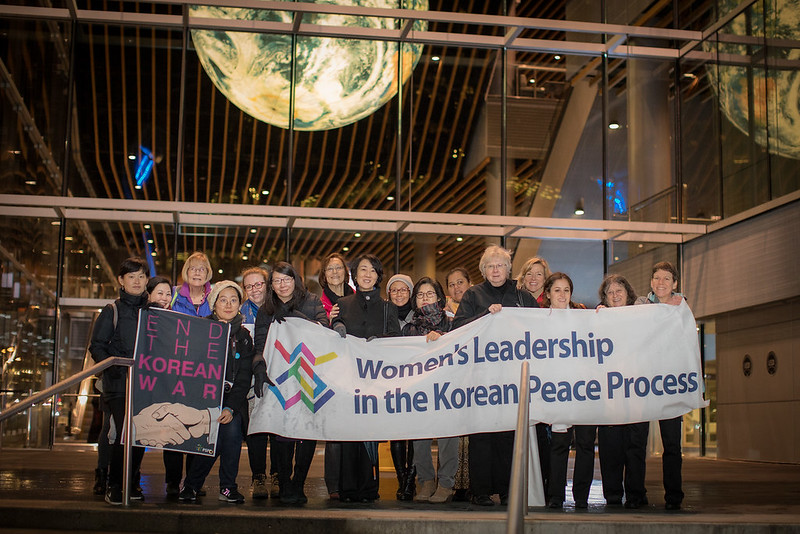


Jan 16th CC (644 of 654)-X2

<사진 = 밴쿠버여성포럼>

시민들의 의견

댓글 달기

Plain text

  • 웹 페이지 주소 및 이메일 주소는 자동으로 링크로 전환됩니다.
  • 줄과 단락은 자동으로 분리됩니다.
  • 사용할 수 있는 HTML 태그: <a href hreflang> <em> <strong> <cite> <blockquote cite> <code> <ul type> <ol start type> <li> <dl> <dt> <dd>
이미지
무제한 수의 파일을 이 필드에 업로드할 수 있습니다.
50 MB 한계입니다.
허용된 유형: png gif jpg jpeg.
Enter the YouTube URL. Valid URL formats include: http://www.youtube.com/watch?v=1SqBdS0XkV4 and http://youtu.be/1SqBdS0XkV4.
CAPTCHA
스펨 사용자 차단 질문

20150413_세계군축행동의날


Joint Statement of the National Assembly and the Civil Society for the 5th Global Day of Action on Military Spending

Our Taxes on Social Welfare instead of on Weaponry


Today on the Global Day of Action on Military Spending, we stand here to be with about 320 organizations from about 70 nations around the world. We should reflect on our reality that peace and safety of citizens worldwide are far from being established even when an astronomical amount of money is spent on military. We demand that our taxes be spent on restoring social justice and building a sustainable and peaceful world. This year, marking the one-year anniversary of the Sewol-ferry tragedy, voices desiring a safe nation have grown louder than ever, and the criticism of the ineffective investment in defense industry in the name of 'national security' is also growing stronger. It is time to change the priorities of the national policy and shift the focus from materialistic national security and military buildup to safety of people and peaceful cooperation.


According to 'Trends in World Military Expenditure, 2014' published by Stockholm International Peace Research Institute (SIPRI), the worldwide military spending last year amounted to 1.8 trillion dollars (about 1,968 trillion won), a little less than the last year's. Korea entered the top 10 for the first time last year and ranked 10th this year. 


Korea's military spending in 2015 amounts to 37.456 trillion won, increased by about 4.9% or 1.7504 trillion won from last year. This is excessive, taking up 14.5% of the government budget. 


While a large sum of military spending is being spent, our society is becoming more extremely socially polarized. Uneasiness from everyday life caused by issues in education, child care, health care, and housing encroaches on our lives, but welfare budget to expand social safety net is not nearly enough. The total amount of university student loan is now over 10 trillion won. The university tuition could be subsidized and cut by half if we decide not to use 7 trillion won of budget on purchasing 40 fighter aircrafts, F-35's, which are the most ineffective and unreasonable among the military weapons to be purchased from the U.S. by the Korean army. 1,400 public daycare centers, which President Park Geun-hye promised to provide during her presidential campaign but failed to fulfill, could be built with 880 billion won of budget set aside for 4 unmanned aerial reconnaissance drones called 'Global Hawk'. Also the budget deficit of 65.5 billion won in 34 local medical centers could be covered for the next 90 years if we do not spend 6 trillion won on operating and maintaining Global Hawk's. Students in South Gyeongsang Province, who had to put up with such remark "a school is not the place you come to eat", could have school lunches for free for the next 30 years if 3.3415 trillion won of budget is not spent on the cluster bomb units and the multiple launch rocket systems, both of which indiscriminate murder weapons banned by international law. All the firefighting equipment which is old to such an extent as to threaten the lives of firefighters could be replaced if we do not spend 1.5233 trillion won on purchasing interceptor missiles such as PAC-3. In retrospect, what we lack is not the budget. Where we allocate finances is important. We should face the threat to our lives, and reprioritize the budget.


How about the Sewol-ferry tragedy? We had to witness 304 people being buried at sea because the country, which spends about 35 trillion won every year to protect citizens from outside threat and ranks 10th in military spending, did not have basic rescue equipment. The Blue House National Security Office denied being the so-called "control tower" for the Sewol-ferry disaster. If so, for whom is the national security if the disaster which could have resulted in deaths of 470 citizens is not a matter of national security? Moreover, the Tongyeong naval rescue ship which proved to be utterly useless at the time of Sewol-ferry disaster showed rampant corruption in the nation's defense industry. If we were to talk about society after the Sewol-ferry tragedy, we should start by dealing with this glaring contradiction.


Someone might raise a question about decreasing the military expenditure when there is a serious threat from North Korea. South Korea spends an amount, almost equal to North Korea's GDP, on military. This amount does not even include the military spending by the United States Forces Korea. North Korea is obsessed with weapons of mass destruction such as nuclear weapons because it knows its military spending is no match for South Korea's. Thus it is not a matter of amount of military expenditure, but a matter of trust.


In the East Asian region, there is a fierce competition on military spending among countries such as the United States, China, Russia and Japan. Some claim that South Korea should increase the military spending in order not to fall behind these nations. However, South Korea, as a middle power country responsible for initiating a peaceful unification on the Korean peninsula, should avoid confrontation based on South Korea-the U.S.-Japan military alliance but should demonstrate leadership for peace, cooperation, coexistence and common security. The recent controversy over the U.S. deploying a Terminal High-Altitude Area Defense (THAAD) missile defenses in South Korea directly shows 'Asian paradox', the disconnect between deep economic interdependence and a serious conflict in military diplomacy. 


There are 20 nations worldwide whose military expenditures take up over 4% of their GDP's in 2014. This number is greater than that in the early 1990's right after the Cold War. If the world had spent even 5% of its military spending on combatting poverty, we could have realized the United Nations Millennium Development Goals (MDGs) that promised to halve global poverty rates by the year 2015. However as the world went through two great wars in Iraq and Afghanistan, the promise could not be kept. Korean government also promised to provide 0.25% of its GNI as Official Development Assistance (ODA) by the year 2015 to eradicate poverty but it allocated vastly insufficient amount and ended up breaking its promise to the international society. The new Sustainable Development Goals (SDGs) which is to be proposed in September, 2015 cannot be achieved without fundamental changes and reflection on military expenditure in each country.


The 5th Global Day of Action on Military Spending should not be the anniversary full of empty promises but should be a milestone to change. Thus, to the government and citizens of Korea which ranks 10th in military spending in the world and ranks last in welfare spending among 28 OECD countries, we suggest the following:


1. We demand that the military spending be reduced to alleviate social bipolarization, to expand social safety net, and to build safe society without disasters. Increasing military spending means taking away other opportunities under a limited government budget. Finances obtained by decreasing military expenditure should be used to remove any urgent threats that citizens face in their daily life.


1. This year, the 70th anniversary of the division of Korea, we demand that the efforts be put to end the Korean war and create a peace regime. The Korean government should reflect on the large amount of direct and indirect expenses spent to keep the unstable armistice regime during the past years. The nuclear threat in the Korean peninsula, which is the main reason behind the increase in the military spending, is also the result of this armistice regime and arms race. We should devise measures to recover mutual trust and start conversations instead of purchasing offensive weapons and increasing military expenditure every year. The first step towards achieving this is to lift the May 24th measures which stands between the inter-Korean relations. 


1. We express our deep concerns over the situation where the preparation for war comes before peace and where military alliance comes before cooperation in the Asia-Pacific region. We demand that Korea put efforts to change relations based on various disputes and military conflicts into cooperative ones. Appealing to the military means or strengthening military alliances to antagonize a specific country cannot resolve the conflicts. We should protect the Japanese pacific constitution, a bastion of peace in East Asia, and should not allow the right of collective self-defense. We should not allow the deployment of the U.S. missile defense system in South Korea and break away from the South Korea-U.S.-Japan military ties.


1. In order to establish peace we need participation of citizens and solidarity of people across borders. A mature sense of citizenship is more effective than any weapons to protect the community. Understanding each other and cooperation across borders are  faster ways to solve conflicts than using fighter aircrafts and missiles. We should not stand by and watch the government make decisions on whether a nation exaggerates an outside threat it claims to exist, and on whether our taxes should be used for purchasing military weapons or for building a sustainable society. Decisions on and execution processes of national security matters, including conclusion of various security treaties, development of military cooperation, execution of military exercises, and purchase of expensive and offensive weapons, must be transparent and controlled democratically, considering their enormous effects on society. Priorities in foreign policies and national security policies should be determined by citizens as it is done in other fields. 


Disarmament is not a story of a distant future but an imminent and real issue. We demand that the government, the national assembly and all the citizens show wisdom to establish peace together. 


April 13, 2015
Participants of the 5th Global Day of Action on Military Spending


For more information


The GDAMS website http://demilitarize.org

The GDAMS Korea website http://gdams.or.kr
The GDAMS Preparatory Committee of Seoul
People’s Solidarity for Participatory Democracy +82-2-723-4250, [email protected]

월, 2015/04/13- 20:50
78
0

사드 배치 결정 철회 촉구 시국회의


The decision to place THAAD in South Korea, which threatens peace in the Korean Peninsula and Northeast Asia and violates the residents’ right to live peacefully, must be rescinded. 


The entire country is being shaken, and the already-dangerous political situation in the Korean Peninsula and Northeast Asia is becoming even more unpredictable because on July 8, 2016, South Korea and the U.S. announced that they are deploying THAAD to South Korea. Up until South Korea and the U.S. officials announced Seongju, North Gyeongsang Province as the location for THAAD deployment, this process had been entirely ambiguous and one-sided. Even though a plethora of concerns regarding the use, the efficiency, the military/diplomatic prices, and the side effects of THAAD were raised, the South Korean government, behind the curtains, decided to follow the request of the U.S. Now, in Seongju, the anger and the resistance of its residents, who have suddenly been notified of the deployment of THAAD, are growing rapidly. 
 
THAAD is not a weapons system for the residents of the Korean peninsula or for their defense. 

THAAD is essentially a part of the U.S. Missile Defense System (MD). It will be the U.S. military and government that will be running THAAD. MD is an aggressive weapons system, based on the “absolutely stubborn” idea, which aims to incapacitate the missile attacks of the countries against the U.S. and enable the U.S. to launch missiles whenever they want to. The South Korean government is insisting that the deployment of THAAD is to defend the Korean Peninsula from North Korean nuclear weapons and missiles. However, recently, the government has admitted that THAAD cannot defend Seoul and its metropolitan area. The South Korean government is still advertising as if THAAD can at least defend the area within its 200km radius, but this is not true. 200km is nothing but a number to describe the range of the intercept missile attached to THAAD. But, the detectable range of the radar on THAAD theoretically reaches at most a few thousand kilometers. This is why there has been criticism that the main purpose of the frontline deployment of THAAD is to detect medium- to long-range missiles flying over the Korean Peninsula and nearby skies according to the U.S. military strategy. Therefore, there is no such thing as an “adequate” location to place THAAD in this country. The decision of South Korea and the U.S. to place THAAD in Seongju must be rescinded. 


THAAD deployment is militarily and diplomatically self-destructive measure, which will threaten the safety of South Korean citizens and become a severe obstruction in peace and prosperity of the Korean Peninsula and Northeast Asia.

South Korean THAAD is closely related to the missile defense system that was introduced to Japan. Deployment of THAAD to South Korea signifies that South Korea will be sucked into the U.S.-Japan MD, which targets not only North Korea but also China, as a subsidiary partner, and that the Korea-U.S.-Japan military cooperation system will become official. No matter how much South Korean government claims that this is essential to the South Korean sovereignty, the international society and neighboring countries will not accept it. The “strategic companion” relationship with China has become a meaningless term, and the basis of economic cooperation and the friendly relationship between the citizens of both countries can be at risk. China and Russia have already announced that they will be “taking correspondent measures.” It is obvious that this will also negatively affect the international cooperation to solve the nuclear problem in the Korean Peninsula. This is why THAAD can never be a tool to protect the safety of South Korean citizens and peace in the Korean Peninsula. The decision to place THAAD, the “real danger,” which brings threats and conflicts instead of peace, in South Korea must be rescinded.   


We also protest against the undemocratic and non-transparent decision process. 

Before facilitating THAAD deployment, exhibitions, discussions, and evaluations of its use, effects, and military/diplomatic significance should have been carried out. The information about the negotiation process must have been transparently released. However, the South Korean government skipped all these procedures and simply controlled all information. There was not enough discussion even within the related organizations. They treated this important matter, which puts the future of peace in the Korean Peninsula at stake, as if they are carrying out a military strategy. The South Korean national assembly, which represents all of South Korean citizens, never received any substantial reports. The character, the content, and the discussion process of “South Korea-U.S. joint working group for the discussion of THAAD deployment” were not shared with the National Assembly. Even after the decision to deploy THAAD in South Korea, the South Korean government is insisting that this does not require the agreement of the National Assembly. In the case of Seongju, which was decided as the location for THAAD deployment, the residents and the military officials received the unexpected news without any explanation. They were not notified of the negative effects on the environment surrounding the THAAD base and health of the residents. The undemocratic and non-transparent decision of the South Korean government to place THAAD must be rescinded immediately.  


THAAD deployment must receive the consent of the representative body, which in this case, is the National Assembly.

THAAD deployment is directly related to the lives and the safety of South Korean citizens and is a critical matter, which will influence the friendly cooperative relationship with neighboring countries. It may also cost an astronomical amount of money. Therefore, this matter cannot be solely decided by the administrative body; it needs the agreement of the National Assembly. More than anything, the dangerous practice of the South Korean government, which ignores the discussion process and treats this issue like a secret military strategy to avoid the regulation of the National Assembly, cannot be left uncontrolled. If the National Assembly represents all of South Korean citizens, they must stop the one-sided push of THAAD deployment and exercise their right to consent. If the government never asks for the agreement of the National Assembly, the National Assembly must restrain the government’s abuse of its authorities through every measure, such as an investigation in relation to government, an adaptation of the resolution to oppose, and a demand for jurisdiction dispute.  


We are going to start a pan-national peace action to rescind the decision to place THAAD in South Korea. 

We are going to start a pan-national peace action that gathers people from various backgrounds and publicizes the problems of this decision to rescind the decision to place THAAD in South Korea and to stop South Korea from being sucked into the U.S.-Japan missile defense system. We are going to form solidarity to prevent Seongju, North Gyeongsang Province from becoming another victim of state violence, like Pyeongtaek Deachuri or Jeju Gangjeong village. In addition, we are going to fight with all of South Korean citizens, so that THAAD will not be placed in Seongju or any other parts of South Korea. To accomplish this, we are going to actively try to convince and pressure local governments, the National Assembly, and related government organizations and will convey our message to governments and civil societies of neighboring countries, including the U.S. and japan. We will surely punish any abuse of power that undemocratically pushes for the placement of THAAD. Moreover, we are going to form solidarity to facilitate the reconciliation and the cooperation of North and South Korea and to form a peaceful system. The Korean Peninsula should no longer become an explosive warehouse, which is swayed and used by the arms race of the neighboring powers, but should transform as the stepping stone of Northeast Asian peace and cooperation. We are going to actively spread civil resistance and actions for the withdrawal of the decision to place THAAD and for peace in the Korean Peninsula and Northeast Asia. 


July 14, 2016


번역 : 목지수 (참여연대 평화군축센터 자원활동가)

목, 2016/07/14- 23:23
104
0

2016 GDAMS 캠페인


Global Day of  Action on Military Spending (GDAMS)
How long  should South Korea stay as an international loser?

With the lowest welfare spending and highest suicide rate among OECD members, 
South Korea was ranked as the world's No. 10 military spender this year and No. 1 arms importer in 2014.


The Stockholm International Peace Research Institute (SIPRI) has released the 2015 annual world military expenditure figures today (4 May). There is a country which has been once again ranked as the world No. 10. It is, while being the tenth biggest global military spender, also recorded as the lowest welfare spender with the highest suicide rate among the 28 OECD countries. That nation is South Korea. The South Korean government has been spending 15% of its budget on military expenditure, which is 2.5 times bigger than the OECD average. The South Korean government has been pouring in 6 billion dollars over its acquisition of 40 F-35 fighter jets, the center of controversies over cost and technical problems. This is the reality of our nation, 'Hell Chosun', an infernal feudal kingdom.


Korea, breaking its usual record of world's top 10 arms importer became the world's biggest arms importer. The annual CRS (Congressional Research Service) report on Arms Transfers, published in December 2015, shows that the South Korean government bought arms and defense equipment worth 7.8 billion dollars in 2014, making it the number 1 weaponry importer in the world. About $7 billion of South Korea's contracts were made with the United States. Now South Korea has become the most lucrative client of the world's largest defense company, Lockheed Martin. This has been attributed to the South Korean government's decision to buy the fighters whose capabilities haven't yet been verified, even after the US refusal to allow core technologies' transfer to South Korea. Also, there's more good news for Lockheed Martin, which is that the US has reportedly agreed to deploy THAAD to South Korea.


Is the huge military expenditure justified? The nation, with an annual defence budget of $9.6 billion, has so far been discovered to have spent $876 million in defence industry corruption by a joint investigative team which was launched in 2014. According to the joint investigative team, there has been a continuous flow of bribes, the falsifying of public documents, shady arms acquisition processes etc. throughout the Army, Air force, and Navy. The 2014 National Defence Annual Reports says that within 10 years defence spending doubled from $4 billion to $8 billion. Anyone can guess that this figure is not healthy at all. 


Then have our 630 thousand soldiers been benefiting from this military spending? The biggest item in South Korea's military budget is labour costs, most of which has been spent on commissioned officers. Only 9% of the military labour cost budget has been allocated to enlisted soldiers, who make up 70% of the entire military force, while the commissioned officers, who only make up 11% of the military force, take 42% of the entire labour costs. The enlisted soldiers are on less than one seventh of the nation minimum income. Is this treatment fair and just?


Some may say that "we can't possibly reduce military spending while facing the North Korean threat". The fact that South Korea's military power is far superior to that of North Korea has already been acknowledged by the government. South Korea has been spending on its military budget an amount almost equivalent to North Korea's national GDP, without even factoring in expenditure on American army bases in South Korea. Unable to match that amount, North Korea may have had to focus on weapons of mass-destruction. The key to solving the inter-Korean tension is trust-building, not military spending increases. The recent news on North Korea's 4th nuclear test caused many South Korean politicians to propose developing our own nuclear weapons. Without stopping this vicious competition of military spending and force increases on the Korean peninsula,  the necessary dialogue cannot be initiated, hence peace will remain unreachable.


The world of arms, of which American President Eisenhower once said "Every gun that is made, every warship launched, every rocket fired signifies, in the final sense, a theft from those who hunger and are not fed, those who are cold and are not clothed." still persists now. This year the United Nations Office for the Coordination of Humanitarian Affairs (OCHA) will issue an estimated $20.1 billion needed to provide humanitarian assistance to countries around the globe, including Syria, Afghanistan, and Iraq. We need to remind ourselves that last year alone the world spent $1.8 trillion on defence. Just 1% of the total international military spend would make so much difference if it were to be spent on humanitarian purposes and the eradication of poverty. 


More military spending will never bring in peace and safety to the world, but rather causes neighboring countries to increase their own military funding, therefore ending up enriching arms companies. Now is the time for us to rethink our priorities. The change we are hoping for will be brought forward by those who cry out "tax money for our lives, not for weapons" and the national assembly, which reviews and votes for bills based on our nation's voice. The 20th national assembly will have to allocate taxes to help its citizens facing hardship from cradle to grave. On the 5th of April  2016, celebrating the 6th Global Day of  Action on Military Spending, we propose to enter into such a paradigm shift in our escape from 'Hell Chosun'.


April 5, 2016

The GDAMS Preparatory Committee of Korea


For more information


The GDAMS website http://demilitarize.org

The GDAMS Korea website http://gdams.or.kr
The GDAMS Preparatory Committee of Seoul
People’s Solidarity for Participatory Democracy +82-2-723-4250, [email protected]


번역 : 윤현희 (참여연대 평화군축센터 자원활동가)

화, 2016/04/05- 22:56
145
0

Joint Statement of 102 Peace Activists

Now Is the Time for Dialogue on Denuclearization and Not Military Action That Will Escalate the Crisis on the Korean Peninsula


We, undersigned peace-loving people around the world, are deeply concerned about the current escalating tension in Northeast Asia and urge governments to have peaceful dialogues among each other rather than taking military actions.


The state of affairs on the Korean Peninsula is more volatile than ever, now that President Park has been impeached and new government is to be constituted through an early presidential election in South Korea. The Trump administration, in the meantime, is fueling the escalating tension even further with messages that it will not rule out a preemptive strike on North Korea, and that it will redeploy strategic nuclear warheads to South Korea if necessary. The situation is further destabilized by the Trump administration’s decision to send an aircraft carrier to waters near the Korean Peninsula. The latest military stance and strategy of Washington, however, completely overlooks the desire of Koreans for peace. The Kim Jong-un government in Pyongyang meanwhile has warned of another upcoming nuclear test it intends to conduct, poised as it is to show off its growing nuclear capabilities. An existing crisis is already escalating in Northeast Asia over the Terminal High Altitude Area Defense (THAAD) system that the South Korean and U.S. governments have decided to deploy in South Korea. All these acts of military bravado, taking hostage the lives and peace of Koreans, must cease now. It is time for policymakers to be responsible and return to dialogue and negotiations and stop fueling the growing tensions.


Therefore, we exhort the US administration and political leaders of North and South Korea. 


Withdraw the decision to deploy the THAAD system, part of the U.S.-South Korea-Japan Missile Defense system, in South Korea.
The South Korean and U.S. governments have decided heavy-handedly, without the consent of the Korean legislatures and despite strong public objections, to deploy the THAAD system to Seongju, South Korea. The two governments claim that such a decision is necessary to protect South Koreans against possible nuclear strikes by North Korea, but the claim is backed by little realistic evidence. South Korea is too close to North Korea for THAAD to be effective. The North only needs low-altitude missiles, to hit and destroy the South in a matter of a few minutes, and these missiles could not be intercepted by THAAD. Moreover, the THAAD system has never been proven effective in actual battle. The deployment of THAAD by the U.S. Army in South Korea represents the South Korea-U.S.-Japan alliance against China and effectively symbolizes South Korea siding with the Americans over the Chinese. The presence of such an openly hostile missile defense system gravely disrupts the prospects for peace in Northeast Asia. Beijing and Moscow have already warned that they would take “corresponding measures” in response to the deployment, with the Chinese government and businesses now engaged in unofficial but retaliatory economic sanctions against South Korea. The growing instability and arms race in Northeast Asia will only undermine international efforts for a peaceful resolution of the nuclear crisis on the Korean peninsula.


What we need now is to resume dialogue towards denuclearization of the Korean Peninsula and a genuine end to the Korean War.

Pyongyang must desist from further testing of its missiles and nuclear capabilities. We cannot support the development of weapons that directly contradict international efforts for nuclear disarmament and that hold the lives and safety of innocent people hostage. It is critical to resume dialogue and negotiations to root out the nuclear threats to the entire region and to achieve the much-needed transition from the Armistice’s ceasefire to a peace regime on the Korean Peninsula. In doing so, we ought to admit the failure of the past sanction- and neglect-centered policies that insisted, unrealistically, that the government in Pyongyang either renounce its nuclear program prior to negotiations or collapse. With the end of nuclear diplomacy, the Kim government did nothing but augment its nuclear and missile capabilities, complicating the situation still further. We realize that countless military drills and the acquisition of cutting-edge weapon systems no longer guarantee peace and security. The perpetual political tension and military hostility can end only through dialogue and negotiation. Honest talks hold the only wise solution to the current predicament.


The Korean Peninsula can no longer afford to exist as a powder keg waiting to be ignited by the chronic military tensions and the constant arms race. This is among the first and foremost place where international efforts to tackle the nuclear problem and overcome the old Cold War legacy should begin. We need to start making serious efforts for peace, not only for the two Koreas, but also for Northeast Asia and the world at large. We urge the Trump administration, the Kim government, and the newly elected President of South Korea to listen to the desire of people worldwide for peace and resist the temptation to ratchet up military tensions on the Korean Peninsula for political gain.


May 16th, 2017


Akiko Yoshizawa(The Association for military base free peaceful Okinawa in Japan, Co-chair), Akira Asada(Sinsyu University, Professor Emeritus), Alfred L. Marder(US Peace Council, President), Alice Slater(Nuclear Age Peace Foundation, New York Representative), Ann Wright(Veterans for Peace, Colonel), Arnie Saiki(Moana Nui Alliance, Coordinator), Ayumi Temlock(Member of New Jersey Peace Action), Bruce K. Gagnon(Global Network Against Weapons & Nuclear Power in Space, Coordinator), Bruce Kent(Pax Christi UK, Vice President), Changsoon Chang(Musician), Chiaki Lee(The citizens of Matsue in Japan), Christine Ahn(Women Cross DMZ, International Coordinator), Colin Archer(International Peace Bureau, Retired Secretary-General), Corazon Valdez Fabros(International Peace Bureau, Co-Vice President), Daisuke Yamaguchi(Peace Depot Japan, Researcher), David McReynolds(War Resisters International, Former Chair), David Otieno(The Global Campaign on Military Spending Africa, Convener), David Swanson(World Beyond War, Director), David Webb(Campaign for Nuclear Disarmament, Chair), Dieter Deiseroth(IALANA Germany, Member of the Academic Council), Ellen-Rae Cachola(Women's Voices Women Speak, Organizer), Harumi Ishino(Osaka International University, Professor Emeritus), Hiroki Tanaka(Blue Legion), Hiroko Suzuki(Montreal Save Article 9), Hiromichi Umebayashi(Peace Depot Inc, Special Advisor), Hitomi Taniguch(Anti-War Committee of Yawata), Ichiro Yuasa(Peace-Depot, Vice-President), IWAKAWA Yasuhisa(Interpreter/translator), Iwase Hiroko, J. Enkhsaikhan(Blue Banner, Chairman), Jacqueline Cabasso(Western States Legal Foundation, Executive Director), Janis Alton(Canadian Voice of Women for Peace, Co-Chair), Jim Albertini(Malu ‘Aina Center for Non-violent Education & Action), Julia Matsui Estrella(Pacific Asian Center for Theologies and Strategies(PACTS)), Juliane Drechsel-Grau(IALANA Germany, Board Member), Jun Tisaka(Japan Peace Committee, Secretary General), Kataoka Akira(Peace Committee of Kyoto, Chair of the board), Kawasaki Akira(Peace Boat, Executive Committee Member), Kazuhiro Furuoya, Kazuyuki Yamada(The Wind from Yonaguni Island), Kenji Ago(Seinan Gakuin University / Japanese and Korean Citizens’ Peace Solidarity against Nukes, Professor Emeritus), Kevin Zeese(Popular Resistance, Co-Director), Kip Goodwin(Kauai Alliance for Peace and Social Justice, Communications Director), Kitamura Megumi(Hiroshima religious peace council affiliation), Kiyoko Takahashi(Article9 Association group in Hadano/Peace Depot), Koji Sugihara(Network Against Japan Arms Trade, representative), Koohan Paik(International Forum on Globalization, Asia-Pacific Program Director), Kouitirou Toyosima, Kristine Karch(International Network No to War - No to NATO, Co-Chair), Kuni Nagatomo(Japanese Constitution Article9), Kyle Kajihiro(Hawai'i Peace and Justice, Board member), Leah Bolger(World Beyond War, Chair Coordinating Committee), Lucas Wirl(International Association of Lawyers against Nuclear Arms(IALANA) Germany, Executive Director), Lynette Cruz(Hui Aloha Aina o Ka Lei Maile Alii, President), Maki Sasaki, Makoto Yanagida(No-Nukes Plaza Tanpopo-sya, Co-Representative), Margaret Flowers(Popular Resistance, Co-Director), Masako Watanabe, Masami Ono(Retired Teachers), Meri Joyce(Global Partnership for the Prevention of Armed Conflict, (GPPAC), Northeast Asia Regional Liaison Officer), Michael Pulham(Christian Campaign for Nuclear Disarmament), Michie Ichihara(Gallery of Life, President), Mitsumasa Ohta(Wind of Citizens toward Uniting for Peace), Monique Salhab(Veterans For Peace, Secretary, National Board of Directors), Muto, Ichiyo(People’s Plan Study Group), Nagase Riei(Board Member, Board Member), Nami Morita(KAFTI, Director), Naomi Klein(Author), Noam Chomsky(MIT, Retired Instituted Professor), Nomura Osami, Noriko Kuju(Peace-Life-Ignatio-A9), Otto Jaeckel(IALANA Germany, Chair), Patricia Pulham(Christian Campaign for Nuclear Disarmament), Pete Shimazaki Doktor(Hawai`i Okinawa Alliance, Co-Founder), Peter Becker(International Association of Lawyers Against Nuclear Arms (IALANA), Co-President), Phyllis Creighton(Hiroshima/Nagasaki Day Coalition, Board member), Reiner Braun(International Peace Bureau, Co-President), Ronald Fujiyoshi(Ohana Ho`opakele, Treasurer), Sachiko Mikami, Sato Daisuke(No Nukes Asia Forum Japan, General Secretary), Shigehiro Terajima (Labornet-TV), Shigeru Nakamura(Article9 Association group in Hadano), Shimazu Rumi(The One Thousand Against War Committee), Shin Chiba(International Christian University, Professor), Shizue Tomoda, Suda Minoru(Ritsumeikan University, Professor Emeritus), Sukla Sen(EKTA (Committee for Communal Amity), Activist), Sumi Hasegawa(McGill University, Retired Faculty), Taikei Kokubu(Shinshuu Ōtani-ha Ansenji Priesthood, Shinshuu Ōtani-ha), Takeda Takao(NIPPONZANMYOHOJI), Tarak Kauff(Veterans for Peace, Board of Directors), Taro Abe(Nagoya Gakuin University, Professor), Tutihashi Ryoko, Wataru Mikami, Will Griffin(The Peace Report), Wolfgang Alban(IALANA Germany, Board Member), Yasunari Fujimoto(Forum for Peace, Human Rights and Environment (Peace Forum), Co-President), Yasuo Takagi, Yayoi Tsuchida(Japan Council against A and H Bombs (Gensuikyo), Assistant General Secretary), Yoshinobu Toyoda, Yoshioka Tatsuya(Global Partnership for the Prevention of Armed Conflict, Northeast Asia Regional Representative), Yoshiyuki Ishino(Anti-War Committee of Yawata Kyoto)

화, 2017/05/16- 11:17
367
0

Pyeongchang Olympics and the Great Shift in Korea


LEE Seung-hwan South-North Korea Exchanges and Cooperation Support Association


Korean Peninsula, Spring 2018


The series of events that began with the participation of North Korean athletes in the Pyeongchang Olympics and the accompanying visit by the North Korean delegation headed by Kim Yeo-jeong, followed by the visit to North Korea by the South Korean delegation, completely transformed how the Korean Peninsula entered spring this year, by putting an end, at least for the time being, to the nuclear and missile experiments and military drills that had raised the tension between the two Koreas every spring. With the volatility characterizing the state of affairs on the Korean Peninsula so quickly dissolved and the groundwork for the historical summits between the leaders of the two Koreas as well as between the North Korean leader and the U.S. president completed, the Pyeongchang Olympics will likely be remembered as a watershed moment in the Korean struggle for peace.


The background to the “nearly miraculous situation in East Asia,” as described by the Japanese government, can be found in the so-called March 5 Accord between Kim Jong-un and the South Korean delegation to Pyongyang. North Korea took the world by surprise by completely reversing its position and embracing the accord encompassing the organization of the third inter-Korean summit, the resumption of the North Korea-U.S. dialogue on the denuclearization of North Korea and the restoration of relations between the two countries, and the possible cessation, by North Korea, of its nuclear and missile experiments, contingent upon the successful continuation of dialogue with the United States. Through the accord, Pyongyang eagerly expressed its willingness to cease the nuclear and missile provocations that have fueled the escalating military tension on the Korean Peninsula and even to contribute to détente by tolerating without any changes to intensity ROK-U.S. joint military exercises slated for April.


Background of the March 5 Accord


Experts offer a number of different explanations as to the factors motivating the dramatic shift of attitude on the part of North Korea as displayed in the March 5 Accord.


The most widely accepted theory is that the international community’s prolonged sanctions against North Korea forced the country into accepting the terms of the accord. Notwithstanding the attendant controversies, these sanctions have been working. UN Security Council Resolution 2270 of March 2016 broadened the scope of the sanction to include comprehensive measures beyond responses to the country’s weapons of mass destruction (WMD) development, and significantly strengthened the intensity of sanctions exercised by China, a country that holds the key to the success of sanctions against North Korea. However, detractors of this theory argue that it is still too early to determine the true effects of these international sanctions, and that sanctions alone could not have changed Pyongyang’s policies so dramatically, given the nature of the Kim regime. These critics alternatively point to the innate change in Pyongyang’s strategy as the more direct source of the about-face displayed in the March 5 Accord. As the Kim Jong-un regime aspires to transform North Korea into a “strategic country” (with normal relations and a capability to shape the order it faces), it has had to address the reality that the extensive development of nuclear programs has failed to significantly improve the North Korean economy. In other words, it has had to embrace the opportunities for increased aid, the removal of sanctions, the signing of a peace agreement, and restoring relations with the United States even if embracing such opportunities would require the denuclearization of North Korea.


Even more important than the effects of sanctions and the change in the Kim regime’s strategy are the efforts being made by the Moon Jae-in government. By delaying the joint ROK-US military exercises last December, the Moon government succeeded in inducing Pyongyang’s decision to send North Korean athletes to the Pyeongchang Olympics and to accept the March 5 Accord. By responding, belatedly, to Pyongyang’s offer made in January 2014 that it would cease nuclear and missile experiments should Seoul cease the joint military exercises with the US military, the Moon government enabled Pyongyang to turn its stance around on the state of inter-Korean relations. Without the Moon government’s efforts at persuading Washington and postponing the joint military exercises, neither the sanctions nor the North Korean strategy would have led to this “nearly miraculous situations in East Asia.”


Why Sanctions Are Not the Cure-All Solutions to Problems Involving North Korea


Both Washington and the general American public view the recent development on the Korean Peninsula with a wary eye, regarding the shift in Pyongyang’s attitude as motivated by the strategic goal of increasing economic gains by putting the option of denuclearization on the negotiation table. President Trump denied that the decision to hold a summit with the North Korean leader was impromptu, but has expressed both doubts and hopes in his tweets: “May be false hope, but the U.S. is ready to go hard in either direction” and “Great progress being made, but sanctions will remain until an agreement is reached.”


Accordingly, the Trump administration’s new line of diplomacy with North Korea features hardliners like Mike Pompeo and John Bolton, a testament to Washington’s resolve to challenge North Korea even further with military options should its talks with Pyongyang fail.


The Liberal Korea Party and conservatives critical of the Moon government in South Korea, on the other hand, have blatantly characterized the change in Pyongyang’s attitude as “a mere security show put on by a hard-pressed North Korea,” expressing distrust and discontent even in the face of Washington’s new willingness to give talks a try. These detractors keep demanding sanctions as the only solutions to all problems involving North Korea, claiming that only stronger and continued sanctions would induce positive change in Kim Jong-un and lower the risk of an armed conflict.


Blind trust in sanctions, especially in the absence of a strategy for engagement and dialogue, can have fatal results, however. The current level of sanctions is already so high that it threatens the daily livelihood of North Koreans. Additional sanctions could backfire by tempting North Korea into accelerating its nuclear development program with a view to breaking through the uncomfortable status quo with violent actions. Unlike other countries, South Korea, too, stands to lose much from continued sanctions against North Korea. The May 24 Sanction Measures, the restriction on tourism to Mt. Kumgang, and the shutdown of the Kaesong Industrial Park all intended to hurt the North Korean economy, but also ended up damaging South Korean businesses just as much. Unconditional sanctions against North Korea, in other words, presents a self-destructive strategy from the South Korean perspective that increases the risks of war. Unconditional sanctions should not form South Korea’s strategy on long-term relations with the North.


Trilemma of Peace on the Korean Peninsula


The three main goals the South Korean government seeks to achieve with the Great Shift on the Korean Peninsula are denuclearization, the establishment of a peace regime, and the continuation of the Korea-US alliance. Two of these three goals may be achieved without much conflict, but all three cannot be achieved at the same time. Until now, all the parties involved have been pursuing different goals—South Korea, the establishment of a peace regime on the peninsula; the United States, the denuclearization of North Korea; and North Korea, its own rise as a “strategic country.” The three countries are now compelled to find effective measures to overcome this trilemma in order to achieve their objectives.


The Pyeongchang Olympics and the March 5 Accord created a new opening in this search for possible solutions to this trilemma. Pyongyang has so far sought to become a strategic country by amassing a nuclear arsenal. Through the March 5 Accord, however, it has offered to sit down for a summit with the US president and showed a willingness to make political and economic gains by giving up (allegedly) “completed” nuclear programs. Note Kim Jong-un’s remark to the South Korean delegation that North Korea “would like to be taken seriously as a partner of dialogue.”


Recall the five conditions of denuclearization Pyongyang demanded in an official statement released on July 6, 2016. The five conditions included in this July 6 Proposition were: (1) the disclosure of U.S. nuclear weapons brought into South Korea; (2) the abolition of all nuclear weapons and their bases in South Korea; (3) the prohibition on the introduction of nuclear strike assets into the Korean Peninsula; (4) the confirmation of the prohibition on the use of nuclear weapons against North Korea; and (5) the declaration, by Washington, of the withdrawal of US troops from South Korea with their ability to launch nuclear weapons. The proposition repeats much of the conditions listed in the Joint Statement on the Denuclearization of the Korean Peninsula of 1992, with the withdrawal of US troops additionally demanded. Washington has stated that it has either already satisfied or is willing to entertain the four earlier conditions. The only remaining problem between Washington and Pyongyang is therefore the latter’s latest demand that the former withdraw its troops from South Korea. 


Pyongyang, however, was careful to hedge its last demand, limiting the scope of troops to be withdrawn to those with the ability to launch nuclear weapons, and also demanding not the immediate withdrawal per se, but the declaration to that effect. Pyongyang, in fact, has expressed much willingness to tolerate the American military presence in South Korea at every major opportunity for negotiation. At the South-North Korean Summit of 2000, Kim Jong-il famously remarked that the US troops in South Korea should remain not as a force hostile to North Korea, but as the keepers of peace on the Korean Peninsula.


A Bold Proposition for the Inter-Korean and DPRK-US Summits


There are, in other words, a number of measures that all three parties may adopt toward solving the trilemma involving the denuclearization of North Korea, the continuation of the ROK-US alliance, and the establishment of a peace regime on the Korean Peninsula. These include guaranteeing the security of North Korea by implementing the Joint Statement on the Denuclearization of the Korean Peninsula, guaranteeing North Korea’s entry into the international community and its prospects for future prosperity by lifting sanctions, and guaranteeing the United States’ continued influence on East Asia by agreeing to keep US troops in South Korea without nuclear capabilities. The denuclearization of the Korean Peninsula without the withdrawal of US troops is perhaps the best possible scenario to which both Koreas and the United States could agree. The realization of that scenario would amount to the establishment of a joint security regime involving all three countries on a denuclearized Korean Peninsula. The rise of such a regime, in turn, would imply the accumulation of sincere and mutual trust among the three countries.


The establishment of a military alliance between North Korea and the United States, as demanded by some hardliners, would represent a more advanced form of such joint security regime. Hardliners like Hong Seok-hyeon thus demand that the Trump administration ought to work on enhancing the pro-US stance of Pyongyang by explicitly saying “No” to toppling the Kim regime, working towards the collapse of the Kim regime, accelerating the Korean unification, and moving US troops north of the 38th Parallel.


Once the three countries begin to develop mutual trust in one another by exercising new and bold ideas unbounded by the conventional mold of hostile relations, they will be able to maintain the impetus for denuclearization notwithstanding differences in detail. The peacebuilding process based upon such mutual trust would differ significantly from the step-by-step denuclearization and peacebuilding processes envisioned by the September 19 Joint Statement of 2005. In order to capitalize upon the current “miracle-like” opportunity created by the Pyeongchang Olympics and the Great Shift, bold actions akin to cutting the Gordian Knot are required.


Multilayered Approaches to North Korea and Expanding Civilian Exchange


The current state of affairs on the Korean Peninsula differs markedly from similar opportunities for peace that arose in the past, as the current situation requires bold actions and a firm commitment to peace. The solution required by the current situation would involve solving the major obstacles to peace on the Korean Peninsula early in the negotiation process. This, in turn, requires mutual trust and friendship among the two Koreas and the United States, which is crucial to maintain the drive for peace until the final end of the negotiation process, i.e., the permanent denuclearization of North Korea.


Another interesting characteristic of the current situation is that the peacebuilding process is guided in a top-down fashion with the strong commitment of the leaders involved. Given the complexity of the Korean Question and the history of distrust among the countries involved, a top-down approach involving a series of summits is crucial for solving the problems early on and establishing sufficient trust in a short span of time. At present, civilian exchange among the three countries involved would be restrained until local elections are held in South Korea in June, even all the while preparations are being made for the summits and high-level official talks.


Nevertheless, peacebuilding between South and North Koreas should be a multilayered process, and civilians have as important a role to play in the unification process as governments. Efforts should therefore be made in various areas in order to expand the opportunities for civilian exchange between the two Koreas shortly after the summits are held.


Both the South and North Korean governments, in particular, ought to address the issue of promoting exchange at multiple levels as part of the summit. Although the upcoming South-North Korean summit will mainly focus on denuclearization, peacebuilding, the evolution of inter-Korean relations, and economic cooperation with the United States, the leaders of both Koreas should not neglect the importance of restoring the ecosystem for rich civilian exchange at multiple levels. The two Korean leaders could provide a significant boost for continued and stronger civilian exchange if they embrace a written resolution to guarantee and support civilian exchange at various levels irrespective of political and military tension. By embracing such a resolution, the two Korean leaders could effectively declare their commitment to diversifying inter-Korean relations over and beyond government control.


This essay is the first essay written for the 2018 Peace Report Project of the Civil Peace Forum,

under the sponsorship of Friedrich-Ebert-Stiftung Korea Office.


[2018 Peace Report] See/Download

 
화, 2018/04/10- 09:47
78
0

참여연대 평화군축센터는 뉴욕 유엔 본부에서 열리는 2015 핵확산금지조약 검토회의(NPT Review Conference)에 참가해 시민사회 단체들이 각국 대표부에게 공식적으로 의견을 개진할 수 있는 구두발언 자리에서 아래와 같은 구두발언문을 발표했습니다. (2015년 5월 1일)

영문 구두발언 바로가기 >> http://bit.ly/1AGR3M0 


2015 핵확산금지조약 검토회의 (NPT Review Conference)

참여연대 백가윤 간사 시민사회 구두발언

2015년 5월 1일(금)


의장님, 각국 대표님들, 그리고 시민사회 여러분 

저는 대한민국 서울에 있는 참여연대 백가윤 간사입니다. 이 발언문은 참여연대와 평화와통일을여는사람들(평통사)가 공동으로 작성하고 전세계 300여명이 넘는 개인들과 100여개가 넘는 단체들이 연명한 공동 선언문을 요약한 것입니다. 

참여연대는 현재 한반도에서 지속되고 있는 정전체제에 깊은 우려를 표하며 관련 정부들에게 핵없는 동북아시아를 실현하기 위해 한국 전쟁을 끝낼 것을 촉구합니다. 

지난 20여년간 한반도 핵문제를 평화롭게 해결하기 위한 다양한 추가적인 합의가 있었지만 제대로 이행되지 않았습니다. 결과적으로 북한은 3차례의 핵실험을 강행하였습니다. 한반도 핵 위기는, 적어도 어느 일방이 아니라 미국과 북한, 남한과 북한, 주변국과 북한 사이의 누적된 불신에 의해 악화되어 왔다고 볼 수 있습니다. 이는 단순히 한 국가의 문제가 아닙니다. 모든 국가들이 책임을 져야 합니다. 

지난 20여년간 미국의 동맹국과 파트너들이 주로 동원해온 압박과 봉쇄, 핵우산과 재래식 군비의 강화 같은 일방적 대북정책 수단들은 북한 핵문제를 둘러싼 갈등의 해결에 전혀 효과적으로 작동하지 않았습니다. 적어도 협상과 대화가 진행되는 동안은 북한의 핵무기 개발이 중단되었습니다. 반면, 적대적인 정책과 제재가 가해지는 동안에는 북한은 핵 능력을 키워갔습니다. 특히 체제 붕괴 혹은 전환 같은 주관적인 기대를 품은 채 대화를 배제하는 정책은 사태를 크게 악화시켰습니다.

북한으로부터 긍정적인 답변을 이끌어내기 위해서는 양쪽 모두가 동의할 수 있는 새로운 형태의 대화, 대담하고도 건설적인 제안이 이뤄져야 합니다. 이 새롭고 포괄적인 해결책은 한반도의 평화 체제 구축, 북미‧북일 관계의 정상화, 그리고 동아시아의 핵위협을 제거하는 것에 바탕을 두어야 합니다. 

이에 저희는 다음과 같이 제안합니다.

  • 한반도 핵 위기 해결을 위하여 2005년 9.19합의에 입각한 6자회담을 조속히 재개해야 한다.
  • 정전체제 종식과 새로운 평화협정 체결을 위한 남‧북‧미‧중 등 관련당사국간의 회담을 6자회담과 동시에 혹은 선제적으로 추진해야 한다.
  • 북미, 북일 관계의 포괄적 관계 개선을 위한 양자대화를 6자회담과 동시에 혹은 선제적으로 추진해야 한다.
  • 남과 북은 대화와 협력을 확대하고 주변국은 이를 적극 지원해야 한다.
  • 한반도와 동아시아의 군비경쟁을 촉발하는 미사일 방어 협력을 비롯한 한미일 군사협력/동맹 추진을 중단해야 한다.
  • 동아시아 평화의 보루인 일본 평화헌법을 무력화하는 일본의 집단적 자위권 추구를 허용하지 말아야 한다.
  • 한반도 비핵화 논의는 한반도 혹은 동북아시아 차원의 비핵지대 건설의 전망 속에 이루어져야 한다. 
  • 한반도 평화협정 체결과 병행하여 남북이 각각 맺은 상호적대적인 군사동맹을 단계적으로 해소하고, 한반도와 동아시아의 공동안보에 기여하는 호혜적이고 평화적인 관계로 전환해야 한다.

이제는 한국전쟁을 끝내고 핵무기 없는 동북아시아로 한걸음 나아가야 할 때입니다. 우리는 여기 계신 여러분 모두가 핵무기 없는 동북아시아를 만들기 위해 우리의 제안에 동의하고 연의 마음으로 함께 해 주시기를 촉구합니다.

감사합니다. 

금, 2015/05/01- 14:36
203
0

20230110_정전70년 평화행동 제안 기자회견

On 10 Jan, the Korea Peace Appeal Campaign and the South Korean Committee on June 15th Joint Declaration had a press conference <Let’s work together to resolve war crsis and realize peace on the Korean Peninsula>.

Thourogh the press conference, they expressed concerns about the current crisis and strongly urged “to stop all military threats aggravating tensions on the Korean Peninsula, stop provocative actions and start crisis management together.”


Let’s Work Together to Resolve the War Crisis and Realize Peace on the Korean Peninsula

January 10th, 2023

The new year has begun full of anxiety over war. The military crisis on the Korean Peninsula gets worse without an exit. The peninsula has reached a dangerous situation where tensions have simmered as all communication channels between South and North have been cut off. And a realistic solution to prevent armed conflict and rebuild the condition for dialogue is nowhere in sight. President Yoon Suk-yeol is creating more anxiety by continuing remarks such as ‘prepared for entering the war,’ ‘superior war preparation,’ ‘review of the suspension of the September 19 military agreement’ and so on. The Ministry of Unification is also raising tensions by mentioning measures like installing loudspeakers or allowing leaflets to be sent which might lead to clashes in the border area.

We gathered here today with a desperate heart of ‘No more war on the Korean Peninsula under any circumstance.’ It is difficult to predict what catastrophe will happen if any unexpected armed conflict should occur in a strained atmosphere. Amid a vicious circle in the form of a chicken game on the Korean Peninsula and deepening confrontation between the ROK-the US-Japan and the DPRK-China-Russia, Northeast Asia is increasingly becoming a powder keg of the world.

All military threats aggravating tensions on the Korean Peninsula must be stopped. We strongly urge that the parties concerned stop provocative actions and start crisis management together. Hostile policies and force projection operations can never be a solution but only worsen the vicious circle. The current crisis is the result of the collapse of mutual trust as negotiations have failed after the agreements were not kept and hostile policies continued. The hard-won inter-Korean and DPRK-US agreements in 2018 must be implemented. What we need are realistic measures and preemptive actions to ease military tensions and shift to a dialogue phase. In particular, the suspension of large-scale ROK-US joint military exercises will play a key role in improving relationships and setting conditions for dialogues.

We can’t just stand idly by and let this crisis happen with anxiety. The more difficult it is to speak about peace, the louder our voice for peace should be. Moreover, this year 2023 is the 70th anniversary of the signing of the Korean War Armistice Agreement. However, even the 70-year-old unstable armistice cannot be guaranteed to remain the same in the future. It is a moment when the voices calling for no war and the realization of peace, as well as the efforts of civil society from all spheres, are more desperate than ever.

At this potential flashpoint a way out seems hard found, the South Korean Committee on June 15th Joint Declaration and the Korea Peace Appeal Campaign propose ‘2023 Korea Peace Action for the 70th Anniversary of the Armistice (tentative)’ and earnestly urge everyone who wants peace to join us.

To resolve the war crisis and realize peace on the Korean Peninsula this year, we are carrying forward

☮ an intensive signature campaign to oppose the war and realize peace on the Korean Peninsula
☮ demand to stop the ROK-US joint military exercises and ROK-US-Japan military cooperation
☮ simultaneous peace actions in 300 places around the world including 200 Korean cities and towns
☮ a massive peace rally and a march on 22 July, Saturday
☮ a large-scale peace action around 15 August

Through this, we would like to resolve the war crisis and create a new turning point for peace as we meet people from all over the nation to firmly organize the voice of peace and stand in solidarity with people across the globe who want peace on the Korean Peninsula and East Asia.

Starting with today’s press conference proposal, we will meet civil society organizations across the nation to bring together wisdom and hearts, and launch ‘2023 Korea Peace Action for the 70th Anniversary of the Armistice (tentative)’ on 14 February, Tuesday to get into our stride with actions. We request all sorts of religious and civil society organizations to participate in ‘2023 Korea Peace Action for the 70th Anniversary of the Armistice’ to discuss and seek actions that we can take together here and now, and to show the strong power of the peace-wanting people. Let’s overcome this unprecedented war crisis with remarkably wide and robust solidarity and joint action so that we can open the way for peace again.

? Korean Version


Korea Peace Appeal 2

? Signature Campaign to End the Korean War
Sign the Korea Peace Appeal Now ?
endthekoreanwar.net

The post Let’s resolve the war crisis in Korea appeared first on 참여연대.

월, 2023/01/16- 13:00
1
0

On December 8 2022, in partnership with the Permanent Mission of Mongolia to the United Nations, the Global Partnership for the Prevention of Armed Conflict (GPPAC) organised a roundtable discussion titled Building and Sustaining Peace at the Regional Level: The Network Approach to Regional Coordination in Northeast Asia during an advocacy visit of Ulaanbaatar Process participants to New York City.

This discussion was an informal dialogue to share the learning from the Ulaanbaatar Process with global peacebuilding policy experts within the United Nations, Member States and regional organisations. The conversation outlined critical avenues to support regional peacebuilding coordination in policy and shared practical experiences for practical action. The discussion also outlined persistent challenges of regional peacebuilding coordination, and discussed recommendations to develop solutions to strengthen peacebuilding work in Northeast Asia.

During the roundtable, remarks were shared by Ulziibayar Vangansuren, Permanent Mission of Mongolia to the United Nations; Ambassador Enkhsaikhan Jargalsaikhan, Chair of NGO Blue Banner and former Mongolian Permanent Representative to the UN; Sonja Bachmann, Teamleader Northeast Asia and Pacific, UN Department of Peacebuilding Political Affairs (DPPA); Kajita Natsuha, learning designer and facilitator; Kim Jeongsoo, Standing Representative, Women Making Peace and Hwang Sooyoung, Manager, Centers for Peace and Disarmament and for International Solidarity, People’s Solidarity for Participatory Democracy (PSPD).

Based on the experiences from Northeast Asia, the following key elements build an effective regional peacebuilding architecture:

  • Multi-stakeholder coordination is required and must be based on complementarity among partners.
  • The network approach to peacebuilding must be at the core of regional coordination.
  • Inclusivity is key for effective regional peacebuilding networks.

The following recommendations have thus been identified for the strengthening of the regional peacebuilding mechanisms:  

  • The UN should take a more active convening role to bring together regional actors, the UN, national governments, and civil society, among others, to coordinate actions better and ensure a stronger impact of peacebuilding activities.  Where regional peacebuilding networks play an essential role in building the foundation for regional dialogue, the UN should provide technical and political accompaniment to ensure the commitment to action. 

  • Improved funding mechanisms are needed to support the civil society organizations’ network approach. A network approach creates empowering and equitable spaces for exchanging expertise for more impactful and informed action, sharing resources and access points at various levels, and enabling and supporting communities committed to peace. Donors should reflect on how to improve funding mechanisms to support better civil society organizations engaged in regional peacebuilding networks, allowing them, through effective funding, to fill the gaps in the regional peacebuilding infrastructure. It is crucial to ensure that all regions are fairly represented in the international discussion on peacebuilding and are given international attention, as this also impacts funding availability. 

  • The inclusion of women and youth is key in regional peacebuilding networks and should be supported. Although women are strongly affected by conflicts, they are often excluded from negotiations and peace processes, especially in highly patriarchal contexts. The inclusion of local women within peacebuilding initiatives is essential to ensure that their unique perspectives can have a real impact at the decision-making level. Likewise, the meaningful participation of young people in dialogue on equal terms is essential to achieve and sustain peace. Young people in all their diversities should be considered as drivers for change, and their contributions should be held as relevant and valuable. Donors should prioritise supporting regional peacebuilding dialogues that ensure the meaningful participation of women and youth at all stages of the process.  The UN and its Member States should use their influence and international platforms to  ensure that the unique perspectives of local women and youth peacebuilders are heard and taken into account in the decision-making processes.

This is an article for Global Partnership for the prevention of Armed Conflict (GPPAC) Northeast Asia News, Jan 2023

Summary Document [See/Download]

The post Building and Sustaining Peace at the Regional Level appeared first on 참여연대.

월, 2023/01/30- 15:02
1
0
20230214_정전 70년 한반도 평화행동 출범대회
2023.02.14 Korea Peace Appeal Campaign

⭐ End The Korean War, Let Us Peace!

Tuesday, 14  February, 2023, Korea Press Foundation

As 2023 marks the 70th anniversary of the Korean War Armistice, the <South Korean Committee on June 15th Joint Declaration> and the <Korea Peace Appeal Campaign> launched a new project <Korea Peace Action for the 70th Anniversary of the Armistice>. A press conference was held where many religious and civil society representatives, who have been endeavoring for peace in the Korean Peninsula, participated and gathered eager to rebuild hope of peace over the threat of war. 735 organizations nationwide are a part of the <Korea Peace Appeal Campaign>.

Our main goal is to resolve the threat of war and build peace. As a joint civil society, we plan to continue the signature campaign but more intensively, and organize other various peace actions. The <Korea Peace Appeal Campaign> will warn the danger of the present crisis, create domestic and foreign public opinions for the peace of the Korean Peninsula and Northeast Asia, and gather voices of opposition toward the recent rapid promotions of the military cooperation between South Korea, the US, and Japan. This year we will be manifesting the following actions:

☮ Korea Peace Appeal Signature Campaign
☮ Actions urging suspension of the ROK-US Combined Military Exercises and ROK-US-Japan Military Cooperation
☮ Korea peace actions in 300 cities worldwide comprising 100 overseas (June-July)
☮ Saturday, 22 July 2023, Massive Peace Rally and Parade
☮ Thursday, 27 July 2023, International Conference
☮ 15 August 2023 (TBD), Massive Peace Rally

20230214_정전 70년 한반도 평화행동 출범대회

Korea Peace Action for the 70th Anniversary of the Armistice Declaration

Let’s resolve the threat of war and build peace in the Korean Peninsula

70 long years have passed since the roar of gunfire coming from the three-year war in Korea stopped. The past 70 years were certainly not a peaceful period but a temporary ceasefire. Due to the fear and anxiety that the war could outbreak any time soon, the neverending hostility and military tension, and the internal and external challenges leveraging and goading these unstable conditions, everyone living on the Korean Peninsula had to cope with the immense pain and expense.

When the South and North Korean Leaders, and the North Korean and US leaders discussed a transfer to a new relationship at the Panmunjom Declaration of 27 April, the Pyongyang Joint Declaration of 19 September, the Singapore Joint Statement of 12 June, the Korean people saw a single thread of hope that the tension and danger of war, which had been crushing us, would disappear and a peacefully coexisting future unlock. Despite the North-South and North-US Agreement, dialogues were adjourned on account of the different views on corresponding measures, and as the power-to-power confrontations intensify, the present Korean Peninsula is falling into great despair. We are not even sure if the unstable ceasefire will be maintained. A sense of crisis that there is no guarantee an accidental collision could turn into a terrible disaster from a nuclear war is oppressing every life and existence on this land.

No methods of dialogue are left between the North-South and North-US. Moreover, the global environment is restraining us. Amidst the Russia-Ukraine war and the US-China conflict, the possibility of Korea being used as a proxy battlefield for international-level military tensions and new Cold War confrontations is greater than ever. However, there is no sound of a practical and active solution to ease tension, prevent armed conflict, or create dialogue conditions.

The government of Yoon Suk Yeol clarified ‘Peace through Strength’ and massively expanded the scale of military exercise, propagandizing that military force can beget surrender. However, this has only aggravated the danger of military clashes in Korea. By stating the practicality of extended deterrence against nuclear and missile threats of North Korea, the Yoon Suk Yeol government has been justifying that we jump on the United States’ strategy against China and South Korea to be subordinated to the ROK-US-Japan military cooperation system. However, the danger of a nuclear arms race and nuclear war around the Korean Peninsula is proliferating. The result of pressure through power is merely the repetition of North Korea’s advancement in nuclear power and mutual armed protests. The only thing the Yoon Suk Yeol government proved so far is that they have no practical method nor capability to manage the crisis and bring peace.

We still have time to prevent conflict and disintegration. We also have a chance for dialogue and negotiation. The reason things got worse is that even after agreeing to a new relationship, the government hesitated to take corresponding measures to build trust, such as suspending the ROK-US joint military exercises, not the insufficiency of armed protest. We must stop the outbursts of armed protests. We must open the door to peace through bolder and more flexible confidence-building measures and pre-emptive easing of tensions. We must act to build peace. The more difficult it is to talk about peace, the more we must gather willingness toward peace from all social standings and reverberate the voice of people who demand peace.

As we launch the <Korea Peace Action for the 70th Anniversary of the Armistice>, we call for the following. We call for stopping hostilities. We call for immediate and faithful action to improve relations as agreed by two Koreas and North Korea and the US. We call for an end to a 70-year-old unstable ceasefire and an agreement on the peace treaty. We call for a Korean Peninsula and a world without nuclear weapons and nuclear threats. We call for restoring trust and resolving conflicts through dialogue and cooperation, not sanctions and military threats. Particularly, we call for a halt in the large-scale ROK-US combined military exercise and opening the way for dialogue toward peace. We call for stopping military cooperation between South Korea, the US, and Japan, which will lead to a new Cold War confrontation, and instead creating an order of cooperation in which the Korean Peninsula and Asia coexist peacefully. Please, we do not call for a destructive arms race, but we call for the safety of people and cooperation to overcome the climate crisis.

We will act. We will take action in the 1 million signature campaign for the Korea Peace Appeal. We will continue the peace declaration and solidarity of people from all social standings in many parts of the world, including 200 cities in Korea and 100 cities in overseas, in the online and offline space. We will work hard to stop ROK-US joint military exercises and military cooperation between South Korea, the US, and Japan, which are escalating tensions and confrontations on the Korean Peninsula and Asia. Marking the 70th anniversary of the Korean War Armistice in July this year, we will focus our actions so that the nation calling for peace on the Korean Peninsula and the voices of peace forces from all around the world can resonate all over the Korean Peninsula and the whole world.

If we seek peace, we can open the way to peace.

We decide our future.

Join us in the <Korea Peace Appeal Campaign>.


14 February 2023

From all Korea Peace Appeal Campaign organizations (total of 735)


Korea Peace Appeal 2

? Signature Campaign to End the Korean War
Sign the Korea Peace Appeal Now ?
endthekoreanwar.net

The post ⭐️ Fresh Start of the Korea Peace Appeal Campaign appeared first on 참여연대.

금, 2023/03/03- 16:30
0
0
Korea Peace Appeal International Partners Meeting

Korea Peace Appeal Campaign International Partners Meeting

? 70 years of the Korean War Armistice,
Let’s Build Peace Together!

Korea Peace Appeal has scheduled a Zoom meeting for international partners.

Military tension on the Korean peninsula is elevating amid the never-ending ceasefire. The risk of an accidental armed conflict is very high. The prospect of peace on the Korean Peninsula and Northeast Asia is not so bright. There is a desperate need for voices calling for peace.

Marking the 70th anniversary of the Korean War Armistice this year, the Korea Peace Appeal Campaign has launched a new project <Korea Peace Action for the 70 years of the Korean War Armistice>. We plan to continue the Korea Peace Appeal signature campaign but more intensively, and organize various peace actions all over the world.

We aim to share awareness of the current situation and introduce our plan for 2023 and discuss ideas and opinions on building peace on the Korean Peninsula through the meeting.

Please join us in building peace together!


☮ Program

  • Presentation : Current Crisis on the Korean Peninsula
    – Jae-Jung Suh (Professor for Politics and International Relations at International Christian University)
  • Presentation : 2023 Plan and Introduction for International Participation
    – Korea Peace Appeal Campaign
  • Discussion

We have set two individual sessions considering the time difference. The two sessions will cover the same content! Please register for a session that suits your schedule by clicking on the link beside each session.

✅ 1st Session  Register
30 March 2023 (Thu) 5pm (PDT) / 8pm (EDT)
31 March (Fri) 9am (KST)

✅ 2nd Session  Register
31 March 2023 (Fri) 10am (CEST) / 5pm (KST)


Korea Peace Appeal 2

? Signature Campaign to End the Korean War
Sign the Korea Peace Appeal Now ?
endthekoreanwar.net

The post Korea Peace Appeal International Partners Meeting appeared first on 참여연대.

목, 2023/03/23- 06:56
4
0

20160331_웹홍보물_회원확대캠페인02_이정보모르고뽑지마오.jpg


[회원확대 캠페인 ②] 이 정보 모르고 뽑지마오!

국회가 지난 4년간 한 일, 유권자 선택을 위한 정보로 알려드려요.

참여연대의 흔들림 없는 권력감시운동.
이번에는 4.13총선에서 유권자들의 올바른 선택을 돕는 정보 제공활동으로 이어집니다. 

지난 4년간 유권자와의 약속 제대로 지켰는지, 
누가 서민을 울리는 법을 만들려고 했는지
누가 국민들이 원하는 진상규명을 방해했는지 낱낱이 기록했어요.


정치권력에 맞선 참여연대의 감시활동
회원가입으로 참여연대에 힘을 보태주세요! (클릭)


*참여연대 활동보기

- [새누리당 공약이행 평가 프로젝트] 집권여당은 유권자와 한 약속, 얼마나 지켰나
- [이슈리포트] 한국사회 주요 이슈에 대한 19대 국회의원 발언과 태도
- [이슈리포트] 19대 후반기 국회, 디딤돌·걸림돌 법안 표결 보고서
- [이슈리포트] 19대 국회 나쁜 법안, 누가 발의했나
- [3분 총선] 총선 관한 모든 정보를 한 손에 (http://www.vote0413.net)
- [홈페이지] 열려라 국회 - 국회의원들의 성적표를 속속들이 보여드려요! (바로가기 클릭)


  *홈페이지 자료실에서 더 많은 보고서와 정보를 보실 수 있습니다. (바로가기 클릭)

목, 2016/03/31- 15:18
294
0

회원확대 캠페인 5월은 푸르구나! 우리들은 잘 한다!

[회원확대 캠페인 ④] 5월은 푸르구나! 우리들은 잘 한다! 

시민여러분의 참여만큼, 참여연대도 자라고 있습니다!

시민들의 자발적 후원으로 권력을 감시하고 민주주의를 더 키우겠습니다!


참여연대는 100여명의 자원활동가와 1만여 개 노란리본 지역 가게들에 배포했습니다. 
앞으로도 세월호를 기억하기 위한 노란리본을 나누겠습니다. 


'권력감시의 대표작' 국회 감시 전문사이트 '열려라 국회'를 새단장했습니다. 
20대 국회의원들의 의정 활동도 꼼꼼히 기록하겠습니다. 


"이젠 안 사요" 옥시 제품 불매운동(#옥시불매) 캠페인도 벌이고 있습니다. 

기업의 불법행위 재발을 막기 위해 집단소송제와 징벌적 손해배상제 도입에 앞장서겠습니다. 


* 참여연대 활동보기

- ['서촌길 노랗게 물들이기’ 시즌2] 서촌이 노랗게 물들고 있습니다

세월호를 기억하는, '노란 리본 공작소' 자원활동가 모집 

[열려라 국회 웹사이트] 국회의원들의 성적표 

- [이젠, 안 사요! '옥시' 제품 불매운동 캠페인] 가습기 살균제 피해자들의 손을 잡아주세요! 

가습기살균제 사건의 엄정하고 신속한 수사를 촉구한다 


정치 권력에 맞선 참여연대의 꾸준한 감시 활동!

정부지원금 0%

참여연대는 회원들의 회비와 후원으로 쑥쑥 자라납니다!  ( 지금 바로 회원가입 클릭 )

화, 2016/05/03- 19:38
264
0


홍준표 주민소환의 날이 다가오고 있다.

홍준표 주민소환 서명에 대한 신속한 검수를 요구한다.


오늘 홍준표 경남지사를 소환하기 위한 주민소환 서명이 검수에 들어간다. 그 서명은 아집과 독선으로 똘똘 뭉쳐 패악을 일삼던 홍준표 지사를 심판하기 위해 수많은 사람들이 120일 동안 거리에서, 마을에서, 직장에서 하나하나 받았던 서명이다. 또한 그 서명은 안하무인 도지사에 의해 유린당한 도정을 끝내고 도민을 위한 민주적 도정이 실현되기를 바라는 36만 도민의 소중한 의지가 담긴 서명이다. 따라서 선관위는 서명 하나 하나를 소중히 여기고 빠른 시간 안에 검수를 마무리해야 할 것이다.

지난 20대 총선에서 국민의 민주를 향한 의지가 강하게 표출되었으며 우리는 총선을 통해 국민들의 민주에 대한 염원이 얼마나 강한지를 알 수 있었다. 경남에서도 새누리당은 도민에게 심판 당했다. 그리고 그것은 박근혜 정권의 독재회귀와 민생파탄에 대한 심판이자 패악적인 홍준표 도정에 대한 심판이었다. 그럼에도 불구하고 홍준표도지사의 막말은 이어지고 안하무인의 태도는 바뀌지 않고 있다. 홍준표 지사는 자신의 잘못을 뉘우치지도 않고 도민에게 사과하지도 않고 있다. 그는 스스로 변할 수 없음을 지금까지도 명확히 보여주고 있다.

하여 우리는 홍준표지사에 대한 아무런 기대도 하지 않는다. 다만 우리는 홍준표 소환의 그날을 기다린다. 도민의 손으로 홍준표를 심판하고 도민의 힘으로 민주적 도정을 세우는 그날을 손꼽아 기다린다. 다시는 홍준표와 같은 독선적 인물이 도정을 유린하고 패악을 일삼지 못하도록 단호히 응징하고 도민의 요구에 따라 도정이 이루어지는 민주적 도정을 튼튼한 반석위에 세우는 그날을 간절히 기다린다.

이제 민주는 거스를 수 없는 대세이고 흐름이다. 이제 민주는 거부할 수 없는 도민의 염원이자 요구이다. 선관위는 도민의 염원을 명심하고 신속하게 주민소환 서명에 대한 검수를 완료할 것을 요구한다.


2016년5월9


홍준표경남지사주민소환운동본부

저작자 표시 비영리 변경 금지
크리에이티브 커먼즈 라이선스
Creative Commons License
화, 2016/05/17- 17:12
332
0

[회원확대 캠페인 ⑤] 잘 뽑았으니 잘 감시합시다

[회원확대 캠페인 ⑤] 잘 뽑았으니 잘 감시합시다 

국민이 직접 뽑은 국회의원, 국민이 직접 감시합니다. 


"우리 동네 국회의원은 잘 하고 있나?" 


21년간 권력감시활동을 해온
참여연대가 만든 열려라국회 웹사이트에서 
국회의원들이 발의한 법안, 
회의 출석 및 표결 결과, 
재산내역과 정치 후원금 등 
다양한 의정활동 정보를 제공합니다.  


* 2016년 참여연대가 펴낸 주요 국회감시 보고서 

- 19대 국회 후반기, 국회 활동 평가 보고서

- 19대 국회 나쁜 법안, 누가 발의했나  

한국사회 주요 이슈에 대한 19대 국회의원 발언과 태도 

- 19대 후반기 국회, 디딤돌ㆍ걸림돌 법안 표결 보고서 

- 유권자가 꼭 알아야 할 새누리당의 공약 - 위험하거나 없거나 

- 유권자가 꼭 알아야 할 20대 총선 정당별ㆍ후보자 재산 현황 분석 

- 유권자가 꼭 알아야 할 20대 총선 후보자들의 이런! 전력 

- [공약이행 평가] 집권여당은 유권자와 한 약속, 얼마나 지켰나 

- 20대 국회 입법ㆍ정책과제를 제안하고, 국회 개혁을 촉구합니다 


정치 권력에 맞선 참여연대의 꾸준한 감시 활동!

정부지원금 0%

참여연대는 회원들의 회비와 후원으로 쑥쑥 자라납니다!  ( 지금 바로 회원가입 클릭 )

[회원확대 캠페인 ⑤] 잘 뽑았으니 잘 감시합시다

수, 2016/06/01- 18:14
304
0


마창진참여자치연대 등 참여자치지역운동연대 "선관위-경찰 규탄"


정당한 정치활동 탄압하는 선관위와 경찰을 강력히 규탄하다!!


- 선관위의 황당한 고발은 역사에 길이 남을 만행이며, 우리 정치를 후퇴시키는 자충수 될 것

- 총선넷의 공개적인 활동에 대한 경찰의 황당한 압수수색은 선거 패배에 대한 정치 보복이며 시민단체 탄압

- 선관위와 경찰의 행태는 유권자의 정치적 권리, 정치 활동에 대한 심각한 침해 

- 전국의 시민사회단체와 연대하여 강력히 대응할 것, 선관위 개혁 포함한 정치개혁운동 지속적으로 진행해나갈 것


16일, 서울지방경찰청 지능범죄수사대가 참여연대를 포함한 10여 곳의 단체를 압수수색하는 어처구니 없는 일이 벌어졌다. 단체뿐만 아니라 참여연대 안진걸 사무처장과 인천평화복지연대 이광호 사무처장의 자택도 압수수색을 당했다. 

우리는 황당무계한 선거법 위반 고발 조치도 모자라 너무나도 비상식적인 압수수색까지 자행하고 있는 선관위와 경찰을 강력히 규탄하며, 시민단체의 정당한 정치활동에 대한 탄압을 당장 중단할 것을 강력히 경고한다. 


2016총선시민네트워크(이하 총선넷)에서 이미 공식적인 입장을 밝힌 바와 같이 서울시선거관리위원회가 총선넷의 활동을 공직선거법 위반이라며 검찰에 고발한 사안은 근거가 너무나도 취약한 억지 고발이다. 

총선넷이 전국의 유권자를 상대로 실시한 최악의 후보 10인, 최고의 정책 10개의 선호도 투표는 선거법에서 신고대상으로 정한 여론조사에 해당되지 않는다. 또한 선관위가 문제 삼은 낙선투어 기자회견도 선관위의 사전 자문을 받아 선거법을 위반하지 않고 진행한 기자회견이다. 선관위의 고발은 시민단체의 정당하고 합법적인 정치활동을 탄압하고 선거법 위반으로 끼워 맞추기 위한 억지 고발이다. 누구보다 공정하게 업무를 수행해야 할 선관위의 이번 고발 조치는 역사에 길이 남을 만행이며 선관위 스스로 우리 정치를 후퇴시키는 자충수가 될 것이다. 


선관위의 황당한 고발에 근거해 압수수색까지 자행하는 경찰은 더욱 가관이다. 

2016총선시민네트워크는 전국에서 공익적으로 활동하고 있는 1,000여개의 시민단체와 유권자들이 함께 모여 활동했던 단체다. 시민들에게 선거 관련 다양한 정보를 제공하고 나쁜 후보는 심판하자는 운동을 진행했다. 민생이 실종된 정치를 민생을 책임지는 정치로 만들기 위해 후보자와 정당에게 좋은 정책을 제안하고 약속받는 운동을 진행했다. 이런 활동이 불법이고 선거법 위반이라면 시민단체와 유권자는 도대체 정치적인 의사표현을 어떻게 해야 한다는 말인가?

더군다나 이런 활동들은 모두 공개적으로 진행했고, 언론에도 보도자료를 통해 다 공개했다. 무엇이 의심스러워 압수수색을 한다는 것인가? 선거 패배에 대해 시민단체에 분풀이를 하고 싶은가? 본보기를 보이기 위한 쇼를 하고 싶은가?


우리는 이번 압수수색을 선거 패배에 대한 정치 보복, 시민단체와 유권자에 대한 정치탄압으로 규정하며, 총선넷에 함께한 전국의 단체들이 좌시하지 않을 것임을 다시 한 번 강력히 경고한다. 


서민을 위한 정치, 민생을 챙기는 정치, 정쟁보다는 정책이라는 유권자들의 바램을 실현하기 위해 시민단체들은 부족하지만 정치개혁운동을 꾸준히 진행해왔다. 하지만 이를 방해하고 억압했던 자들은 아이러니하게도 항상 선관위와 공권력이었다. 선관위와 경찰이 지금과 같은 행태를 반복한다면 유권자들이 바라는 정치개혁은 요원할 수밖에 없다. 선관위가 외치는 정책선거는 헛구호에 그칠 수밖에 없다.


우리는 선관위 고발과 경찰의 압수수색에 공동으로 대응해나갈 것을 다시 한 번 밝히며, 선관위 개혁을 포함한 정치개혁운동도 지속적으로 진행해나갈 것이다. 끝.


2016년 6월 16일


참여자치지역운동연대(전국 19곳 단체) 소속단체

경기북부참여연대, 대구참여연대, 대전참여자치시민연대, 마창진참여자치시민연대, 부산참여자치시민연대, 성남참여자치시민연대, 순천참여자치시민연대, 여수시민협, 울산시민연대, 제주참여환경연대, 참여연대, 참여와자치를위한춘천시민연대, 참여자치21(광주), 참여자치전북시민연대, 충남참여자치지역운동연대, 충북참여자치시민연대, 투명사회를위한정보공개센터, 평택참여자치시민연대, 평화와참여로가는인천연대


참여연대 등 압수수색 관련 성명서(160616).hwp


저작자 표시 비영리 변경 금지
크리에이티브 커먼즈 라이선스
Creative Commons License
금, 2016/06/17- 19:33
322
0