주요 콘텐츠로 건너뛰기

[기자회견] 사드배치철회 미국시민평화대표단 No to THAAD in Korea, Yes to Peace through Dialogue
지역

[기자회견] 사드배치철회 미국시민평화대표단 No to THAAD in Korea, Yes to Peace through Dialogue

익명 (미확인) | 화, 2017/07/25- 21:41

20170725_사드미국대표단 기자회견

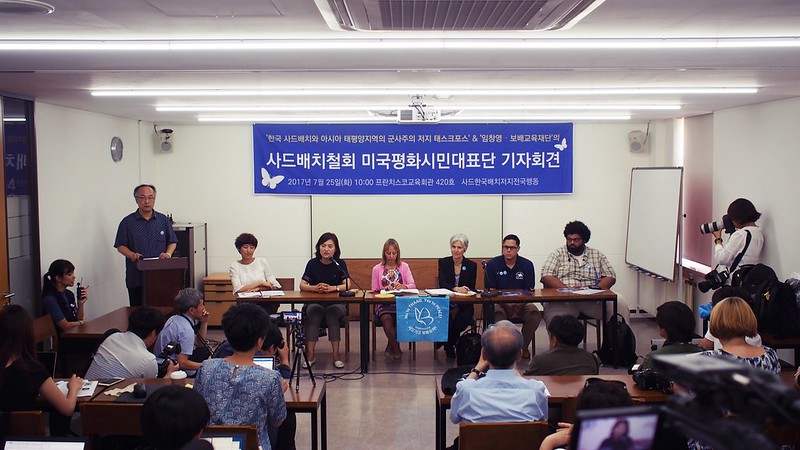
2017.07.28. 사드 미국 대표단 기자회견 (사진 = 녹색당)


사드배치철회 미국평화시민대표단 기자회견

No to THAAD in Korea, 
Yes to Peace through Dialogue

2017년 7월 25일(화) 오전 10시, 프란치스코교육회관 420호


대표단

  • Medea Benjamin, CODEPINK 메디아 벤자민, 코드 핑크
  • Reece Chenault, U.S. Labor Against the War 리스 쉐놀트, 미국 노동 반전위원회
  • Will Griffin, Veterans for Peace, Taskforce to Stop THAAD in Korea and Militarism in Asia and the Pacific 윌 그리핀, 평화재향군인회, 한국사드배치와 아시아 및 태평양 지역 군사화 저지 태스크포스
  • Juyeon Rhee, Taskforce to Stop THAAD in Korea and Militarism in Asia and the Pacific 이주연, 한국사드배치와 아시아 및 태평양 지역 군사화 저지 태스크포스
  • Jill Stein, 2016 presidential candidate, Green Party U.S.A. 질 스타인, 2016년 녹색당 대선후보


대표단 주요 발언


메데아 벤자민 "여성단체로서 우리는 북한과의 갈등에 대한 외교적 해결책을 찾기 위한 노력이 없는 상황에 사드가 (동북아시아) 지역에서 핵무기를 사용하는 갈등까지 이어질 수 있는 군사적 긴장을 악화시키기 때문에 반대한다. 또한 우리 지구가 직면하는 환경위기와 인간의 필요를 무시하고 이미 부풀려진 군대에 국가의 자원을 더 많이 쏟아붓는 미국정부, 특히 도널드 트럼프 행정부의 파괴적인 정책방향의 일환이기에 반대한다.

As a women's organisation, we oppose THAAD because it increases tensions in the region, with the grave threat of nuclear confrontation, instead of using diplomatic means to solve the conflict with North Korea. It is also part of a destructive tendency in the United States, particularly under Donald Trump, to put more and more of our nations resources into an already bloated military, while ignoring human needs and the climate crisis facing our planet."


질 스타인 "괌에 사드가 배치되기 전에 진행된 환경영향평가가 2년 가까이 걸렸다. 성주 주민들은 최소한 같은 수준의 건강권 보장과 존중을 받을 권리가 있다. 환경영향평가가 마무리되기 전에 (사드 레이다를 가동)하는 것은 성주와 김천 주민의 생명을 가지고 실험을 하는 것과 다름없다. 비양심적인 행위다.

In the case of THAAD deployment in Guam, the Environmental Impact Assessment took two years. The people of Seongju are no less deserving of health and respect. Moving ahead withouot an Environmental Impact Study amounts to a real life experiment on the people of Seongju/Gimceon. This is unconscionable."


리스 쉐널트 "기후변화로 위협을 받는 세계에서 미국 노동자가 전쟁무기를 계속 생산해야 하는 것은 정당하지 않다. 사드 배치는 미국 노동자가 더 이상 받아들일 수 없는 사양산업에 대한 재투자를 강요한다.  

Weapons of war aren't what American workers need to produce in a world being shaped by climate change.  THAAD represents a reinvestment in a declining industry that union workers can no longer afford."


윌 그리핀 "우리 미국시민평화대표단은 사드 미사일 방어체계에 저항하는 지역주민의 투쟁에 연대하기 위해 한국을 방문했다. 미사일과 폭탄, 얼룩무늬 군복은 평화를 가져올 수 없는 것을 잘 알고 있다. 평화는 민중의 연대로 만들어진다.
Our Solidarity Peace Delegation is here in South Korea to support and strengthen the local resistance against the THAAD anti missile system. We understand that peace doesn't come in the form of missiles, bombs, or camouflaged uniforms. Peace is achieved by building unity in community."


한반도 사드 배치 반대!
대화를 통한 평화 실현!


한국 사드 배치와 아시아 태평양지역 군사화 저지 태스크포스 & 임창영·보배교육재단의 ‘사드배치철회 미국시민평화대표단’ 성명서 


어둠의 장막 아래 한국 성주의 사드 배치는 지난 4월 26일 기습 감행되었다. 지역주민과 전국적으로 확산된 반대 의견과 매일 열리던 저지 시위, 그리고 한국 정부의 공식적인 절차를 무시한 행위이다. 사드 배치는 이미 예민해져 있는 중국과의 외교관계를 긴장시키고, 국내의 군세력 및 반민주주의 정치세력을 고양시키며 남북관계의 긴장을 악화시킬 것이라고 여론에서 정확하게 지적해왔다. 또한 사드 레이다 망의 운영은 주변 지역의 건강과 환경에 부정적인 영향을 미칠 것이며, 원불교의 성지에 대한 모독이라는 우려를 불러일으키고 있다.


미국과 일부 한국 고위 관계자들은 사드 체제가 북한의 미사일 위협에서 한국을 보호할 것이라 주장한다. 그렇지만, 거의 2천5백만의 인구를 가진 서울 수도권 지역은 135마일 남쪽에서는 사드의 보호막 안에 포함되지 않는다고 관계자들은 이야기한다. 더구나 MIT 물리학자이며 미사일 방어체제 전문가인 테드 포스톨(Ted Postol) 교수는 사드 체제가 미사일이 동시다발적으로 실제 발사되는 상황에서도 유용하다는 검증이 되지 않았다고 부연한다. 반면에 한국에 배치될 사드 레이다는 중국의 미사일 체제를 감시할 능력을 가지고 있는데, 바로 이것이 사드 한국 배치의 실제 주된 목표일 것이라 많은 이들이 추측하고 있다. 중국은 한국의 사드 배치를 노골적으로 반대해왔으며, 가속화되는 군비확산경쟁을 경고했다.


한국 사드 배치는 미국의 아시아 태평양으로의 ‘회귀’ 정책의 일환이다. 이는 기존의 중국과 러시아를 둘러싸는 미국 미사일 방어체제를 확장한 것이다. 그렇지만 현재 감소 추세인 미국의 정치적 경제적 영향력을 증대하기 위한 고육책인 한국의 사드 배치의 비용은 미국 시민들에게는 큰 희생을 요구한다. 이는 미국 사회가 기간산업의 노후화, 전례 없는 사회적 불평등과 사회적 공공성 약화를 경험하고 있는 이 시기에 국민이 필요로 하는 공공서비스에 사용될 수 있는 수십억 달러의 공적 자금을 유용하는 것이다. 사드 배치는 또한 지역간 군사 긴장을 높이고, 군비확장경쟁을 부추기며, 상상할 수 없는 인명 피해를 초래할 핵무기를 포함해 한반도에서의 전쟁 발발 위기를 고조시킴으로써, 평화를 사랑하는 미국인들의 안전과 원칙을 위협한다


미국의 사드 한국 배치는 북한이 한미연합군사훈련을 중단하거나 축소한다면 핵동결을 할 수 있다는 제안을 낸 이 시점에서 남북한 관계를 악화시킬 것이다. 오바마 정권 때는 북의 이런 제안은 으레 거부되었다. 그러나 요즘 들어 리차드 하스(Richard Haass) 미국외교협회 회장, 전 하원의원 제인 하먼(Jane Harman) 우드로윌슨 국제학술센터 소장, 클린턴 정부 1기의 국방장관이었던 윌리엄 페리(William Perry) 등 쟁쟁한 정책 전문가들 및 미국 관리들이 북핵 동결과 한미연합군사훈련을 교환하는 조건으로 북핵문제 해법의 첫걸음을 내딛는 것을 지지한다고 발표하고 있고, 중국과 러시아도 북의 대륙간 탄도미사일 실험에 비추어 이 제안을 지지하고 있다.


많은 미국 시민들은 사드 배치, 한국 시민들의 배치 반대 여론, 북한과의 긴장관계를 회복하려는 최근의 외교적 노력에 관하여 아무것도 알지 못하고 있다. 더 나아가 한국의 전작권이 미군에 있다는 사실과, 한국인들이 평화통일을 아직도 염원하고 있다는 것은 한국전쟁을 기억하는 극소수의 미국 시민들만이 알고 있다. 그럼에도 불구하고, 이러한 알려지지 않은 사실들은 미국 시민들의 이해와 직결된다. 한국전쟁을 종결한 것이 아니라 잠시 중단시킨 데 불과한 불안하기 짝이 없는 정전협정이 깨어져 한반도에 전쟁의 불길을 다시 일으킨다면, 우리 미군뿐만이 아니라 남북한의 시민들, 그리고 셀 수 없는 아시아 지역의 사람들이 이루 말할 수 없는 피해를 입을 것이다. 미 국방부 관계자에 따르면 전쟁 발발 첫달 안에 백만 명 이상의 사상자가 날 것이라고 예상된다. 제임스 매티스(James Mattis) 미국 국방장관은 “만약 이 문제가 군사적 충돌로 이어진다면, 믿지 못할 스케일의 재앙이 될 것”이라 표현했다.
 

이 중대한 시점에 미국과 한국 정부는 남한을 더욱 군사화함으로써 전쟁의 불길을 부채질할지, 아니면 영구적인 평화의 기반을 구축할 것인지의 기로에 서 있다. 미국 정부는 어느 방향을 선택하든, 미국 시민들의 이름으로 그 선택을 집행할 것이다. 따라서 미국 시민으로서 우리는 한국에 살고 있는 사람들과 교류하고 그들과 함께 아시아 지역의 군사적 대결을 해소하기 위해, 모두가 동의할 수 있는 평화적인 해결책을 찾아 나갈 책임이 있다. 그 공동활동을 시작하는 것이 우리 대표단의 주된 목적이다. 


미국시민평화대표단은 사드 배치 철회를 위해 싸우고 아시아 지역의 군사적 분쟁을 종결지을 수 있는 기본적인 해결책을 모색하고 있는 한국 시민들에게 평화를 사랑하는 미국인들의 연대를 전달하고자 한국을 방문한다. 서로의 입장에 대한 이해를 높여, 한반도에 평화를 정착시키고 나아가 자주적 평화통일을 이루자는 한국 국민들의 염원에 맞게 미국의 정책을 조정하는 방법을 모색하려 한다.


미국시민평화대표단은 한반도의 군사적 경쟁이 한국과 미국 시민에게 초래하는 막대한 피해를 인식하며 미국과 한국 정부에 다음과 같이 요구한다. 


  1. 한국 사드배치를 철회하라!
  2. 북한의 핵무기 생산 동결에 맞추어 한미연합군사훈련을 중단함으로써 군비 확장 경쟁을 중단하라!
  3. 한국전쟁을 종결짓는 평화협정을 체결하고 북한과 국교 정상화를 이루기 위한 외교적 노력을 기울이고, 한반도의 평화통일을 이루기 위한 한국 시민들의 노력에 최선을 다해 협조하라!

마지막으로 우리는 귀국 후, 한국 사드 배치 철회와 아시아지역에서의 미국의 군사화 저지를 위한 연대활동을 강화해 나갈 것을 분명히 밝힌다. 우리는 미국과 세계 평화를 사랑하는 모든 사람들에게 이 활동에 같이 할 것을 호소한다.


No to THAAD in Korea, 
Yes to Peace through Dialogue


Solidarity Peace Delegation of the Task Force to Stop THAAD in Korea and Militarism in Asia and the Pacific and the Channing and Popai Liem Education Foundation, July 2017


Under cover of darkness a Terminal High Altitude Area Defense (THAAD) missile defense system was installed in Seongju City, ROK in April 26 this year, in spite of daily and growing opposition from local villagers and their nation-wide supporters and without official deliberation by South Korea’s governing bodies. Protesters correctly fear that its deployment will strain their country’s already delicate relationship with China, embolden militaristic and anti-democratic political forces in their own country, and exacerbate tensions between North and South Korea. They also worry about potential negative health and environmental effects associated with the operation of the THAAD radar system, and defilement of sacred lands like the nearby pilgrimage site of the Won Buddhist community.
 

U.S. and some ROK officials claim the THAAD system will protect South Korea from the threat of North Korean missiles. However, because it is stationed 135 miles south of Seoul, virtually all observers agree that the 25 million Koreans living in the capital city area fall outside THAAD’s protective shield. Even more damning, missile defense expert, MIT physicist Ted Postol, adds there is no demonstrable evidence that THAAD is effective under live fire conditions with multiple incoming missiles and decoys. On the other hand, THAAD radar in South Korea has the capacity to monitor missile systems in China, which many suspect is a chief U.S. objective in insisting on stationing it in Korea. China has voiced its opposition to THAAD in Korea in no uncertain terms, enacted economic retributions against South Korea, and threatened an accelerated arms race.
 

The U.S. THAAD deployment in South Korea is part of the U.S. “pivot” to the Asia Pacific. It expands the already significant network of U.S. missile defense systems encircling China and Russia. This effort to boost declining U.S. political and economic influence in the region comes at a high cost, however, to the American people. It diverts billions of dollars away from critical domestic needs at a time of decaying infrastructure, unprecedented economic inequality, and limited access to basic human services. It also compromises the principles as well as safety of peace-loving Americans by intensifying regional military tensions, fuelling a new arms race, and threatening a renewed outbreak of fighting on the Korean peninsula, this time involving nuclear weapons with unimaginable consequences for human life. 
 

The U.S. deployment of THAAD also complicates North/South Korean relations at a time when North Korea has offered to freeze its nuclear weapons program in exchange for an end to or significant reduction in annual U.S.-South Korea war games. This proposal was routinely rejected by the Obama administration. But today a growing number of respected U.S. officials and policy analysts such as Richard Haass, president of the Council on Foreign Relations, Jane Harman, former congresswoman and head of the Woodrow Wilson International Center for Scholars, and William Perry, Secretary of Defense during the first Clinton administration, have expressed support for considering a freeze and halting war games as a first step toward first step toward addressing North Korea’s security concerns as well as those of the U.S, its allies, and China and Russia in light of North Korea’s progress in producing nuclear capable ICBMs. 
 

Most Americans know nothing about THAAD, the opposition of South Koreans to its deployment, or recent diplomatic overtures by North Korea to reduce tensions on the peninsula. Even fewer remember the Korean War, are aware that the U.S. retains war time control over South Korea’s armed forces, or understand the desire of the Korean people to achieve the peaceful reunification of their country. Yet, these unknowns should be of vital concern to people in the United States. Should the fragile armistice agreement that halted the fighting but did not end the Korean War give way to renewed fighting, we, along with Koreans in the North and South and countless others in the region will suffer untold losses. In the words of U.S. Secretary of Defense, James Mattis, “…if this goes to a military solution, it is going to be tragic on an unbelievable scale…”
 

At this critical moment, the U.S. and South Korean governments can continue to fuel the fires of war in Korea by further militarizing South Korea or take steps to create international conditions for a lasting peace in Korea. Whichever path the U.S. adopts will be done in the name of the American people. It is, therefore, incumbent upon citizens of the U.S. to engage and work with the people of Korea to arrive at mutually agreeable, peaceful means to resolve hostilities in the region. Beginning this collective work is a primary goal of our delegation.
 

The Peace Delegation travels to South Korea to express the solidarity of peace-loving Americans to those in Korea fighting the THAAD deployment and seeking a fundamental resolution to conflict on the peninsula and in the region. We aim to strengthen mutual understanding about how to achieve these objectives with the goal of aligning U.S. policy with the desire of the Korean people to achieve a lasting peace on the peninsula and, ultimately, the peaceful and independent reunification of Korea.
 

Recognizing the immense costs of increased militarization of Korea for both the American and Korean people, the Solidarity Peace Delegation calls upon the governments of the United States and the Republic of Korea to: 
ㅡRemove THAAD from South Korea.
ㅡHalt the arms race on the Korea peninsula by ending the U.S.-South Korea war games in favor of an agreement by North Korea to freeze its production of nuclear weapons.
ㅡEngage in diplomacy with North Korea to end the Korean War with a peace treaty, normalize relations with North Korea and support all efforts by the Korea people to achieve the peaceful reunification of their country.
 

Finally, we state our intention to build solidarity in the U.S. for the struggle against the stationing of THAAD in South Korea and the expansion of U.S. militarism in Asia. We also call on peace-loving people in the United States and globally to join us in this effort. 
 

시민들의 의견

댓글 달기

Plain text

  • 웹 페이지 주소 및 이메일 주소는 자동으로 링크로 전환됩니다.
  • 줄과 단락은 자동으로 분리됩니다.
  • 사용할 수 있는 HTML 태그: <a href hreflang> <em> <strong> <cite> <blockquote cite> <code> <ul type> <ol start type> <li> <dl> <dt> <dd>
이미지
무제한 수의 파일을 이 필드에 업로드할 수 있습니다.
50 MB 한계입니다.
허용된 유형: png gif jpg jpeg.
Enter the YouTube URL. Valid URL formats include: http://www.youtube.com/watch?v=1SqBdS0XkV4 and http://youtu.be/1SqBdS0XkV4.
CAPTCHA
스펨 사용자 차단 질문


어머! 여긴 가야해~

가수 안치환, 정세진 아나운서, 김한광 앵커와 함께 하는 여덟 번째 돌마고 집중파티

일시 및 장소 2017년 9월_8일(금) 저녁 7시,  광화문_중앙광장(세종대왕상 앞)


이번주 9월_8일(금) 저녁 7시,  광화문_중앙광장(세종대왕상 앞)에서 여덟 번째 돌마고 집중 파티가 열립니다.

국민의 방송 KBS고봉순,  만나면 좋은 친구 MBC 마봉춘 총파업 응원해야죠.

그리고, 방통위에 #조속한 #공영방송 #정상화 조치를 촉구합니다.

촛불시민이 주신 기회를 발판으로 마지막 온 힘을 다해 공영방송 정상화를 외치는 방송 종사자들을 응원하기 위해, 

안치환과_자유 와 안녕바다 가 함께 합니다.


특별손님도 있어요.

돌마고 멘토 황교익 님,
KBS #정세진 아나운서,
전주 MBC #김한광 앵커가 
고봉순과 마봉춘으로 돌아가는 이야기를 나눕니다.


공영방송 정상화를 위해 시민이 할 수 있는 아주 간단한 몇가지


1. 공영방송 정상화 KBS MBC노조 파업 지지 의사 표명


어떤 방법이라도 좋습니다. 비판과 감시역할이라는 언론본연의 역할,  방송의 역할을 다하기 위해 노동자로서 최후의 수단인 파업에 돌입한 kbs mbc노조원들을 지지한다는 내용이라면 무엇이든 좋습니다. 자신의 사회관계망서비스, 플래카드, 스티커, 동영상 ..모든 방법을 동원하여 지지 의사를 밝혀 주세요. 

응원메시지 남기러 가기 -> http://dolmago.com/84


2. 금요일마다 열리는 언론적폐청산 '불금파티' 참석


소중한 전파자원을 정권유지와 여론왜곡 도구로 사용하고 이에 반대하는 pd,기자,아나운서들에게서 카메라를, 펜을, 마이크를 뺏아버린 고대영 kbs사장, 김장겸mbc사장과 그 부역자들이 물러날 때까지 함께 합시다.  소중한 불금이지만, 우리 조그만 더 힘을 보태요. 

이번주는 9월 8일(금) 오후 7시, 광화문광장


수, 2017/09/06- 19:19
508
0

사회복지연대_

공공의료 강화를 위한 새로운 모델, 민간병원의 공공병원화


부산은 대표적으로 건강이 나쁜 도시이다. 서울과 비교했을 때 기대수명이 많게는 9.7세까지 차이가 났으며(2014년 기준, 서울 서초구와 부산 동구의 격차), 피할 수 있는 죽음도 16개 구군 중 강서구를 제외한 15개 구군이 서울의 모든 자치구보다 높게 나타났다(2013년 기준).

하지만 아이러니하게도 의료공급은 과잉된 대표적인 도시가 부산이기도하다. 병상수가 전국에서 1~2위를 다툴 정도로 많으며 요양병원 병상의 수는 전국에서 단연 1위를 차지하고 있다. 병원은 많은데 왜 건강이 나쁠까? 그 해답을 공공의료에서 찾기로 했다.


ⓒ 사회복지연대


지난 9월 8일 건강정책학회와 부산대학교 공공보건의료정책센터 공동주최로 “의료의 공공성 확대·강화 어떻게 할 것인가? - 부산 침례병원 사태를 중심으로” 토론회가 부산일보사 소강당에서 개최되었다. 건강불평등 해소 운동을 진행하고 있는 사회복지연대는 지난 7월에 파산한 침례병원 사태를 공공의료강화의 기회로 삼기위해 ‘민간병원의 공공병원화’라는 공공병원 확대의 새로운 모델을 고민해 왔고 침례병원 파산에 따른 새로운 공공병원 설립을 위한 부산시민대책위와 함께 토론회에 참여하였다.

토론회에 참석한 부산의대 윤태호 교수의 발제에 따르면 부산은 7대 특·광역시 중 공공의료 수준이 취약하며(2015년 기준: 의료기관 수 6등, 병상 수 5등) 시민의 건강수준을 개선하기 위한 정책을 수행하는 것이 어려운 실정에 놓여있다.


때문에 공공병원의 확대가 필요한데, 의료공급과잉인 상태에서 새로운 병원을 짓는 것 방법보다는 민간병원을 공공이 인수(투자)하여 공공병원을 확충하는 방안이 효율적이며 600병상규모의 대형병원인 침례병원이 그 첫 사례로 적합하다는 발제가 이어졌다.

이후 토론에서는 성남의료원의 사례를 들어 주민들이 간절하게 원하고 자랑할 수 있는 공공병원, 민간병원이라 할지라도 민주적으로 운영될 수 있도록 주민이 이사회에 참여하는 병원 등 공공성 확대를 위한 병원의 미래상에 대한 토론과 침례병원을 공공이 인수하기 위한 현실적인 방안과 한계 등의 토론들이 이어졌다.

토론회의 좌장을 맡았던 김용익 전 의원은 민간병원의 공공병원화는 향후 공공의료를 강화하는데 필수적인 방법이며, 민간병원을 공공병원화 하는 침례병원의 사례와 주민들이 참여하고 자랑스러워할 수 있도록 올바른 공공병원 운영을 추진하는 진주의료원의 재개원의 사례를 함께 고민하며 부울경 지역의 공공의료를 강화시키기 위해 노력해야 한다고 이야기했다.

사회복지연대는 지난 2013년, 부산일보사와 공동기획한 ‘건강최악도시부산’시리즈 이후로 부산의 건강불평등 해소와 공공의료 강화를 위해 노력해왔다. 토론회를 통해 이번 침례병원사태가 오히려 기회가 될 수 도 있다는 생각이 들기도 한다. 물론 민간병원을 공공이 인수하는 것이 쉬운 길은 아니겠지만 건강최악도시부산이 건강최고도시 부산으로 거듭날 수 있도록 사회복지연대는 계속해서 활동할 것이다.


복지세상을 열어가는 시민모임_

'2017 권리로 요구하는 천안시 사회복지 정책제안 토론회'

시민 정책참여과정을 통해 모은 시미느이 목소리를 천안시 정책으로 제안


참여예산복지네트워크(사무국 : 복지세상을 열어가는 시민모임)는 9월 19일(화) 권리에 기반한 시민 정책참여과정으로 시민이 직접 천안시에 필요한 정책 7건을 발표하는 ‘2017 권리로 요구하는 천안시 사회복지 정책제안 토론회’를 천안축구센터에서 진행하였다.

정책제안 토론회는 아동, 청소년, 노인, 장애인, 이주민, 자활참여주민, 대학생 등 7개 영역에서 158명의 복지 당사자와 사회복지기관․단체 현장 실무자가 직접 권리워크숍과 원탁회의, 정책모니터링에 참여하며 문제점과 개선방안을 도출한 결과, 최종 7건의 정책을 천안시에 요구하는 자리이다.


2017년 시민 정책참여과정은 아동부터 노인, 장애인 등 총 158명이 4월 인권교육을 시작으로 각각 8번의 권리워크숍을 통해 320여가지 결핍점을 생생하게 이야기한 후, 75명이 한 자리에 모여 ‘권리원탁회의’를 통해 16가지 주제 중 ‘내 삶에서 가장 결핍된 점’에 대해 세부토의를 진행하고 우선순위 투표를 거쳤다. 이후 네트워크 기관․단체와 당사자가 함께 정책모니터링을 통해 실태와 문제점, 개선방안을 도출한 후 최종적으로 ‘저소득층 중․장년층 1인가구 고독사 예방 및 보호대책 마련’ 등 총 7건의 정책제안서를 작성하였다. 제안된 제안서는 9월 초 천안시 각 해당 부처에 정책을 전달하고 부서별로 의견서를 수렴하였다.


정책별 천안시 해당부서 사전 검토의견 수렴은 올해로 4년째 시행하고 있는 과정으로 사전 검토의견을 요청하기 이전보다 시민들의 삶을 더욱 살피며 책임 있게 정책을 수행하는 등 긍정적인 효과를 나타내고 있다. 그러나 부서검토 결과 7건 중 4건이 미반영과 보류 결과를 보이며, 절반이 넘게 시민의 의견이 반영되지 못하였다.

특히 저소득층 특수촬영 의료비 지원의 경우 참여예산복지네트워크에서 3년동안 제안하여 2015년 천안시장 공약사업에 포함되어 조례제정 후 시행하고 있으나, 지원되는 질환의 폭이 좁아 2016년 말 기준 18.%의 예산집행률을 보이며 실질적으로 지원이 필요한 저소득층에게 제대로 이루어지지 않고 있다. 또한 저소득층 중․장년층 1인가구 고독사의 경우 기록적인 고령화와 가파른 1인가구 증가세와 맞물리면서 전국적으로 급증하며 사회문제로 떠올랐다. 현재 고독사 관련 공식적인 정부차원의 통계는 없는 상태이며, 이와 관련있는 무연고 사망자 통계의 경우 전국 222개 지자체 중 천안시가 6위로 지난해 27명이 무연고 사망자가 발생하였다. 이에 지자체별로 중․장년층 1인가구에 대한 전수조사를 실시하고 대책을 마련하는 반면 천안시는 아직 고독사 예방을 위한 조사나 대책을 마련하지 않고 있다.


참여예산복지네트워크는 토론회 이후 조례개정 등을 통해 제안한 정책이 실행될 수 있도록 간담회 등을 진행할 예정이며, 사회복지예산의 양적인 확대 뿐 아니라 실질적으로 시민들이 필요로 하는 정책이 될 수 있도록 활동하고자 한다.

일, 2017/10/01- 17:53
507
0

※ 기사 원문(영어) 보기 | See original version(EN)

최근 미국은 한국에 대한 선진 무기 수출 및 군사기술의 이전을 “상당히 증가시키기로” 합의했다고 밝혔다. 이는 도널드 트럼프 대통령과 문재인 대통령이 북핵 문제 대응방안을 논의한 뒤 나온 결과물이다.

뉴스타파가 미국 정부 성명 및 군수업체 웹사이트를 검토한 결과, 이번 합의에 따라 미국이 한국에 대규모로 수출할 품목은 북한과의 전쟁에서 군사시설과 공격 목표를 찾아내서 파괴할 수 있는 정보·감시·정찰(ISR)용 무기일 가능성이 높다.

미사일 방어 시스템 역시 큰 비중을 차지할 것으로 보인다. 최근 정의당 김종대 의원은 미국이 사드(THAAD·고고도미사일방어), 패트리엇(PAC-3), 이지스함 탑재용 요격미사일(SM-6) 등의 한국 판매를 추진할 가능성이 높다고 주장했다. 사드 시스템과 패트리엇 포대는 록히드 마틴에서, 이지스함 탑재용 요격미사일은 레이시온(Raytheon)에서 제조한다.

정보·감시·정찰(ISR)용 미국산 무기 수입 늘어날 것으로 전망

▲록히드 마틴이 2017 미국 워싱턴 육군 정기회의 및 박람회에서 사드(THAAD·고고도미사일방어) 시스템을 홍보하고 있다.

▲록히드 마틴이 2017 미국 워싱턴 육군 정기회의 및 박람회에서 사드(THAAD·고고도미사일방어) 시스템을 홍보하고 있다.

정보·감시·정찰(ISR)은 그동안 한국이 중요하게 여겨온 분야다. 미국의 권위있는 군사전문지 디펜스 뉴스(Defense News)에 따르면, 최근 한국 정부는 “자체적인 감시 및 정찰 역량을 제고하기 위한 프로그램의 일환”으로 물자조달 및 연구개발 예산으로 106억 달러(약 12조 4,780억원)를 배정하고, 2년 내에 군사용 정찰위성 5기중 1기를 발사하겠다는 계획을 밝혔다. 한국이 전시작전권을 회수하게 될 경우 필요한 업그레이드된 통신시스템에 있어서도 정보·감시·정찰(ISR) 기술은 중요하다.

일부 관측자들은 한국이 선택할 수 있는 옵션으로 기존에 ‘프레데터(Predator)’로 알려졌던 ‘어벤저(Avenger)’ 드론을 꼽았다. 제너럴 아토믹스 에어로노티컬 시스템(General Atomics Aeronautical Systems)이 만든 이 무인항공기는 미국 중앙정보국(CIA)과 미 공군이 아프가니스탄, 파키스탄 및 시리아 등지에서 광범위하게 사용한 바 있다. 최신 어벤저 드론은 센서와 폭탄을 1.36톤까지 적재할 수 있으며, 세상에서 가장 치명적인 무기 중 하나로 알려져 있다.

▲제너럴 아토믹스의 ‘어벤저 드론’

▲제너럴 아토믹스의 ‘어벤저 드론’

어벤저 드론은 한국이 2015년도에 구매하여 2018년 도입을 앞둔 노스럽 그러먼(Northrop Grumman)사의 RQ-4 ‘글로벌 호크’ 4기로 이루어진 고고도 무인정찰기 편대를 보강할 수 있을 것으로 보인다. 노스럽 그러먼은 미국에서 두 번째로 큰 규모의 군수업체로, 삼성 및 한국항공우주산업(KAI)과 밀접한 관계를 맺고 있다. 제너럴 아토믹스는 지난 8월 외국 구매자와 어벤저 드론 판매 협상을 진행중이라고 밝혔는데, 디펜스 뉴스는 이 외국 구매자가 인도 정부라고 보도했다.

한국에 어벤저 드론을 수출하려면 미국 정부의 정책 변화가 필요할 것으로 보인다. 지난 5월 미국 의회조사국이 미국 의원들을 위해 준비한 보고서에 따르면, 오바마 정부에서 한국 정부에 수출한 글로벌 호크는 오로지 정찰용으로만 사용할 수 있고, 무기가 탑재되지 않은 것이었다. 미국 의회조사국은 이 때문에 한국 국방부가 2021년 완성을 목표로 무장전투에 투입할 수 있는 무인항공기를 자체 개발하는 데 거의 4억 5천만 달러(우리돈 약 5,106억원)를 지출하고 있다고 밝혔다.

백악관과 미국 국방부는 아직까지 향후 한국에 수출할 무기와 기술에 대한 세부사항은 거의 공개하지 않고 있다. 한국에 대한 미국의 무기수출도 짧은 시간 내에 이루어질 것이라고 보기 어렵다.

미국의 안보전문매체 ‘리얼클리어디펜스(Real Clear Defense)’는 지난 9월 “미국 정부의 대외군사판매(FMS)는 몇 년이 걸릴 수도 있는 오랜 절차를 거쳐야 한다”고 언급했다. 이 매체는 군사장비 수출 절차는 “일반적으로 두 국가 간 합의도 필요하지만, 미국 정부 내에서도 국방부, 국무부, 그리고 미 의회를 중심으로 한 복잡한 협상과정을 거친다”고 덧붙였다.

후퍼 중장, “무기 빨리 제공하기 위해 전력 다할 것”

한국에 대한 미국의 무기수출은 미 육군 찰스 후퍼 중장이 감독할 것으로 보인다. 그는 미국 군수품 수출업체들에 대한 미국 국방부의 재정적, 기술적 지원을 책임지고 있는 국방안보협력국(DSCA) 국장을 맡고 있다.

워싱턴 현지시간 10월 10일, 후퍼 중장은 2017 미 육군 정기회의 및 박람회(2017 AUSA Annual Meeting & Exposition)에 모인 수백 명의 군수업체 관계자들과 외국 군 관계자들에게 미국 국방부가 한국을 포함한 다른 군사적 파트너들이 “필요로 하는 것이 무엇인지 제대로 이해하기 위해” 최대한 많이 들을 준비가 됐다고 밝혔다.

후퍼 중장은 국방안보협력국이 “파트너들에게 무기를 가능한 한 빨리 제공하기 위해” 무기 수출을 서두르는 데 전력을 다할 것이라고 밝혔다. 그는 또 “우리는 현재 경쟁이 심해지고 있는 환경에 놓여 있다”고 덧붙였다. 그가 연설한 곳은 미 육군이 매년 주최하는 미 육군 정기회의 및 박람회로, 미국의 모든 주요 군수업체뿐만 아니라 한국에서도 20여 개 군수업체가 참여했다.

▲미 육군 정기회의 및 박람회에 참여한 한화의 부스

▲미 육군 정기회의 및 박람회에 참여한 한화의 부스

후퍼 중장은 구체적인 무기 수출에 대한 언급은 피했다. 그러나 지난달 그는 다른 회의에서 미국 국방부가 이미 “동맹국인 한국이 당면한 상황을 평가하고 우리의 공동 이익을 위해 한국과 긴밀히 협조하고 있다”고 밝혔다. 그는 이 방면에 있어 경험이 풍부하다. 지난 3년 간 그는 이집트에서 미국 국방무관으로 근무했는데, 이집트의 미국산 무기수입은 2016년 2억 3,800만 달러(우리돈 약 2,695억 원)로 2011년에 비해 46% 증가했고, 이는 이집트 총 무기수입량의 16%를 차지한다.

한국은 세계 6위 무기 수입국…다시 대목 맞은 거대 군수업체

스톡홀름 국제평화연구소(SIPRI)의 무기거래 데이터베이스에 따르면, 2016년도에 한국은 약 16억 달러 (약 1조 8천억 원) 상당의 무기를 수입하면서 사우디아라비아, 알제리, 인도, 이라크와 이집트에 이어 세계 6위의 무기수입국으로 이름을 올렸다. 한국은 대부분의 무기를 미국에서 수입한다.

미국 의회조사국은 최근 발표한 보고서에서 한국이 “미국산 무기의 주요 구매자”이며 “대외군사판매(FMS) 고객 명단에서 상위권을 차지한다”고 언급했다. 같은 보고서에 따르면, 2008년에서 2016년 사이 정부 간 대외군사판매(FMS)에 따라 한국이 맺은 무기수입 계약은 157억 달러(약 17조 8천억 원), 민간 군수업체와의 무기 조달 계약은 69억 달러(약 7조 8천억 원)로, 이 기간동안 미국으로부터 무기를 수입하는 데 총 225억 달러(약 25조 5천억 원)를 썼다.

미국 의회조사국에 따르면, 한국이 수입한 무기의 75%는 노스럽 그러먼, 록히드 마틴, 레이시온, 그리고 보잉(Boeing) 등 미국 군수업체로부터 구매한 것이다. (보잉사는 최근 한국의 F-15 편대를 유지하기 위한 5년짜리 계약을 따냈다.) 이들 4개 업체는 모두 세계 무기시장에서 5위권 안에 든다.

▲이지스함 탑재용 요격미사일 제조업체 레이시온의 부스

▲이지스함 탑재용 요격미사일 제조업체 레이시온의 부스

미국 의회조사국은 또 “유럽과 이스라엘의 군수업체들이 계약 수주를 위해 경쟁한다. 한국은 국방비 지출이 증가하고 있기 때문에 매력적인 시장이다”고 덧붙였다. 미국과 경쟁하는 업체들 중 유럽의 에어버스(Airbus)는 최근 보잉을 제치고 한국 공군으로부터 13억 달러(우리돈 약 1조 4천억원)짜리 공중급유기 계약을 따냈다.

대외군사판매 절차 중 ‘복잡한 협상’의 대부분은 기술이전에 관한 것이다. 한국항공우주산업(KAI)이 록히드 마틴의 도움으로 개발한 KF-X 전투기 등 한국의 주요 무기시스템의 핵심 기술은 미국에 의존하고 있다. 특히 항공기의 ‘눈과 귀’에 해당하는 신형 레이더의 경우가 그렇다.

그러나 작년까지만 해도 미국 정부와 미 국방부는 이러한 기술을 이전해 달라는 한국 정부의 요청을 거절해왔다. 특히 미사일 기술의 경우가 이에 해당한다. 한국의 미사일 기술은 한국이 2001년 미사일 기술 통제체제에 가입하면서 제한되어 왔다.

군사분석가 존 파이크(John Pike)는 자신의 유명한 군사 관련 블로그인 ‘글로벌시큐리티(Global security)’를 통해 당시 “미군은 한국이 자체적인 장거리 타격 역량을 갖추는 것을 원치 않았다”고 적었다.

2012년에야 한미 양국은 타협을 통해 한국의 미사일 사정거리를 300킬로미터에서 800킬로미터로 늘리는 데 합의했다. 그러나 미국은 최근 한국이 요청한 장거리 공대지 정밀 미사일 재즘(JASSM)의 수입에 “퇴짜를 놓았다“고 가디언이 보도했다. 재즘(JASSM)은 록히드 마틴이 제조하는 미사일이다.

미사일 수출과 기술이전에 대한 미국 측의 제한은 이제 북한의 핵실험과 대륙간탄도미사일(ICBM) 발사 실험에 따른 긴장 고조의 결과로 느슨해지고 있다. 트럼프 대통령은 북한이 지난 9월 3일 사상 최대 규모의 6차 핵실험을 한 며칠 뒤 트위터를 통해 “일본과 한국이 미국으로부터 상당히 증가된 양의 첨단 군사장비를 구매할 수 있도록 허용한다”고 밝혔다.

그렇지만 트럼프의 발표가 있기 전부터 한국 정부는 미사일 탄두 중량 제한을 기존보다 두 배 무거운 1t으로 늘리기 위한 한-미 미사일지침 개정을 추진해 왔다.

CIA에서 한반도 문제 담당 부국장을 역임했으며 현재는 우익 싱크탱크 헤리티지 재단에서 동북아시아 프로그램을 맡고 있는 브루스 클링너 선임연구원은 군사전문매체 ‘디펜스원(Defense One)’과의 인터뷰에서 (미사일 탄두 중량 제한이) “한국이 견고한 표적을 파괴하는 역량을 개선할 수 있을 것”이라고 말했다. 그는 이를 통해 “동맹국의 억제력과 방어 역량을 증대시키고, 한국이 자국 국방에 대한 책임을 늘려가고 있는 흐름을 촉진시킬 수 있다”고 말했다.

최근 문재인 대통령이 미군으로부터 전시작전권 환수를 가속화하려는 움직임을 통해 한국이 군사문제에 있어 더욱 큰 역할을 하고자 하는 의욕을 엿볼 수 있다.

문재인 대통령은 지난 9월 28일 국군의 날 기념사를 통해 “우리가 전시작전권을 가져야 북한이 우리를 더 두려워하고, 국민은 군을 더 신뢰하게 될 것”이라고 공표했다. 군사분석가들은 전시작전권 환수에 따라 한국이 위성통신을 확대할 필요가 생길 것이라고 지적한다. 호주 보안전문가 유안 그레이엄 박사는 디펜스 뉴스와의 인터뷰에서 한국이 전시작전권을 갖기 위해서는 “통신체제 전반에 걸쳐 상당히 많은 투자가 필요하다”고 말했다.

이는 카시 인터내셔널(CACI International)과 같은 미국의 정보통합서비스 업체들에게 수익성이 높은 새로운 시장을 열어주는 기회일 수 있다. 카시 인터내셔널은 미국 첩보 및 감시 시장에서 군림하는 5개 업체 중 한 곳으로, 평택의 험프리스 미국 육군기지를 비롯한 한국의 여러 미군기지에서 활발한 활동을 벌이고 있다. 카시 인터내셔널의 웹사이트의 채용공고란에 따르면, 현재 이 업체가 평택기지에서 일할 기밀통신망 운용자를 찾고 있다.

▲미국 정보통합서비스 업체 카시 인터내셔널

▲미국 정보통합서비스 업체 카시 인터내셔널

한국이 드론과 같은 첨단기술 품목을 구매하는 것은 한-미 간 산업협력을 강화할 것으로 보인다. 예를 들어 노스럽 그러먼사는 2015년 한국 정부가 노스럽 그러먼과 체결한 드론 수입 계약에 따라 한국측이 “드론 시스템을 통제하고 유지하기 위해” 지상관제시설 2기와 부속장비를 구매했다고 밝혔다. 여기에는 폭넓은 훈련이 수반되기 때문에, 이는 첩보활동에 있어 한-미 간 협력을 강화시키고 군사 동맹을 한층 결속시키는 효과를 가져온다.

군수업체들 중 가장 광범위한 훈련 프로그램을 운영하는 곳은 록히드 마틴이다. 이 업체는 한국의 F-16 전투기와 일본에서도 배치한 이지스 탄도유도탄방어체계, 그리고 한국항공우주산업(KAI)과 공동으로 전세계에 홍보하고 있는 T-50 초음속 고등훈련기를 제조한 곳이다.

록히드 마틴의 웹사이트에 따르면, 이 업체는 “ROKStar”라는 이름의 프로그램을 통해 한국 대학과 연구기관들을 대상으로 자사의 ‘핵심 역량’과 관계된 기술 개발을 위해 연구개발비 조달 및 멘토링 명목으로 수백만 달러에 이르는 자금을 대고 있다. 미국 국가안보국(NSA)이 전세계 통신을 감시하는 데 사용하는 신호처리기술도 이렇게 개발된 기술 중 하나다. 2016년 ROKStar 상은 고려대, 서울대, 그리고 울산과학기술원 소속 연구자들에게 돌아갔다.

한반도 위기 고조되면서 미국 군수업체 주가 폭등

미국 미사일 프로그램이 사용하는 신형 레이더를 대량 제조하는 노스럽 그러먼은 한국지사 CEO 브라이언 킴을 통해 한국에 깊숙히 뿌리를 내리고 있다. (브라이언 킴은 보잉 방산우주보안에서 AH-64 아파치 헬리콥터와 소형 폭탄 판매 책임자를 역임했다.) 그는 지난 20년 간 미국에서 한국항공우주산업(KAI)과 삼성항공산업 및 휴스 항공기 회사(Hughes Aircraft Company) 등에서 KAI T-50과 같은 항공기 프로그램을 맡았다.

▲미국에서 두 번째로 큰 규모의 군수업체 노스럽 그러먼

▲미국에서 두 번째로 큰 규모의 군수업체 노스럽 그러먼

물론 보잉사도 마크 리퍼트 전 주한미국대사를 내세워 주목받고 있다. 리퍼트 전 대사는 지난 4월 외국 정부 업무 담당 부사장으로 보잉사에 합류했고, 얼마 지나지 않아 곧 한국과의 관계에 뛰어들었다. 그는 지난 6월 문재인 대통령이 트럼프 대통령과의 정상회담 직전에 미국 상공회의소에서 연설을 할 때에도 귀빈으로 참석했고, 워싱턴 시내에서 열린 CSIS(전략국제문제연구소) 포럼 이후 모든 한국 관련 주요 행사에 빠짐없이 참석한 것으로 확인된다.

올해 한반도에서 긴장이 고조되면서 한국에서 사업을 하는 업체의 주식 가격이 크게 뛰었다. 트럼프 대통령이 지난 1월 취임한 이후, 보잉사의 주가는 60% 올랐다. 레이시온의 주가는 25% 올랐고, 록히드 마틴과 노스럽 그러먼 모두 주가가 20% 올랐다. (이는 다우존스 산업주 평균지수인 12.4%의 두 배에 달하는 수치다.)

그러나 지난 한 해 동안 미국 내 국방예산이 소폭 삭감된 것마저도 미국 군수업체들이 수출량을 늘리는 데 초점을 맞추게 된 원인이 되었다. 록히드 마틴의 CEO인 메릴린 휴슨은 지난 3월 록히드 마틴이 주최한 미디어 데이 행사에서 “앞으로 우리의 성장 잠재력이 나올 분야 중 하나로 우리의 해외 고객들을 꼽는다”고 밝힌 바 있다. 이들의 계획에 한국이 핵심적이라는 점을 엿볼 수 있다.


취재: 팀 셔록
번역: 임보영

목, 2017/10/12- 17:50
505
0

공동서한

국제 평화단체, 한반도⋅동북아 위기에 대한 외교적 해결 촉구

퍼그워시 회의 등 전세계 110개 평화단체, 무력사용 반대 입장 담은 서한을

미국과 북한 등 주요국가들에 전달


보도자료 [원문보기/다운로드]


전 세계의 110개 평화단체들과 146인의 평화운동가들은 당면한 동북아와 한반도 위기에 대해 무력 사용을 반대하고 외교적 해결을 촉구하였습니다. 전 세계 평화와 군축을 위해 활동하는 이들은 이번 서한을 통해 지금의 위기가 오판과 우연에 의해 핵전쟁으로까지 비화된다면 전 세계는 핵참화를 피하기 어려울 것이라고 우려하며 △선제적 무력 사용 반대, △도발적인 군사연습 중단, △동북아비핵지대안 검토, △한국전쟁 종전, △6자회담 재개, △유럽연합의 외교적 협상 지원 환영, △외교적 해결 우선 등 7개 요구사항을 제시하였습니다.


이들은 이러한 입장을 담은 서한을 지난 9월 7일 남⋅북⋅미⋅중⋅러⋅일 등 6개국 대통령(또는 수상)과 유엔주재 대표, 유엔안보리 회원국, 안토니오 구테레스 유엔 사무총장 그리고 페데리카 모게리니 유럽연합 외교안보 고위대표에게 보냈다고 밝혔습니다. 


이번 공동서한에는 퍼그워시 회의(Pugwash Conference), Campaign for Nuclear Disarmament(영국), Coalition for Peace Action(미국), 원수폭금지협의회(일본), 참여연대(한국) 등 전세계 24개국에서 활동하는 평화단체들과 1976년 노벨평화상 수상자인 메어리드 코리건 매과이어(Mairead Corrigan Maguire)를 비롯한 대표적 평화운동가들이 함께 하였습니다. 


* 전체 연명단체, 서명자 명단은 영문서한 하단에 있습니다. 


▣ 공동서한 국문


동북아 상황의 외교적 해결을 호소합니다


전 세계에서 평화와 군축을 위해 활동하는 ‘어볼리션(Abolition) 2000’의 회원단체들을 대신하여 미국과 북한에 동북아가 직면하고 있는 전쟁 직전의 상황에서 한 걸음 물러나, 대신 전쟁을 막기 위한 외교적 접근법을 택하라고 촉구합니다. 


우리는 군사 갈등이 발발하는 것을 막고 나아가 근본적인 갈등을 해결하기 위해 즉시 협상에 나설 것을 요구합니다. 그러한 협상은 양자 간은 물론 중국, 일본, 북한, 러시아, 한국, 미국을 포함하는 새로운 6자회담 틀을 통해 이뤄져야 합니다. 


북한의 핵‧미사일 능력을 두고 고조되는 긴장과 군사 갈등 위협은 외교적 해법이야말로 필수적이며 최우선임을 다시금 일깨워줍니다. 전쟁 위기가 높아지고 오판과 우연, 또는 의도에 의해 핵무기가 사용될 수도 있다는 사실은 매우 끔찍한 일입니다. 


1950년에서 1953년까지 이어진 한국전쟁에서 목숨을 잃은 사람들의 수는 남북, 중국, 미국 등 다 합해 총 300만 명을 넘습니다. 만일 전쟁이 다시 발발한다면, 특히 핵무기가 사용된다면 사망자 수는 훨씬 더 많을 것입니다. 한반도에서 발발하는 핵전쟁은 핵 참사로 전 세계를 집어 삼킬 것이며 이는 우리 모두가 알듯이 문명의 종말을 가져올 것입니다. 


전쟁보다 외교적 해법을 지지하며, 우리는 다음과 같이 요구합니다.

  1. 우리는 그 어느 측의 선제적 무력 사용에도 반대합니다. 이는 역효과를 낳을 것이며 상황을 핵전쟁으로 이끌 것입니다. 
  2. 우리는 모든 측에 군국주의적 수사와 도발적인 군사 연습을 그만두기를 촉구합니다. 
  3. 우리는 중국, 일본, 북한, 러시아, 한국, 미국이 3+3 방식의 동북아 비핵지대 수립을 위한 단계적이고 포괄적인 접근법을 검토하기를 권합니다. 이는 일본과 한국에서 두 개 이상의 정당의 지지를 받고 있으며 북한 정부도 관심을 가지고 있습니다. 
  4. 우리는 중국, 일본, 북한, 러시아, 한국 그리고 미국이 또한 한국전쟁(1950-1953)을 공식적으로 끝내도록 1953년 정전협정을 전환하기 위한 가능한 옵션과 양식을 고려할 것을 권합니다. 
  5. 우리는 6자회담을 재개하라는 유엔 사무총장의 요구와, 협상을 지원하겠다는 그의 제안을 환영합니다. 
  6. 우리는 이란 핵 프로그램 협상을 성공적으로 이끌었던 것처럼 외교적 협상을 지원하겠다는 유럽연합(EU)의 제안 역시 환영합니다. 
  7. 우리는 유엔 안전보장이사회에 갈등에 대한 외교적 해결을 우선시할 것을 요구합니다. 


* 3+3 틀은 일본, 한국, 북한이 핵무기를 보유하거나 반입하지 않고, 중국과 러시아, 미국이 일본, 한국, 북한에 핵무기를 배치하지도, 이들을 핵무기로 공격하겠다고 위협하지도 않을 것을 요구합니다. 


▣ 공동서한 영문


Appeal for a diplomatic solution in North East Asia


The Abolition 2000 members and affiliated networks listed below, representing peace and disarmament organisations from around the world, call on the United States and North Korea to step back from the brink of war in North East Asia, and instead adopt a diplomatic approach to prevent war. 
 
We call for the immediate commencement of negotiations to prevent a military conflict from erupting, and to resolve the underlying conflicts. Such negotiations should take place both bilaterally and through a renewed Six-Party framework involving China, Japan, North Korea, Russia, South Korea and the United States.
 
The escalating tensions and threat of military conflict over North Korea's nuclear and missile capabilities makes a diplomatic solution of vital importance and the highest priority. The increasing risk of war - and possibly even the use of nuclear weapons by miscalculation, accident, or intent - is frightening. 
 
More than three million citizens of Korea, China, USA and other countries lost their lives in the Korean War from 1950-1953. Should a war erupt again, the loss of lives could be considerably worse, especially if nuclear weapons are used. Indeed, a nuclear conflict erupting in Korea could engulf the entire world in a nuclear catastrophe that would end civilization as we know it.
 
In supporting diplomacy rather than war, we:
 

  1. Oppose any pre-emptive use of force by any of the parties, which would be counter-productive and likely lead to nuclear war;
  2. Call on all parties to refrain from militaristic rhetoric and provocative military exercises; 
  3. Encourage China, Japan, North Korea, Russia, South Korea and the United States to consider the phased and comprehensive approach for a North-East Asian Nuclear-Weapon-Free Zone with a 3+3 arrangement*, which already has cross-party support in Japan and South Korea and interest from the North Korean government;
  4. Encourage China, Japan, North Korea, Russia, South Korea and the United States to also consider options and modalities for turning the 1953 Armistice Agreement into a formal end to the 1950-1953 Korean War;
  5. Welcome the call of the UN Secretary-General for a resumption of Six-Party talks and his offer to assist in negotiations;
  6. Welcome also the offer of the European Union to assist in diplomatic negotiations, as they did successfully in the negotiations on Iran’s nuclear program;
  7. Call on the United Nations Security Council to prioritise a diplomatic solution to the conflict

 
* The 3+3 arrangement would include Japan, South Korea and North Korea agreeing not to possess or host nuclear weapons, and would require China, Russia and the USA agreeing not to deploy nuclear weapons in Japan, South Korea or North Korea, nor to attack or threaten to attack them with nuclear weapons. 
 
Endorsers of the Appeal for a diplomatic solution in North East Asia:
 
Organisations:
Abolition 2000 UK (UK)
Albert Schweitzer Institute (USA)
All Souls Nuclear Disarmament Task Force (USA)
Anglican Pacifist Fellowship of New Zealand (NZ)
Aotearoa Lawyers for Peace (New Zealand)
Artistes pour la Paix (Canada)
Artsen voor Vrede - Flemish IPPNW (Belgium)
Association Des Medecins Francais Pour La Prevention de la
Guerre Nucleaire - IPPNW France (France)
Association of World Citizens (Germany)
The ATOM Project (Kazakhstan)
Australian Anti-Bases Campaign Coalition (Australia)
Baptist Peace Fellowship of North America (USA)
Basel Peace Office (Switzerland, International)
Beyond Nuclear (USA, International)
Blue Banner (Mongolia)
Campaign for Nuclear Disarmament – CND (UK)
Canadian Pugwash Group (Canada)
CND New Zealand (New Zealand)
CND Scotland (Scotland)
Christian Campaign for Nuclear Disarmament (UK)
Coalition for Peace Action, New Jersey (USA)
Coalition for Peace Action, Pennsylvania (USA)
Colorado Coalition for the Prevention of Nuclear War
Committee of 100 (Finland)
Connecticut Peace and Solidarity Coalition (USA)
Cymru Campaign for Nuclear Disarmament (Wales)
Denman Island Peace Group (Canada)
DPRK Friendship and Cultural Society (Australia)
Earth Action (USA, International)
Earthcare not Warfare (USA)
Economists for Peace and Security (USA)
Edinburgh Peace & Justice Centre (Scotland)
Edinburgh CND (Scotland)
Environmentalists Against War (USA)
European Environment Foundation (Switzerland)
Frauen für den Frieden – Women for Peace (Switzerland)
Gandhi Development Trust (South Africa)
Gensuikyo - Japan Council against A and H Bombs (Japan)
Grandmothers for Peace (USA, International)
Green Party of Washington State (USA)
Ground Zero Center for Nonviolent Action (USA)
Harrison fellowship of Reconciliation (USA)
Hokotehi Moriori Trust (Rekohu, Chatham Islands)
Human Survival Project (Australia, International)
IALANA (International Association of Lawyers Against
Nuclear Arms) Italy Section (Italy)
IALANA Germany – Vereinigung für Friedensrecht
International Fellowship of Reconciliation - Austria
IPPNW Germany
Iona Community (Scotland)
Irish Campaign for Nuclear Disarmament (Ireland)
Japan Association of Lawyers Against Nuclear Arms
Ke Aupuni O Hawaii (The Hawaiian Kingdom) (Hawaii)
Lawyers’ Committee on Nuclear Policy (USA)
Leo Club of Sunflower Saidpur City (Bangladesh)
Mankato Area Peace vigil (USA)
Medact (IPPNW UK) Nuclear Weapons Group (UK)
Le Mouvement de la Paix (France)
Network of Spiritual Progressives (USA)
Nobel Peace Prize Watch (Norway)
Norges Fredslag - Norwegian Peace Society (Norway)
Norwegian Peace Council (Norway)
Nuclear Age Peace Foundation (USA)
Nuclear Free Local Authorities (UK)
NZ DPRK Society (New Zealand)
One People One Planet (New Zealand)
Oxford Network for Global Justice and Peace (UK)
Pacific Institute of Resource Management (NZ)
Pax Christi International (Belgium, international)
Pax Christi Metro New York (USA)
Peace Action Manhattan (USA)
Peace Action NY State (USA)
Peace Depot (Japan)
Peace Foundation – Te Taupapa Rongomau o Aotearoa (NZ)
Peace People (Northern Ireland)
Peace Union of Finland (Finland)
Peaceworkers (USA)
People for Nuclear Disarmament (Australia)
Peoples Solidarity for Participatory Democracy (Republic ofKorea)
Phoenix Settlement Trust (South Africa)
Physicians for Social Responsibility/IPPNW (Switzerland)
Portland Fellowship of Reconciliation (USA)
Pugwash Conferences on Science and World Affairs (Italy, International)
Quaker Peace and Service Aotearoa New Zealand (NZ)
Religions for Peace (USA, International)
Religions for Peace Canada (Canada)
Rideau Institute (Canada)
Scientists for Global Responsibility (Australia)
Shining Bangladesh Foundation (Bangladesh)
Soka Gakkai International New Zealand (NZ)
STOP the War Coalition (Philippines)
Swedish Fellowship of Reconciliation (Sweden)
Swedish IALANA (Sweden)
Swiss Lawyers for Nuclear Disarmament (Switzerland)
Trident Ploughshares (UK)
Tri-Valley CAREs (USA)
United Religions Initiative (USA)
Uniting for Peace (UK)
Forum voor Vredesactie - Peace Action (Belgium)
Washington Physicians for Social Responsibility (USA)
Western States Legal Foundation (USA)
Western Washington Fellowship of Reconciliation (USA)
Women for Peace Germany (Germany)
WILPF (Women’s International League for Peace and
Freedom) German Section (Germany)
WILPF Scottish Section (Scotland)
Seattle Fellowship of Reconciliation (USA)
World Beyond War (USA, International)
World Future Council (Germany, International)
Yorkshire Campaign for Nuclear Disarmament (UK)
Youth for Nuclear Nonproliferation and Disarmament
(Bangladesh, India, Nepal, Sri Lanka).
Zone Libre (Mexico)
 
Individuals:
(Titles and organization names included for identification purposes)
Junko Abe (Japan)
Mostafiz Ahmed (Bangladesh). President, Leo Club of Sunflower Saidpur City
Nur E Alam (Bangladesh). Youth NND Group
Giorgio Alba (Italy). Abolition 2000 Global Council
Paul Alexander, Ph.D. (UK). Visiting Scholar, College of Arts and Law. University of Birmingham
John Amidon (USA). President, Veterans fr Peace, Chapter 10
Jean Anderson (Aotearoa/New Zealand)
Irshad Ansari (Nepal). Youth NND Group
Carol Archer (UK). Peace activist
M.K. Bashar Bahar (Bangladesh). Chairman, BSB Cambrian Education Group.
Nivy Balachandran (Australia). Religions for Peace Regional Coordinator, Australia, New Zealand and the Pacific Islands
Patti Bass (USA)
David Barrows (USA)
Rev. Kathleen Bellefeuille-Rice (USA)
Dr. Terry Bergeson (USA). Former WA State Superintendent of Public Instruction
Phon van den Biesen (Netherlands). Vice-President, International Association of Lawyers Against Nuclear Arms
Ranjit Bhagat (Nepal). Youth NND Group
Cr David Blackburn (UK), Nuclear Free Local Authorities English Forum Chair, Leeds City Council
Dr Frank Boulton (UK). Trustee of MEDACT, the UK affiliate of the International Physicians for the Prevention of Nuclear War (IPPNW)
Francis Anthony Boyle (USA). Professor of international law, University of Illinois College of Law
Dr Derman Boztok MD (Turkey). President of IPPNW Turkey
Dr Adam Broinowski (Australia). Research Fellow, College of Asia and the Pacific. Australian National University
Allen Brubaker (USA). Former development worker in Somalia and member of the Mennonite Board of Missions
Mark & Margaret Bubenik (USA). Members of Ground Zero Center for Nonviolent Action
Shawkat Chowdhury MP (Bangladesh)
Rob Clarke (Aotearoa/New Zealand). Special Officer for Education, United Nations Association of New Zealand
Prof. Ana María Cetto (Mexico). Director, Museum of Light, Universidad Nacional Autónoma de México.
Peter von Christierson (USA)
Brenda Clowes (USA). Couples Counsellor
Harriett Cody (USA)
Betsy Collins (USA)
Dr Tony Colman (UK) World Future Councillor
Phyllis Creighton (Canada), Science for Peace
Tarja Cronberg (Finland), Chair of the Middle Powers
Initiative. Abolition 2000 Global Council Member
Cr Feargal Dalton (UK), Nuclear Free Local Authorities Scotland Forum Convener, Glasgow City Council
Rev. John Dear (USA). Author and activist
Cr Mark Dearey (UK), Nuclear Free Local Authorities All Ireland Forum Co-Chair, Louth County Council
Dr. Dieter Deiseroth (Germany). Academic Council, International Association of Lawyers Against Nuclear Arms
William H. Dent, Jr. (USA)
Dr Kate Dewes (Aotearoa/New Zealand). Co-Director, Disarmament and Security Centre
Akib Dipu (Bangladesh). Youth NND Group
Sergio Duarte (Brazil). President of Pugwash Conferences on
Science and World Affairs. Former UN Under-Secretary General for Disarmament Affairs.
Leonard Eiger (USA). Coordinator, NO to NEW TRIDENT Campaign
Cheryl Eiger (USA). Member, Ground Zero Center for Nonviolent Action
Dr Scilla Elworthy (UK). Founder, Oxford Research Group and of Peace Direct. Councillor, World Future Council
Andreas Emerson-Moering (UK). Head of Religious Studies,
Norwich High School, UK
Edwin G. Ehmke (USA)
Anwar Fazal (Malaysia). Director of the Right Livelihood College. Right Livelihood Laureate, 1982
Rosemary Field (UK). Medact - IPPNW UK section.
Anda Filip (Romania/Switzerland). Member of the World Future Council
Cr Grace Fletcher-Hackwood (UK), Nuclear Free Local Authorities English Forum Vice Chair, Manchester City Council
Dr. Royston Flude (Switzerland). President, World Circle of the Consensus: Self-sustaining People, Organizations and Communities
Dr. Frank A. Fromherz (USA). Professor of sociology of religion, war, peace, and social justice, Portland State University, Oregon
Ela Gandhi (South Africa). Vice-President, Religions for Peace 
Prof Emilie Gaillard (France). Law professor at University of
Caen Normandy. IALANA Board member
Roger Gordon (USA). Retired psychotherapist Commander (ret.)

Robert Green (Aotearoa/New Zealand). Co-Director, Disarmament and Security Centre
Robin Greenberg (Aotearoa/New Zealand). Filmmaker & conflict resolution practitioner
Daniel Gingras (Canada). Former president of Artistes pour la Paix. Member of la Société Saint-Jean-Baptiste de Montréal
Chris Gwyntopher (UK). Refugee and Migrants Advice Worker. Member of FOR, Religious Society of Friends, Trident Ploughshares and CND.
Gwyn Gwyntopher (UK). Retired Social Workers and Lecturer. Member of FOR, Religious Society of Friends, Trident Ploughshares and CND.
Regina Hagen (Germany). Atomwaffenfrei Jetz (NuclearWeapons-Free Now) Campaign Council member. Abolition 2000 Global Council Member 
David C Hall MD (USA). Past president, Physicians for Social Responsibility
Rev. Anne S. Hall (USA). Retired Lutheran pastor (ELCA), member of Ground Zero Center for Nonviolent Action and Washington Physicians for Social Responsibility.
John Hallam (Australia), People for Nuclear Disarmament. Human Survival Project. Abolition 2000 Global Council Member
Michael Hamel-Green (Australia). Emeritus Professor, Victoria University Melbourne
Mary Hanson (USA), Co-chair, Ground Zero Center for Nonviolent Action Stewardship Council
Stephen A. Harrison (USA). Lawyer. Member of Peace Action
Thea Harvey-Barratt (USA). Executive Director, Economists for Peace and Security
M.A, Hasan (Bangladesh). Chairman, Aristopharma Ltd.
Aminul Haque (Bangladesh). Youth NND Group
Elaine Hickman (USA). Member of Ground Zero Center for Non-Violent Action
Ronja Ievers (New Zealand), National Administrator United Nations Association of New Zealand
S.M. Imtiaz Alam (Bangladesh). Youth NND Group
Yaeka Inoue (Japan). JALANA
Chand Babu Iraki (Nepal) Youth NND Group
Mehboob Babu Iraki (Nepal). Youth NND Group
Moinul Islam (Bangladesh). Youth NND Group
Mokhlasur Islam (Bangladesh). Principal, Sunflower School & College, Saidpur.
David T. Ives (USA). Executive Director of the Albert
Schweitzer Institute. Adjunct Professor of Political Science, Philosophy, and Latin American Culture
Frank Jackson (UK). Abolition 2000 UK Committee
Enkhsaikhan Jargalsaikhan (Mongolia), Blue Banner
Bishakha Jha (Nepal). Youth NND Group
Birgitta Jonsdottir MP (Iceland). Parliamentarian. Poet. Member, Pirate Party. PNND Council Member. Chair of the International Modern Media institute.
Senator Sehar Kamran (Pakistan). Member Senate of
Pakistan Standing Committees on Defence, Human Rights & Federal Education. President Centre for Pakistan & Gulf Studies 
Akira KASAI (Japan). Member of the House of Representatives
Richard Keller (Aotearoa/New Zealand)
Rabbi Jonathan Keren-Black (Australia)
Naimul Haque Khan (Bangladesh). Director, Lubnan Trade Consortium Ltd.
Bill Kidd MSP (Scotland). Co-President of Parliamentarians for Nuclear Nonproliferation and Disarmament. Abolition 2000 Global Council Member
Maruf Zaman Koyel (Bangladesh). President, Nilphamari Chamber of Commerce & Industries.
Kristi (Canada). Peace campaigner from Edmonton
Raffaella Kristmann (Switzerland). Frauen für den Frieden, Basel
Stephen Vincent Kobasa (USA), Trident Resistance Network
Prof. Rolf Kreibich (Germany). Secretariat for Future Research, Freie University Berlin. Member of the World Future Council
David Krieger (USA). President of the Nuclear Age Peace Foundation
Dennis Kucinich (USA). Former Congressman and Mayor of Cleveland Ohio
Prof. Elizabeth Kucinich (USA). Regenerative Agriculture & Agroforestry Advocate
Barry Ladendorf (USA). President, Veterans For Peace
Dominique Lalanne (France). Nuclear physicist. Coordinator of Armes nucléaires STOP. Abolition 2000 Global Council Member
Jean-Yvon Landrac (France). Abolition 2000 Global Council member
Sarah Lasenby (UK). Oxford Quaker
Nydia Leaf (USA). Member of Granny Peace Brigade
Cr Sue Lent (UK), Nuclear Free Local Authorities Welsh Forum, Cardiff City Council
Rabbi Michael Lerner (USA). Editor, Tikkun Magazine
Joyce Leeson (UK) Public Health Physician
Andrew Lichterman (USA). Western States Legal Foundation. Abolition 2000 Global Council Member
Dr David Lowry (UK). Former director, European Proliferation Information Centre (EPIC)
Tim Lynch (New Zealand). Our Planet
Lachlan Mackay (New Zealand), Parliament of the World’s Religions Youth Ambassador. Abolition 2000 Global Council Member
Dirk Van der Maelen MP (Belgium). Chairman Commission for Foreign Affairs, Belgian Parliament
Mairead Corrigan Maguire (Ireland). Nobel Peace Laureate 1976
Muna Makhamreh (Jordan). Lawyer. Board director of "MASAR" for Human Development. PNND Coordinator for Arab Countries.
Jean-Marie Matagne (France). Action des Citoyens pour le Désarmement Nucléaire. Abolition 2000 Global Council Member 
Prof. Manfred Max-Neef (Chile). Universidad Austral de Chile. Member of the World Future Council
Fabio Marcelli (Italy). Association of Democratic Lawyers. Board Member of IALANA
Joanie McClellan (USA). Fellowship of Reconciliation
Cr Norman McDonald (UK), Nuclear Free Local Authorities Steering Committee Vice Chair, Western Isles Council
Nancy McGill (USA). Journalist
R. Michael Medley, Ph.D. (USA). Professor Emeritus of English, Eastern Mennonite University
Dr Philip Michael (Ireland). Past VP (Europe) International Society of Doctors for the Environment
Patricia A. Milliren (USA)
Mokhsedul Momenin (Bangladesh). Union Chairman
LeRoy Moore PhD, (USA). Rocky Mountain Peace and Justice Center
John Morgan (New Zealand). Special Officer for Human Rights, UNA New Zealand
Sean Morris (UK). Secretary (Principal Policy Officer), Nuclear Free Local Authorities.
Prof. Keiko Nakamura (Japan). Research Center for Nuclear Abolition at Nagasaki University (RECNA)
Kara Nelson (NZ). 97-year old peace marcher
Alan Newberg (USA)
Ian Newman (Australia). Biophysicist 
Roland Nivet (France). Spokesman, Le Mouvement de la Paix
Jan Oberg (Sweden) Co-founder & director of the Transnational Foundation for Peace & Future Research
Kenichi Okubo (Japan). JALANA
Sister Kay O’Neil (USA). Presentation Sisters Social Justice Team, Minnesota
Dr Kirsten Osen (Norway). Member Norske leger motatomvåpen – IPPNW Norway
John Otranto (Germany)
Rev. LeDayne McLeese Polaski (USA). Executive Director, Baptist Peace Fellowship of North America
Rosemarie Pace (USA). Director of Pax Christi Metro NY
Mary Jane Parrine (USA). Stanford University. Pacific Life Community.
Lorin Peters (USA). Physics teacher. Daughter of a Manhattan Project scientist.
Dr Tomasz Pierscionek (UK). Psychiatrist. Journalist. Member of Medact, UK section of IPPNW
Prof Pasquale Policastro (Poland), Law Professor. Board Member of IALANA
Mary Popeo (USA). Peace Culture Village 
Judi Poulson (USA)
Montserrat Prieto (Spain). Mundo sin Guerres – World without War or Violence. Abolition 2000 Global Council
Michael and Patricia Pulham (UK). Christian CND 
Mukund Purohit (India)
Eva Quistorp (Germany), Women for Peace
Rezaul Islam Raju (Bangladesh). Principal, Lions School & College, Saidpur
M. V. Ramana (Canada), Liu Institute for Global Issues. Abolition 2000 Global Council Member
Tanja Ranke (Germany)
Hemamali Yasintha Rathnayake (Sri Lanka). Youth NND Group
Prof Nasila Selasini Rembe (South Africa). UNESCO ‘Oliver Tambo’ Chair of Human Rights, University of Fort Hare
Reetika (India). Youth NND Group
Nasim Reza (Bangladesh). Youth NND Group
Laurie Ross (Aotearoa-New Zealand). New Zealand/Aotearoa Nuclear Free Peacemaking
Philippa Rowland (Australia). President, Multi-faith Association of South Australia
Audrey van Ryn (Aotearoa-New Zealand)
Harvey Sadis (USA)
Steve Saelzler (USA). Veterans for Peace Chapter 74
Sadman Sakib (Bangladesh). Youth NND Group
Richard Salvador (Belau/Palau). Abolition 2000 Global Council Member
Rahanuma Saraha (Bangladesh) Youth NND Group
Amzad Hossain Sarkar (Bangladesh). Mayor of Saidpur
Takeya Sasaki (Japan). JALANA
A.H.M. Sazzad (Bangladesh). Youth NND Group
Jürgen Scheffran (Germany). Abolition 2000 Global Council
Wolfgang Schlupp-Hauck (Germany). Chairman, Friedenswerkstatt Mutlangen.
Sister Gladys Schmitz (USA). Mankato Peace vigil.
Suzanne Schwarz (Switzerland), Journalist. Member Frauen für den Frieden Schweiz
Sukla Sen (India), Abolition 2000 Global Council Member
John and Mary Sevanick (USA)
Elizabeth J. Shafer J.D (USA). Board member of Lawyers’ Committee on Nuclear Policy
Janet Siano (USA)
Benjamin H Sibelman (USA)
Helen Simpson (UK). Entrepreneur. Wholestep Ltd.
Ivo Šlaus (Croatia). Physicist. Honorary President of the World Academy of Art and Science.
Gar Smith (USA). Co-founder of EAW, author of Nuclear Roulette and editor of The War and Environment Reader
Maui Solomon (Rekohu, Chatham Islands, NZ). Barrister. Chairman, Hokotehi Moriori Trust
Gray Southon (New Zealand) 

Rae Street (UK). Greater Manchester & District CND
Noel Stott (South Africa, UK). VERTIC
Shigemasa Sugiyama (Japan). JALANA
Lornita R. Swain (USA). Fellowship of Reconciliation
Alamgir Swapan (Bangladesh). Reporter, Somoy News.
Bishop Bill Swing (USA). United Religions Initiative 
Kyoko Tanaka (Japan). JALANA
Prof. Armin Tenner (Netherlands). Former Chair, International Network of Engineers and Scientists for Social Responsibility
Aaron Tovish (Mexico). Executive Director, Zone Libre
Cr John Trainor (UK), Nuclear Free Local Authorities All Ireland Forum Co-Chair, Newry, Mourne and Down Council.
Brian Trautman (USA). Treasurer, National Board of Directors, Veterans For Peace
Cr Stephen Tollestrup (New Zealand). Member of the Auckland City Council, Waitakere Ranges Local Board.
Diane Turner (USA). Director, Meaningful Movies Project 
Hiromichi Umebayashi (Japan). Special Advisor, Peace Depot.
Yasuo Umeda (Japan). JALANA
Prof Kenji Urata (Japan). Waseda University School of Law.
Board Member of the International Association of Lawyers Against Nuclear Arms
Corazon Valdez Fabros (Philippines) Abolition 2000 Global Council Member
Jo Valentine (Australia). Former senator for Western Australia. Abolition 2000 Global Council Member
Mrinal Verma (India). Abolition 2000 Youth Working Group 
Thore Vestby (Norway). Vice-President, Mayors for Peace.
Gordana Vukomanovic (Serbia). Yugo sport & Art Association 
Paul F. Walker, Ph.D. (USA). International Program Director, Green Cross International
Jimi Wallace (New Zealand). Soka Gakkai International NZ
Alyn Ware (New Zealand/Czech Republic). Abolition 2000 Global Council Member.
Barbara H Warren, MD, MPH (USA). Physicians for Social Responsibility, Arizona
Brian E. Watson (USA). Artist
Dave Webb (UK). Chair, Campaign for Nuclear Disarmament. Member, Abolition 2000 Global Council
Anders Wijkman (Sweden), Co-President of the Club of Rome, Member of the World Future Council
Lucas Wirl (Germany). International Association of Lawyers Against Nuclear Arms. Abolition 2000 Global Council.
Lawrence S. Wittner, Ph.D. (USA). Professor of History
Yoji Yahagi (Japan). JALANA
Daisuke Yamaguchi (Japan). PNND Japan Coordinator. Member of the Abolition 2000 Global Council
Dr Ichiro Yuasa (Japan). Vice-President of Peace Depot
Mounir Zahran (Egypt). Egypt Council for Foreign Affairs. Abolition 2000 Global Council Member
Luis Roberto Zamora Bolaños (Costa Rica). Lawyer. Board Member of International Association of Lawyers Against Nuclear Arms
Angie Zelter (UK). Trident Ploughshares. Right Livelihood Laureate 2001


화, 2017/09/26- 22:04
497
0
2017년 4월, 우리만 몰랐던 용산 이야기를 보러 갑니다. 잊혀졌던 땅, 용산 미군기지 지역은 일부를 제외하고 반환 되어 한국의...
목, 2017/03/30- 00:15
495
0